Matching Tracksuits

fun in fours

christianity

Distinctives

Growing up, there were a lot of Bibles in our house. All were corrupt translations in one way or another, my father (on the teaching and authority of our little sect) assured me, and it was necessary to read a given passage in a number of different translations to understand it fully.

One of the Bibles we had was the Scofield Reference Bible. Our sect's leader, Herbert Armstrong, extolled it for its important commentary. It was, in essence, the King James Version with James Scofield's commentary and explanation.

The Scofield was a Bible out of step with what corrupt Protestants and whore-of-Babylon Catholics used. We were the only real Christians on the entire planet, see, and everyone else was corrupt in one way or another. The Protestants liked the King James Version, that's true, and that was a redeeming point in our eyes, but too many used the Revised Standard Version, or even worse, the liberal New International Version. Like other Christians, we referred to these versions by their initials: the KJV was superior, and the RSV was acceptable, but the NIV was an abomination. Above them all, though, was the Scofield Reference Edition, which I doubted any of my Protestant friends at school had ever heard of.

It turns out, several probably had. It was the favored edition of John Nelson Darby, a nineteenth-century Evangelical who came up with the idea of the rapture, the idea that Jesus would whisk his believers away just before all hell breaks loose on Earth at the end of time. These eschatological ideas come from various places in the Bible. Passages from the Old Testament prophets are mixed with passages from the New Testament epistles of Paul and then folded into the Book of Revelation to produce a horrifying image of the end of the world with something like three-fourths of humans dying in the misery. Scofield's ideas shaped Darby's ideas, and the idea of the rapture is a key component of Evangelical Protestants to this day. Most of the pastors serving as "spiritual advisors" to Trump during his first term held to this idea, which is somewhat terrifying: people advising the president were expecting the literal destruction of most of humanity, thinking that they might be playing a part in the prophetic nonsense that leads up to all of that.

Our sect had its own end-of-the-world scenario, but I was always taught that our vision of the future was original and, most significantly, correct. So I grew up not knowing about the idea of the rapture and how Evangelicals interpreted the Bible to create a picture of the end of the word. I certainly didn't realize how damn similar it was to ours. They even used terms that I thought were exclusive to our correct understanding of the Bible, terms like "The Great White Throne Judgement."

That's one thing I've learned as I study more about other sects and denominations of Christianity. Far from being unique, our beliefs were an amalgamation of just about every sect out there. Bits and pieces from the Mormons? Check. A little something from the Jehovah's Witnesses? It's right there. A touch of good old fashioned Evangelicalism? Got it. Our combination of these things was unique, to be sure, but there was nothing new in anything we believed. Contrary to the assurances of our ministers and leaders, we were not special or unique.

I got to thinking about all of this tonight because of a book by Bart Ehrman I'm reading. Armageddon: What the Bible Really Says About the End takes a scholarly look at the Book of Revelation and traces the history of some of the ideas modern Christians root in that book -- like the rapture. Suddenly I was reading about the Scofield Reference Bible, something I hadn't thought about in decades.

Papa's was in a leather cover with a zipper, and he had covered countless pages with endless annotations. When Papa moved in with us, we got rid of most of his Bibles (his choice -- "How many do I really need?"), but I found myself wondering if we still had his Scofield. I walked into his old room, looked at the top row of his bookshelf where I knew the Bibles lived.

And there was a Scofield.
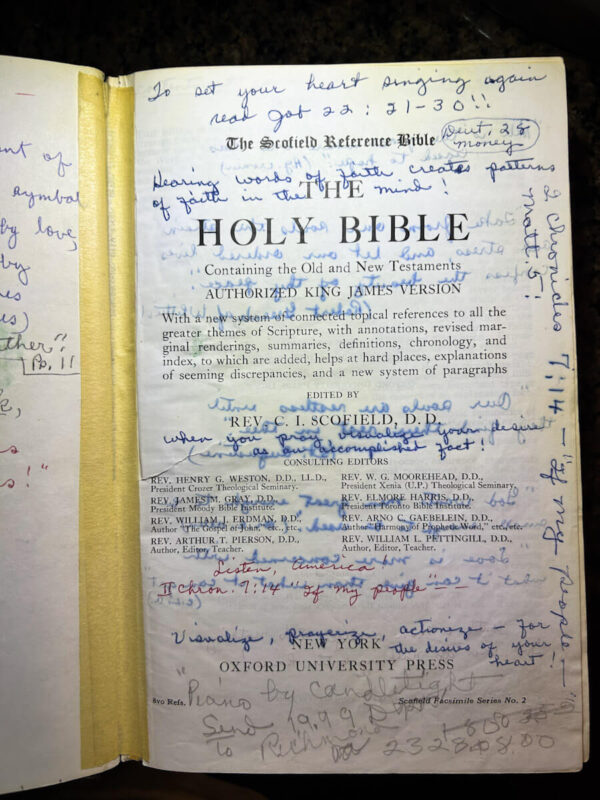
"I don't think that's his, though," I thought, remembering the leather cover. I opened it and saw it was covered in annotations. "But that's not Papa's writing," I realized. Sure enough, on the inside cover: Ruby Williams, Nana's mother. She wasn't a member of our sect. In fact, I think she rather disliked it. But she was an Evangelical and so shared a preference for the Scofied.

The annotations themselves are fascinating. On one page, there are all the signs of the interpretative practices we borrowed from Evangelicalism.

"The Bible is a jigsaw puzzle!" Herbert Armstrong, our sect's founder and leader, taught countless times. One had to piece together bits from here and bits from there to see the true picture. In serious (i.e., scholarly) study of the Bible, there's a term for this: proof-texting. The idea is simple: if you take bits randomly from the Bible (i.e., get your proof from throughout the text), you can prove anything.

On the above page of text from the Old Testament prophetic Book of Zechariah, we see my grandmother connected it to the Book of Revelation (chapters 17 and 18) as well as Paul's Epistle to the Galatians (chapter 1 verse 4). The vast majority of the text is underlined to indicate its importance.
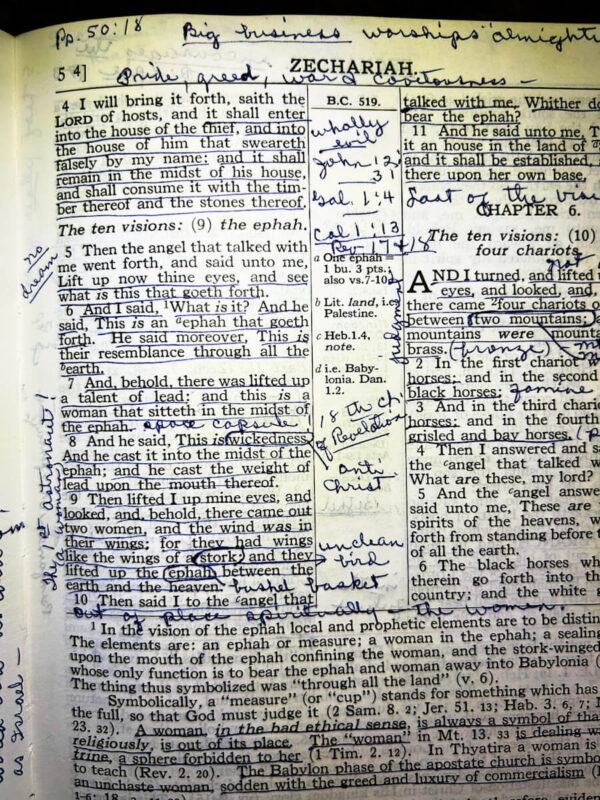
And along the foot of the page, the reason for everyone's love (or hatred) of this particular edition: James Scofield's commentary. He patiently explains that "Symbolically, a 'measure' (or 'cup')" is something that's full and "God must judge it." These are not usual study notes for a Bible. It's not explaining some ambiguities of the original Hebrew. It's not discussing the translation difficulties of a given term. It's telling readers what this particular passage symbolizes. It is interpreting the Bible, putting ideas in readers' heads that really don't come from the Biblical text but rather from Scofield's vision of the whole sweep of Biblical history.

Along the top, we also see it connected to contemporary social commentary: "Big business worships 'almighty dollar.'" On that single annotated page is the story of the Evangelical approach to the Bible, and while it would have pained me to admit it as a child (who doesn't want to be special? called out? unique?), it is the story of our interpretative technique as well.


Tone Deaf

Few things about religion are as interesting to me as fundamentalist Christians' ideas about how "the world" (i.e., anyone who is not a fundamentalist Christian, but most specifically anyone they deem "secular") views them. I recently watched bits of Left Behind: Rise of the Antichrist, the latest in the whole Left Behind movie series. It's about what will supposedly happen when all the true believers are whisked away to heaven and the heathen are -- here comes the title -- left behind.

The main protagonist, whose wife and young son were raptured away, decides to visit the church she attended. The voice-over narration explains that as soon as the Christians disappeared, churches were the target of violent protest. This included the graffiti below: "All souls matter!"

The thinking behind this seems to be that those left behind would be angry at the remaining Christians (though not true Christians because, you know, they got left behind) as they proclaimed that those who disappeared were Christians, that the fact they disappeared is proof a god favored them. The reaction: those left behind who didn't think they were Christian (i.e., the true heretics) would be angry at this perceived sense of Christian superiority and would adopt a slogan like "All souls matter!"

I'm not even sure what they're suggesting with this little detail. Do they think the dumb liberals left behind (because you can't be a liberal and a true Christian) would be highly offended at the sense of Christian superiority that they would adopt an altered slogan from the right and throw it back at the remaining Christians? Do they think the dumb liberals would be so self-contradictory that they would argue about the equality of all souls even though they don't believe in a god (because you know all liberals are atheists)?

I just don't get this little detail. I don't think they do either.

Clearly

This image was making some rounds on social media. On Twitter, I'm sure it went unchecked, but other platforms (read: platforms not yet run by megalomaniacal Nazi idiots) took the image down. It's fairly clear why: it's obvious AI.

"I don't think FB wants this picture on FB. They have been deleting it."

Why do right-wingers fall so easily for conspiracy theories?

They even have conspiracy theories about their conspiracy theories:

Reflections

Why would there be any way to see hate in a text written by a completely benevolent deity?

Why would there be any way to see prejudice in a text written by a completely benevolent deity?

Why would there be any way to see malice in a text written by a completely benevolent deity?

Signs 3

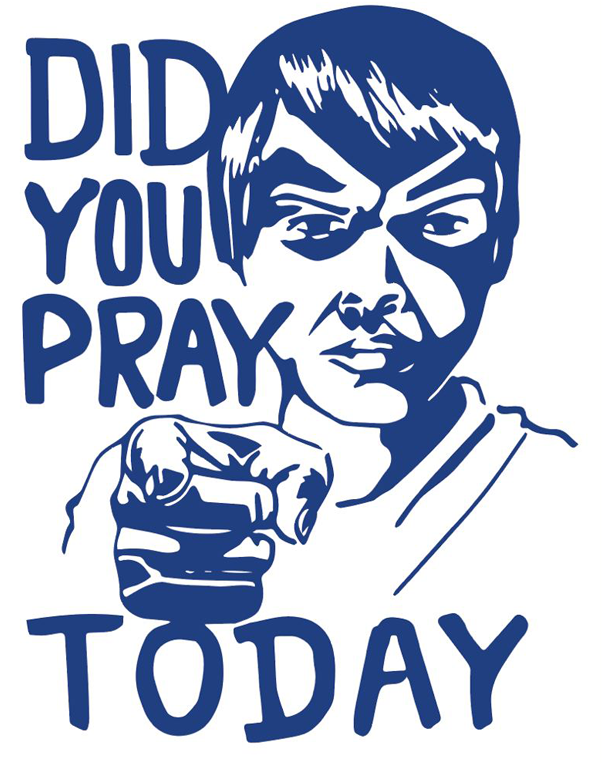
During our three trips to Florida this summer, I noticed a lot of interesting billboards. I also saw a sign on the the trailer of several semi trucks.

I'm not sure what that image is supposed to evoke. There are hints of Uncle Sam draft posters in the overall design, but the wording would have been something like "I want you to pray." Additionally, given the right's strong feelings about the necessity for clear gender boundaries, this person seems unexpectedly androgynous. Finally, there's the feeling of aggression inherent in the shadows and pointing finger. It's like it's daring you not to pray.

Christian Virtue Signals

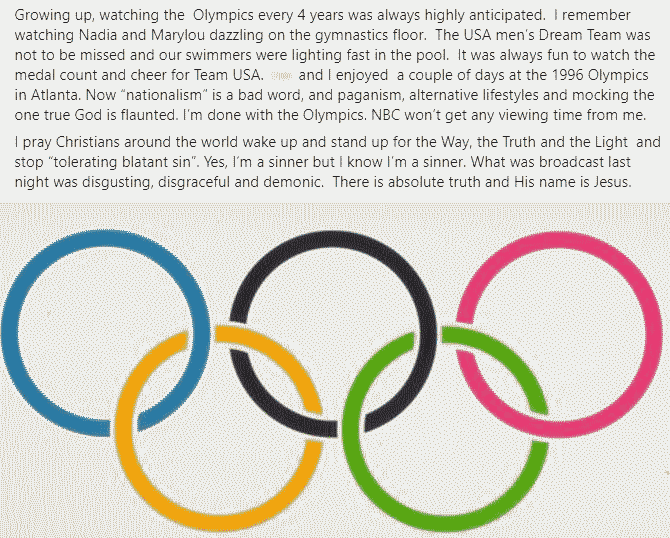
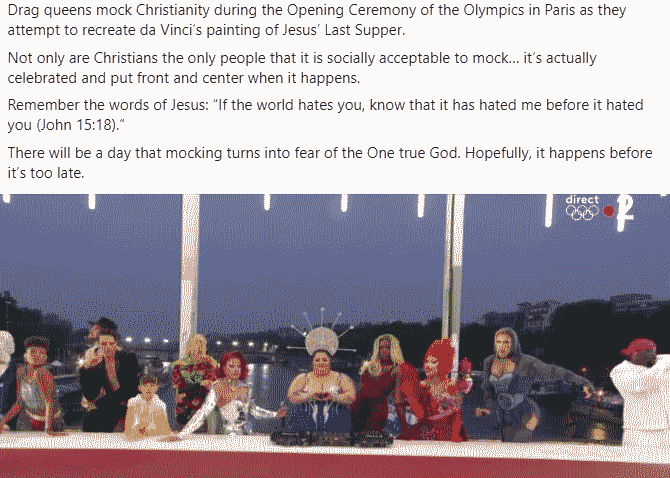
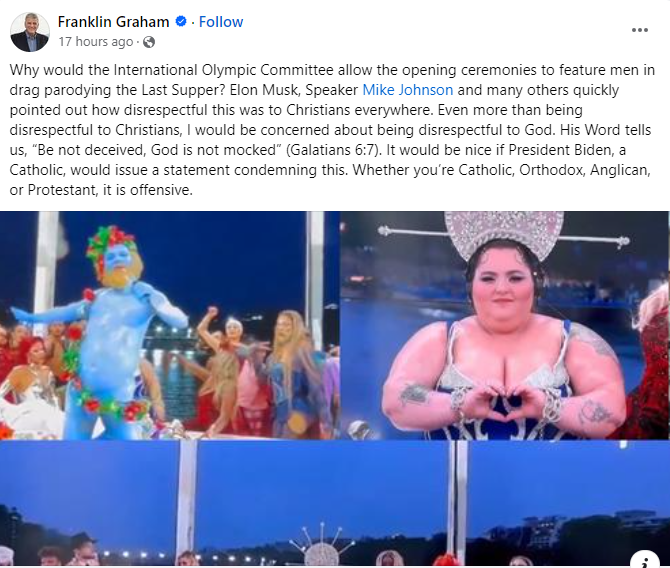
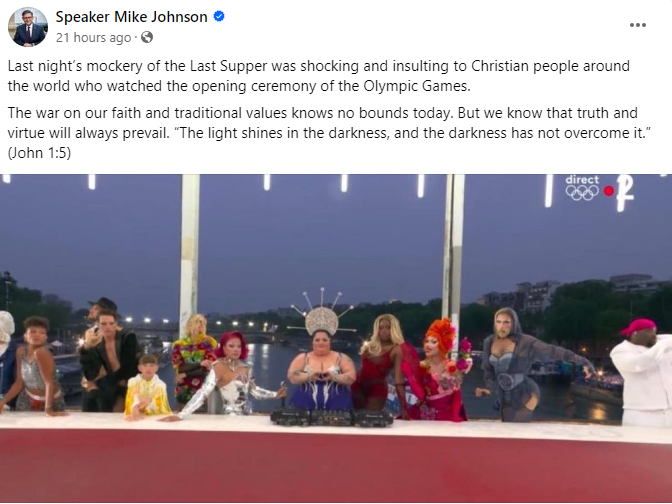
The bruhaha about the opening ceremony in Paris offers an instructive insight into the minds of fundamentalist Christians. It was everywhere. On friends' feeds:

Post A

Post B

It was on public figures' streams:

Post C

Post D

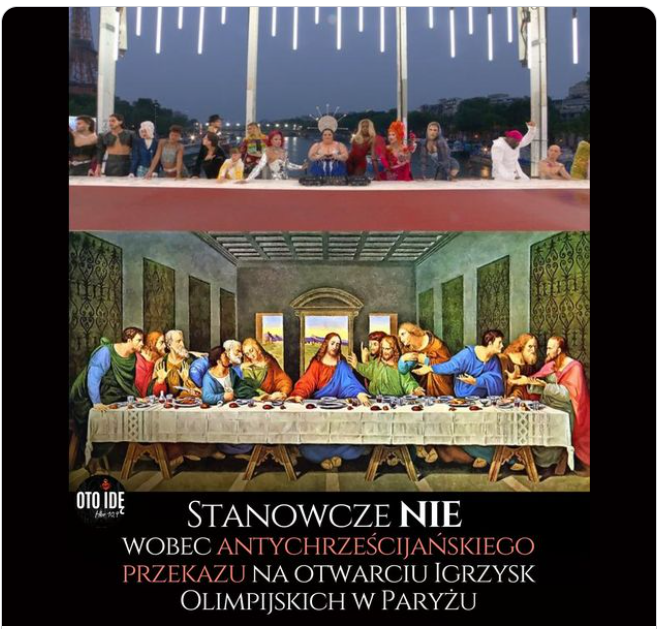
It was on Polish streams:

Post E

Even the parish K attends got into the action:

And those public figures not posting about it were commenting to the media.

Robert Barron, a Catholic bishop with a large online platform, said,

France felt evidently as it's trying to put its best cultural foot forward, that the right thing to do is to mock this very central moment in Christianity where Jesus at his last supper gives his body and blood in anticipation of the cross.

It's presented through this gross or flippant mockery. France which used to be called the oldest daughter of the church. [...]

France has sent Catholic visionaries all over the world. France whose culture and I mean the honouring of the individual, in human rights and of freedom is grounded very much in Christianity. [...]

What's interesting here is this deeply secularist, post-modern society knows who its enemy is, they're naming them, and we should believe them, because this is who they are.

But furthermore we Christians, Catholics, should not be sheepish. We should resist, we should make our voices heard.' 

Daily Mail

Trust me, Mr. Barron, your voices are heard. Some of us are just a little bemused at the ignorance behind it all.

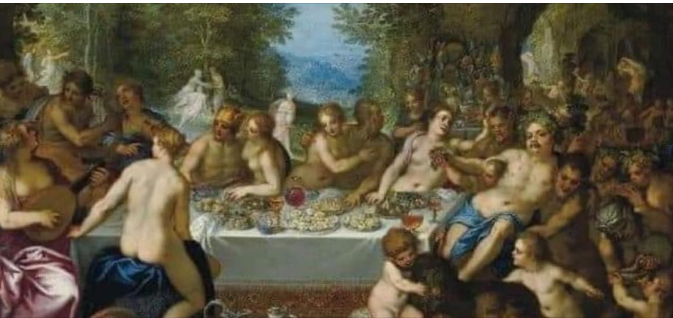
What makes more sense? That the organizers would choose to satirize a Renaissance painting or portray something distinctly Greek, specifically the Feast of Dyonisus?

Whatever their intent, the

[o]rganizers of the Paris Olympics have apologized for any offense caused by a skit in the games' opening ceremony Friday that featured drag stars in what many viewers saw as a parody of Leonardo Da Vinci’s famous “The Last Supper" masterpiece, a similarity that drew the ire of Catholic leaders and conservatives like Elon Musk and Donald Trump Jr.

Forbes

They also pointed out that

[r]ecreations of “Last Supper” are not uncommon and have not often been met with the same kind of backlash as what followed the Olympic opening ceremony. Popular TV shows like “Lost,” “House,” “Battlestar Galactica,” “The Sopranos” and “The Simpsons,” among others, have posed their actors in similar photos, and art with celebrities like Marilyn Monroe, Freddie Mercury and Bill Murray portraying Jesus are readily available online.

Forbes

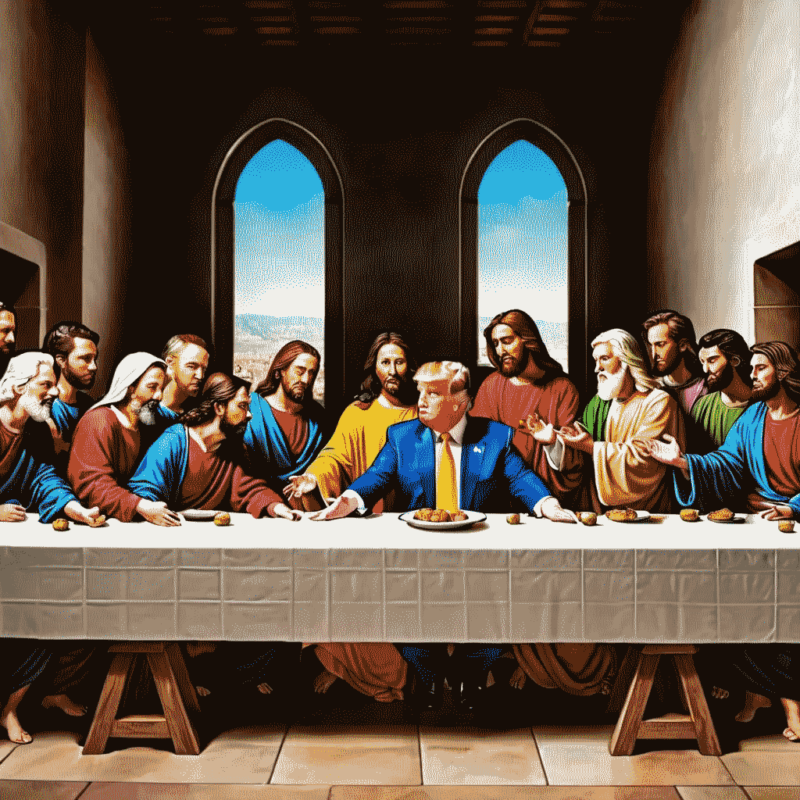
Heck, the MAGA people who are so upset were decidedly less upset about a different recreation of the painting:

At its heart, though, I can't help but see this as an example of Christian fundamentalist ignorance and hypocrisy. They are all "America first!" in everything else, but here they're willing to refuse to support American athletes who had nothing to do with the planning of the opening ceremony because in their ignorance they've confused the Feast of Dyonisus and a Renaissance painting which isn't even part of any religious canon at all. Davinci's painting was itself a derivative and unrealistic interpretation.

Signs

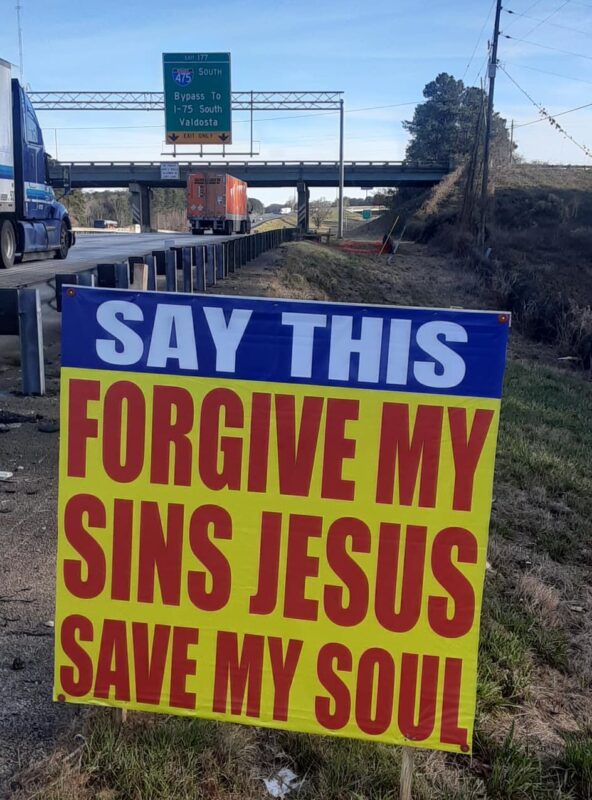
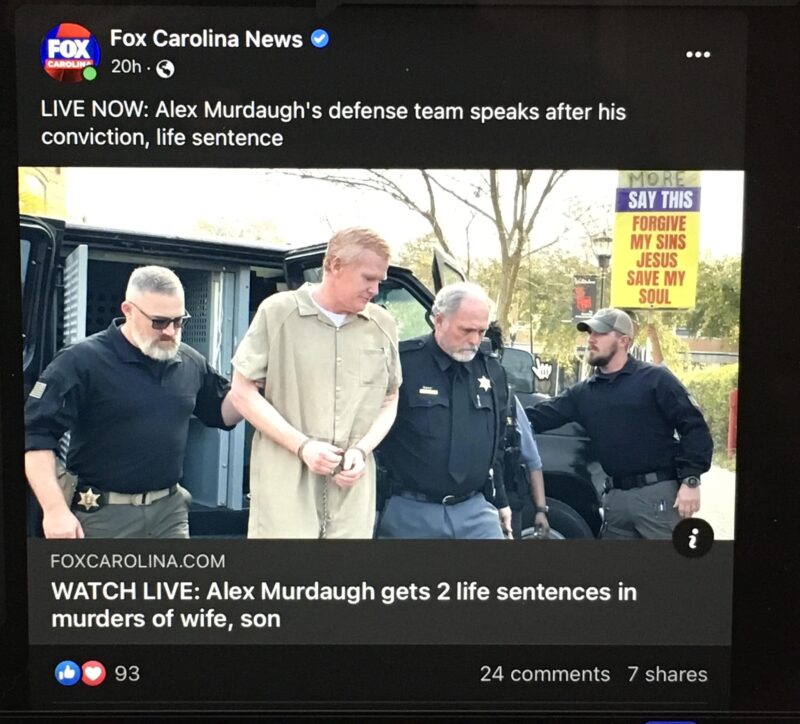
We’ve been traveling back-and-forth to Florida quite a bit lately, which means we drive through almost the entirety of South Carolina each trip. Along the way, I’ve noticed yellow and red billboards along the highway with one of two messages. when simply says, “Jesus, save me.” That’s a fairly straightforward. Evangelical sentiment were used to seeing signs like that in the audiences of football games though many of them are simply the John 3.16 signs, which reference the Bible verse proclaiming that God sent his son to save us. there are certain logical issues I have with such a sentimental sense. God and the sun are supposed to be the same being thanks to the doctrine of the Trinity, and the person doing the condemning from which we need to be saved is God. This means that God sent himself to save us from a consequence that he himself was going to implement. In short, God sent himself to save us from himself, which makes absolutely no logical sense. But that’s not the most interesting sign. The most interesting sign is this one.

Critics of prayer often say that many prayers amount to nothing sentimentality: “Bless this food” does nothing to the food. It’s just a nice sentiment.

With Catholic prayers, some of them have a feeling of being nothing more than magic words. This is especially true of the prayers that the priest will say during communion, prayers which allegedly transform a bit of unsavory bread and overly sweet wine into the body and blood of Jesus, I used to think that price of prayers didn’t really have this magical word sense, but this sign makes me wonder.

Yet here with this particular formulation, we see real magic words. If this sign is to be relieved, all one has to do is say these words and salvation is a done deal.there’s nothing on the sign to indicate you actually have to mean it. There’s nothing on the sign that indicates that you have to hold this belief for any particular period of time. There’s nothing on this side that suggest you have to do anything or change anything. All you have to do is say the magic words.

No, I understand that the individuals who sponsored this sign don’t really think that it’s just a matter of saying these words. And the same font with the same color scheme there are science that simply say repent usually a few miles after the sign. Of course, repent in this case usually means For them to take a conservative point of view regarding LGBTQ issues, physical issues, death penalty abortion, and all the other right wing issues. Repent for them basically means become a republican, and a far right Republican and usually at that.

However, you can’t get all of that on a sign. What’s most important is to get them to say the words and maybe just maybe they’ll actually mean it. Or if they don’t mean it now perhaps mean it later.

There was an article in the Charleston Post and Courier about this which the AP picked up and carried. Apparently at least one of the individuals sponsoring the billboards spends 50% of his salary on them. He suggested it’s money well spent if it keeps even more in person out of hell. I find it strangely ironic though that Jesus in the Bible seems to suggest a different way ofspending one’s money: to sell all and give what give all the proceeds to the poor as he told the rich young man in one of the gospels.

Article

Religious Discussion

Review: This is My Body

According to the author, Bishop Robert Barron, this book is intended to help bring Catholics back to the fold in regards to the Catholic teaching that despite all appearances to the contrary, the cracker and wine of Mass become the body and blood of Jesus.

How does he do this? Does he deal with the simple fact that one reason a lot of people don't believe this literal-bronze-age nonsense is because we've learned a bit about the nature of reality in the past two thousand years, and we understand that the classic explanation of substance and accident (a la Aristotle) is really just an ancient attempt at explaining the world which has now evolved into current scientific understanding? No. Does he deal with the Church's own admission that nothing physically changes? Even more no. So how does he deal with it? The only way he can -- the best way Catholics deal with anything in their faith that inherently makes no sense. He piles on the metaphors.

But why then the prohibition [in the Garden of Eden]? Why is the tree of the knowledge of good and evil forbidden to them? The fundamental determination of good and evil remains, necessarily, the prerogative of God alone, since God is, himself, the ultimate good. To seize this knowledge, therefore, is to claim divinity for oneself-and this is the one thing that a creature can never do and thus should never try. To do so is to place oneself in a metaphysical contradiction, interrupting thereby the loop of grace and ruining the sacrum convivium (sacred banquet). Indeed, if we turn ourselves into God, then the link that ought to connect us, through God, to the rest of creation is lost, and we find ourselves alone. This is, in the biblical reading, precisely what happens. Beguiled by the serpent's suggestion that God is secretly jealous of his human creatures, Eve and Adam ate of the fruit of the tree of the knowledge of good and evil. They seized at godliness that they might not be dominated by God, and they found themselves, as a consequence, expelled from the place of joy. Moreover, as the conversation between God and his sinful creatures makes plain, this "original."

What is this saying? Does this amount to anything other than just a rehashing of the story with some new metaphors thrown it? I don't see anything more than that.

This complex symbolic narrative is meant to explain the nature of sin as it plays itself out across the ages and even now. God wants us to eat and drink in communion with him and our fellow creatures, but our own fear and pride break up the party. God wants us gathered around him in gratitude and love, but our resistance results in scattering, isolation, violence, and recrimination. God wants the sacred meal; we want to eat alone and on our terms.

Again, this is just metaphor. It doesn't mean anything because it refers only to some story in a book that is itself of dubious historical accuracy (read: nonsense). Even Barron would suggest that the story of the Garden of Eden is really more metaphor than anything else, so this is all metaphor about another metaphor.

[T]he salvation wrought through Israel and Jesus and made present in the Mass has to do with the healing of the world. We see this dimension especially in the gifts of bread and wine presented at the offertory. To speak of bread is to speak, implicitly, of soil, seed, grain, and sunshine that crossed ninety million miles of space; to speak of wine is to speak, indirectly, of vine, earth, nutrients, storm clouds, and rainwater. To mention earth and sun is to allude to the solar system of which they are a part, and to invoke the solar system is to assume the galaxy of which it is a portion, and to refer to the galaxy is to hint at the unfathomable realities that condition the structure of the measurable universe. Therefore, when these gifts are brought forward, it is as though the whole of creation is placed on the altar before the Lord. In the older Tridentine liturgy, the priest would make this presentation facing the east, the direction of the rising sun, signaling that the Church's prayer was on behalf not simply of the people gathered in that place but of the cosmos itself.

We can't be surprised at the degree to which Barron relies on metaphor to describe the rituals of the Catholic Mass since he can't even describe his god in straight terms:

God is, in his ownmost reality, not a monolith but a communion of persons. From all eternity, the Father speaks himself, and this Word that he utters is the Son. A perfect image of his Father, the Son shares fully the actuality of the Father: unity, omniscience, omnipresence, spiritual power. This means that, as the Father gazes at the Son, the Son gazes back at the Father. Since each is utterly beautiful, the Father falls in love with the Son and the Son with the Father-and they sigh forth their mutual love. This holy breath (Spiritus Sanctus) is the Holy Spirit. These three "persons" are distinct, yet they do not constitute three Gods.

The father "speaks himself"? What could that possibly mean? He insists that "as the Father gazes at the Son, the Son gazes back at the Father." How can spiritual beings gaze at each other? It makes no sense. And then they "sigh forth their mutual love." What, do the Father and the Son breath? What are they sighing? They don't even have bodies -- how can this make any sense? That "holy breath" is the third part of this weird god? And yet it's one god? In an attempt to use metaphor to explain the inherently self-contradictory notion that three is one and one is three, Barron just ends up uttering inane deepities.

Coping

An article by Karl Vaters entitled "13 Reasons Not to Worry About the Future of the Church" offers insight into how Christians are dealing with the nosedive in attendance and affiliation they are experiencing in America. Vaters acknowledges this immediately:

The church is in trouble.

It must be. My blog feed keeps telling me it is.

For several years now, barely a day goes by without someone writing about the imminent demise of the body of Christ.

Everyone seems to have a different reason why they think the church is dying:

  • The “nones” are growing faster than the church
  • The “dones” are leaving faster than we’re replacing them
  • People aren’t singing together any more
  • Offerings are way down
  • Regulars attend less often than they used to

The post-pandemic turndown seems to be permanent in many places
But despite all the gloom and doom, I have not lost one moment of sleep over the demise of the church.

That Vaters feels no stress reveals the basic disconnect between believers and non-believers on this matter, and that gap is, I'm afraid, permanent and unbridgeable.

It's evident from the first of thirteen points he makes:

Point 1: The Church Belongs to Jesus, Not Us.

The explanation for this point is one sentence: "And Jesus knows what he’s doing." God is in control, believers insist, and so even if it looks bleak, his steadfastness is cause for calm. But this, of course, assumes that Jesus/God exists and operates the way Christians believe he does. They are not open to the possibility that the reason people are leaving religion is because they've realized the truth: gods don't exist. Instead, these people are somehow deceived or never were Christians to begin with. This seems a little obvious, perhaps even axiomatic, but the shortsightedness inherent in such a position ("We could be wrong!") means they will be in constant denial about the reality of the problem, and as it worsens, some of Vaters's more moderate positions might radicalize.

Point 2: The Picture Is Not As Bleak as We Think

His second point is an attempt to make things global:

While the European and North American church is dealing with significant issues, the church in many parts of the world is experiencing strong, steady growth. As reported at Lifeway.com, “There are fewer atheists around the world today (147 million) than in 1970 (165 million), and the Gordon-Conwell report expects the number to continue to decline into 2050.” Plus, “Not only is religion growing overall, but Christianity specifically is growing,” especially in the global south.

We could summarize this point as follows: Sure, in the West, where scientific literacy is steadily rising, religion is on the decline. But in the developing world, where scientific literacy lags, it's growing.

If the growth of your religion is most pronounced where scientific literacy is most lacking, it doesn't say much about the foundations of your religion.

Point 3: The Church Always Thrives Under Persecution

Christians have a persecution complex: they see it as inevitable because it's throughout the New Testament. True Christians suffer for their faith. This is so engrained in the Christian psyche that I'm not surprised it appears this early and only surprised that it wasn't the second point.

If persecution is coming to the American church (which is where almost all of this hand-wringing is coming from) it may reduce church attendance numbers and perceived cultural influence, but it won’t kill the church.

Prosperity is far more dangerous to the church than persecution has ever been. As the Puritan writer Cotton Mather put it in the early 1700s, “Religion brought forth prosperity, and the daughter destroyed the mother.”

This point seems more like pop psychology than measured reasoning. It also ignores the reality driving this decline. People aren't leaving the church because they have cushy lives -- not exclusively, anyway. They're realizing they don't need this in their lives anymore, and they have tools at their disposal (read: the internet) that put dissenting views and reasoning well within their grasp. They can begin by feeling church is just not for them anymore and fill that in later (as they so choose) with good critical analysis of Christian theology that makes them add, "Well, not only do I not need it but it also just doesn't really make a lot of sense when I think about it."

Point 4: Loss of Privilege Is Not the Same As Persecution

This point is actually refreshing.

The removal of the Ten Commandments monument from a courthouse is not persecution.

I’m not saying it’s good, but it’s not persecution.

There are Christians in places like Syria and Iran who know what real persecution feels like. When we claim persecution for what is a loss of privilege, we minimize the real persecution our brothers and sisters face all over the world today.

It does feel a little like Vaters can't make up his mind, though: are Christians facing persecution or not? As church attendance continues to dwindle, he might shift his opinion on this a bit.

Point 5: The Church Is at Its Best When We Are Counter-Cultural

I get the feeling that this is an attempt to be a little edgy, but it is in fact quite ridiculous:

The church doesn’t hold the reins of power well. We’re better in a burr-in-the-saddle role than being the conquering hero on the stallion. Let’s leave that role to Jesus himself.

Christianity has dominated the Western world for most of the last 1,700 years. It's had a near-total monopoly on the culture. Its myths fill our collective consciousness. For hundreds of years it had the power to compel compliance through various means (including torture). To suggest that at any time in modern history it's only been a "burr-in-the-saddle" of society is absolutely ridiculous.

This is why Christians are panicking. They are losing that monopoly. They are losing their political and cultural power. And they are going crazy about it.

Point 6: The Church Is Bigger than Our Buildings and Our Denominations

Churches are being turned into residential units, bars, and even skateparks. What are we to make of that?

We are likely to lose many church buildings in the coming decades. This will be especially challenging for churches with full-time pastors and a mortgage. I also foresee massive stress points coming for most, if not all, denominations.

I sympathize with those who love their church’s historic building and their denomination, only to lose one or both. But I’m grateful that buildings and denominations are not needed for the church to survive and thrive.

In fact, we may need to lean on our buildings and denominations less in order to lean on Jesus more.

This point is just to serve as a balm to those handwringing traditionalists who are upset about the material decline in the church, nothing else.

Point 7: The Church Is People Who Love Jesus, God’s Word, and Each Other

If churches aren't buildings, what are they?

This is one of the main reasons the church thrives under persecution. It forces us to turn to what really matters and can never be taken away – loving Jesus, following the Bible, and caring for each other.

Churches (particularly Protestant churches, especially those that align with the Evangelical movement) maintain their hold on people through the social cohesion they provide. Non-theistic churches are forming that attempt to fill this void, so this point is a non-starter from the beginning.

Point 8: The Church Has Faced Bigger Problems Than This (Whatever Your “This” May Be)

Besides, Vaters says, it's not all that bad:

Whatever your real or perceived church crisis may be, it is not “the greatest calamity the church has ever faced.”

We tend to magnify the severity of small pains that are close to us, while diminishing the reality of much larger pains that are further removed from us.

The church has faced far bigger problems than what most of us are currently experiencing, but those problems are so far away from us that they feel insignificant. The church survived them all.

But it is that bad. Christians fail, intentionally or unconsciously, to realize exactly what the problem is.

The internet is killing the church. It is exposing young people to more and more arguments against theism in general and Christianity in particular. These ideas weren't widely diseminated in times past. A thousand years ago, uttering such criticism would risk death. Now, it's everywhere. And content creators are getting better and better at presenting the dark and illlogical sides of Christanity, and Christianity just keeps throwing the same apologetics mud at them. And here, the internet applies something new: reactions to those apologetics. Discections of those apologetics. Critical analysis of those apologetics. So not only does the internet provide the initial explanation of why Christianity makes no sense, it provides answers to Christians' attempts to explain away those faultlines and fractures, and it shows apologetics to be hollow, shallow, and repetative.

Point 9: My Corner of the Church Is Not the Church

I'm not sure why Vaters put this one in here:

My segment of the body of Christ may be tied to a particular worship style, theological stance, historical background, denominational identity, or any of a wide variety of other distinctives. But the way I worship is not the church. It’s just my little corner of it. If the way I like to worship becomes less popular, that has nothing to do with the strength of the church as a whole.

In fact – brace yourselves – even if the church in America collapses, as tragic as that would be, it would not mean the end of the church.

Jesus has sheep that are not of this fold.

It's really a tweak of point 6.

Point 10: Maybe the Parts that Can’t Survive Shouldn’t

This point seems like it's going in a direction of critical self-examination.

I know that sounds harsh, and it may even be triggering for many small-church pastors who have heard something similar because of their lack of numerical gowth. But the small church is not the issue.

This is not a point about size, but of type.

Anything Jesus does will not just survive, but thrive. Eternally. So I have to wonder, if my favorite form of church is dying, maybe it’s because Jesus isn’t building it?

Everything but the church itself (as defined in point #7, above) has an expiration date. No denomination, worship style, or tradition is forever. Sometimes a congregation, tradition, or denomination dies because it has finished serving its purpose.

This point is not meant to trivialize the very real pain of a local church going through serious hardships. I stand with you. Like John said to the suffering saints in Philadelphia (Rev 3:7-13), “I know that you have little strength, yet you have kept my word and have not denied my name.” You have my heart, my prayers, and any help I can offer.

Instead, though, Vaters is simply using an old apologetics technique applied to those those who leave the faith to explain why some churches are failing: they weren't really Christian.

Point 11: The Church Is the Most Relentlessly Growing Organism In History

This, too, is a short point -- two sentences.

For almost 2,000 years of great triumphs and horrifying persecution, the church keeps going.

When Jesus builds something it tends to stand. And stand strong.

The fact that it's been dominate in the political and cultural machinary of Europe and America for centuries has nothing to do with its longevity. It's all Jesus's work.

Remember when we used to worshop Zeus? Neither do I. Worshiping Jesus will eventually seem as antiquated.

Point 12: Worry Doesn’t Work

Another one-sentence explanation: "In fact, worry makes it worse." This smacks of desparation, but I could be reading more into it than is really there.

Point 13: Jesus Told Us Not to Worry About Anything

The bottom line:

You can toss the previous 12 points. This is all I need to know.

To wildly (but hopefully not inappropriately) paraphrase Jesus’ words in the Sermon on the Mount from Matthew 5:25-33:

Therefore I tell you, do not worry about your church building, where you will worship or fellowship; or about your denomination, what decisions it will make. Is not the church more important than buildings, and the faith more important than denominational creeds? Who of you by worrying can add a single hour to his church’s life or a dollar to its offering basket? But seek first his kingdom and his righteousness, and all these things will be given to you as well. Therefore do not worry about tomorrow, for tomorrow will worry about itself. Each day has enough trouble of its own.

Whatever is of worry is not of faith.

And we need all the faith we can get.

Vaters is doing his best to cope with the coming reality, but he's still in denial, so he will never accept it when it comes.

karlvaters.com/future-of-the-church/