Matching Tracksuits

fun in fours

christianity

Circumcision and the Bible, Part 2

Suddenly spring arrives in full force. The snow has just about all disappeared—all that remains is the big mountains of it. Birds are singing outside, and I’d forgotten how the first birds of spring sound. I just lay in bed this morning for a little while listening to them.

Returning to the quote from Romans above: “The one who is not circumcised physically and yet obeys the law will condemn you who, even though you have the written code and circumcision, are a lawbreaker.” When I read that, I think, “You know, Armstrongites have a point: it wasn’t just all love this love that.” And further I wonder if Christians (Catholics included) don’t just pick and choose the things they want to obey.

The problem is in the Bible itself, for after having made such a big deal out of keeping the law, Paul writes in Romans:

Do you not know, brothers—for I am speaking to men who know the law—that the law has authority over a man only as long as he lives? For example, by law a married woman is bound to her husband as long as he is alive, but if her husband dies, she is released from the law of marriage. So then, if she marries another man while her husband is still alive, she is called an adulteress. But if her husband dies, she is released from that law and is not an adulteress, even though she marries another man. So, my brothers, you also died to the law through the body of Christ, that you might belong to another, to him who was raised from the dead, in order that we might bear fruit to God (7.1–3).

This is the kind of stuff that the new WCG points out to the old Armstrongites and says, “See, the law doesn’t count now!” And yet the author of this had just finished going on and on about the law. So the problems arise from people trying to interpret a faulty book that contradicts itself at every turn.

Later, we find this:

What shall we say, then? Is the law sin? Certainly not! Indeed I would not have known what sin was except through the law. For I would not have known what coveting really was if the law had not said, “Do not covet.” But sin, seizing the opportunity afforded by the commandment, produced in me every kind of covetous desire. For apart from law, sin is dead.

Once I was alive apart from law; but when the commandment came, sin sprang to life and I died. I found that the very commandment that was intended to bring life actually brought death. For sin, seizing the opportunity afforded by the commandment, deceived me, and through the commandment put me to death.

So then, the law is holy, and the commandment is holy, righteous and good.

Did that which is good, then, become death to me? By no means! But in order that sin might be recognized as sin, it produced death in me through what was good, so that through the commandment sin might become utterly sinful.

All I can say is, “What the hell is he trying to say?!” Paul is supposes to be this erudite but this is just nonsense. “Through the commandment sin might become utterly sinful?” Has he personified sin, like he personifies death sometimes? That’s like saying, “So that black might become utterly black.”

I swear, I try to read the Bible with an open mind, I try not to take preconceptions to it, but it continually shows itself to be nonsense.
Marriage and Faith

“Efekt konicowy.” That’s what Kinga’s dad is always talking about, and I’m starting to wonder if there’s any way I can get baptized without lying and saying I believe this and that.

And I find myself asking, “Why does anyone believe in the first place?” What does it give them? Then this morning I read something I’d taken from the internet some time ago:

Once I learned this way of making an examination of conscience. At the end of the day ask, What things did Jesus and I do together? For example, when I called that person who needed to hear from me, it was Jesus acting with me and thru me. But then later, I brushed someone off. Face it, I was acting on my own. Our life is a constant struggle to allow Jesus to take more authority, to extend his rule further in our hearts. (Secularism and the Authority of Jesus)

In this case, Jesus is simply—or even “just”—an ethical ideal. And I think, “Why not just ask yourself, ‘What good things did I do?’” And the answer from this priest would clearly be that “I, of my own accord, did nothing good. The good comes from Jesus.” I find such an attitude insulting to all those people who are not Christian and yet manage to be decent people.

Change of Venue

The wedding will not be in Orawka. The priest found out how much more (paper) work is involved in a mixed marriage and decided he didn’t want to give of his time to help us. He was very rude, Kinga said — gave her his decision in a single sentence, said goodbye, and hung up, not waiting for her response.

Very Christian.

And people wonder why I’m not a Christian. If it’s true, and Jesus lives in you and all that nonsense, then why don’t we see an effect? Why is the country where something like 97+% of the population professes to be Christian one of the most corrupt in Europe? Why are the rudest, most selfish people those who serve a boss who supposedly gave his life for them?

More on Will and Belief

Peter Kreeft was talking at KC about the logical impossibility of religious pluralism, that all religions are true. “Either Mohammed was a prophet of God or he wasn’t,” he reasoned. I find it increasingly difficult to believe that he said that. As a Catholic, he believes, for example, that even though the host looks like bread, tastes like bread, feels like bread, and would be shown under scientific tests still to be bread, that it’s actually the body and blood of Jesus. That Jesus can be completely two different things.

It’s a question of faith, and I read an article on a Catholic website that took this even one step further. The author argued that only Jesus’ disciples — those who believed — could have seen him after his resurrection. In other words, if Jesus had appeared before Pilate, Pilate wouldn’t have seen him because he didn’t believe. That sounds suspiciously like willful self-deception.

Recall that Pieper writes that the chief obstacle to belief is the question, “Why should man be dependent upon information which he himself could never find and which, even if found, is not susceptible to rational examination?” Exposure to religion is a cultural experience, and it’s not something various individuals have independently worked out as they tried to figure out what this weird Unknown is that they’ve been experiencing. In other words, the seed is sown by cultural exposure to the idea of a crucified and risen god.

I wonder why that Franciscan bloke never wrote back. Perhaps he didn’t receive the email? Perhaps he thinks there’s no point? Perhaps he realizes that there’s no hope for me?

Will to Believe

Just before Christmas, I sent a letter to “Ask a Franciscan” on a Catholic website. I’m not sure why. Silly thoughts of conversion that I’ve since (or rather “sense”) put aside. The original letter:

I’m an American living in Poland, and I’ve been thinking about conversion lately. A lot of it has to do with the fact that I'm marrying a Polish woman in a few months (June) and everyone is asking me why I don't convert. “It’s simple,” I say. “I don’t believe.”

However, I can’t deny a certain pull I feel toward Catholicism – the ritual and the beauty of the faith. I’m an atheist, though, and for more intellectual reasons than anything else. I don’t know that I could ever say, “I believe this faith is true,” but I’m finding myself thinking sometimes, “It would be nice if this is true.” Or even, “I hope this is true.”

So the question is this: is it enough simply to say, "I hope these things are true?" Where does hope that something is true end and faith that it is true begin?

The response:

Thanks for writing and I do appreciate your honesty both intellectual and moral. The Catholic Church has a very strong teaching that a person’s conscience is the ultimate criteria for that person’s decisions and behavior. At the same time, it is important that the conscience be correctly and well formed.

You are correct. You could not be true to yourself if you said, “Well, I just pretend I believe, go through the motions.” You could not do that nor would any real church want you to do that.

At the same time, it might help if I explore the idea of faith just a little bit with you. As Catholics, we believe faith “is a gift” of God…..and that that gift is offered to every person. The reason it is a gift is that faith means that we believe in what we cannot see or fully understand.

Yet, from a purely human point of view, you and I live by faith every day. You believe that when you shop for food, the labels on the cans say what they mean. You don’t have to presume to have every can tested “just to make sure because you never know.”

In fact, society is based on truth for its people. That’s why perjury is such a terrible crime….if a person lies under oath, then there is no way for true justice to be accomplished. No one could trust anyone any more and society would be thrown into chaos.

When it comes to religious truth, we are dealing with great and unfathomable mysteries. But one thing to keep in mind is that a mystery is not something about we know nothing; it’s really something about which we just don’t know EVERYTHING. I’m sure the deepest human mystery you’ve experienced is your love for your fiancé and her love for you. You know what that is but still I’m sure you stand back at times and realize that “this love is bigger than the both of us.” When a mother and father hold their first child, they are stunned by what they hold in their arms and what they feel and experience may not be able to be put into words. In fact, some of our deepest experiences deal with the mysteries of life and death and of our human relationships.

In regard to faith and religion, there are three questions that come to mind:

  • Where did I come from?
  • Where am I going?
  • What am I doing in the meantime?

In a way, the way I answer those question will determine to a very high degree the way I live my life and for that matter why I even care about how I live my life. If I say, “I came from pure chance out of nothing; in time (who knows when) I will go back into nothing; in the meantime I’ll just do what I think is right.” Those are questions, though filled with mystery, are questions your fiancé comes up with a different answer. And perhaps the best way to see what faith is, is to look at it in another person whom you love and admire. What is it that you love the most? She beautiful, loveable, and all those good things. But is there something inside her, her values, her convictions and her beliefs that make you wonder, “Why does she believe the very things I can’t make sense of?” When my Dad married my Mom in 1930, my Mom was an Irish Catholic and she jus his heart. He was a faithful man and he was an inspiration to me and my sister.

So, what I would suggest is that you ask your fiancé just for the opportunity to explore her faith, take instructions and see how it turns out. If after you are finished you are still where you are, then you have in good faith explored the faith and found it lacking. On the other hand, you never know what will happen. It’s still your conscience and you must follow it. I know your fiancé would not want you to pretend.

I liked your expression, “I hope this is true.” But the hope might well turn into faith in time as you learn more about our faith. Remember also, you don’t have to figure out everything…what you are looking for is an understanding of our view of those three questions. What from; Where to; What now?

I do hope this helps. And remember Gary, if you have any more question or issues, please feel free to write back. I’m the only one who answers on this website and I’ll remember your name.

And so after almost six weeks, I took him up on the offer and wrote this back — a desperate effort, I suppose.

Thanks for your answer to my question. I’ve been meaning to write back, but I’ve simply been too busy. And also, I’ve been working on this reply for some time — a little here, a little there.

I didn’t initially tell you the whole story, because I wanted it to be short. The thing is, I was raised in a Christian home; I studied at a private Christian college; I did a year of graduate work in philosophy of religion at Boston University; and I’m constantly obsessed with religion and theology. I’ve read Aquinas, Augustine, and Pieper among the Catholic “greats” and Luther, Niebur, Bonhoffer (sp?), and Calvin among the Protestant “greats.”

This is not to try to brag — “Oh, I’m so well read.” I know in fact I’ve barely scraped the surface. It’s simply to show that, as far as taking instruction, in some ways I don't need it. To a certain degree, I know more about the Catholic Church and theology than my fiancé does. That sounds a little presumptuous, but she’s even told me, “You know the Bible and theology better than I do!”

I say that in response to your comment that you suggested I “ask [my] fiancé just for the opportunity to explore her faith, take instructions and see how it turns out.” Lately, I’ve read a great deal about Catholicism, its history, theology, etc. I’m currently working my way through The City of God (slow going and I only read a few chapters every few days) as well as Przekroczyć Próg Nadziei, which is the Polish translation of “Crossing the Threshold of Hope.” (I would say it’s probably not a translation in reality, since, as I understand it, John Paul writes his encyclicals and such in Polish and then others translate it into Latin and Italian.) I’ve gone from knowing little about Catholicism to knowing quite a bit, from regarding it as essentially misled (the old Protestant upbringing still lingered/lingers in me though I have considered myself a complete non-believer for years now) to having a great deal of respect of many of its teachings.

In fact, I would even say (and have said, to my fiancé, Kinga, and her family) that if I ever “re-converted,” I would be a Catholic. Indeed, I’ve even defended the Church’s theology to fundamentalist, anti-Catholics! You might say I’m the ultimate debater, able to argue positions I don’t even believe. (To be fair, I wasn’t misrepresenting myself and saying I believed any of it; I was simply arguing that these fundamentalists were misrepresenting the Church and her teachings).

All this is not to brag or anything, simply to show you where I’m coming from. I’m cerebral to the point of — well, I don’t know what. I think too much, I’ve been told; I’m a “classic intellectual,” Kinga says. She wasn’t the first to say that! That always sounded corny to me and I resisted the label, but perhaps everyone’s right. Two examples perhaps further illustrate this: First, and somewhat amusingly, I was voted the “Most Intellectual” senior superlative in high school. Secondly and more of an indictment, in college I went to the school counselor for a while after the unexpected dissolution of a close friendship, and with her help I came to the realization that even with feelings, I think. I think first — analyzing the feeling — and “feel” later!

So, all that out of the way, you see that the issue for me is — an intellectual issue, in short.

You wrote, “Remember also, you don’t have to figure out everything. What you are looking for is an understanding of our view of those three questions. What from; Where to; What now?” I wonder. The thing is, I never think about those things. Honestly. Well, I should rephrase that — I never think of the first two questions. The third — well, we’ll get to that.

Regarding the first question, it’s always dumbfounded me that people can get so upset about the thought, for example, of evolution. “I did NOT evolve from monkeys!” some cry, as if suggesting that somehow affects their self-worth now. My point of view is this: my self-worth comes from me. That’s why it’s called “self-worth.” I don’t see how the prospect of “coming from monkeys” makes me any less valuable or any less human.

It seems we can’t conclusively answer the first. Even if we say we’re created by God, that doesn’t fully answer the question, for the specter of evolution and the “how’s” of it all still linger, with their shadowy, intellectual implications.

The same goes for the second question: where am I going? Again, I can’t conclusively answer that, and neither can anyone else. (What I mean by “conclusively” is “empirically provable,” I suppose.) That is more of a question of faith than the first question, it seems to me.

More important I would say is the third: What am I doing in the meantime? Good question. But the more I think about it, the more I’m convinced that it’s less what we believe and more what we do.

An improbable scenario: You’re a father, and in the country in which you live, it’s customary for the father to grant permission for the son to live beyond age eighteen. In making your decision, would you really say, “I’m afraid I’ll have to banish you or kill you, son, because you didn’t believe this or that?” Would you even take into consideration what he believes? For that matter, unless he’d committed some atrocious act — say, killing your wife, his mother — would you even consider what he’d done? And in the end, if you had to base the decision on one or the other, which would you chose? Belief or action?

Now of course, this improbable scenario is doubly so because it’s probably a false dichotomy. Neither actions nor beliefs would really come into the picture if you truly loved your son, right? You would want to say even if he’d killed a thousand innocent children, “Well, I don’t want to see him die.”

God — and I’m assuming here he/she/it (and if God is God, I don’t think any of those pronouns do justice) — is supposed to be the ultimate father. In fact, that’s what Freurbach suggested in the nineteenth century, if you recall: God is the projection of our ultimate, perfect father figure. (One of the best books I’ve ever ready is Peter Berger’s A Rumor of Angels, in which he says basically, “Even if God is a projection, atheism/the non-existence of God doesn’t necessarily follow from that premise.”) So if God is only as good as a human father, it seems fear of missing out on some eternal bliss is unfounded, that God would give us chance after chance, opportunity after opportunity.

So part of me is thinking, “What am I even considering this stuff? If God exists, he will certainly take care of me in spite of all my shortcomings and intellectual pride.”

You wrote, “At the same time, it might help if I explore the idea of faith just a little bit with you. As Catholics, we believe faith ‘is a gift’ of God…..and that that gift is offered to every person.” But how does one know that faith is from God and not simply wishful thinking? Self-deception?

One of the most useful and fruitful ways of looking at religion secularly is through the eyes of sociology, and one thing that sociology points out is the importance of plausibility structures: those things that make it easier for us to say, “I believe this.” For example, not many inhabitants of New York City believe in voodoo because there’s not support for it; in Haiti, there’s significantly more plausibility structures. Among the things that serve as a plausibility structure is Mass and the congregational recital of the various prayers. It’s visible and audible backing for our own beliefs. “What I believe isn’t so crazy! How can it be if all these other people believe it too?” Such might be an explanation of how plausibility structures work. (Forgive me if you’re well versed in all this.)

So where does this leave us? Faith in our faith? Faith that our faith is faith in God and not a form of willful self-delusion?

It seems to me faith is a faith in experience — something that happens, which some interpret as being from God. It’s not ultimately a question of logical proofs. It’s a question of experience.

Yet I lack that experience. I’ve never had anything happen that makes me think, “Undoubtedly this is from God.”

And yet I know that going to look for that experience means I’ll find it. It reminds me of what one of my professors said about Biblical interpretation: if you go to the Bible expecting to find something specific there — proof of this or that — no matter how ridiculous it is, you’ll find it. The proof of this is all the Protestant sects that derive the most bizarre beliefs out of the Bible because of their poor exegesis.

But it just brings us back to the willful self-deception question. As the devil says to Ivan in The Brothers Karamazov (probably the best novel ever written in my opinion), “What's the good of believing against your will? Besides, proof is no help to believing, especially material proof. Thomas believed, not because he saw Christ risen, but because he wanted to believe, before he saw.”

And I’m also reminded of Kirkergaard in Fear and Trembling: “Faith begins precisely where thinking leaves off.”

And Josef Pieper in Belief and Faith: “The obstacle [to religious belief] which must be leaped rather than climbed consists in the difficulty of understanding why man's nature and situation should be such that he cannot make do with what is naturally accessible to him. Why should man be dependent upon information which he himself could never find and which, even if found, is not susceptible to rational examination?”

So why the draw? Why did I even contact you in the first place? Why am I thinking these things which a year ago — less, even — I would have brushed aside as silliness?

The only answer I can come up with now is ritual. I go to Mass with Kinga, my fiancé, occasionally (only occasionally because we live in different villages), and I find the ritual of it all very enchanting. Hardly a reason to consider conversion, I know. And as I said, the idea is something I sort of hope is true at some level, but which I highly doubt is true

And it seems to me that no matter what I do, it would ultimately be an intellectual game for me. Or an intellectual exercise. A continual effort to justify rationally why I’m trying to believe the things I am, or even more remotely, why I want to try to believe.

All this is why I originally wrote, “I don’t know that I could ever say, ‘I believe this faith is true,’ but I’m finding myself thinking sometimes [. . .] ‘I hope this is true.’” I suppose in asking if that was enough I was more asking from a church law point of view (to which I knew the answer — don’t know why I asked) than a moral/philosophical point of view.

I could go on, but what for? I’ve already turned myself into so many mental knots that it seems of little use, and would simply be a reiteration of what I’ve already ramble. I just thought I’d share a little more of the situation and my reaction to your response.

And the corresponding response? Well, there is none. Perhaps he didn’t get the letter, but why waste my time and risk looking like an idiot for something I don’t even believe?

And why did I even do all that? It’s like admitting I’m gay or something, but the truth is that on some level, I want to believe this nonsense. I’m convinced it’s just that, but I’m still trying. Why? That’s why I can’t figure out. Why can I logically list the reasons I don’t believe and the reasons I can’t ever believe and yet still want to believe? Childlike innocence I’m seeking in some ways. No, not innocence, but naivety.

There is no soul. Jesus apparently thought he was coming back before his disciples died and 2,000 years have passed. Religion arose from a lack of understanding of what happens to a person at death. All these things make sense. And the first two are virtually empirically provable. And yet.

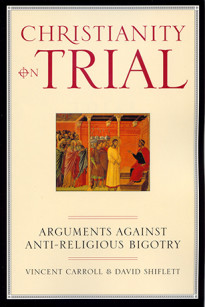
Review: Christianity on Trial

I'm not sure whether the thesis of this book could best be summed up as, "Christianity isn't all that bad" or "Christianity has made the world the wonderful place it is today." That depends on whether you're trying to summarize the intended or actual thesis.

This purports to be basically a book of Christian apology, in a sense: not defending the faith's tenants, but defending the faith's acts. It rightly points out that there is a lot of criticism directed toward Christianity that, were it directed toward any other religion, would be construed as bigotry. That's true enough, and a fair criticism. On the other hand, the book seems to imply that the majority of contributions Christianity has made to civilization are positive - that the scales tip toward the good. That's fine and good, but it doesn't provide enough proof of that. We never get any idea if the people and groups in each chapter are exceptions to the rule, or the standard. I got the feeling that the authors didn't know either, but were trying to pass them off as the latter.

This is particularly noticeable when we consider the two topics conspicuously missing from the book: Christian anti-Semitism and Christian misogyny. The environment, democracy, and science all rightly get chapters, but nary a word about misogyny, and only lip-service to anti-Semitism ("Okay, okay, Luther was anti-Semitic, but look at all the good things he did!"). The closest thing to mentioning misogyny, on the other hand, is perhaps a reference to the (to use their woefully inadequate understatement) "unfortunate" Salem witch trials.

On the whole, I remain unconvinced of Christianity's virtues through the centuries. It's a human institution, filled with the hatred, bigotry, and stupidity common to all people.

Still, it did make me realize that condemning the Apostle Paul for his views on slavery is to use an anachronistic morality to judge him. This is a common theme in the book, and somewhat rightly so. We can't condemn society X for being cruel when it was no crueler than any other contemporary society, even if it is vastly more vicious than our own. We can comment on it, but it doesn't make them immoral.

XCG Thoughts

Last night I spent a lot of time on the internet, and I found a lot of information about the Philadelphia Church of God. I’d found most of it before, but I hadn’t read it. It is, indeed, a cult. It is almost reminiscent of Jim Jones or David Koresh in its horror. From the account of one Sue Hensley:

March 1993 — He compared what was happening in Waco Texas to the persecution that would happen to us.  He told us the Branch Davidians were an example of the persecution coming upon us because they used many of the same terms we did.  David Koresh talked about a “little book,” he said the “lion roars,” he said Christ was the “Key of David,” he claimed his predecessor was “Elijah,” and he preached about the “Millennium.”  Mr. Flurry also brought up Jim Jones & the People’s Temple during his examples of the persecution to come, and he said Jonestown was their “place of safety.”

Regarding the “college” he’s building, Ms. Hensley wrote:

When the announcements were made in 2000 about the land that was being bought for the college, one of the tapes from headquarters told us a great deal of what was planned for the future of this land. They are putting in their own sewage treatment system, so that, if things reach a critical stage, all the members could stay on the property; they would be capable of handling over 7000 people on site. There was also an old airstrip in the property, which they thought could be refurbished and utilized to either “further the work” or to fly people out to the place of safety when the time came. The swimming pool (announcement made in 2001) is also to serve as an emergency water supply in case of fire or other needs. Even the first time I heard these things, it gave me a chill.

And lastly, regarding Flurry’s status:

He has also lately given the ministry some very strict rulings concerning what the ministers should do if a person in the congregation talks to them about something they think is wrong. Mr. Flurry has told the ministers that even if the person is right, they should never agree with the member because it would be disloyal to God’s Prophet.

I used to think that the PCG was just a silly bunch of neo-Armstrongites who were pissed because the WCG made all these changes. On the contrary — they are a full-blown, physically dangerous cult. The WCG was mentally dangerous. Spiritually abusive, even. But it never made statements like this. It never openly compared itself to the People’s Temple. And if Armstrong had been alive to see the Waco fiasco, I’m sure he wouldn’t have compared himself to Koresh. He would have said something ridiculous about it, no doubt, but I don’t think he would have drawn a direct parallel between the two organizations.

The reason is simple: I don’t think Armstrong really ever actually believed he and his group would “flee.” Why would they? That would mean giving up the luxurious lifestyle he’d grown so accustomed to. You can’t buy prosthetic dildos in the desert; Steuben crystal is fairly impractical in the desert; a Rolls Royce doesn’t take well to the desert. He never actually believed it. It was a good way to milk people of their money. Nothing more.

People like Jim Jones, David Koresh, and, apparently, Gerald Flurry, though, actually do believe the nonsense they’re teaching. And apparently, they’re all willing to die for it.

I’ve really got to get a handle on this obsession I’ve had for the WCG and all its splinter groups. It’s really just a waste of time, I know, but I can’t help it. I can’t bear the thought of something sensational happening in, say, the PCG and me not knowing about it. Why? I guess I just want to be able to watch the fallout as it happens.

Ex-Roommate Visit

Bus Jesus

On the 86 coming to work today I was witnessed to. I was sitting on the foremost single seat, minding my business, when this women asked me, “Jew have Essus in your heart?” I had to ask her a couple of times to repeat herself, but I finally realized she was asking me, “Do you have Jesus in you heart?” She began to explain to me that he loves me, died for me, is knocking on my heart and keeping me awake at night. She had a little flip-book with several verses on individual pieces of paper. She would read them to me, moving her finger along below each word as if she were a mother reading to her child. (Instead of a full stop at the end, though, she had colons. I'm not sure why.) At one point she asked me if I believed in God. When I told her I didn’t she didn't really know how to deal with it, it seems. She returned to talking about how Jesus died for me, how he loves me, and so on. She also explained that eventually God would close the door. I didn't know how to explain that any God with such conditional love as the God she is describing exhibits is not worthy of my love/respect.

She was, in all honesty, sweet. She was doing what she thought was necessary. Of course the question is, was she doing this because she wants me not to go to hell, or because she’s afraid God demands this of her for her salvation? I’m sure she couldn’t even answer that question completely.

Qualifications

Yet another birthday. For the first time in years I won’t be going to work thinking, “I wonder if anyone remembers. I wonder if any classes will do anything?” It was a nice sign that they liked me, and I always tried to be a pleasant teacher whom students actually thought was an okay person. Such was “proof,” I suppose.

Last night, after walking home from class, I was thinking about knowledge — again. I was recalling the interview I had with Rob for the job I now have, and he asked me if I’d be more interested in an editing position or a content-based position (“course developer” is the official title now, I think). I said that I didn’t know enough yet to be comfortable with the idea of being a content person. Muttering to myself as I walked down North Beacon Street, “I know just enough to realize how little I really know.” And I thought of my adventures trying to determine whether any of the New Testament was written in the second century or not as ample proof. I talked to Peter — large guy with earrings and a husky voice — last night after class and he confirmed that there was something written in the second century. (I mentioned 2 Peter and he said that it was a possibility, along with the other Neo-Pauline epistles, “But I really haven’t studied 2 Peter that much,” he said, and I realized, “God, in New Testament studies you could devote a significant portion of your life to studying one single book.”) Anyway, he said that there was something written in the second century, and now I “know.” But to what degree do I know? How can I be sure? What is the criterion for “knowing” versus simply “believing” or “thinking that . . .”? On what authority can I say I know this? Because he told me. On what authority does he have it? Because someone told him, or he read it (which constitutes the same thing as being told something — simply a different form). Someone, at some point in the process, knows it because she has examined the various documents — the scrolls and such — and done textual examination, and through various processes determined that it was second century. She “knows” it in a way different than I now “know” it. But what is the criterion? Expertise? Certainly not.

A good example of this is chaos theory. At one point, all meteorologists and atmospheric physicists (if there be such a thing, which I sure there is) “knew” that there really were no laws governing cloud shape. It was just random nonsense — noise, in other words. Then along comes fractals and fractional dimensions and we start saying, “Well, no, it’s not quite like that. It’s really a matter of nonliner equations.” So did the meteorologists “know” beforehand? Obviously not. Of course the same is true of any scientific revolution. Did people “know” before Copernicus that the sun revolves around the earth? They certainly thought they did. And they could have “proved” it in much the same way that I can now prove that some of the canonized New Testament was written in the second century.

Knowledge at one point was defined as “true justified belief,” but can someone know something and not realize that they know it? They just think they believe it? For example, most Christians “know” that God exists, but some more liberal might admit that they only believe it. If it turns out to be true, it was indeed “true, justified belief.” But they didn’t claim it as knowledge, simply as belief. Did they “know” it even though they only thought they “believed” it?

Something I’ve been meaning to write about: What was the purpose of the Passover symbols? Why put blood on the mantel and doorposts? Could God not discern without this visual aid which houses were Israelite homes and which were Egyptian? Wouldn’t it be a little obvious by the sectioning of the city? I sort of doubt that any of the Egyptians lived with the “defiled, uncivilized” Israelites.