Matching Tracksuits

fun in fours

catholicism

Revealing

On one of the Bible-in-a-Year groups that I still follow appeared the following comment:

I’ve been behind…well I actually started on day 5. So I’ve been at least 4 days behind. Today, I got caught up to day 44 and haven’t stop thinking of day 42. I have a lot of friends who are in a same sex marriage, and I just couldn’t accept the thought that my friends who love eachother so much, are sinful. I found this group to see what others thought on the subject; or really what the church’s view really was. I just can’t help but think that God truly loves us no matter who we love. No one chooses to be in a same sex marriage to go against the grain, but with the intention of love! I was really bothered by others not thinking otherwise. I mean, who are we tell other people what God will punish or not?

It’s so unusual to find members of these groups expressing their doubts and disagreements like this. Most of the groups are simply fawning over how great Jesus is, how great the Bible is, how great God is (I know — God and Jesus are supposed to be the same person, but no Christian really thinks of them as the same being in any practical way). To see someone else (someone other than me, that is) saying, “Hold on a tick — this just doesn’t seem to make sense” is fabulous. I had to show some solidarity:

Never will understand this — why is the Abrahamic God so concerned about what consenting adults do to the point that in both the OT and the Koran, believers are commanded to kill homosexuals? One of the biggest things that has pushed me toward exiting the church.

It got a couple of responses, but nothing major. One lady explained it thusly:

You know how in the OT, the objects in the Temple are holy, simply because they were consecrated to God for a specific use? So are a man and a woman holy and their relationship is holy.

When we take something SO Incredibly Holy and use it for our own selfish purposes, it causes SO MUCH Pain to God. We don’t feel our own pain, because it is in our souls, and it is hidden underneath the sweetness of our sinfulness. BTW – it isn’t just a homosexual relationship that is unholy – a heterosexual one can be just as unholy. But a homosexual relationship is sinful inside and out. It is such a deep, deep, deep devaluing of the person of the opposite sex, who has been rejected in favor of a person of the same sex.

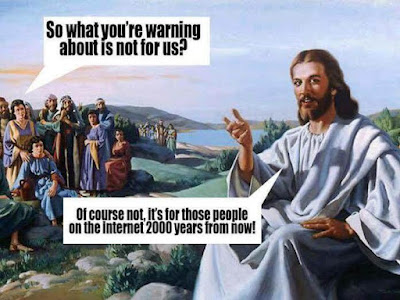
First of all, in what sense does could an omnipotent, omniscient, eternal being feel pain? One only has to think about it for half a second to realize the absurdity of it. But this idea of causing the Christian god pain is one of the fundamental ways Christianity encourages feelings of guilt. “Jesus did so much for you, and you’re just rejecting him?!” First of all, what exactly did Jesus do? He died for a weekend. Second, why did he have to die, according to Christian theology? To pay for our sins. But who defined those sins and defined the consequences for violating those laws? He did. It reminds me of a favorite meme:
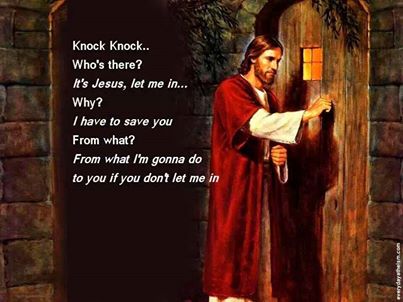
Second, the idea of it being “such a deep, deep, deep devaluing of the person of the opposite sex, who has been rejected in favor of a person of the same sex” illustrates how deep this person’s misunderstanding of human sexuality.
Question-Begging

29533993. sy475 In the introduction to Hard Sayings: A Catholic Approach to Answering Bible Difficulties, Trent Horn quotes Dan Barker’s succinct point about the Bible: “An omnipotent, omniscient deity should have made his all-important message unmistakably clear to everyone, everywhere, at all times.” By this, Barker of course means that a god who is all the things the Christian god is supposed to be would send a message that couldn’t be so easily misunderstood, so easily used to justify so many conflicting ideas, as the Bible is.

There would be no difficult scriptures. For example, from the Catholic point of view, references to the “brother of Jesus” are troubling because Mary was, according to the Catholic Church, always a virgin. There was no way then that Jesus had brothers. How do we explain this, then? Well, in Aramaic, there is no term for “cousin.” Everyone is a “brother.” So that’s what the passage means. The only problem is that, although Jesus and his disciples would have been speaking Aramaic, the Gospels were written in Greek, a language that does have a word for cousin. In that case, why didn’t the Christian god inspire the gospel writers to say “cousin” and avoid all this confusion?

Horn responds to Barker’s claim most curiously:

I agree with Barker that God should provide an opportunity for all people to be saved since 1 Timothy 2:4 says God wants all to be saved. But that is not the same thing as saying that the Bible should be easily understood by anyone who reads it. Perhaps God has given people a way to know him outside of the written word? For example, St. Paul taught that God could make his moral demands known on the hearts of those who never received written revelation (Rom. 2:14-16). The Church likewise teaches that salvation is possible for those who, through no fault of their own, don’t know Christ or his Church.

Yet Barker never said anything about salvation. It’s not that Barker’s argument is that this god is doing a bad job of getting his salvific message out, but that’s what Horn’s response suggests. “No, no!” says Horn, “it’s not that people might lose their salvation over a confusing book. God also, according to St. Paul, communicates directly with people’s hearts.” In Horn’s strawman argument, Barker accepts that there is a god who wants everyone to be saved but just feels that this deity could be doing a better job of communicating that plan. But Barker is arguing the opposite: the massive amount of confusion stemming from this book suggests that is has a most decidedly human origin with no divine influence whatsoever. He’s arguing from the book to the hypothetical god that would have created it and saying that there is a significant incongruity between that hypothetical god and the Christian god.

Not only that, but Horn is quoting the Bible (Rom. 2:14-16) to provide evidence of his rebuttal (that God provides other means of salvation rather than through the knowledge gleaned from his book) when in fact it’s the Bible’s validity itself that’s at stake.

The problem is that for Horn, it’s impossible to see how someone could not accept the Bible as divinely inspired. He’s working with that presupposition so firmly in his mind that he doesn’t even realize when it causes him to go question-begging as he does in this response.

Clerical Error

A curious story appeared in Newsweek the other day that highlights some of the quirks of Catholicism. Apparently, a priest there has been saying the wrong words during baptisms, which makes the baptisms invalid:

A priest with over two decades' worth of service to multiple congregations has resigned "with a heavy heart" in the wake of revelations that he incorrectly performed baptisms.

Father Andres Arango, who most recently served in the Roman Catholic Diocese of Phoenix, Arizona, was found to have used the wrong phrasing.

When performing the sacrament, Arango would say, "We baptize you in the name of the Father, and of the Son, and of the Holy Spirit."

However, as the Vatican's Congregation for the Doctrine of the Faith made the diocese aware, the use of the word "we" made the baptisms "invalid." Instead, Arango was supposed to use the phrase "I baptize" rather than "we baptize." (Source)

So all these families have been taking their children to the priest to say the right words in order to remove the effects of the apple curse and safeguard their children from the horrors of hell, and this guy has been saying the wrong words! According to Catholic teaching, if they're not validly baptized, they're not saved. If they died still a child, then they go to limbo heaven -- I forgot, the Catholic church changed that teaching when enough people protested that the idea of infants going to limbo for eternity was unconscionable. (Does this mean that all the infants in limbo never were in limbo, or did they get a "Get out of limbo free" card?)

For the poor schmucks who made it to adulthood and thought they were freed of the effects of the talking-snake-induced apple curse, it's another story. These folks died in the assurance of heaven only to awaken in the next life to the surprise of, well, not just their lives but of eternity.

"Um, excuse me, I think there's been some kind of mistake," they shriek, doing their best to maintain some kind of professional decorum.

"No, no mistake," the demon idly pulling their intestines out and wrapping them around its forefinger says, almost sounding bored.

"Yes, I think there was. You see, I was baptized."

The succubus pauses for a moment, tightens the ringlets of intestine just a bit, yawns and says, "No, I'm afraid you weren't. You see, Father Arango said 'we baptize you' when all decent priests know the correct words are 'I baptize you.' A simple clerical error, to be sure, but nonetheless, an error."

"But, but!"

The demon becomes irate: "Now look here -- we don't make the rules about these or those magic words. We're just as bound to the formalities as you are." He gives a good tug, dislodging the large intestines. "You'd have to take that up with God."

"Where is he?"

"Not here," giggles the tormentor...

All joking aside, there are lot of people now unnecessarily mentally tortured with the thought that their loved one is in fact in hell because of a priest's mistake. Just how many people might be going through this?

Katie Burke, a spokesperson for the Diocese of Phoenix, told Newsweek that while the diocese has no exact number of invalid baptisms Arango performed, the number is "in the thousands."

Thomas Olmsted, bishop of the Diocese of Phoenix, wrote a January 14 letter to his congregation informing them of the invalid baptisms. He said it is his responsibility to be "vigilant over the celebration of the sacraments," adding that it is "my duty to ensure that the sacraments are conferred in a manner" consistent with the Gospel and the tradition's requirements.

I guess Father Arango should have realized the importance of using the proper words...

Circles and Spirals

I’m reading Trent Horn’s Hard Sayings: A Catholic Approach to Answering Bible Difficulties. He speaks of Karl Keating’s argument for scriptural inspiration, saying “when taken as just a reliable human document, the Bible shows that Christ not only rose from the dead, but that he established a Church built on the apostles.” These apostles “were then able to authoritatively declare the Bible to be the word of God.” So the Bible proves the church and the church proves the veracity of the Bible. That’s called circular reasoning, isn’t it? Horn doesn’t think so.

This is not a circular argument, in which an inspired Bible is used to prove the Church’s authority and the Church’s authority is used to prove that the Bible is inspired. Instead, as Keating says, it is a “spiral argument,” in which the Bible is assumed to be a merely human document that records the creation of a divinely instituted Church. This Church then had the authority to pronounce which human writings also had God as their author.

The level of cognitive dissonance in this statement is absolutely astounding. He can assert that calling it a “spiral argument” somehow removes the circularity of the argument, but in essence, he is still using the Bible to prove the Church to prove the Bible. No Christian ever regards the Bible as “a merely human document.” People regard the Bible as authoritative because they see it as divinely authored. I get that this is a distinctly Catholic explanation of things, but no Catholic ever sees the Bible this way, either. It is, defacto, divinely inspired in their eyes. The so-called divine nature of the Catholic church is in no way illustrated in the pages of the Bible, and we still have the basic problem of Biblical error: how are we to know that that particular portion of the Bible detailing the founding of the church is accurate? In short, we don’t. We have to take that on faith. And who is the one explaining all of this? The Church. So the Church says the Bible is just a humanly written document that proves the Church is divinely inspired, which then proves the Bible is not just a humanly-written document.

It’s almost as convoluted as God impregnating Mary to give birth to God to die to appease God’s anger, which is the story of Christianity in its most simplistic form.

Barron’s Response

On Bishop Robert Barron's minstry's YouTube channel -- Word on Fire -- he had a conversation with staff member Brandon Vogt after Barron's interview with Alex O'Connor in which they promised to go a little deeper in the responses.

Vogt points out that Barron and O'Connor went back and forth for a long time on faith, and invited Barron to elucidate a little. Instead, he just gave the same analogy, changing it from getting to know his interlocutors to getting to one one's spouse:

The analogy which I think is very illuminating there I often use is come to know a person. So you're coming to know another human being. Of course, reason is involved all the time. I mean, reason understands all sorts of things, but there is a moment when that person, if you're coming to real intimacy with that person, reveals something about herself that you could not in principle know no matter how many google searches and how much analysis and how much how clever you. There's no way you'd get what's in that person's heart unless she chooses to reveal it, at which point you have to make a decision: do I believe it or not. Now is it credible what she's saying, and you might say, "Yeah it is because it's congruent with everything else I know about her." At the same time, is it reducible to what I know about her? No, otherwise it wouldn't be a revelation. So that's why it's a false dichotomy to say reason or faith. No, it's reason that has reached a kind of limit, but reason has opened a door. Reason has poised you for the self-manifestation of another.

Well, that's not just with God; that happens all the time. When two people are married and deeply in love, I'm sure you could point to those moments when [your wife] revealed something to you that you would never ever have known otherwise. You revealed something about yourself to her and then the two of you, because you're in love with each other, I imagine said, "Yeah, I believe that."

Now, can I reduce that to an argument? No, you never can. In a way it remains always mysterious to you yet your will, in that case, has commanded your intellect. That's exactly what Thomas Aquinas says about faith. It's a rare instance when the will commands the intellect. Normally, it moves the other way right? The intellect kind of leads the will. The intellect understands the good and then it leads the will, but in the case of faith, the will leads the intellect. It says, "No this is worthy of belief. This person who's speaking to me is worthy of belief, and what the person is telling me is congruent with reason yet beyond it, and so I choose to believe." That's the relationship between faith and reason it seems to me so.

In the debate with O'Connor, Barron defined faith as "the response to a revealing God." That makes very little sense in terms of how most people use faith. "You just have to have faith that God's plan, which involves this horrendous suffering, will result in good," someone might say. Let's switch those out: "You just have to have [the response to a revealing God] that God's plan, which involves this horrendous suffering, will result in good." Clearly, this definition of "faith" is not the same as the original sentence's sense of "faith." This might work for "the Christian faith" -- "the Christian response to a revealing God." That works. That's fine. You'd also have "the Muslim response to a revealing God," and so on -- but this "faith" just means "belief system" or even "religion."

Furthermore, the faith that Barron gives in this example is not faith -- it's trust. It's a trust that is based on experiential evidence. I believe my wife because she's shown herself to be trustworthy. I wouldn't make this same move (to use a favorite Barron term) with a stranger. The only time such a move (there it is again) is conceivable is if the revelation the stranger gives you is utterly trivial: "I have a dog."

This faith/trust often moves into faith/trust in Jesus, that we're to get to know Jesus and then we'll have faith in him. Or trust in him. But that is utterly different from the situation with my wife. My wife is physically present with me. She's not some hypothetical spiritual being out there but a real person that I can observe and talk to.

"You can get to know Jesus," comes the rejoinder. But how? Directly? No.

I can get to know him through the Bible, but that's problematic for obvious reasons that I've discussed numerous times here. It's filled with contradictions. The image of God presented in the Old Testament is positively barbaric. It's packed with immorality commanded from God -- it's just not a good example of a good supposedly written by an omnipotent being.

I can get to know him through what the church teaches about him, and here the Catholic church has a leg up on Protestants because they don't restrain themselves to the Bible. The magisterium has equal footing -- or nearly-equal footing. So if the Pope says it ex-cathedra, it's an article of faith. Still, that's just the same as relying on the Bible -- it's a product of humans.

Finally, I can get to know him in that way that Evangelicals and Mormons are especially fond of: that sense we have in our heart (it's telling that religions insist on using that metaphor when we've known for ages that the seat of our intellect is not our hearts but our brains -- it's an attempt, I suspect, to move the whole experience away from the intellect) that God is involved in our lives. That warm feeling in their hearts that Christians attribute to the Holy Spirit. I don't doubt the experience of that warm feeling, but to attribute it to anything outside one's own mind is itself an act of faith, an act not based on evidence. "It's the Holy Spirit!" the Bible proclaims and our pastors echo, and so Christians accept that explanation. Muslims have the same experiences but attribute that not to the Holy Spirit (that would be blaspheme, for God is one!) but to Allah. Hindus would make the same move. (It's rubbing off on me.)

So all three ways we get to know God or Jesus or the Holy Spirit are questionable: they're all open to interpretation; none are firmly grounded on rational reasoning based on evidence. That is what we skeptics mean when we say that faith is not reason, that it does not work in a similar way, and that it is separate from (sometimes anathema to) evidence.

Snow Days 2022 — Day 4: Instructions about the Rapture

An acquaintance posted a video on social media about the rapture -- one of the most bizarre ideas in all of Evangalicism.

He begins thusly:

The rapture of the church is when Jesus comes for his church the second coming is when Jesus comes with his church. The rapture of the church happens when he appears in the clouds of heaven he does not come to earth we go up to meet him. The dead in Christ rise first we which are alive and reign shall be instantly caught up to be with the lord in the air and we go to heaven.

The first thing that happens is the judgment seat of Christ. Paul said we must all appear before the judgment seat of Christ to give an account of the deeds that have been done in our body whether they are good or whether they are bad. Our works are going to be tried by fire so that our lives in its essence will be given purity as we enter our eternal life. Every person is going to stand here people say well uh you're already in heaven it's not a matter of if you're going to be in heaven and on it's a matter that you are going to give an account to God for what you have done and what you fail to do. The gap that exists between what you could have been and not were not because you did not use the opportunities god blessed you. You are still going to be in heaven but you are going to receive a reward in heaven based on what you did on this earth where there are going to be five different crowns that you can receive. You'll receive a white robe and we are going to receive the mansions. We are going to be there for a period of seven years and there will be the marriage supper of the lamb.

While we're in heaven seven years there will appear on this earth the antichrist and he's going to set up a government of ten -- ten men who will lead groups of nations -- that will be complete dictators on the face of the earth. Every commercial exchange shall be recorded. You cannot do anything without his permission. He will start out making a treaty with the state of Israel that's for seven years. He will break that treaty in three and a half years.

In this seven-year period there will be six seals, seven seals, seven trumpets, and seven vials: 21 supernatural acts of judgment that are coming on this earth. Just one of those acts will be whenever angels are released to destroy a third of the earth's population in a day what's going to happen on this earth will be hell on earth and we the bride of Christ are going to be in heaven.

People teaching that we are going to go through that just simply biblically misinformed.

This claim that dissenters of this view are "simply biblically misinformed" would carry a lot more weight if there was anything in the Bible that actually explained things like he does in the video. If we could turn to Hypothetical Book of the Bible chapter x beginning in verse y and find what is quoted above, perhaps in more flowery language, perhaps a little more poetic, I might think the guy has a point here. However, the Bible says nothing about this. Instead, we find passages describing hallucinations of multi-headed beasts rising from the sea and then these people interpret it to mean this silliness. They explain it as if they are simply describing something they see in front of them or the process by which uranium-238 gets processed into uranium-235 (i.e., observable, confirmable, testable facts in our reality), but in fact, it's just wild conjecture.

And then there are all the competing interpretations. The Catholics, for example, have their own interpretation, strangely (for such a superstitious belief system) less based in wild conjecture:

The aim of the Apocalypse, the most difficult book of the Bible to interpret, is eminently practical. It contains a series of warnings addressed to people of all epochs, for it views from an eternal perspective the dangers, internal and external, which affect the Church in all epochs.

It's sort of a handbook for spiritual growth, I guess. It's not for the future, in other words; it's for all time. That's less crazy than suggesting that beasts coming out of the sea somehow represent contemporary events.

And there's a meme that perfectly illustrates a central problem with this interpretation:

Epiphany 2022

Today's reading in Mass had to do with the coming of the wise men -- the magi:

When Jesus was born in Bethlehem of Judea, in the days of King Herod, behold, magi from the east arrived in Jerusalem, saying, “Where is the newborn king of the Jews? We saw his star at its rising and have come to do him homage.” (Matthew 2.1, 2)

It doesn't take much to see that they are using the star rising -- which is a clear reference to astrology -- and by this, learn of Jesus's birth. Astrology is condemned in the Old Testament: "Do not practice divination or seek omens" (Leviticus 19.26) makes this clear, as does "Do not turn to mediums or seek out spiritists, for you will be defiled by them. I am the LORD your God" (Leviticus 19.31) and "There shall not be found among you anyone who makes his son or his daughter pass through the fire, one who uses divination, one who practices witchcraft, or one who interprets omens, or a sorcerer" (Deuteronomy 18.10). But here it seems to be fine. In fact, God is using astrology to guide the wise men to the infant Jesus.

Bishop Robert Barron spoke of this in his homily today. The magi are astronomers, he suggests, and because of their "scientific investigation[, they] are now journeying to find this newborn king of the Jews." Only in one's wildest fantasies could one call these three astronomers. They were clearly astrologers. Astronomers do not see stars as being guiding forces in any way; that's exactly what astrologers do.

The priest in Mass today brought up science as well, though in a different way. He talked about how atheists deny God's existence by saying there's no scientific proof for him. "But science changes all the time!" the priest protested, adding with a pause, "Just ask the CDC." Laugher in the congregation prompted him to admit, "I thought you'd like that one." It was an underhanded way of belittling science's advances: "It really doesn't say anything completely trustworthy because it's always changing. It's useful, but not for grounding ultimate concerns," was the insinuation. It's a way of having the benefits of the scientific advances of the last 200 years ("We're not Luddites, after all!") without having to deal with the direct challenges science makes to religion.

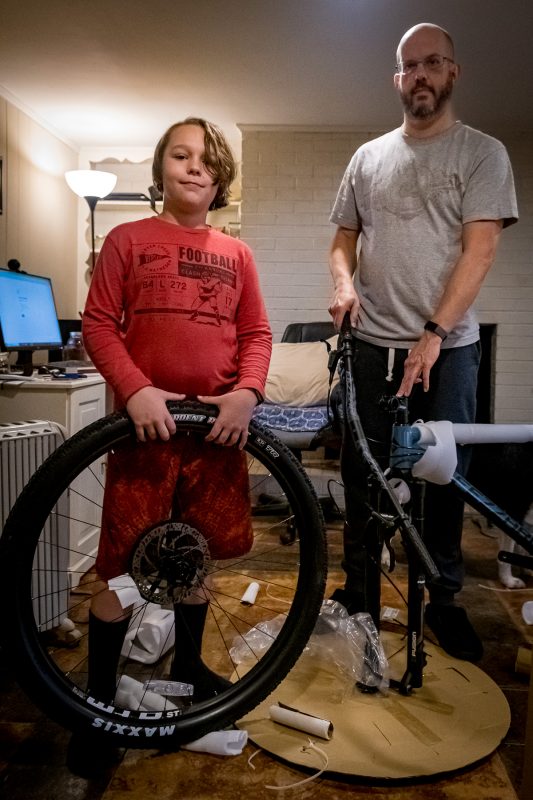
On the non-religious side of things, my new bike arrived today:

A new mountain bike for me actually means a very happy Boy. "Think of all the places we can ride now!"

Immaculate Confusion

Today is the Feast of the Immaculate Conception, a feast day that always puzzled me even when I was actively trying to convince myself that I was a believing Catholic. Britannica defines it succinctly enough in a non-theological, non-devotional way:

Immaculate Conception, Roman Catholic dogma asserting that Mary, the mother of Jesus, was preserved free from the effects of the sin of Adam (usually referred to as “original sin”) from the first instant of her conception. (Britannica)

The question it at first raises, before the skeptic has a full understanding of the doctrine, is why God could not simply do for all humans what he did for Mary. Why not just preserve all people “from the effects of the sin of Adam” instead of this whole convoluted way of getting forgiveness in the Old Testament through blood sacrifice which then comes to full fruition in the New Testament with an actual human sacrifice (i.e. Jesus)? If he could do it for Mary, why couldn’t he do it for everyone?

A Catholic apologist at this point would explain that it’s not simply that God preserved Mary from the effects of this sin without the need of Jesus and his sacrifice. Instead, the apologist would explain, the sacrifice was applied to Mary in some kind of retroactive way. The Catholic Encyclopedia New Advent explains it thusly (emphasis added)

The immunity from original sin was given to Mary by a singular exemption from a universal law through the same merits of Christ, by which other men are cleansed from sin by baptism. Mary needed the redeeming Saviour to obtain this exemption, and to be delivered from the universal necessity and debt (debitum) of being subject to original sin. The person of Mary, in consequence of her origin from Adam, should have been subject to sin, but, being the new Eve who was to be the mother of the new Adam, she was, by the eternal counsel of God and by the merits of Christ, withdrawn from the general law of original sin. Her redemption was the very masterpiece of Christ’s redeeming wisdom. He is a greater redeemer who pays the debt that it may not be incurred than he who pays after it has fallen on the debtor. (New Advent)

Yet far from making this a simpler solution that solves the question of why God didn’t just do this for everyone, it makes an even more convoluted and illogical argument. Somehow, an event that hadn’t yet taken place affected the conception of the person who would later give birth to the individual to whom this salvific event would take place — see, there’s just no way to explain it without it sounding like some kind of theological Rube Goldberg contraption.

Re-Vision

As we go through life, we start to see things differently. That really goes without saying, I know, but looking over old photographs makes this so much more literal. I saw today a photograph from 2015 and immediately saw flaws in it. The newest iteration of Lightroom allowed me to fix some of the flaws, but not all of them.

"Corrected" version

It was the little things.

That gate behind us -- why didn't I think to close it? It would have made the background that much more fluid. (Perhaps I thought I had. Maybe I closed it, but something opened it back up -- wind, gravity, a squirrel.)

Why didn't we move further down the hill so that more leaves would be behind us? It was a simple fix -- why didn't we see it? (Maybe we did -- maybe we were as far down as possible. Perhaps just beyond the bottom of the frame the leaves disappear.)

Why didn't I open the aperture a little more to get a little creamier background? (Perhaps it was as wide open as possible -- in 2015, we still didn't have a great portrait lens. Truth be told, we still don't, but we've got a much better lens than I would have used for this picture.)

It's no big deal, obviously, but looking back, I see so much wrong with this.

I had a similar thought in Polish Mass today. I hadn't been to Mass since the last Polish Mass a month ago, and the less frequently I go to Mass, the more foreign it seems. Everyone going onto the stage (I know that's not what it's actually called but I can't remember what it is called, and since it's an elevated platform upon which the whole ceremony is conducted, it is, for all intents and purposes, a stage) stopped and bowed or genuflected. When I first saw people doing that in Poland, I was curious: why are they doing all that bowing? Once I learned about the idea of the real presence of Jesus in the host (i.e., the idea that somehow the bread ceases to be bread and is actually the body of Jesus), I understood what was going on. It still didn't make sense because I didn't believe that was the case, but I understood why they did it.

When I tried being a Catholic, that was one of the doctrines that I thought was just a little off but put it out of my mind. I behaved as if I believed it even though, deep down, I know I never did. It doesn't make any sense: the official church teaching is that nothing physically changes. You can press a priest on the matter, and he'll even admit that nothing atomically changes. The logical conclusion: if nothing atomically changes, then nothing changes. Full stop. The bread is made of molecules which are made of atoms which are made of subatomic particles. If nothing in that chain of being changes, then nothing changes. It's not complicated logic -- it's quite basic in fact.

Yet Catholic apologists will start talking about substance and accident and making Aristotelian moves to suggest that the thing that makes bread bread -- the substance -- changes but the outward appearance doesn't. Yet nothing makes bread bread. "Bread" is the name we give molecules of wheat, water, and usually (though not in this case) yeast that have undergone chemical changes through the application of heat. The atoms themselves didn't change even in the cooking. It's not complicated logic -- it's quite basic in fact.

Still, as someone attempting to be a believer I watched everyone bowing, I was a little jealous that they seemed actually to believe. I knew I didn't, though I would not have admitted it to anyone. As my doubts resurfaced several years ago, I eventually realized I didn't have to pretend I believed anymore that the little tasteless wafer was Jesus himself, and I felt a bit of relief about that.

Today as I watched as the altar servers bowed before going on stage, as the lector bowed before going on stage, as all the parishioners bowed before taking the bit of bread, I found myself back where I started, knowing exactly why they were doing it but still thinking it made little objective sense.

Where is the re-visioning in all that? It's not that I believed the wafer became anything different; it's that I saw myself as someone who should believe that but never really did. The re-vision is an understanding that I was almost purposely deluding myself.

Catholic “Humor”

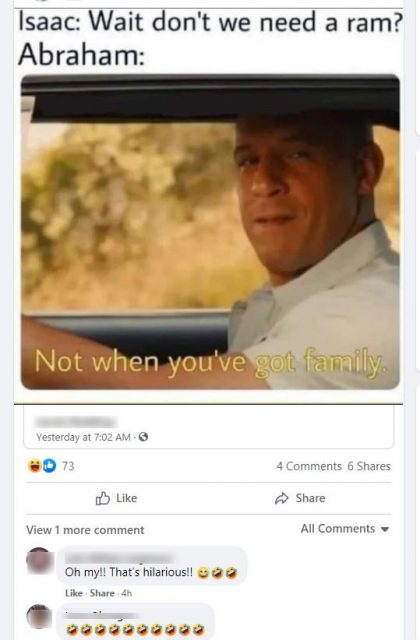
The group that is putting out the Bible in a Year podcast that I’ve been listening to on and off (mainly off, I must admit) has a social media page for podcast participants. Someone posted a joke about one of the most horrific stories in the Bible, when God commands Abraham to sacrifice his own son Isaac.

“Wait,” Isaac asks in the meme, “don’t we need a ram?’

The original passage reads,

“The fire and wood are here,” Isaac said, “but where is the lamb for the burnt offering?”

Abraham answered, “God himself will provide the lamb for the burnt offering, my son.” (Genesis 22.7, 8)

It’s the initial confusion of a boy who’s probably beginning to suspect what’s up but can’t possibly accept it. It’s the confusion of a boy about to experience such trauma that I’m not sure multiple lifetimes of therapy and counseling could heal. It is, in short, the beginning of one of the most horrifying stories in the Bible, a story that non-believers point to as strong evidence of the immorality of the god portrayed in the Old Testament.

In the meme, Abraham answers Isaac’s confusion flippantly, “Not when you’ve got family.”

It’s a screenshot from some film or TV show with which I’m completely unfamiliar, so I’m likely missing something as memes depend often on the disconnect between the visual and the verbal. A quick search reveals the line is from the Fast and the Furious film franchise, something I know absolutely nothing about and have no interest in. Apparently, references to the importance of family in memes stem from these films.

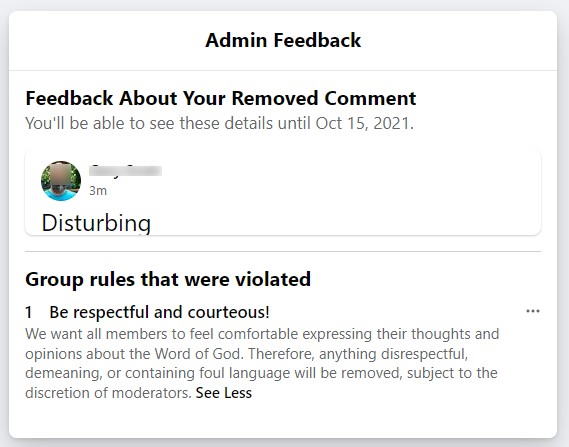
I found the humor disturbing, though. Here’s a man joking about the fact that he’s about to kill his own son. That he was willing to do so in the first place is striking; that the Abraham in the meme is being flippant about it is obscene. So of course I called them on it with a single-word comment: “Disturbing.”

The administrator, though, didn’t like my comment and removed it.

Apparently, I wasn’t being respectful and courteous. They want “all members to feel comfortable expressing their thoughts and opinions about the Word of God” as long as those opinions don’t actually criticize the “Word of God.”

Was the comment disrespectful? I wasn’t criticizing the person, just the idea of the meme, so I don’t see how it was disrespectful.

Did I demean anyone with the comment? Not that I can see.

Did my comment include foul language? No, not at all.

Indeed, it was the meme itself that was disrespectful and demeaning. In making light of such a brutal and barbaric act that a supposed man of God was about to comment, it trivializes the trauma of the story and demeans victims of abuse at the hands of those who are supposed to be protecting them.

I’m sure the common response would be, “Come on, man — it’s just a joke! Relax.” But it makes me wonder how they would react were the roles reversed. Let’s say I share a joke I encountered on Twitter: “When the Holy Ghost impregnated Mary with Jesus, was he shouting ‘Oh me! Oh me! Yes! Yes! Oh me!’?” I don’t think they would be willing to accept the “Come on, man — it’s just a joke! Relax!” argument.

Of course, this “joke” (it’s really not even funny at all) is problematic to believers for two reasons. Most obviously, It’s very disrespectful of one of the central tenants of Christianity, turning it into a crude sex joke. The virgin birth of Jesus is, for some strange reason, very important in traditional Christian theology, and the way this happens is with God himself (in the form of the Holy Ghost) performing the actual impregnation. In no way would this really be thought of as a sexual act. It was a miracle according to Christians. To juxtapose this miracle with the crude image of a sex act demeans the nature of the supposed miracle and makes a mockery of the claim that Jesus was born to a virgin. In truth, it’s not a joke as much as a crude attempt at humor. But that leads to the second reason it’s problematic for believers: It highlights the illogical nature of that central tenant in a way that’s hard to ignore. Due to the dogma of the Trinity, God the Father, Jesus, and the Holy Ghost are all just God. So God impregnated Mary with God. That makes Mary both God’s spiritual spouse and God’s mother. That’s illogical and disturbing, and the joke gets at that around the edges by pointing out that the Holy Ghost is also God, so instead of saying “Oh God!” he/it would be declaring “Oh me!” It’s a very unrefined way of making a basic observation: the idea of the Trinity is illogical and makes the incarnation of Jesus a weirdly incestuous act.

In short, believers don’t like having their beliefs mocked, and that joke does that. But what it’s mocking cuts close to the theological bone: it takes a basic tenant of Christianity and says, “Okay, let’s look at it from a purely logical, material point of view.” But in telling this “joke,” I would essentially be mocking Christian teaching and by proxy Christians themselves.

But doesn’t the original meme do that to victims of domestic abuse? Doesn’t it make light of one of the most tragically common and inexcusable crimes humans across all cultures have historically committed? Certainly. But because it’s wrapped in the cloak of religious dogma, many believers are blind to it.