Matching Tracksuits

fun in fours

catholicism

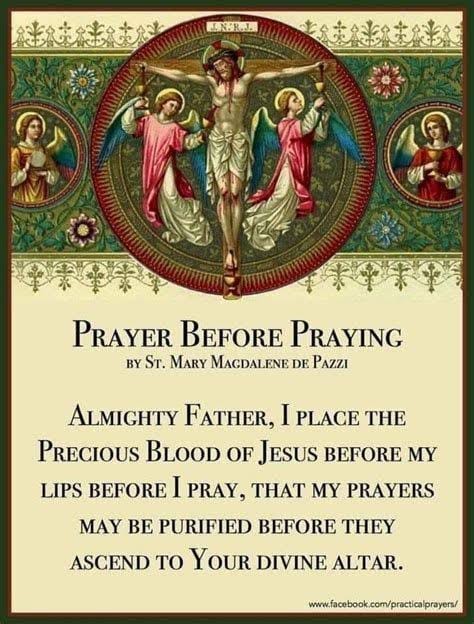
Prayer Before Praying

Nothing could epitomize better the sense of worthlessness that Catholicism instills in its believers than this "prayer before praying." In it, the penitent admits that even when praying, when doing what the god of the Bible commands, he's a worthless pile of nonsense, and without a little bit of Jesus' blood smeared on his lips, he would say the most outrageous things...

But then there's the eternal problem with such things: if there should be a prayer before praying, shouldn't there be a prayer before praying the prayer before praying? And logically, shouldn't there be a prayer before praying the prayer before praying the prayer before praying? If nothing I say is worth saying without praying beforehand, and even that prayer is not worthy of anything other than scorn because I'm some useless shit of a sinner, shouldn't I just play it safe and keep my mouth shut?

Leaving the Faith

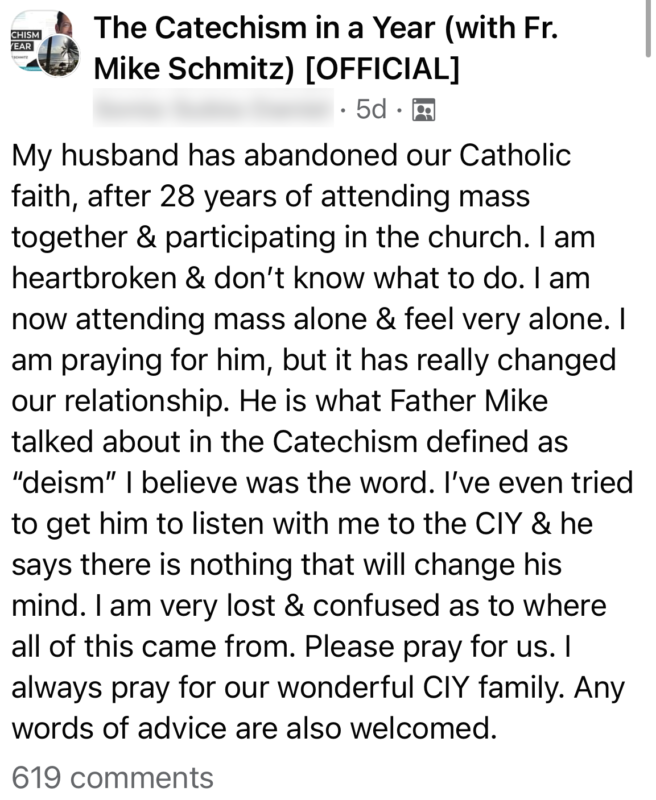
The post stood out immediately: I can relate, and so can K. Granted, I hadn't been attending Mass as long as the gentleman in question, but I could see myself in the post:

"I am very lost & confused as to where all of this came from," she admits, and I find myself wondering how this came about. Perhaps the husband had been on this long road of deconversion for years and simply kept it to himself because he didn't want his wife to worry. Perhaps as the issues piled up in his head he was in some sort of denial. Perhaps he dropped hints, unsure how to begin the conversation outright, and she just didn't pick up on them because they were so incongruous with everything she knew about him or because he, inexperienced with dropping such hints, was unable to do so in a sufficiently clear way. (That's the double problem with dropping hints.) Whatever the case, from her perspective, it's coming out of nowhere.

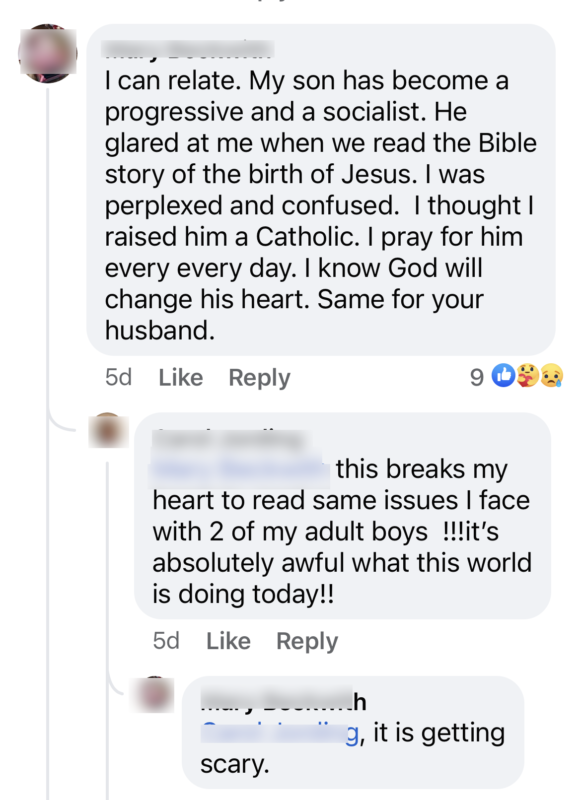
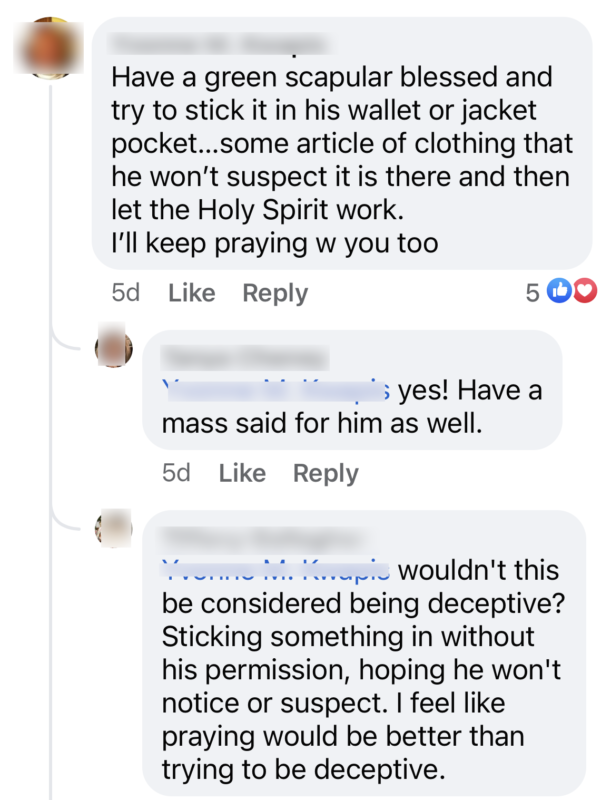
In responding to this, some people shared that they can relate. But at least a couple had me wondering if effective communication was actually taking place. One response declared that her son had become "a socialist."

Perhaps he does not align with a socialist political position, but knowing conservatives of the 2020s, it could simply be that he's now aligned himself with the Democratic party and the mother, true to Fox News talking points, simply labels him a socialist.

To that response, someone commiserated that "it's absolutely awful what this world is doing today," to which the original commenter replied that "it is getting scary." She suggests it's "this world," which is American Christian-ese "the Satan-influenced, Satan-worshiping society we live in," which in turn is simply the non-Christian segment of the population. And it's getting "scary" because more and more people are realizing that they don't need Christianity in their lives: church attendance is plummeting, especially among those under 40. These two ladies see the issue in terms of society as a whole, but they fail to understand the underlying causes, attributing it most likely to Satan's growing influence.

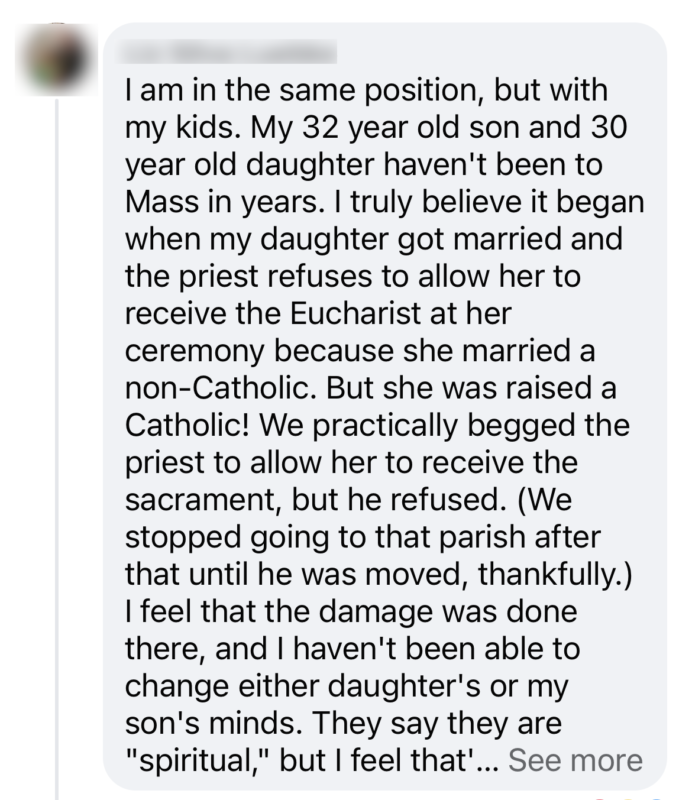
Some, however, did see that it wasn't simply a question of Satan's supposed influence but also a question of the hypocrisy and judgmental nature of contemporary American Christianity:

This comment reveals what I see as one of the primary causes of declining church attendance: the church is continually creating situations that amount to self-inflicted wounds.

Fundamentalist Christians insist that the Genesis account is accurate and that evolutionary theory is a Satanic lie. Then their children learn about the mountain of evidence supporting evolution and they're forced to choose between the faith of their parents or, as they see it, reality.

Fundamentalist Christians insist that homosexuality has no place in a Christian worldview. Then their children meet queer people and realize, "Hey, they're not the devils they're made out to be," and another church teaching falls to the side.

Fundamentalist Christians remove from their fellowship individuals who choose not to live according to fundamentalist interpretations of sexual morality, and their children find out their soccer coach has been fired, despite parents' and players' begging, mid-season because she got pregnant out of wedlock. Then the players are crushed, and a handful of them start thinking, "If this is how Christians behave, I don't think I need that in my life."

These are just a handful of the ways modern Christianity is sabotaging itself. Perhaps something like this went on with these commenters' children.

Others tried to fix the problem.

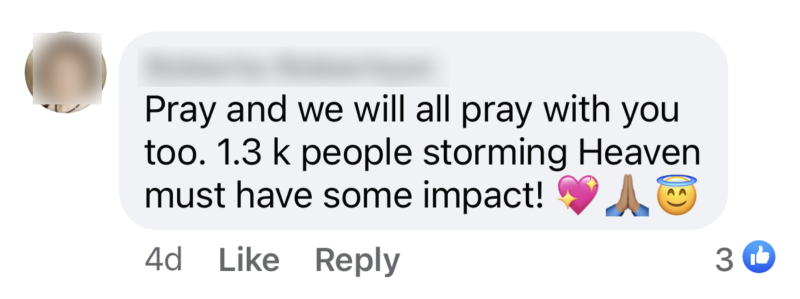
What happens when prayer doesn't work, though? What happens when these people are still not returning to church? These poor folks then have a second layer of doubt: why isn't God helping my child save herself? What am I doing wrong that is preventing this prayer from being answered?

As an aside, the metaphor of prayer as "storming heaven" is always a little strange for me. "Storming" is always used in the sense of an assault -- storming the beaches of Normandy. Soldiers storm a position because it's held by the enemy. In this case, "storming heaven" has connotations of viewing God as an enemy. I'm certain this is not what they intend, but I'm equally certain they've never really thought about the metaphor. It just sounds like strong, intense praying -- praying really hard.

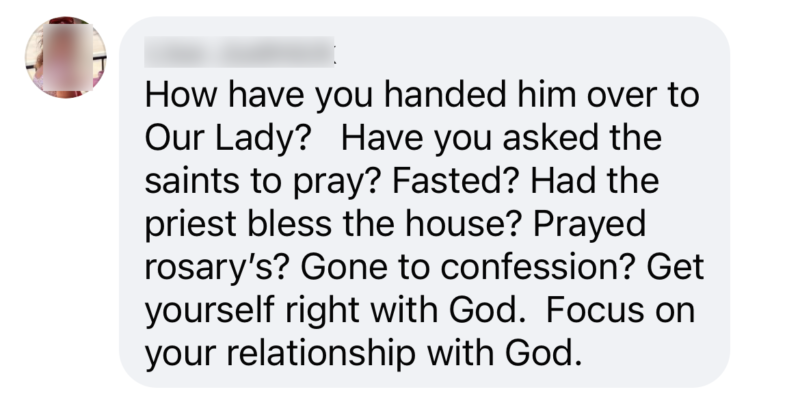
Some people just passively-aggressively blamed the believers: it's your fault. You're not trying hard enough. You're not holy enough.

This could not possibly be helpful. Such a response only increases the sense of overwhelming guilt these people must feel. As with the "storming heaven" metaphor, this commenter probably didn't even think this comment out.

Finally, there was the Catholic sense of magical thinking on full display:

The Catholic reliance on relics and holy objects fascinates me. What would this scapular actually do? How would it affect things? And since this husband would be unaware that it's there, would that amount to God acting against this guy's will, thus negating the cherished notion of free will, a staple among Christians for explaining how evil exists on earth given the existence of an all-knowing, all-powerful, completely-benevolent god?

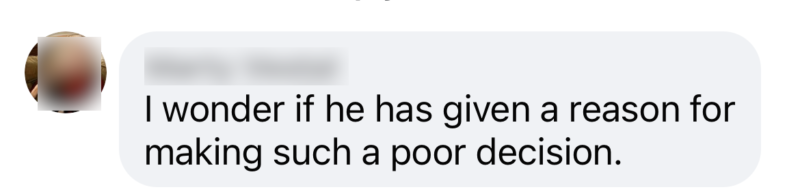
I can't really blame them for their thinking, though: there are certain lines a Christian cannot cross, and "he might have had perfectly good reasons for leaving Christianity, and he might have done so in good faith" is one of them. In such a case, if he found a reason to leave, perhaps I could as well -- and that's unthinkable.

No matter the reason he'd give, though, it wouldn't be good enough for them.

Clerical Education

I'm currently reading The Dark Box: A Secret History of Confession by John Cornwell, and it's enlightening and depressing, as one might imagine. The crux of the argument is that confession has been damaging in a lot of ways throughout history, but it has been most damaging in the last 100 years to children. When Giuseppe Melchiorre Sarto (Pope Pius X), at the start of the twentieth century, mandated that first communion and first confession shouldn't happen at age fourteen but rather age seven, he opened a door to the potential emotional abuse of children. Seven year olds don't really have a good conception of what "sin" might be, and they get conflicting ideas from various people. Therefore, we've had several generations of cradle Catholics who have grown up suffering from guilt over the silliest thing, tormenting themselves mentally about "sinning." For instance, one young boy was terrified that he was going to hell for breaking the pre-communion fast because he'd opened his mouth to catch some raindrops in his mouth on the way to church.

"But wouldn't these priests hearing these confessions realize this and apply the child psychology they'd learned in seminary to help teach these kids what the church considers sin to be and how to deal with guilt constructively?" one might ask.

Child psychology classes? What are you thinking? That's not what the pre-Vatican II seminarians learned.

What did they learn?

It was taught that to break the fast and receive the Blessed Sacrament, as we have seen, was a mortal sin. The textbooks enlarged on the circumstances in which the fast might or might not be broken. The rule admitted, it was pointed out, of no exception, and it extended to the smallest quantity of food or drink taken as such'.

So what does it mean to 'eat' or 'drink? The thing consumed must be 'taken exteriorly. So it is not a violation of the fast, for example, 'to swallow blood from the gums, or teeth, or tongue, or nasal cavities', although it would be a violation of the fast to swallow blood flowing externally from the exterior parts of the lips, or from a cut finger, or from the nose, or to swallow tears, unless in each case only a few drops entered the mouth and were mingled with the saliva.' To violate the fast, moreover, requires that a substance 'must pass from the mouth into the stomach, so that the fast is not broken if liquid is taken into the mouth, as an antiseptic or for gargling, and is not swallowed. A third condition insists that violation of the fast occurs by the action of eating and drinking, and inadvertence 'has no bearing on the matter even if it is a 'drink given to a patient during sleep?

Davis declares that the 'divines are still disagreeing whether a 'nutritive injection' is food, but certainly the introduction of soup or milk through a stomach pump is not allowed, whether the injected liquid be intended to nourish or merely to flush.' Turning to the vexed question of nail-biting, Davis reports that he believes that this does not affect the fast, but biting off and swallowing pieces of finger skin might do so, if the particles were more than the smallest and not mixed with saliva.'

Such useful information.

My hope is that in the sixty years since Vatican II there has been a change. Surely there's been a realization that some basic psychology might be necessary. When I look at a seminary's course offerings at random, though, I don't see that. I see courses like this:

  • CHUR 501 The First Millennium: Patrology (3)
  • LITY 501 Introduction to the Liturgy (3)
  • MORL 501 Fundamental Moral Theology (3)
  • SCRP 501 Introduction to Biblical Studies: Wisdom & Psalms (3)
  • SYST 501 Revelation, Faith, & Theology (3)
  • ORDN 501 1T Formation Seminar: Celibate Witness (0)
  • PAMU 501 Pastoral Music I (0.5)
  • PFED 502 1T Field Ed Placement: Catechetics & Teaching Ministry (1)
  • PFED 599 Pedagogy seminar (0)

Or like this

  • CANL 601 Code of Canon Law (3)
  • CHUR 601 Modern & Contemporary Church History (3)
  • SCRP 601 The Prophets (3)
  • SYST 605 Protology & Anthropology (3)
  • ORDN 601 2T Formation Seminar: Personal Conduct/Character of Priest (0)
  • PAMU 601 Pastoral Music II (0.5)
  • PFED 601 2T Field Ed Placement: Health Care or Social Justice Ministry (1)

Or this:

  • HOML 701 Models of Preaching (3)
  • LITY 701 Deacon Practicum (1)
  • SCRP 701 Luke & Acts of the Apostles (3)
  • SYST 707 Ecclesiology (1)
  • SYST 709 Ecumenism (1)
  • SYST 711 Mariology (1)
  • ORDN 701 3T Formation Seminar: Parish Admin/Human Resources (0)
  • PAMU 701 Pastoral Music III (0.5)
  • PFED 701 3T Field Ed Placement: Evangelization or Parish Ministry (1)

All very practical. All very helpful. All a bunch of lofty-sounding nonsense.

With each passing year, my disgust at the Catholic church grows.

Definitions

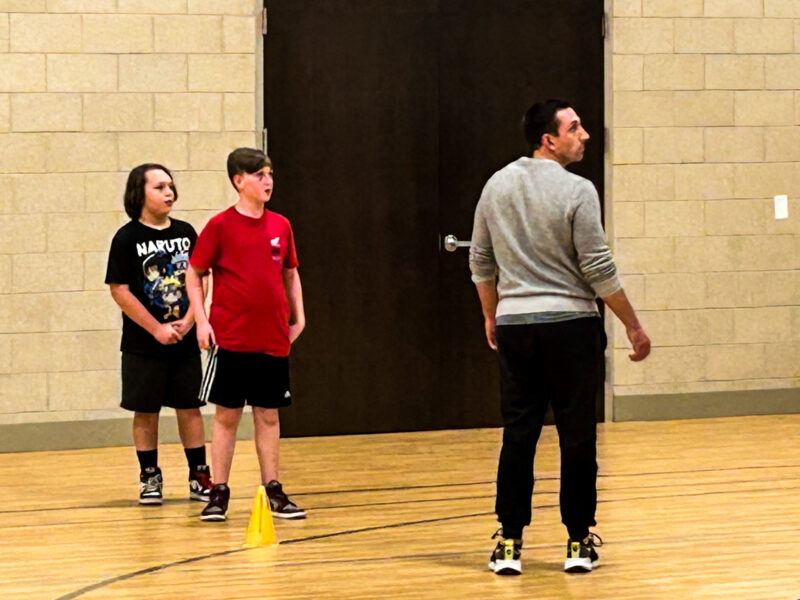
“I was just here a little while ago,” E lamented as we neared our parish church for basketball practice tonight.

“Why?” asked N, genuinely perplexed. N is a dear friend but not a member of the church.

“For religious education,” the Boy explained.

“What’s that?”

“It’s like school,” E said.

“What do you learn about?”

“Church.”

“That wasn’t a very informative answer,” N pressed.

“Well, we learn about,” the Boy pauesed for a moment before finishing, “well, it’s about everything church.”

“That still doesn’t tell me much,” N insisted.

“Well, today we learned about sacraments,” E clarified.

N thought for a moment before admitting, “I don’t know what that is at all.”

When I was N’s and E’s age, I, too, would have had no idea what a “sacrament” might be, and I certainly would have no idea what it’s supposed to do. According to the Catholic Church, sacraments are “outward signs of inward grace, instituted by Christ for our sanctification.” Even if someone told me that, I doubt I would have understood what any of that might mean.

Outward sign? Simple enough.

Inward grace? Not sure what “inward” means here, and even now as an adult, it's not clear. I suppose it's meant to be juxtaposed with "outward" to create an appealing bit of parallelism. But are we talking internal medicine "inward" or are we talking mental inward? Or are we talking spiritual? Of course, that doesn't even exist, but if they meant "spiritual" why not say "spiritual" instead of "inward"?

I certainly wouldn’t know what “grace” means here. I would have known "grace" from a basic Christian idea of forgiveness, but beyond that, I'm lost. And what's an "inward grace"? Are their other kinds of grace? What does the Catholic Encyclopedia say?

Grace (gratia, Charis), in general, a supernatural gift of God to intellectual creatures (men, angels) for their eternal salvation, whether the latter be furthered and attained through salutary acts or a state of holiness. Eternal salvation itself consists in heavenly bliss resulting from the intuitive knowledge of the Triune God, who to the one not endowed with grace "inhabiteth light inaccessible" (1 Timothy 6:16). Christian grace is a fundamental idea of the Christian religion, the pillar on which, by a special ordination of God, the majestic edifice of Christianity rests in its entirety. Among the three fundamental ideas — sinredemption, and grace — grace plays the part of the means, indispensable and Divinely ordained, to effect the redemption from sin through Christ and to lead men to their eternal destiny in heaven.

Source

Look at all those links -- they're all articles to offer further explanation about the various ideas.

“Sanctification?” No idea then as now. The Catholic Encyclopedia lists "grace" as "sanctifying grace" and has an article on the related topic of justification but nothing on sanctification. It's all just a confusing mess when you really look at it:

Since the end and aim of all efficacious grace is directed to the production of sanctifying grace where it does not already exist, or to retain and increase it where it is already present, its excellence, dignity, and importance become immediately apparent; for holiness and the sonship of God depend solely upon the possession of sanctifying grace, wherefore it is frequently called simply grace without any qualifying word to accompany it as, for instance, in the phrases "to live in grace" or "to fall from grace".

I suspect most adult Catholics wouldn’t be able to explain it beyond the memorized explanations they might have learned in religious education. Push these ideas a little and they begin to slip and slide for the average believer; shove and heave on these ideas and they begin to crack for the average parishioner.

Apologists would explain that this is due to “insufficient catechesis.” But eventually, even the most expert catechist is going to run out of answers. Or they're going to begin saying stuff like the quotes above, which sound elevated and sophisticated but which, when really examined, are empty and relatively meaningless -- when someone pushes back hard enough.

N, however, was content to sit in ignorance.

The Priest

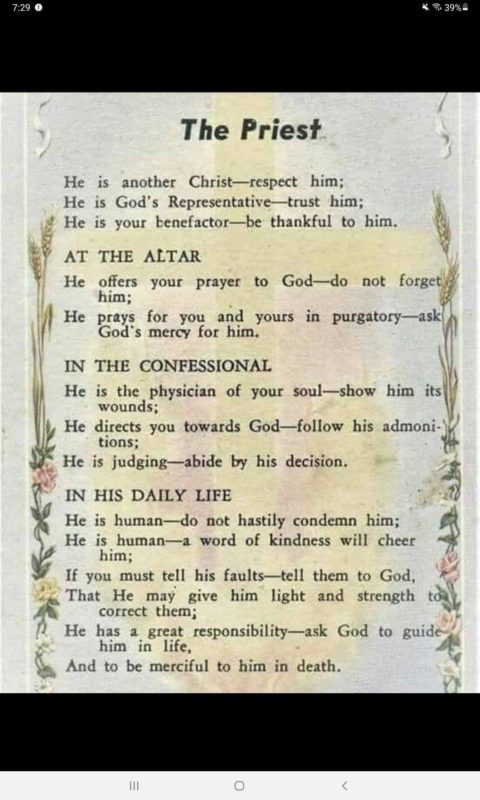
Priests in the Catholic church have always been afforded special status. Priests in Poland have almost god-like status. Why is this? A post on a Catholic social media stream might offer some insight:

If he is "another Christ" and "God's Representative," how could his status increase except by being declared an actual god?

Who Commanded What

I really don't know why I do it. I follow some of these Catholic groups online for no good reason, I think. Am I there just to pick a fight? I guess.

Today, this one popped up as a joke.

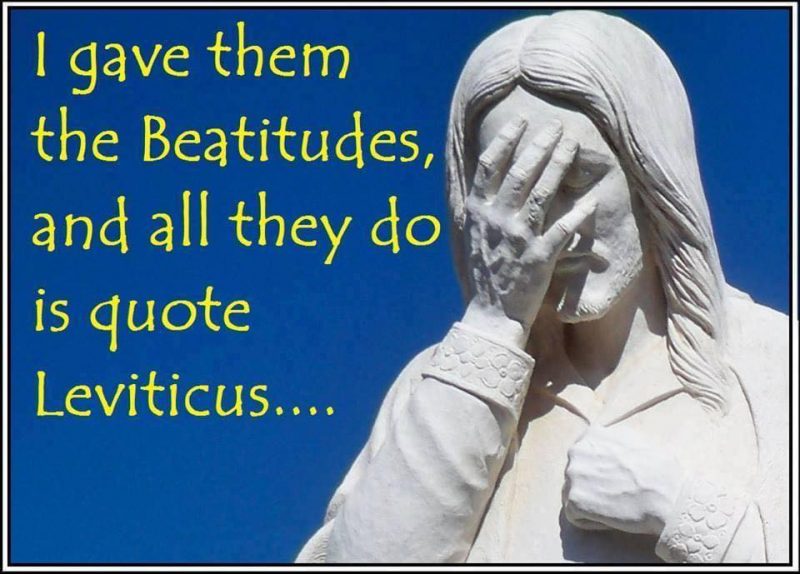
Everyone was laughing about it, so I guess humor is the new way of dealing with the awful things God commands in Leviticus. Of course, I replied: "But both come from God. Both are commands from God. That's the problem."

A user named Joseph responded, "no there is no problem. None of the levitical laws are valid anymore. Thus any command from Chirst is superior."

People just don't get it, though. Jesus might have done away with these laws, but because of the trinity doctrine, it was Jesus who created the commands in the first place. I responded to Joseph:

But the fact that they were commanded in the first place -- that's the problem I'm referring to. That God commanded his people to stone to death incorrigible children, stone homosexuals, stone people for breaking the sabbath -- THAT is the problem. Whether or not he did away with those laws is not as troubling as the fact that he made them in the first place.

At this point, Jesse jumped in to help:

[I]f you listened to the first couple of episodes, Fr. Mike clarified it. Some laws were "allowed", just as what Jesus said about the law on divorce. Also that some must be understood that they were given to a savage, nomadic, tent-living, and with frequent streaks of going astray kind of people who lived thousands of years ago.

I've heard this so many times I'm sick of it. No one sees the problem that the same god who gave us the kinder, gentler Jesus also gave us these commands in Leviticus! In fact, because of the trinity, it's the same being! I tried to explain this:

No, that doesn't fly. God didn't allow those laws. He didn't see them stoning people and say, "Well, I'll let you do that for a while." It was God who COMMANDED the stoning. Why does no one get that distinction?

There were a few more responses -- I replied to them all. And then everyone just stopped responding to me. Questions are unwelcome, I guess, and even more so follow-up questions.

Communion

One of the most disturbing passages in the Bible comes in the Gospel of John after Jesus feeds the 5000. In the passage known as the Bread of Life passage, we read,

Jesus said to them, “Very truly I tell you, unless you eat the flesh of the Son of Man and drink his blood, you have no life in you. Whoever eats my flesh and drinks my blood has eternal life, and I will raise them up at the last day. For my flesh is real food and my blood is real drink. Whoever eats my flesh and drinks my blood remains in me, and I in them. Just as the living Father sent me and I live because of the Father, so the one who feeds on me will live because of me. This is the bread that came down from heaven. Your ancestors ate manna and died, but whoever feeds on this bread will live forever.” (John 6.53-58)

This is an echo of what we read in other gospel accounts about the Last Supper:

While they were eating, Jesus took bread, and when he had given thanks, he broke it and gave it to his disciples, saying, “Take and eat; this is my body.” Then he took a cup, and when he had given thanks, he gave it to them, saying, “Drink from it, all of you. This is my blood of the covenant, which is poured out for many for the forgiveness of sins. I tell you, I will not drink from this fruit of the vine from now on until that day when I drink it new with you in my Father’s kingdom.” (Matthew 26.26-29)

Mark’s account is similar because his gospel is a source for Matthew’s:

While they were eating, Jesus took bread, and when he had given thanks, he broke it and gave it to his disciples, saying, “Take it; this is my body.” Then he took a cup, and when he had given thanks, he gave it to them, and they all drank from it. “This is my blood of the covenant, which is poured out for many,” he said to them. “Truly I tell you, I will not drink again from the fruit of the vine until that day when I drink it new in the kingdom of God.” (Mark 14.22-25)

And the same for Luke:

And he took bread, gave thanks and broke it, and gave it to them, saying, “This is my body given for you; do this in remembrance of me.” In the same way, after the supper he took the cup, saying, “This cup is the new covenant in my blood, which is poured out for you.” (Luke 22 19, 20)

In all four accounts, Jesus makes the same ghastly claim: eating his body and drinking his blood is essential for human well-being. John 6.52 records the Jews’ response: “Then the Jews began to argue sharply among themselves, ‘How can this man give us his flesh to eat?'” While they’re not saying it outright, they are saying what most modern humans would say were they exposed to this notion for the first time: “This guy’s talking about cannibalism and vampirism!”

Indeed, there are few things in Christianity as disturbing as the cannibalistic ritual at its very core. No matter how one interprets this, it’s simply disgusting and barbaric. Protestants view it symbolically, which seems to lessen the effect, but it’s still troubling to think that millions of Protestants each Sunday symbolically eat human flesh. Catholics have an even stranger view of it, believing that the wafer they eat somehow mysteriously transforms into the actual body of Jesus even though it still looks like a cracker. For them, then, it’s not symbolic cannibalism but actual cannibalism.

If these Christians had not been raised hearing these words on a weekly basis and encountered it in another religion, they would be disgusted. It’s conceivable that Christians would reject whichever religion did teach this primarily on the basis of this teaching.

Holy Saturday 2022

Today is the day in the Catholic liturgical year when Jesus is supposed to be in the tomb. Crucified yesterday afternoon, he was laid to rest according to the gospels in a tomb provided by Joseph of Arimathea. It is this tomb that various people will find empty tomorrow morning according to tradition in the gospels.

Who exactly find the tomb empty depends on which gospel you read. Critics point this out as one of many discrepancies which undermines the supposed factual accuracy of the gospels. Believers have various apologetics to explain away these differences. That’s a different issue for a different post. Besides that’s not until tomorrow. Today is Holy Saturday: I’m more interested in what’s going on today according to the gospels.

One piece of “evidence” that apologists like to put forth is the empty tomb, but first, we have to get Jesus in the tomb. What is the evidence we have that he was even buried? Only the Bible biblical narrative.

We do know from other contemporary sources, however, that most victims of crucifixion were not given a proper burial. This was part of the punishment. Your rotting corpse served as a deterrent for others. Furthermore, once burial took place, it was most often accomplish by tossing the remains not eaten by the birds into mass common graves. So we have two major problems with the account in the gospels: first, criminals’ bodies are traditionally left on the crucifixion steak to serve as a deterrent; second, once the remains were buried, they were placed in a common grave. The only evidence that we have Jesus was buried, comes from gospels written 50 to 70 years after he died. That’s not terribly convincing evidence, and I would bet that most Christians if this claim were made by another religion where is similar objections.

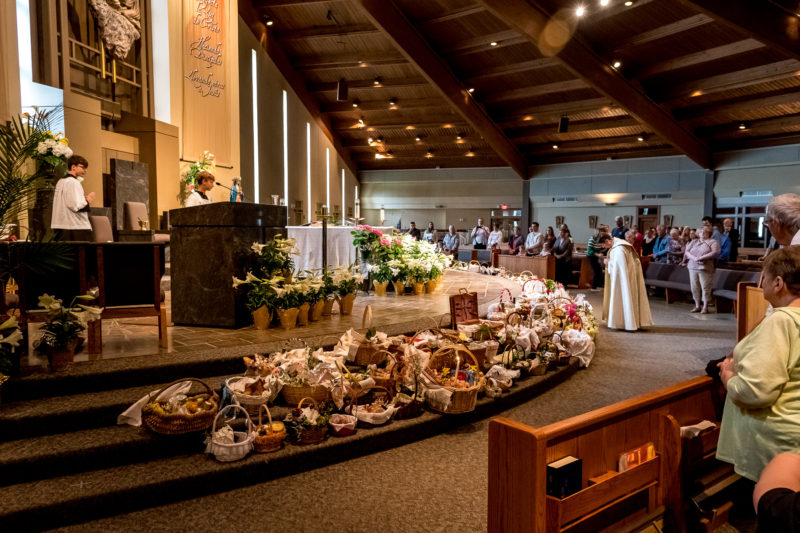
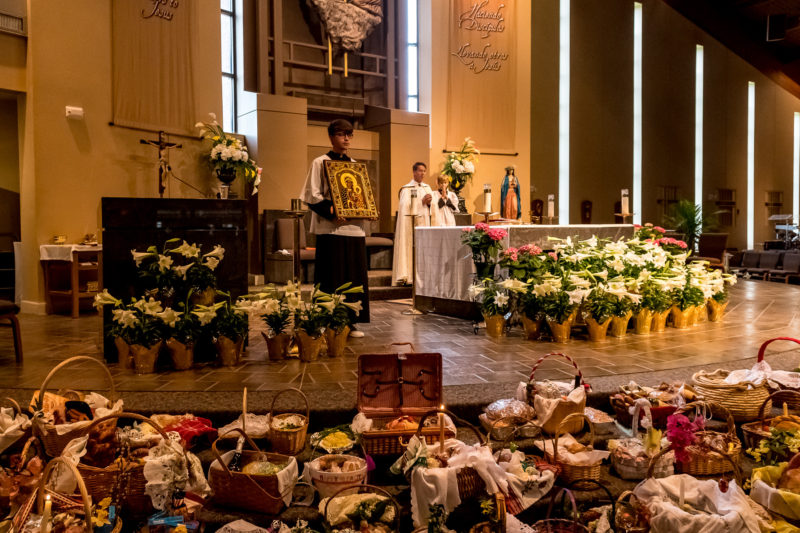
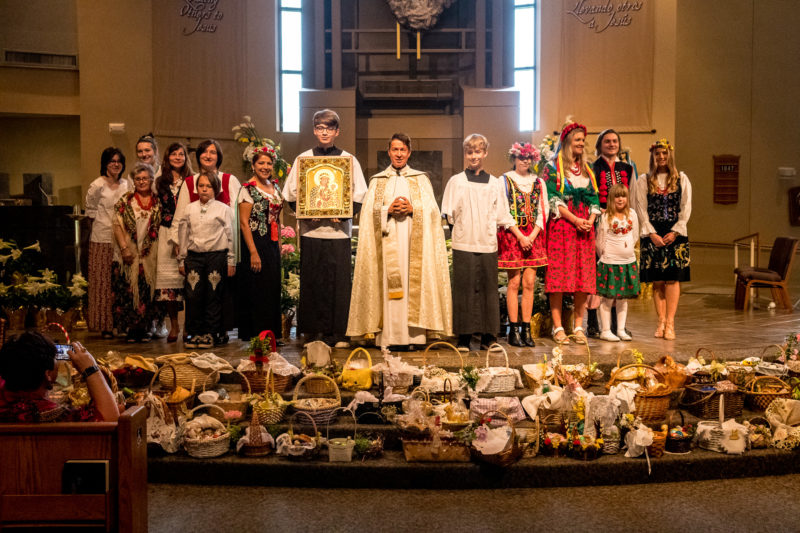
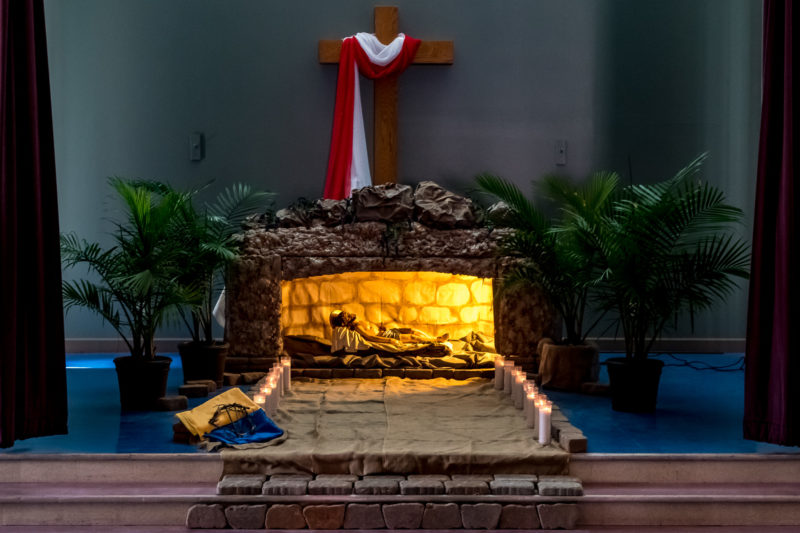
However, most Christians accept this as a simple fact it is beyond dispute, and from this narrative, Catholic secondary traditions have sprung up. Polish Catholics traditionally build a grave in their church and some sort of Jesus figure is placed in it, symbolizing Jesus and Joseph of Arimathea‘s grave tomb. Local Poles brought that tradition to our area, and the parish pastor has fallen in love with the tradition. So every year, the Polish community creates a tomb for Jesus just like they would do in Poland, and the faithful come and keep vigil with him throughout Friday night and Saturday. Of course, everyone knows that this is simply symbolic representation of Jesus in the tomb, but the fervor with which some people sit and pray in front of this tomb suggests that somehow that symbol has become for them very real. It is as if they are sitting by the actual tomb, which of course likely didn’t even exist. How is this possible?

I think there’s a certain predisposition among Catholics to turn the symbolic into the real, to suggest with a line between the symbol and the thing somehow blurs, somehow disappears completely. They do this every week with the bread and the wine. Catholic teaching is that this bread and this wine, after some words uttered by the priest, are no longer bread and no longer wine. It looks like bread and wine; it taste like bread and wine; scientific analysis would show that on a molecular level, it’s still bread and wine. None of these things matter. What matters is that the church has taught for ages that somehow despite all appearances to the contrary, this is now the physical body and blood of Jesus. When someone can make that kind of Leap, all other boundaries between symbol and symbolized unnecessarily begin to slip.

All of this is undergirded by the nearly universal notion that our world is it duality. There is a physical; there is a spiritual. Things can exist that don’t seem to exist, that leave no physical trace, they have no physical characteristics, they have nothing. Humans, according to Catholic teaching, are not just physical beings: at our core, we are a soul. This duality then spills into other things, so that we can suggest it bread and wine have a physical existence, but they have some other kind of existence. This is what changes Catholic say.

Of course, this other “existence,” which they call substance, cannot be shown to exist in any scientific manner. It is a philosophical construct. Once a group of people starts to imbue philosophical constructs with actual existence, then literally things that exist only in the head can be said to exist in reality, and in a certain sense, they do exist in reality, for our conscious experience of the world is the only experience of it we have. But they don’t have an external reality, they don’t have a reality that is not dependent on our contemplation of said philosophical construct.

Freedom doesn’t exist outside our notion of what freedom is. Justice does not exist outside of our notion of what justice is. And our notions of freedom and justice and every other philosophical construct vary widely from cultural culture, from time to time, from person to person. And so their existence is completely relative and completely dependent on human thought.

Once someone is comfortable with a squishy boundary between these two things, though, all sorts of ideas that they might otherwise think are silly can become the most profound, the holiest ideas that they hold. And so we end up with over one billion people in the world kneeling before a piece of bread and a bit of wine with the same reverence as if they were kneeling actually before the most powerful being in the universe. We have people shedding tears in front of a tomb that they themselves made that the houses a carving of a crucified man whose existence or might not be questionable but his characteristics, actions, words, and deeds have scant if any real likelihood of being accurately recorded in the one historical record we have of them. Which is to say, because we don’t actually have Jesus here physically with us it’s all in our heads.

The Veil Removed

There was a short film about Mass that a lot of people shared on the Catholic social media streams I was following last year as I went through the Bible in a Year podcast. It's called "The Veil Removed," and it offers a fascinating idea of what Catholics could argue is, in some sense, going on during the Mass.

In it, angels crowd around the altar, and the priest transforms into Jesus at the moment of consecration while also appearing crucified on a cross above the altar. A drop of blood falls from Jesus's crucified body into the chalice of wine that Jesus is also holding as he stands behind the altar, I guess symbolizing the so-called Real Presence of Jesus in the communion wafers and wine. The fact that Jesus appears literally twice, as a crucified man and as the priest actually celebrating the Mass would not be logically problematic to the average Catholic, I'm assuming, because the average Catholic already believes that God the Father, Jesus, and the Holy Spirit are somehow three but also the same.

In the course of the video, obviously-skeptical congregants miraculously see all the angels and such and lose all sense of doubt.

Yet this whole film, far from assuaging any doubts I have, only creates more: why doesn't this actually happen in Mass? What better proof of the claims of Christianity could there be then for this to be happening in all Masses, worldwide, often simultaneously? This is even echoed in the title: The Veil Removed. Why would a god put the veil there in the first place if this god wants what the Christian god supposedly wants (i.e., the salvation of all)?

Hard Sayings: First Impressions

I’m currently reading Trent Horn’s Hard Sayings: A Catholic Approach to Answering Bible Difficulties and at about halfway through, I’ve definitely formed some definite opinions about the book. Most strikingly, I’ve come to realize it’s mistitled. Instead of Hard Sayings: A Catholic Approach to Answering Bible Difficulties, it should be titled The Passage Makes Sense if We Assume… : A Catholic Approach to Answering Bible Difficulties. That phrase — “The passage makes sense if we assume…” — is a quote from the book, and it’s indicative of the whole argument. In fact, Horn doesn’t just suggest that we have to assume to Bible is correct to really understand how it’s correct, he says it outright:

[I]t is the critic’s burden to prove that there is a contradiction in the Bible because he is the one accusing the text of being contradictory. All the believer has to do is offer one or more reasonable explanations of how the passages could be reconciled, thereby showing that the critic’s evidence is not conclusive (152).

This is ridiculous: there is nothing to prove with the contradictions. They’re sitting on the page, obvious as the sun in the sky. This passage says X; that passage says not X. There — it contradicts itself. It’s the believer’s burden to explain how it only appears to be a contradiction.

But Horn’s approach makes it possible for him to weave his conditional explanations of problems with the Bible and feel that they suffice. And does this book ever have a ton of conditionals. Within X pages, we read that “Mark may have referred to him…”, that the “name Jethro appears to be a title on par with ‘your excellency,'” that it “could be that the Midianites…”, that “[o]ne way to resolve this contradiction … is to propose,” that “both are probably referring…”, and that “It could be the case.” Let’s make a list of those statements:

  • may have
  • appears to be
  • could be
  • to propose
  • probably referring
  • could be the case

This is an argument of possibilities, all of which are extra-Biblical and simply endeavor to save the Bible for people who want it saved. These explanations are just ways of explaining away obvious problems, and these types of “arguments” will only appeal to those who have already accepted the conclusion. In other words, another possible subtitle could be “Begging the Question.”