Matching Tracksuits

fun in fours

catholicism

Out, out!

There's a revival of the practice of exorcism in Poland.

One of the recruits is the Rev. Wieslaw Jankowski, a priest with the Institute for Studies on the Family, a counseling center outside Warsaw. He said priests at the institute realized they needed an exorcist on staff after encountering an increase in people plagued by evil.

Typical cases, he said, include people who turn away from the church and embrace New Age therapies, alternative religions or the occult. Internet addicts and yoga devotees are also at risk, he said.

"This is a service which is sorely needed," said Jankowski, who holds a doctorate in spiritual theology. "The number of people who need help is intensifying right now."

Jankowski cited the case of a woman who asked for a divorce days after renewing her wedding vows as part of a marriage counseling program. What was suspicious, he said, was how the wife suddenly developed a passionate hatred for her husband.

"According to what I could perceive, the devil was present and acting in an obvious way," he said. "How else can you explain how a wife, in the space of a couple of weeks, could come to hate her own husband, a man who is a good person?"

I guess gone are the days, by and large, of attributing demon possession only to cases of people with spinning heads who spew pea soup, or at the very least, speak in tongues unknown to the victim new a husky, gravely voice. But there are still cases of Regan-esque possession:

Exorcists said the people they help can be in the grip of evil to varying degrees. Only a small fraction, they said, are completely possessed by demons -- which can cause them to display inhuman strength, speak in exotic tongues, recoil in the presence of sacred objects or overpower others with a stench.

In those cases, the exorcists must confront the devil directly, using the power of the church to order it to abandon its host. More often, however, priests perform what some of them refer to as "soft exorcisms," using prayer to rid people of evil influences that control their lives. (Washington Post)

Prayer is so much less dramatic than burning holy water, though.

What's troubling about the article is that there is no representation of the opposing viewpoint. Not all Catholics believe that internet addiction can be cured with holy water and prayer. Not all Catholics attribute mental illness to Satan. Not all Poles think that Yoga leads to possession.
Latin Roots

Last week, Pope Benedict has authorized increased use of the traditional Tridentine Mass (i.e., Mass in Latin). There are some concerns because the traditional Latin liturgy has a prayer for all Jews to be converted.

Still, others talk about “turning back the Catholic clock,” fearing that Benedict is on a mission to turn back the now-forty-year-old reforms of the Vatican II conference.

And still, others talk about the silliness of using an ancient, dead language for Mass, a language that most parishioners and probably all visitors will find unintelligible.

What to make of all this?

For all the disadvantages of using Latin, a sense of mystery is a definite advantage. Catholic theology is filled with mysteries

  • the Rosary includes meditation on “Mysteries” (their term, not mine);
  • at the end of the consecration of the host, the priest and parishioners into “the Mystery of faith.”

The candles, the architecture, the liturgical music — it’s all there to invoke a sense of the mysterium tremendum. The Latin — if parishioners understand what they’re saying — can only heighten that sense.

I have limited experience with Catholic Mass, but since K is Catholic, I do have more experience than I did ten years ago. Most of my Mass-going experience was in Poland, and when I came to the States, I found it odd to hear the liturgy in English. Odd, and demystifying.

Spanish Seafood Soup with Migas

Friday for Catholics often means no meat. Good Friday for Catholics means no meat. Period. What to do? What to cook? Seafood soup with migas.

First, the migas, because it has to sit around for a while and get soggy.

  • 1 large loaf of day-old French bread
  • 1 medium-size onion, finely chopped
  • 2 cloves garlic, minced
  • 1/4 cup crumbled, crispy cooked bacon
  • 1/4t each, salt and pepper
  • 1/2 cup water

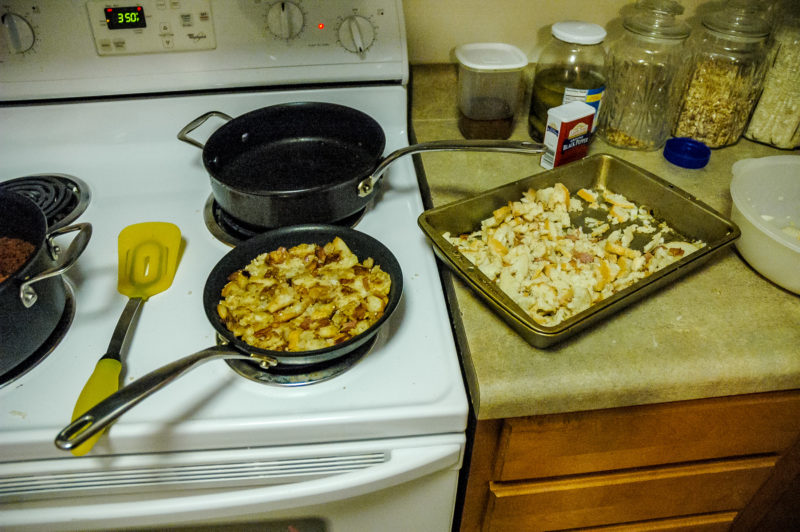
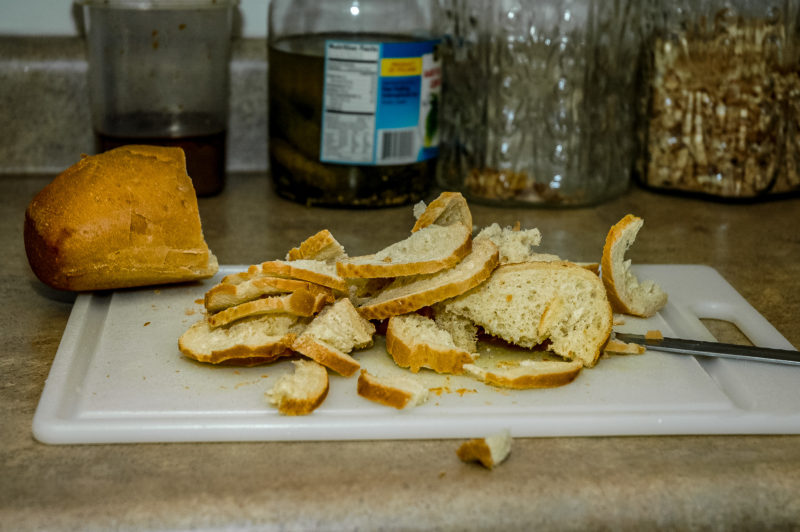
Cut the bread into thin, rather uneven slices. (I tore a lot of my slices up to create irregular shapes.) Then mix the bread, onion, garlic, and bacon together, spread it evenly in a pan, and sprinkle the water over it. Let it sit for at least half a hour. (Cooking it for Good Friday, though, I separated it into two different batches: one with bacon, one without.)

When you begin to fry it, you’ll need a mixture of garlic and olive oil:

  • 1/2 cup olive oil
  • 2 cloves garlic, crushed

Once the migas is migasizing, it’s time to start the soup.

  • 3T olive oil
  • 2 medium-size onions, diced
  • 2 cloves garlic, minced
  • 1 green pepper
  • 1 can (15 oz.) tomato puree
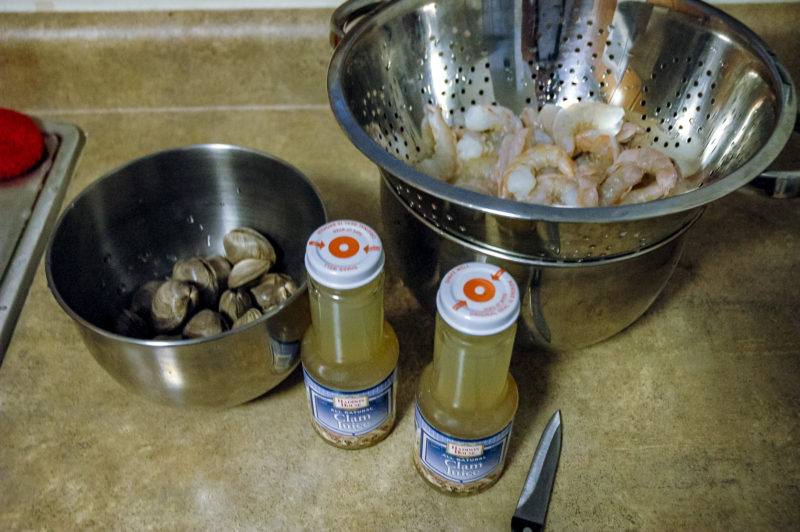
  • 2 bottles (8 oz. each) clam juice
  • 3/4 cup dry white wine
  • 3 1/2 cups chicken broth
  • 2 bay leaves
  • 1 small dried whole hot chile
  • 1/2 t each
    • ground coriander
    • dried basil
    • thyme leaves
  • 1 lemon, thinly sliced
  • 2 medium-size carrots, sliced
  • 1 1/2 pound firm-textured white fish (halibut, rockfish, sea bass, etc.)
  • 1 1/2 dozen hard-shell clams
  • 1/2 pound medium shrimp

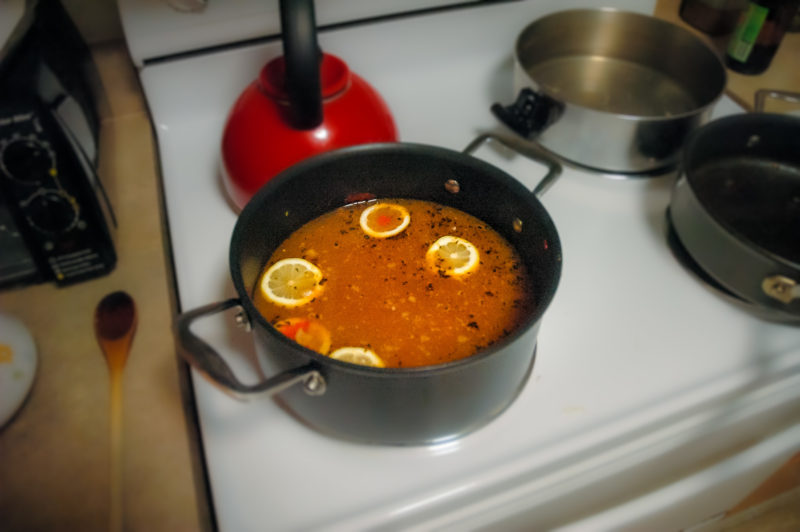
Cook the onion, green pepper, and garlic together in olive oil. When soft, pour in tomato puree, clam juice, wine, broth, bay leaves, chile, coriander, basil, thyme, half the lemon slices, and carrots. Bring to a boil, then let simmer for about 20 minutes (until carrots are soft).

Add fish, clams, and shrimp and simmer until clams open and shrimp are pink.

Immediately after adding the fish begin to fry the migas. Brush a hot frying pan evenly with the garlic and olive oil mixutre, then spread about 1/2 cup of the migas mixture in the frying pan, pressing it down until it’s about 1/4 inch thick. Let it cook for about four minutes, then turn it. It will break apart as you flip it — it’s part of the idea, I guess.

Once the migas is brown and crisp and the calms have overcome their shyness, it’s time to serve.

It’s not for the budget-minded. The ingredients cost over $50, since all the seafood was fresh, fresh, fresh, and wild-caught. Halibut at $18 a pound and shirmp at $12 a pound does indeed add up.

But it was worth it. As a friend would say, fresh and honest.

A Confession

K and J went to pre-Easter confession last week. As with every single thing when you have an infant, it was well planned well in advance.

"Yet J doesn't speak English," I reminded K earlier in the week, when she told me about the plan. "How exactly is this going to work?"

"Well, I'm going to translate."

Some, when reading "This is supposed to between the priest and the individual", might have injected, "Um, no it's between the individual and God." More information about the Catholic view of forgiveness can be found here.

"Do you think the priest will let you? After all, this is supposed to between the priest and the individual, and anonymous at that. That's why there's all the elaborate screens and confessional booths and such." (I've never confessed -- my imagery of it is pretty much straight out of movies, and watching from a distance.)

"We'll see."

What actually transpired was a somewhat amusing solution to the problem. The priest instructed K, "Tell your mother to say what she needs to say in Polish, then give me a sign that she's finished."

J found it both amusing and touching.

Taking the Bait

I really don't get it. It's conceivable that eventually religious leaders would realize that everything Madonna does in her performances is calculated provocation. That when she is on stage, she is performing and part of her performance persona is to be provocative.

Religious leaders in Rome have united against the mock-crucifixion featured in US pop star Madonna's latest show.

In the sequence, Madonna appears on a giant cross wearing a crown of thorns.

Father Manfredo Leone of Rome's Santa Maria Liberatrice church told Reuters news agency it was "disrespectful, in bad taste and provocative". BBC

"Provocative." Yes, Father, that's the whole point.

What is wrong with simply ignoring her? Would that rile her more than "censuring" her?

God in the Aisle

I sometimes go to Mass with my wife for companionship, and today, I was certainly glad I did. Before I get into the reason why, some theology.

Catholics of course believe in something they call the “Real Presence,” which is the belief that the bread and wine are the actual body and blood of Jesus. It’s based on an Aristotelian concept of accident and essence — what a thing looks like and what it really is. So the Catholic explanation of why it still looks suspiciously like bread and wine is that the outward appearance has remained, but the essential reality has changed.

This is why there’s all the genuflection in churches and especially before monstrances, because if that really is God in the flesh flour, then it only makes sense to bow.

This also goes a long way in explaining the controversy about how a parishioner can take the host: standing, kneeling, on the tongue, on the palm of the hand. I think the variety is strictly American. In Poland, the issue is vastly simplified: stand or kneel. There’s no way a priest will give it to your hand in Poland.

“Real Presence” also explains why some might be a little uneasy with the idea of anyone other than a priest handing out the host. In the States, members of the congregation hand out the blood and wine (though the priest has consecrated it and all that). Again, this is probably a completely American thing.

All this is to explain the significance of why I’ve always wondered what would happen if someone tripped and — whoosh — there’s God, all over the floor.

At this morning’s Mass, my question was answered.

An elderly woman, serving as Eucharistic minister, was heading back up to the altar (and so her chalices were probably almost empty) when suddenly there was a stumble, shuffle, and crash. I saw the whole thing out of the corner of my eye, and I immediately directed all my attention there — as did everyone else in the basilica.

The priest kept right ongoing, but not many people were giving him their undivided attention. Everyone was looking at the aisle, watching the lady pick up the hosts as another Eucharistic minister helped her. Then a deacon came with a cloth that had been dampened, I’m assuming with holy water, and wiped the spot.

The woman was obviously quite shaken. She said some words to the priest, and he sympathetically comforted her. Returning to her seat, she muttered something to her husband, and that was that.

It highlights how atypical Catholicism is in modern culture, where all sense of the sacred has disappeared. “And so much the better” many of us would add, but sacredness fosters a certain respect that I’m not sure you can get any other way. It’s simplistic to explain it, “Well of course it’s respect — born out of fear, a terror that some deity will toast you.” There’s certainly an element of truth in that.

Communism tried to foster some sense of the sacred — the working masses were the vessels for salvation. The working man is the communist messiah. Marches, songs, flag-waving, speeches — all these things to foster a sense of the sacred in the people. Yet it didn’t work. My wife grew up in that culture, and it was all a joke for everyone. Why?

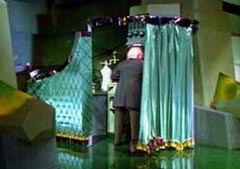
Man behind the curtainIt lacked mystery.

Without mystery, without an element of the unknown and inexplicable, nothing can be sacred. Indeed, sacredness could be defined as a sense of mystery about something thought to be of divine origin. If you see the little old man putting together the wizard show, hanging the curtains, preparing the control panel, it is only through an act of supreme wishful thinking that you can put your faith in the Wizard.

Corpus Christi

From my journal ten years ago today — my first experience with Corpus Christi, though I had no idea what it was.

I am waiting for the bus, sitting in front of a church. I went in for a moment, but decided I should probably leave – I didn’t cross myself with holy water (It appears to be stagnant water with a greasy film.) and I was getting a few looks (though there were several others who did not cross themselves either).

Suddenly the bells began ringing and eventually I caught sight of a procession coming around from behind the church. Choir boys were dinging small bells and behind them was a procession of relics. A little behind that was the priest, walking under a canopy supported by six men, preceded by a young priest waving an incense burner. The head priest was holding a staff with a gold sun in front of his face – he was led by the arms, for he certainly couldn’t see where he was going. Behind the priest was a group of loosely organized lay-persons, singing a capella. The woman beside me knelt as the group went by. A strange thing, this Christianity.

Ten years ago. Ten years. Ten years…

John Paul II is a Liberal

Just when you think the Catholic Church is bad, along comes someone who proves that it really could be worse.

According to Earl Pulvermacher, John Paul II is an Anti-Pope, which I suppose is almost as bad as being an anti-Christ. He in fact is the true pope.

After 40 years of the Holy See being vacant, the Catholic Church has, on October 24, 1998 elected Pope Pius XIII as the Vicar of Christ on Earth. The details of his election and papacy can be found on the Papal Homepage.

JPII is a heretic. Among JPII’s alleged heresies (our hero lists 101 of them – perhaps he was watching a Disney film as he typed them up?) are all the pronouncements that put a human, tolerant face on the Catholic faith.

There are two columns in list: JP2’s alleged heresies, and “Truth of Divine and Catholic Faith.” Under the latter heading of we find:

  • Only Catholics have the right to religious liberty.
  • Equal rights for all men is senseless.
  • The State must forbid non-Catholic religions.
  • False religions worship the Devil.
  • Apostate Jews do not worship the One True God.
  • No one can be saved who is not in the Church.
  • John Paul II worshiped the Devil.
  • Buddhism is a religion of damnation

When I look at the list and think of the possibilities, I am all the more thankful that Karol Wojtyla was elected pope and not some more “traditional” Catholic.

Twentieth Anniversary: Jerzy Popieluszko

“If you can’t say anything good, don’t say anything at all.” So my Mom always told me, and I do try to put it in practice, hence today’s entry.

(pronounced more or less “Je-she Po-peal-oosh-ko”) was a priest killed by the Polish communist internal security forces exactly twenty years ago for his outspoken support of freedom.

Popieluszko was an associate pastor in a parish of a working-class suburb of Warsaw. He began giving a “Mass for the fatherland” at the end of every month in which he encouraged his listeners to defend their rights through rejection of violence. As word of his dynamic sermons spread, attendance for his monthly “Mass for the fatherland” swelled, and included people from not just Warsaw but all of Poland.

One can imagine the affect this had on the Communist leadership. In January of 1982, Popieluszko was asleep when, at one thirty in the morning, the buzzer for his door rang. Rather than getting out and checking the window to see who it was, Popieluszko lingered in bed a moment. It probably saved his life, for shortly after that, a brick crashed throw the window with a small explosive device attached. Part of his apartment was damaged, but Popieluszko remained unharmed.

Shortly after that, Popieluszko began receiving death threats by mail. In 1984, as Popieluszko was returning to Warsaw from Gdansk (the city Hitler attacked, thus starting the Second World War), his car was attacked and bombarded with stones. Popieluszko again survived a potentially fatal accident thanks to a professional driver from the Solidarity movement.

Exactly twenty years today, on 19 October 1984, Popieluszko went to Bydgoszcz to preach. Through a student friend, he asked another priest to substitute for him in a student Bible meeting “if [he didn’t] make it back.”

Four security officials were convicted of Popieluszko’s murder in February 1985, with the lightest sentence being fourteen years.

And he never did make it back.

On 30 October, Popieluszko’s body was dragged from an icy reservoir. He had died from choking from his own blood and vomit while being gagged and a rope had been thrown around his neck to weight his body down with a bag of stones.

At his funeral, Lech Walesa said, “Solidarity lives because you gave your life for it, Father Jerzy.”

Photo by BostonCatholic

Yelled at for a Week

A tent revival is something that is particularly American, and conjures up images of snake-handling believers and wheezing, beet-faced preachers who can stretch the name of Jesus into four syllables, who preach hell fire and damnation, the dangers of card playing, and the outright evil of dancing.

It doesn’t seem to go with the ordered liturgy of a Catholic Mass. And yet, for the week of 9—18 October [2004], that’s exactly what the parishioners of Lipnica Wielka[, Poland] were getting.

The techniques used in the construction of the church are among the best and most expensive. – Three Times Superlative.

Entitled “Misja Swietych” (“Mission of the Saints”), it featured multiple, daily Masses with a particular focus: the family, the mystery of the Stations of the Cross, the sick. It was a fairly big thing, as it happens only once every five years or so.

This year it was led by Wojciech Chochól, a rector of a parish some hundred and fifty kilometers northeast of here, near Tarnów.

Chochól is a short, somewhat paunchy man who appears to be in his mid-forties and who, it seems, stepped directly from the 1950s into the twenty-first century. He believes in what some American Southerners might call “old time preaching.” Translation: he yells at people about their sins.

The Polish- and Italian-granite entry stairs to the new church cost so much that, says Father Wojciech, “for that kind of money, you could frame an entire, new church.” – Three Times Superlative

I suppose there’s nothing really wrong with that. Such “soul-pastoring” (a direct translation of the Polish term for the verb “pastor”) treats the parishioners as children and has a particularly humiliating feeling, but perhaps some feel at home being humiliated in church. They might refer to it as “being humbled.”

I heard him preach when I went to church Sunday afternoon (10 October) for the special “Men’s Mass.” [My wife] didn’t want to go alone, and I was curious what the priest would say to a room full of men.

"Everything here that glistens is gold plated," adds rector [Chochól] , taking the time to show all the internal marble [ . . . , ] the same marble that is in the walls and the entrance to the bathrooms. Marble also rules in the cemetery’s chapel. – Three Times Superlative

I wasn’t disappointed, though somewhat provoked. Some of the highlights:

  • suggested people throw out television and unplug the “Satanic Internet;”
  • castigated people who have only one or two children, saying that children are only “normal” when there are three of them (One child is a little god in the house; two kids are two hysterics; only when you have three can you expect to have normal kids in the house);
  • said people should be worried about money with their kids (“They don’t have to have a gold watch right way. They don’t have to have a car or a mountain bike right away.”);
  • advised fathers to look in their fifteen-year-old children’s pants pockets to look for narcotics or “swinska gumeczka” – “filthy condoms”;
  • told of a little two-year kid who at Mass was lying in the floor, crying, waving his arms and such – being a fairly regular two-year-old. “And I thought, ‘You’ve got a little bin Laden!’” he told everyone. And they laughed – that’s the most disturbing part about it
  • said a child’s salvation lay in the fathers taking a fence board and “lay on as much as fits” (A child’s salvation = beating the daylights out of him);
  • recommended that fathers no let their daughter’s boyfriends sleep in the house;
  • pondered what sons who came home late at night or early in the morning were doing (“And later, three of them come to the altar for a wedding,” he concluded.);
  • told the story of a boy who came into the parish house to use the phone, calling the police and life-saving crew because his father had come home drunk again and began beating his mother. “I don’t know how much longer we can stand this hell,” he exclaimed, then left money on the priest’s desk for a Mass to be said the following day in their intention. And Chochól left the money hanging – didn’t say, “I gave the money back to him and said, ‘You all need this more than I do.’”

All in all, it was the usual, backward, uneducated tirade that, were it to take place in a clapboard building in Appalachia or in a mosque in Cairo, would be labeled fundamentalism: railing against the evils of modern society and the need to return to a Godly life, as defined by the priest, of course. Chochól showed that he knew nothing about children and even less about contemporary society. He showed his disrespect for parishioners by refusing to treat them as adults but screaming at them as if they were children

"The church is being built slowly, but also as expensively and as beautifully as possible." – Wojciech Chochól quoted in Three Times Superlative.

Covering the usual litany of religious anti-modernism, yelling at people about their sinful indulgence in modernism and their material mindset, is one thing.

It’s an entirely different story when the priest is guilty of the very things himself.

It turns out, there might have been a reason he referred to the Internet as “Satanic,” for a few keyboard clicks at Google, and I found “Trzy Razy ‘Naj,’” an interesting article from 2002 about a then—new church being built in Chochól’s parish, with some choice quotes (which appear in the side inserts).

The picture we end up with by combining the sermon and the article is that of a hypocrite. In his sermon, Chochól anecdotally mentioned several times the churches “he’s built,” and so it is obviously a matter of pride to him, which he probably crows about whenever he can. Others derive their pride and self-esteem from what they own; still others from what they’ve built, I guess.

When village priests come caroling and collecting money, they don’t schedule a particular time, but tell their parishioners simply they day they might come – and expect them to wait around all day. Kids miss school for this; parents miss work. If a priest suggested this in a city, such as Krakow or Warsaw, he would be laughed out of the church.

Contrast that with a friend who lost her father when she was still a young girl. “Not once,” she said, “Did any priest come by to ask if everything were okay, to see if they needed anything.” They came about as is the Polish custom during the Christmas season for caroling, which is accompanied by (guess!) a collection. So they came to get money, and nothing else.

As a non-Christian, I find this particularly offensive, and I can think of a few things I might like to say:

  • Religion that is pure and undefiled before God, the Father, is this: to care for orphans and widows in their distress, and to keep oneself unstained by the world – James 1.27, New Revised Standard Version (NRSV)
  • Jesus said to [the young rich man], “If you wish to be perfect, go, sell your possessions, and give the money to the poor, and you will have treasure in heaven; then come, follow me.” – Matthew 19.21 (NRSV)
  • All who believed were together and had all things in common; they would sell their possessions and goods and distribute the proceeds to all, as any had need. – Acts 2.44, 45 (NRSV)
  • [Jesus said,] “Again I tell you, it is easier for a camel to go through the eye of a needle than for someone who is rich to enter the kingdom of God.” – Matthew 19.24 (NRSV)

The second sermon I heard from this jerk was the next Sunday. Highlights from that one:

  • Without priests, you will not go to heaven.
  • Priests are a second Jesus.
  • A wife of a communist official who’d refused permission to build a church came to Chochól when her husband died to ask him to anoint his body. Chochól’s response: “Well, now you can go anoint him with lard.” And this by his own admission.
  • He criticized the church in Lipnica, saying it was old and dirty. He wondered how priests could work in such an environment “without granite, without marble.”
  • He told a couple of stories of people who’d died shortly after criticizing priests.
  • Priests are hated just as Jesus is hated – for their holy example.
  • He whispered to the children in a sickeningly sweet voice, “Don’t say anything bad about priests.”
  • He said that when people go on pilgrimages without a priest, “it’s just an outing.” (“Wycieczka” was the Polish he used.)
  • He said that if you criticize a priest, then you’ll die without a priest (i.e., You’ll go to hell.).
  • He told people don’t send money to other parishes but keep it here. But just earlier, he’d thanked everyone for the donations given to his parish.

The irony: it was labled a “children’s Mass!”

The general reaction of parishoners after this joker wen home: “What beautiful preaching!”

Well, I’m criticizing him, so let’s see how long I last before God kills me for my blatantly Satanic attitude.

(An interesting thread at Catholic.com’s form about this, started by yours truly.)

Update from 18 October 2020

I was looking at this through the Timeline plugin (see footer) when I decided to Google his name. Apparently, he died 17 October 2020 (source, in Polish). I wonder if anyone anointed him with lard...