Matching Tracksuits

fun in fours

catholicism

#18 — Ancient

Icon depicting the First Council of Nicaea.
Image via Wikipedia

The church I grew up in was founded in 1934. My best friend growing up attended a church that was twenty years older. My next door neighbor attended a church with a denomination that was founded in 1609. A good friend from high school traces her denomination's roots to 1521. Yet the Catholic Church, by its reckoning, is older than all of these combined and doubled.

Of course many Protestants -- particularly many here in the south -- hold that Catholicism was a perversion of the original church, and thus the founding of the Church cannot be traced by to the first century. Yet even if we take the official start of the Catholic Church as late as 313, with Constantine's Edict of Milan, it still has 1,200+ years' experience over the first major Protestant division. (I'm leaving aside the Great Schism of 1054, which led to the division of the Orthodox and Catholic Churches. By and large, though, the theologies of the Orthodox Church and the Catholic Church have a great deal in common.)

That's a lot of time for doctrinal evolution.

What's most amazing is that during that time, the core Catholic theology has never come into question. The papacy might have descended into immoral chaos, the bureaucracy of the church might have condoned, encouraged, and even committed awful acts, and corruption might have been rampant, but the doctrines remained steady. What we find in the early Church Fathers is eerily similar to the theology we see in the Catholic Church -- a fact that has led to several notable Protestant-to-Catholic conversions during the last few decades.

What does it take for an institution to last so many centuries?

#17 — Universality

"Catholic" means "universal," and that is an apt description.

Fr. Dwight Longenecker, a local priest with a reputation that extends well beyond the region, explains it better than I could:

We had confirmation at Our Lady of the Rosary parish on Tuesday. What I love about the Catholic Church is her universality. In the congregation were Vietnamese, Palestinians, Nigerians, Poles, Philippinos, Mexicans, El Salvadoreans, French, German and more...why there were even a few converts there too.

We were all united in one church, one faith, one baptism. The bishop was there and our priesthood was united with his and with the gift of Our Lord to the Apostles.

In addition to the ethnic mix there was the socio-economic mix--executives from Michelin and BMW mixing with Mexican immigrants and everyone in between. (Source)

Another measure of the universality of the faith is the number of languages used to celebrate Mass at a given church. The church we attend has Mass in English, Spanish, and, once a month, Polish. Other, larger cities certainly have even more variety.

#16 — Bach’s B Minor Mass

http://www.youtube.com/watch?v=sMUXUQpPdaE

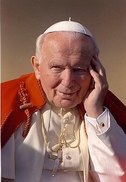
#15 — John Paul II

Pope John Paul II

Poland produces a revolution every five hundred years, and it’s always the same revolution: a man comes along and challenges the way we all look at the universe, challenges us to stop thinking we’re the center of the universe and that all things circle around us.

Copernicus was the first to suggest that the Earth was not the center of the universe. He dethroned the heady notion that literally everything revolved around us, and modern science has pushed us to the point of virtual cosmic insignificance.

Karol Wojtyla, with his famous words, “Do not be afraid,” challenged us to stop thinking of ourselves as the center of our own worlds. Love is the greatest of all these, said Saint Paul, and John Paul, in his insistence on the universal recognition of human dignity and freedom, showed how to put that into practice.

“Nie lekajcie sie!”

Don’t be afraid.

Fear not.

How can we not fear? Look at the world, and the injustice that hounds it, and it seems the only thing we can do is be afraid. How can that possibly work? Perhaps when we start following John Paul’s example and love others more than ourselves, we will stop fear. After all, what is fear? It’s fear of what will happen to me. When I start loving others more, I stop thinking of my self so much, and I stop fearing.

John Paul in that sense was a Copernicus for the soul.

Excerpted from a post dated 5 April 2005.

#14 — Sacred Time

Image via Wikipedia

Catholicism is centered around a sacred calendar, which means there is a notion of sacred time. Indeed, the whole reason I'm attempting to write daily about something positive in Catholicism is due to our being in the midst of Lent, one of several periods of the year that are juxtaposed to "ordinary time." Additionally, sprinkled among the various holy and ordinary times are saints' days and holy days, serving as temporal mile markers throughout the year.

Yet like many things in Catholicism, it's not simply that there are periods of the year that are holy while others are ordinary. Time itself has a sacrality about it because of the historical nature of the religion. Christianity is based on events that happened in time, and Catholicism punctuates time with the offering of the various sacraments, but most especially through the daily Eucharist.

This heavy reliance on time gives a rhythm to Catholicism that is lacking in many forms of Protestantism. Because of the recurring holy times, a pattern emerges: Lent leads to Easter, with the Feast of Corpus Christi and a handful of other holy days  punctuating the long period leading to Advent and Christmas. And then the cycle repeats. The overall effect of this is not immediately obvious, but essentially Catholics are commemorating the story of Jesus's life, death, and resurrection on a yearly basis.

It's no wonder Catholics use the various feast days as temporal references for memories. One thinks of the Nurse in Romeo and Juliet discussing Juliet's age with Lady Capulet:

LADY CAPULET

Thou know'st my daughter's of a pretty age.

Nurse

Faith, I can tell her age unto an hour.

LADY CAPULET

She's not fourteen.

Nurse

I'll lay fourteen of my teeth,--
And yet, to my teeth be it spoken, I have but four--
She is not fourteen. How long is it now
To Lammas-tide?

LADY CAPULET

A fortnight and odd days.

Nurse

Even or odd, of all days in the year,
Come Lammas-eve at night shall she be fourteen.

Perhaps one reason I like this sense of temporal rhythm is that it reminds me of my youth and our church's peculiar insistence on observing Jewish feasts. Those festivals provided a sense of continuity from year to year, something to look forward to and something to reminisce about.

Tiring of the Tiber

I would imagine some are tiring of the Tiber: it’s turned into All Catholic All the Time around here. It’s simply too difficult for me to post doubly on a regular basis, and I want to keep this Lenten promise to myself. Only a few more weeks…

#13 — Steadfastness with Reasonableness

Catholicism is steadfast. There are simply some things — many things — that are non-negotiable. Whether or not I agree with all of those particular positions, I admit that I admire the Church’s willingness to take stands on issues that it knows will not easily or immediately win converts and may in fact drive some people away. It doesn’t seek popularity; it seeks truth. It is, in other words, the exact opposite of contemporary politics, where compromise is everything.

Yet the Church is not unreasonable. The Church teaches abortion to be a sin so grave as to warrant immediate and automatic excommunication. However, far from being absolutist on the issue, the Church admits several reasonable exceptions:

To actually incur the excommunication one must know that it is an excommunicable offense at the time of the abortion. Canon 1323 provides that the following do not incur a sanction, those who are not yet 16, are unaware of a law, do not advert to it or are in error about its scope, were forced or had an unforeseeable accident, acted out of grave fear, or who lacked the use of reason (except culpably, as by drunkenness). Thus a woman forced by an abusive husband to have an abortion would not incur an excommunication, for instance, whereas someone culpably under the influence of drugs or alcohol would (canon 1325). (Source)

Even the excommunication for abortion is not the final response to the act the Church so consistently teaches and campaigns against. Like all sins, it is something that can be confessed and forgiven, with absolution for the excommunication.

The pro-choice response to this would likely be, “Well, the Church shouldn’t excommunicate for abortion to begin with; it’s the woman’s body and the woman’s choice.” That strikes me as more unbending, more absolute that the Church. For pro-choice advocates, the Catholic Church’s preaching against abortion is always and forever wrong, and as such unforgivable; for the Catholic Church, the purposeful ending of a pregnancy is always and forever wrong, but it is forgivable.

The Catholic Church’s reasonableness is not limited to social issues. Its theology is circumspect as well. One of the most troubling doctrines of Christianity is the existence of hell. An extreme Protestant position always struck me as unreasonable: individuals who have not heard of Jesus and his sacrifice are unquestionably condemned to the flames, thus adding great impetus to proselytization. The Catholic position is much more nuanced: it simply states that, apart from saints, humans can’t know who will be condemned and who won’t. While not a pluralistic theology (i.e., all are saved no matter what), it is much more respectful of the simple fact that it would be God, not humanity, making such decisions. It’s a frank admission of a quirky religious agnosticism.


#10 — Smells

The camera was lent to me by my dear little br...
Image via Wikipedia

Walking into an ancient Catholic church can be overwhelming to the senses: the magnificence of the architecture, the completeness of the silence punctuated by echoing footsteps, the cool damp air on one's skin. Yet for first time visitors, the most distinctive surprise is the odors of a church.

A mix of old incense, wood, dampness, stone, cleaning solutions, humanity, and a thousand other mysterious odors almost seduce me from the moment I first entered an historic Catholic church. The stone has been gathering the breath of believers for ages, and the natural dampness of the air activates these strong, earthy odors in the walls and floors. Incense, one of the most noticeable Catholic/Orthodox distinctive practices, lingers from Mass to Mass, mixing with the stones and damp to form a redolence that can only be described as the smell of tradition.

#9 — The Singularity of Mass

If a deacon participates, he reads the Gospel....

The first time I attended a church other than the one I grew up in, I was shocked at how utterly different the service was compared to what I was used to. When the pastor began, "Our scripture for today is...", I immediately began wondering how in the world one could possibly have a sermon with one scripture. I was so accustomed to sermons that often amounted to an artillery barrage of verses that having a sermon with only one verses seemed like having a car with only one wheel.

As I visited other churches, I found that not only did every denomination have its own liturgy but also every single church within a denomination might have its own version. Going to churches in other countries, I imagined, might uncover even more differences.

Today, one can find a liturgy to fit whatever mood one might be in. Looking for something heavy on entertainment? Head to the nearest mega-church. Looking for a calm, quiet, predictable service? Look for Methodists or Presbyterians. Want a little danger in your worship? Seek out the few remaining snake-handling, strychnine-drinking Pentecostals in the hills of Appalachia.

The Catholic Mass, however, is different because it's the same. No matter the country, no matter language, no matter the culture, the Mass is the same. Before Vatican II and the introduction of Mass in the vernacular, it would literally be the same wherever one went. And here's the thing that really impresses me: it's been that way for centuries. The Mass of today would be recognizable, more or less, to Thomas Aquinas as much as it would be to G. K. Chesterton. Certainly, the hymns would be different, and the use of the vernacular (as opposed to Latin) would probably seem odd, but the heart of the Mass itself would be comfortingly familiar to both men.

I realize I'm using broad strokes here: there are certainly minor cultural differences in the Mass, and the Catholic church isn't the only church to achieve this liturgical homogeneity. But one thing is certain: it's had this homogeneity longer than any other institution in the West, and there's something to be said for an institution that can be that grounded in the past and the present.

#8 — Cathedrals

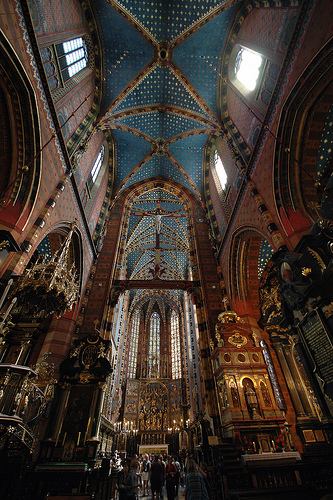
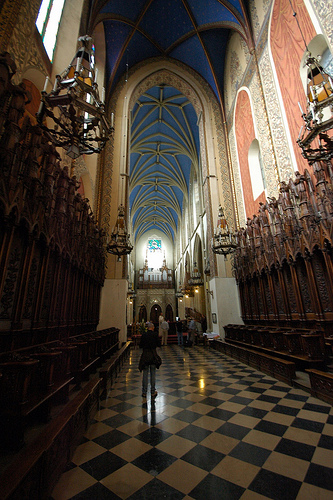
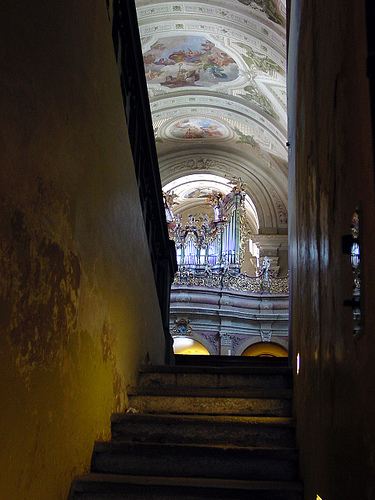
Even those who know nothing about Catholic theology know about Catholic cathedrals. Religions in general have a way of inspiring great architecture, for sacred objects and sacred time requires sacred space. St. Peter's, Notre Dame, Hagia Sophia, Canterbury, Chartres, Reims, St. John the Divine, Westminster Abbey, and seemingly countless others tend to be top tourist destinations even for non-believers. Everyone wanders in, looks about, and inevitably looks up -- which, at least in the case of Gothic architecture, was the whole point.

Basilica of St. Mary

The scale is impressive enough, but for the faithful, cathedrals can be only grand, for they house the "body, blood, soul and divinity" of Jesus, according to the doctrine of the Real Presence. Whether one believes the doctrine or not is somewhat irrelevant: the designers, builders, and curators of the cathedrals did, and those attending services did and still do believe it. If one believes that Jesus is really present in the host (which is the heart of the doctrine of the Real Presence), then it's only logical to build the best tabernacle imaginable to house said host.

DSC_4274

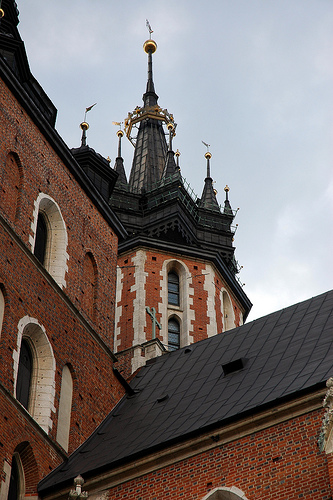
This goes a long way in answering the objection a friend from the States raised as we wandered in and out of churches in Krakow just K's and my wedding. "How does this help anyone spiritually?" he asked. The Catholic answer is, "They weren't built primarily for man but for God."

DSC_4693

Whomever they were built for seems almost irrelevant when I'm standing in the middle of a soaring cathedral, wondering at the engineering required both to design and to construct such spaces.

View from the Crypt