Matching Tracksuits

fun in fours

catholicism

Easter Preparation

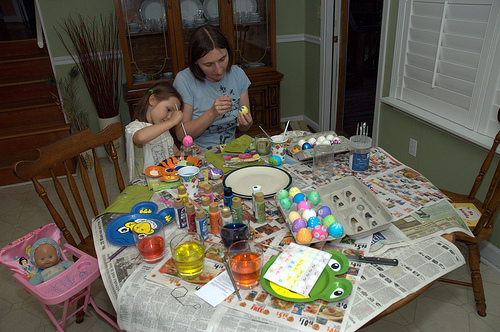
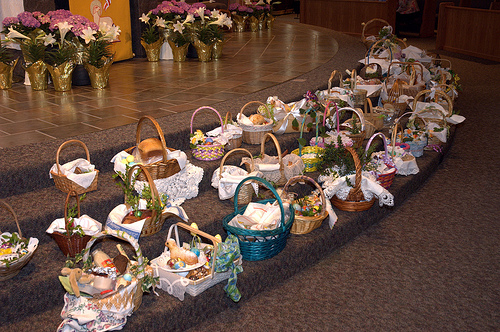
The preparations for a Polish Easter are impressive: hours of cooking, something like 300,000 square inches of cleaning (floors, walls, doors, cabinets, etc.), dozens of eggs for painting, hundreds of baskets for blessing.
DSC_0725

There are some greater pleasures among all these, though. And even in the drudgery, one can find some kind of meaning.
DSC_0726

Though my mother would faint to read it, there is something inherently satisfying about cleaning. Though it’s only a temporary effect — for dirt holds sway in our world — it’s somehow an apt metaphor of life, taming the chaos and finding beauty under ugliness.
DSC_0728

It’s not as difficult to find meaning in cooking as in cleaning, nor is it as difficult to find pleasure. As Cooking is tiring but rewarding. As Tiana’s father in The Princess and the Frog says,

You know the thing about good food? It brings folks together from all walks of life. It warms them right up and it puts little smiles on their faces.

Cooking is inherently a social activity because food is social.

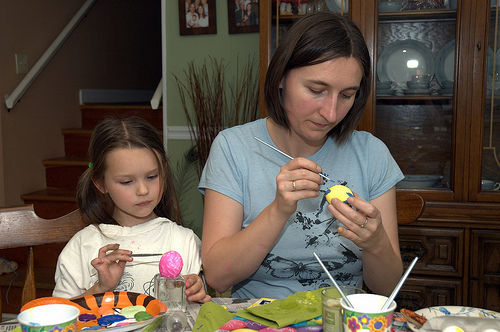
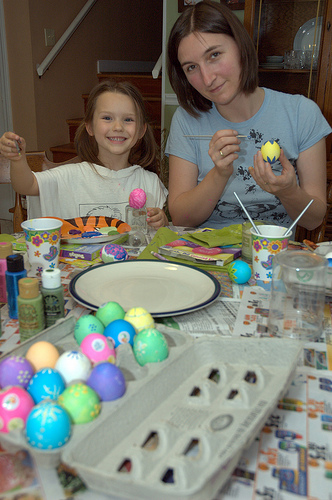
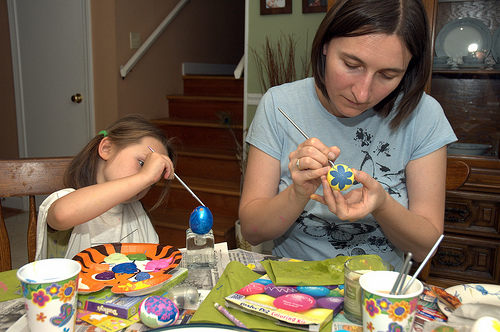
And of course it’s a pleasure to paint eggs; it’s even more a pleasure to watch your daughter paint.
DSC_0733

The yearly painting serves as a metric of development: the designs become more intricate and more precise. With her artistic tendencies, she’ll soon be creating eggs that put mine to shame.
DSC_0781

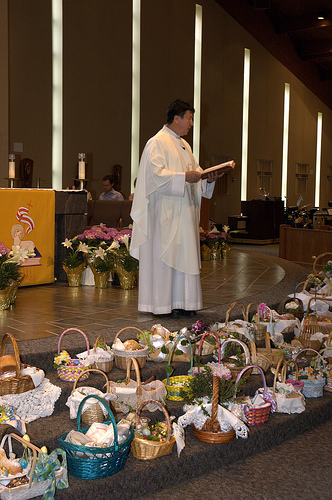
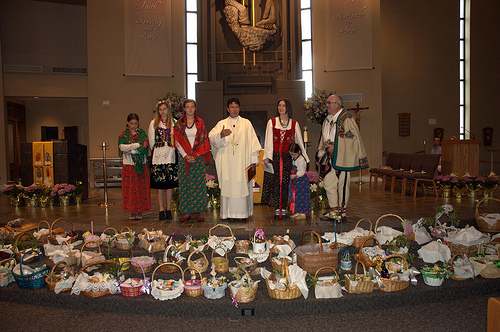
The blessing, too, is a blessing. It’s an imported tradition, with the parish priest, Father Theo — himself a transplant from Columbia — pressed into service several years ago, not knowing the tradition. Each year, Fr. Theo has become more involved, more enthusiastic.
DSC_0792

The first year, he breezed in, not knowing the significance of the tradition, and offered a quick blessing for the handful of Poles who were there. This year, there were songs, prayers, and even jokes — Fr. Theo can’t go for awfully long without smiling.
DSC_0794

#27 — Sacred Words

 Catholicism is filled with sacred words to accompany the sacred gestures, time, space, and objects.

The most sacred words, of course, are the words of Scripture, and within that, the Gospel accounts. One of the first things visitors notice is the treating of those words as sacred. When the priest or deacon begins the reading, saying, "A reading from the Gospel of...", parishioners make three small crosses with their right thumb: one on the forehead (belief), one on the lips (desire to proselytize), and one on the breast above the heart (desire to keep the words in one's heart). Thus, the sacred words are a catalyst for sacred gestures.

Prayer is another moment when sacred words bring forth an accompanying gesture. When a Catholic begins a prayer, she intones, "In the name of the Father, and of the Son, and of the Holy Spirit," and makes the sign of the cross simultaneously. The one without the other is incomplete, and while it might become a mere habit with some Catholics, I've seen some obviously sincere moments was parishioners cross themselves, and that sincerity itself is moving.

Not all sacred words are for all Catholics, though. Some obviously are reserved for priests. Blessings and absolution come to mind, but they're not the most important sacred words a priest can utter; the Eucharistic Prayer is. The highlight of the mass is the Eucharist, which Catholics believe to be the body, blood, soul, and divinity of Jesus. They revere it accordingly. Of course this is not always the case: unconsecrated hosts are simply that -- hosts. So there comes a moment when, according to the Church, the Holy Spirit transforms the hosts. A skeptic might say, "Hocus pocus -- nothing more than cheap parlor magic," and I myself said the same thing for years. Yet whether or not it's effective is not my point here: the fact that the tradition of sacred words continues is somehow admirable. I suppose it's the faith that impresses me.

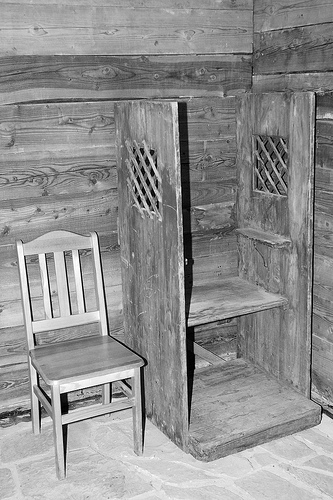
#26 — Confession

Confessional in Poland

Confession is perhaps one of the most inexplicable elements of Catholicism for non-Catholics. The common view is, "Why should I confess to a priest instead of confessing directly to God?"

It's not my intent to discuss whether or not confession is, as Protestants would press, strictly Biblical. In that end, I'll mention only the basics: The Catholic Church bases confession primarily on two passages. The first is John 20:19-23:

On the evening of that first day of the week, when the disciples were together, with the doors locked for fear of the Jewish leaders, Jesus came and stood among them and said, “Peace be with you!” After he said this, he showed them his hands and side. The disciples were overjoyed when they saw the Lord.

Again Jesus said, “Peace be with you! As the Father has sent me, I am sending you.” And with that he breathed on them and said, “Receive the Holy Spirit. If you forgive anyone’s sins, their sins are forgiven; if you do not forgive them, they are not forgiven.”

The other is the renaming of Simon in Matthew 16:17-19:

Jesus replied, “Blessed are you, Simon son of Jonah, for this was not revealed to you by flesh and blood, but by my Father in heaven.And I tell you that you are Peter, and on this rock I will build my church, and the gates of Hades will not overcome it.I will give you the keys of the kingdom of heaven; whatever you bind on earth will be bound in heaven, and whatever you loose on earth will be loosed in heaven.”

One can argue about the interpretation of those passages, but even a cursory reading seems to indicate that the Catholic Church is on fairly solid ground, Scripturally speaking.

Still, I'm not interested in proving anything; I'm fascinated simply by the act. So many non-Catholics seem to find it appalling, but it seems to be a healthy way to deal with guilt -- provided one is a believer. As I understand it, confession is not merely a matter of saying, "I've done this," and the priest responding, "Now go do this." If one is fortunate enough to get a good confessor, it seems like it would be more of a dialogue than a diatribe. One would not be going to confession over a matter one didn't think was a character flaw. The act of confessing -- truly confessing, and not just going through the motions -- indicates that one wants to change, and discussing how to make those changes seems healthy.

It is, after all, what psychiatrists do.

#25 — Mysticism

Mysticism is one of the many elements of religion that seem to exist in every faith. It is present in monotheistic religions and Eastern religions alike: there are Christian mystics, Muslim mystics, Sikh, Jain, Buddhist, and Hindu mystics.

The Catholic Encyclopedia defines mysticism as “either a religious tendency and desire of the human soul towards an intimate union with the Divinity, or a system growing out of such a tendency and desire.” In that sense, it’s easy to see why mysticism is a religious universal.

Yet by and large, there are no Protestant mystics. Indeed, part of the Reformation was a rejection of all that’s non-Biblical, and so reformers viewed mysticism skeptically.

Catholic history, though, is filled with mystical visions and experiences. As with so many other aspects of Catholicism, it seems to me to be something admirable regardless of one’s personal take on it. To so vehemently defend the importance of something the rest of the “modern” world explains away is the height of either or trust. Or perhaps a mix of the two.

It stands to reason that Catholics would be more included to accept mysticism than Protestants: at the heart of the Catholic faith is mystery. “Let us proclaim the mystery of faith,” says the priest at the end of the Eucharistic prayer, to which English speaking parishioners make one of four responses:

  • Christ has died, Christ is risen, Christ will come again.
  • Dying you destroyed our death, rising you restored our life. Lord Jesus, come in glory.
  • When we eat this bread and drink this cup, we proclaim your death, Lord Jesus, until you come in glory.
  • Lord, by your cross and resurrection, you have set us free. You are the Saviour of the world.

The mystery the priest speaks of is not a Mystery Machine type of mystery. In this sense, mystery simply means something we cannot fully grasp through reason.


#24 — Sacred Gestures

For a long time I felt a little ill at ease when I was attending a Mass and realized I wasn't doing the gestures everyone around me was doing. On entering the Church, they dipped a finger in holy water and crossed themselves; I didn't. When crossing in front of the tabernacle, they stopped genuflected or bowed; I didn't. Just before entering the pews, they genuflected and crossed themselves; I didn't. When the priest opens the Mass with "In the name of the Father, and of the Son, and of the Holy Spirit," they crossed themselves again; I didn't. When they spoke the creed or the Confiteor, I remain silent. When they struck their breast during the "mea culpa" phrase of the Confiteor (at least in Poland), I remained motionless. When they made the sign of the cross on their forehead, their lips, and their heart before the reading of the Gospel, my hands stayed by my side. I stood when they stood, knelt when they knelt, and sat when they sat, but otherwise, I was strictly an observer.

And I felt conspicuous.

At last I began going through the motions, literally and figuratively. What an odd feeling to begin crossing oneself at the age of thirty-eight.

#23 — Reasonable Redux

For example, if one were to set a Lenten goal and were not be able to make it despite intentions to the contrary, the Church is wise enough to realize that in many things, the intentions are as important, if not more important, than the actual action. And that is why I can write this exhausted post and still feel I'm keeping my Lenten promise.


#22 — Visual

Any Catholic space is a feast for the eyes. There’s so much to look at that it’s almost overwhelming: stained glass, statues, icons, frescoes, murals, carvings — a traditional (i.e., old, European) Catholic church is filled with visual stimuli.

DSC_3860

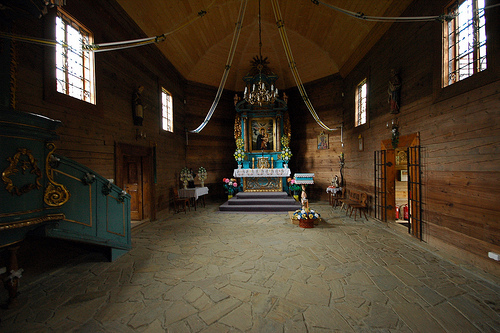
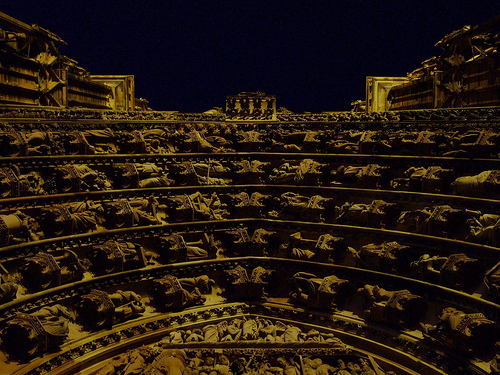
Even the simplest wooden church is filled with details that drawn individuals to get a closer look. And entering a great cathedral like Notre Dame of Strassbourg is an overwhelming visual experience.

Yet it’s not just what individuals see now that sets apart Catholicism; there’s a history of visions throughout the Church: corporal visions, imaginative visions, intellectual visions, visions of saints, visions of demons, and probably, at least once, visions of visions. They’ve happened all over the world, and they continue occurring today, so there’s something in Catholicism that either encourages this or encourages believers by causing this. It’s either wish fulfillment or genuine experience — or a mixture of both.

Now I’m not going to suggest that this impresses me. I don’t know whether these seers actually had an experience or whether it was all suggestion and will. That’s not something I can decide. However, I find it striking how very important vision is in the Catholic faith, especially compared to other faiths. Seeing is not believing, but it helps, and Catholicism realizes that and makes use of it.


#21 — Authority

Pope Urban II at the Council of Clermont of 10...One of the reasons there are so many Protestant denominations is that they don’t recognize a common authority beyond Scripture. The problem with that is simple: whose interpretation is correct? When we look at the varied beliefs of Christians and the doctrines that are contentious (infant baptism, baptismal regeneration, the nature of justification, salvation, divorce and remarriage), it’s sometimes difficult to wonder how they can all claim to be within the same religion.

When Luther broke with the Catholic Church, he expected most believers to follow him and that would have been that. No one was supposed to break from him, and in fact, he anticipated mass conversions of Jews to his purified Christianity.

What he got instead was not a reformed church but reformed churches.

What’s more, he set a precedent: when one claims that the Bible alone is one’s authority, then one necessarily and inescapably adds one’s interpretation into the mix. Sola scriptura might more accurately be “by scripture and interpretation alone” (try as I may, I can’t figure out what that would be in Latin). Without an authority to determine which interpretation is appropriate and which is not, we’re lost. To suggest, as some do, that the Bible somehow interprets itself doesn’t solve the problem at all, for any and all reading requires interpretation. To read is to interpret, and to read one part of a text in order to interpret another part doesn’t magically lift us out of the interpretation quagmire.

The Catholic Church, though, claims to have that authority. Other groups do as well, to be sure, but not many other groups can trace their history back as far as the Church. Not many other groups can claim to have made the decisions about which books and epistles to include in the canonization process and which to exclude. Not many other groups can claim an unbroken line of successive authority back to 32 AD.

#20 — Fr. Robert Barron

Father Robert Barron is what one might call a rising star in Catholic apologetics and philosophy. A professor of Systematic Theology at The University of St. Mary of the Lake in Mundelein, Illinois, Barron runs the Word On Fire website, which includes an enormous number of resources. What's striking about Barron is how he manages to balance theology, philosophy, literature, and culture in each and every lecture, sermon, or talk he gives. He is one of those rare intellectuals who doesn't sound like an intellectual.

Here's a prime example: his discussion of "All Along the Watchtower."

He also discusses everything from The Matrix to Christopher Hitchens -- in a word, everything.

#19 — Plainsong

My first, indirect exposure to Catholicism was in a friend's living room in Knoxville, Tennessee sometime in the early 1990s. Several of us were staying over with this friends family, and as we sat talking that evening, she put on Enigma's debut album, MCMXC a.D. It was the first time I'd really heard plainsong, though it was layered under so much sampling and shallow lyrics that I really didn't know the power of what I was hearing. But I was curious: I wanted to hear pure chant, without all the drum machines and pan flute melodies.

It seemed such a simple idea: a single melody, often limited to a handful of individual tones, sung by dozens of voices. No harmonies; no differentiation whatsoever. Polyphonic choral music-- the famous SATB -- seemed overly complicated in comparison.

http://www.youtube.com/watch?v=d5p_U8J0iRQ&feature=related