Matching Tracksuits

fun in fours

catholicism

#4 — Goodness and Will

Good which is done in this way, almost in spite of ourselves, almost shamefacedly and apologetically, is pure. All absolutely pure goodness completely eludes the will. Goodness is transcendent. God is Goodness.

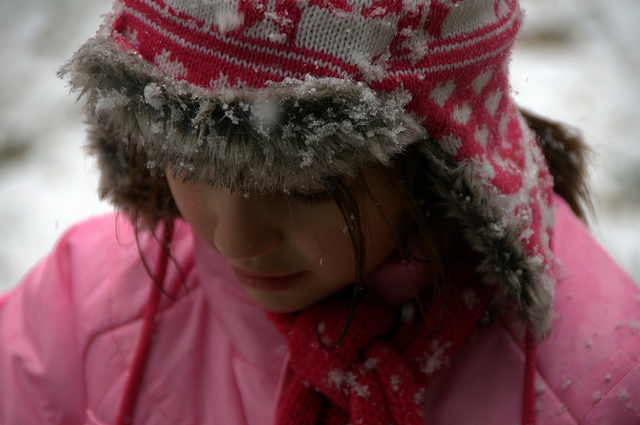
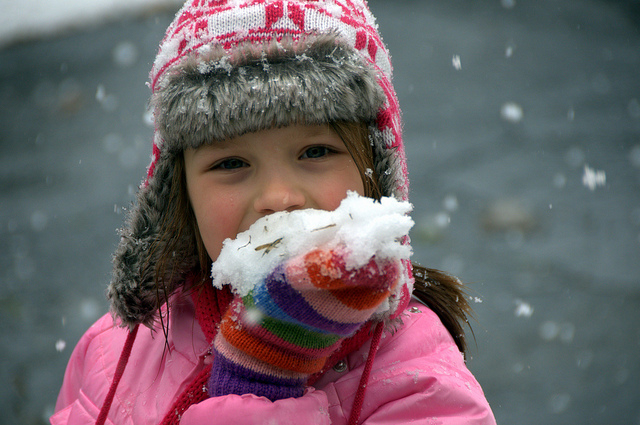
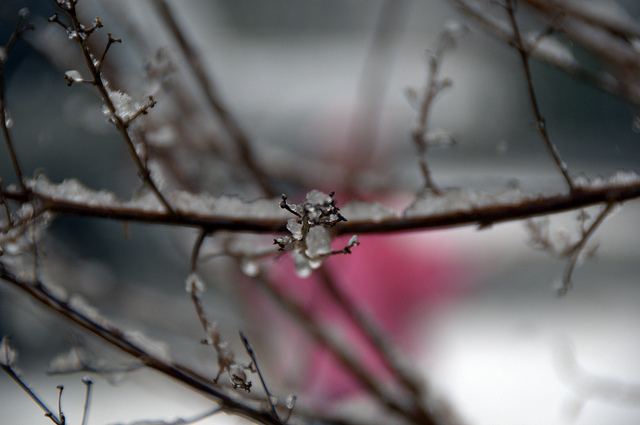
It started with a few, hard flakes that looked more like ice pellets than anything else. Perhaps it was ice. But I didn't worry: it was good no matter what it was. I strolled back into the house and calmly told the girls, "You won't believe what's happening: it's snowing." Within a few minutes, the flakes were fat and heavy, a wet snow that accumulated quickly despite the relatively warm weather. L and I changed our afternoon swimming plans and got dressed as quickly as we could, both excited about the prospect of snow. By the time we made it outside, the flakes were enormous and plentiful, and I found myself watching both the snow and the Girl's excitement with the snow.

Living in South Carolina, snow is such an unpredictable goodness. It's so rare it can only be counted as a good: at most, it might disrupt traffic for a little while; it could close the school system down for a day or two; but even the most sour, pessimist in the Upstate must smile a bit to see the occasional snow.

Yet it's so unpredictable. We can literally go for years without any snow, apparently. Every winter, we wonder: will there be snow this winter> Well, at least I wonder, K wonders, the Girl wonders.
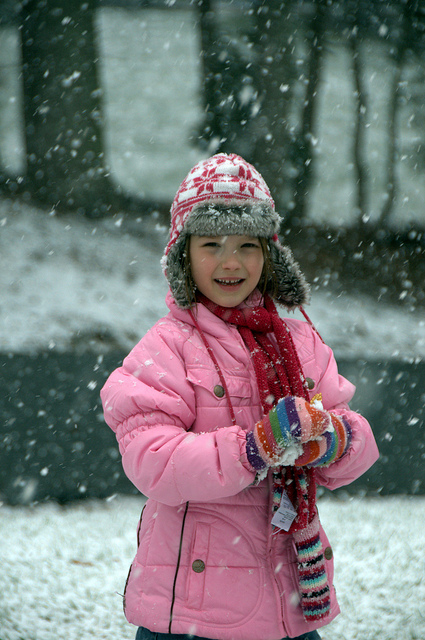
First moments outside

I stood there today, though, marveling at the difference between our Upstate winter reality and that of southern Poland. Here, the question is whether nor not it will snow; there, the questions are when the first snow will come, how long it will last, and if it will melt completely before the next snow falls. There, the first snow fall is just the promise of more, just a whisper of what's to come. Here, it's the promise, the whisper, and the whole story.
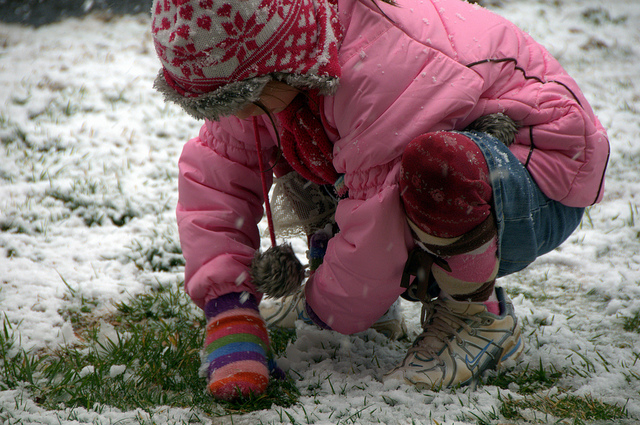
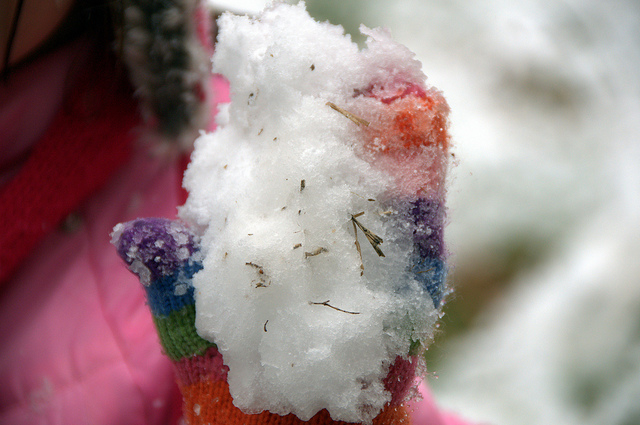
Muddy snowball
Muddy snowball

Sometimes I wonder what it might be like to live in such a place with my family. Perhaps with that much snow, the Girl would come to take it for granted. Is that even possible? Can a child ever grow tired of making snowballs, of digging snow forts, of sledding?
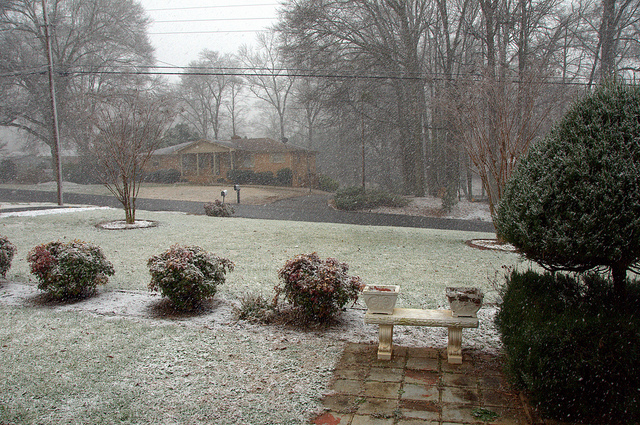

And what of the good, the transcendent good that eludes the will? Perhaps sometimes that good comes from an unexpected change in the weather, a sprinkling of white in an otherwise gray afternoon.
#3 — Choice

When we become conscious that we have to make a choice, the choice is already made for good or ill.

I often speak to my students about choice and habits. So many kids have such ingrained reactions that they've brought into the classroom from various environments -- home, the street, the community center -- which simply do not work in a comparatively-formal setting like a classroom. Perceived slights or insults must be avenged, for lack of a better term, and often very little thought has gone into the decision. These habits, I tell them, are going to get them into some serious trouble at some point in the future. "It won't just be a referral from some teacher who's fed up. It will be dismissal from work."

Hanging on my wall is an almost-cliche but very succinct expression of the principle I'm trying to explain:

Be careful what you think, for your thoughts become your words.
Be careful what you say, for your words become your actions.
Be careful what you do, for your actions become your habits.
Be careful what becomes habitual, for your habits become your destiny.

Yet even when some of them try to break their habit, even when they begin thinking before speaking, there's something in them that just compels them, despite the newly-formed warnings and whistles, to go ahead and say it. That's the habit part, because hidden in every habit is a bit of an addiction. And so these kids are aware of the choice, but in many ways, by the time they're aware of it, they've already made the decision.

Certainly, to a greater or lesser extent, the same is true for almost all of us. The awareness of this tendency, though, like the awareness of an addiction, is the first step toward correcting it. Or so we tell ourselves.

#2 — Drawn to Chains

We are drawn toward a thing because we believe it is good. We end by being chained to it because it has become necessary.

Certainly the image of being caught in chains or wire is a common image, but for me, the most vivid comes from Legends of the Fall, definitely the most vivid because of the conscious decisions of the writer and director, who juxtapose two such images in the film. The first comes during the First World War: a brother struggles to free another brother, tangled in barbed wire and blinded by mustard gas, as German troops prepare to fire on the helpless young man. The second appears later in the film, as the surviving brother tries to free a calf from a barbed wire fence on his father's ranch, thus triggering the painful war memories. In both cases, the greater the struggle, the tighter the barbed wire held. It's probably why sin -- or its modern, secularized equivalent, addiction -- is so often pictured as a chain.

But the more telling part of Weil's thoughts here is the phrase "because we believe it is good." I don't know where I read it, but a couple of years ago, one of those deliberately incomplete statements meant to be somewhat initially provocative: no one ever commits evil. The knee-jerk reaction is simple: "But of course they do! Just look around the world!" What's left out in this initial formulation is simple idea that every act we commit we justify until we think everything we do, in some way or another, is good. Even the sadist, who commits awful atrocities against others, somehow thinks his actions are good -- at least good for him. Even when we say to ourselves, "I know this is wrong, but I'm going to do it anyway," we're adding elliptically, "But in this case, it's good, not evil." And thus we are drawn to all sorts of evils because we believe all our acts to be good. Soon, this so-called good becomes necessary, just like nicotine or caffeine.

That's what I love about Lent. It forces me to look at those things in my life that I have come to regard as necessary and try to loosen the chains a little by simply abandoning them. Lent encourages me to hit a cosmic reset button on myself -- inasmuch as that is possible, or even exists, without supernatural aid.

Retirement

It's not something one expects to read: "Pope to step down." "Pope resigns." Since it hasn't happened in centuries, I guess it's inevitably big news. "Pope prepares for a monk's life" reads one headline, only partially satisfying speculation about what a retired pope might do with his time.

This will be the first papal election I've witnessed as a Catholic convert, and unlike eight years ago, I have some definite preferences for a new pope. Of course, it's not up to me in any sense, so further speculation and wish-making seems fruitless. Whoever is Benedict XVI's successor, he won't be the last, and if history is any guide, it's unlikely he'll do much radically to change anything in the church. It's odd: I find myself more in step with more traditional Catholics every day despite my agnostic, progressive past, but there's one "progressive" change I'd like to see in the papacy: a non-European. Peter Kodwo Appiah Cardinal Turkson has been mentioned as a very possible successor, and I find myself thinking that there could be no better selection for a church that calls itself the Universal Church.

God in the Dative

We must not help our neighbor for Christ, but in Christ. [...] In general, the expression "for God" is a bad one. God ought not to be put in the dative.

One of the more difficult, perhaps the most difficult, challenges to learning Polish was getting accustomed to its inflected nature. In English, we tell who did what to whom in a sentence by syntax, where it appears in relation to other words. In the sentence "The dog bites the man," we know who is doing the biting and who is being bitten by the order: subject verb object; biter bites bitee. Polish and other inflected languages determine these things by adding endings (inflections) to the words. Instead of meaning coming from word order (subject verb object), it comes from word endings. The different meanings are called cases. The subject of a sentence is in nominative case. The direct object is usually in accusative case in most inflected language, but Polish is an odd ball because some direct objects are in genitive case, and all direct objects of negative verbs are in genitive case. Indirect objects, to whom or for whom (i.e., "We gave the dog some treats."), are in the dative case. In Polish, that usually means adding "-owi", "-ze", "-u", or "-i"to the end of the noun. In English, we just slip it between the verb and the direct object.

So what puzzles me about Weil's contention that we shouldn't put God in the dative is how it seems to fly in the face of so much we hear in contemporary Christianity in America. We have "10 Things Young People Can Do for God" and "How to Work for God Effectively" and "Working for God in the Public Square" to name a few articles one can find easily enough. Indeed, it seems to have a Biblical basis. So I wondered what Weil might mean. Perhaps it's a case of not limiting oneself to the dative case but also the instrumental, accusative, genitive, locative, and vocative cases.

Priests

lwMatkaBoskaVisit01Priests

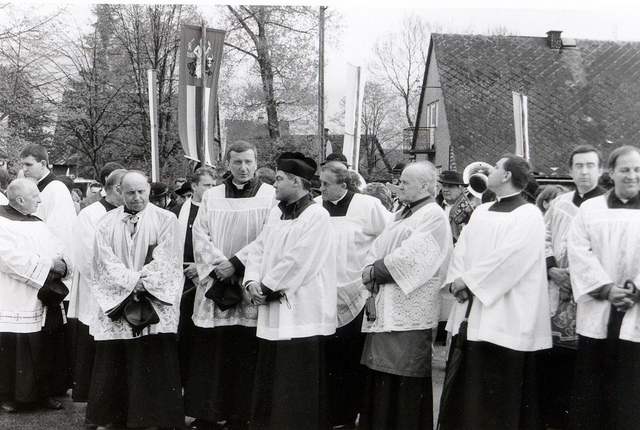
A common enough sight in rural Poland: multiple priests of all ages, looking almost like altar boys. Common enough because of the percentages: 95+% Catholic, 5% other, including a few Muslims. These particular priests had gathered for a procession of the Black Madonna through Lipnica Wielka. At the time, I was skeptical, even cynical. Today, I’d view things a little differently.

Preparation

Advent is a time of preparation, and if there happens to be any Polish genes in your immediate family, that's likely a domestic and culinary as well as spiritual process. There's all the cleaning that should be done -- not quite spring cleaning, but awfully close -- but it pales compared to the amount of cooking.

We've taken to starting early as a result. So early that it's almost an exaggeration. Until you think about the other preparation that awaits. Add to it the coming baptism for the Boy -- itself an event for Poles -- and it's no wonder that we've begun cooking Christmas Eve dinner already.

Dough, Dear

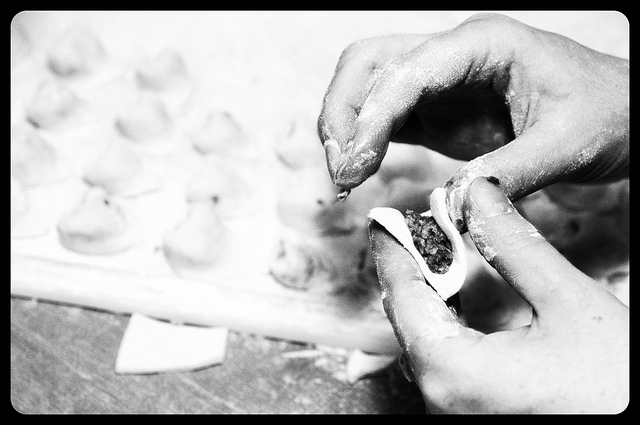
The dumplings for the barszcz and the second-course pierogi are ready. They'll sit in the freezer for the next few weeks while we begin fermenting the beets for barszcz, smoking the tenderloin for Christmas-season gifts and treats, cleaning this, washing that -- at least in the old days. With a six-month-old, who knows how much of the scrubbing will get done. But there are non-negotiables, and the food is among them.

Change

I go to Mass tonight alone because K has already been in an effort to keep our sick son in the house as much as possible. The entrance processional is a rousing hymn complete with drum accompaniment. The tell-tale “tat-tat-tat” of the high-hat cymbal gives it away before the full beat begins, and I realize what has happened: I’ve inadvertently come to a youth Mass. Sure enough, when the lector approaches, he’s wearing jeans and a tee-shirt. The rat-tat-tat of drums continues at times when it seems it really shouldn’t, like the Sanctus and the Agnus Dei. During the consecration of the host, I begin to wonder if the altar boy will ring the altar bell: “Perhaps the percussionist will give three good crashes on the cymbal” I think. Mercifully, that doesn’t happen, but by then, it’s too late. Despite my best efforts to focus on why I’m at Mass, I’m irritated and feeling that I’m almost physically having to resist the urge to march over to the drummer, rip the drumsticks out of her hands, and walk back to my seat. I feel I’m at some Benny Hinn camp meeting rather than Catholic Mass, and that eats at me.

Back at home, K and I talk about that. “If that’s what it takes to get the kids interested,” she suggests, “if it helps, then I don’t have a problem with it. I don’t like it, but I understand.”

But what does it help? Attendance? Perhaps. But do we really want kids coming to Mass because it’s fun, because it’s entertaining because it has just enough of a whiff of popular culture that they feel “at home”?

Shouldn’t Mass feel decidedly different? Shouldn’t we have the feeling that all of the every-day concerns and reality have drifted away for a short time? Isn’t that, at some level, the purpose of Mass? Should we be teaching our kids that, at some level, there’s not a heck of a lot of difference between Mass and a Justin Bieber show?

It makes me long for one more All Saints Day in Poland.

All Saints' 2003 II

Lent 2012: Day 6

There are few gifts more precious to a soul than to make its sins fewer. It is in our power to do this almost daily, and sometimes often in a day.

I've been thinking about my daily interactions with students as a source of some many daily opportunities to show kindness, but certainly the first place one should look is one's own home. Most auto accidents, we're told, happen close to home. This is because of the kernel of truth in the cliche that familiarity breeds, if not contempt, at least indifference and inattention. Perhaps the same is true, sadly enough, of our own home life at times. We take for granted what we see daily if we're not careful, yet nowhere else are the opportunities for the grace of kindness more plentiful than at home. That we need from time to time to remind ourselves of this simple fact is saddening and humbling.

The quoted excerpt is from Father Frederick Faber’s Spiritual Conferences, excerpted here.

Practicing

K and I have been concerned about L’s attentiveness in Mass on Sunday. We’ve come to realize that she’s reached that age that quite, unobtrusive behavior is not the goal; participation is the goal.

To that end, we’ve been practicing after school. We stand for prayer, kneel at the end table, sit quietly. We practice crossing ourselves, including one of the oldest variants.

110524

“When do we kneel?” I ask.

“When the priest sets the holy bread,” L replies.

Sometimes the simplest way is the best.