Matching Tracksuits

fun in fours

at risk

Wednesday in Class

That fifth period can be a tough group of kids. They sometimes disregard what's going on in class to have a little private conversation that is not at all private because of the number of participants and the volume of their voices. They sometimes ignore simple instructions. A few of them are capable of being truly disrespectful to other students, to me, and by proxy, to themselves.

Yet by and large, they're a great group of kids. They're just typical 14-year-olds, many of whom come from less-than-perfect situations and have developed less-than-perfect habits. In my teaching career, there have only been a handful of students that, as humans, I didn't like, I just didn't trust. In almost 25 years of teaching perhaps four or five such kids. There are no such kids in this group.

But they can be tiring.

These final weeks of school, we're going through The Diary of Anne Frank. Why do such an important piece in the waning, testing-ladened final quarter of the year? That's when the district requires it. It might be a good thing, though, because these kids are more engaged now than they've been all year: more focused, more involved, more eager in their participation.

Plopped down in the middle of this is L, a young man from Mexico who speaks not a word of English. Not a word. Well, no, that's not true: he spoke not a word of English when he arrived last week. He's already picked up quite a bit. And today, he was able to follow along with the play, even though he didn't understand 95% of what the kids were saying.

"Where do you think we are?" I'd ask through my phone using Google Translate. He'd point to where we were -- each time, dead on. "Great!" I'd say. His smile was ear to ear.

Left Behind

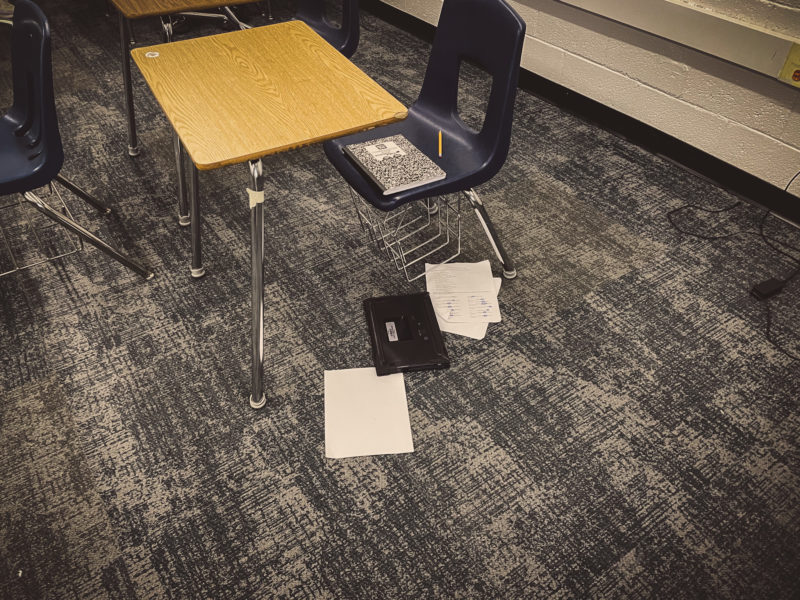
“Pick it up!” she yelled. We were at the end of class when A, who’s always a bit of an immature prankster, pushed K’s materials off her desk. K, who has issues with impulse control (i.e., she’s a chronic disrupter) doesn’t like when her world is disrupted, and she grows verbally violent when it happens. A was walking away smiling, which of course led to K feeling even more aggrieved. “I said,” she began, taking a deep breath, “pick it up!” He walked out the door. She walked out the door herself — not to accost him in the hallway, not to get help from an adult. No — she declared as she walked out, “Well, I ain’t pickin’ it up.” Bear in mind: these were her materials. She literally walked into her next class without her materials, thinking she was perfectly justified in doing so.

I picked her materials up and stowed them in my cabinet. Part of me was justifying it with the thought that it would teach her a little lesson; part of me did it, I think, just to irritate her further. That is, I’ll readily admit, somewhat childish, but at the time, I wasn’t thinking in terms of irritating her. I wanted her to go through the last two periods of the day without her materials to provide an object lesson to her: “Do you realize how many of your problems in school are of your own creation?” I’d planned on asking her when she got her materials back. “You had to go through two periods explaining why you didn’t have your materials, and I guarantee all your teachers responded the same way: ‘That’s your own fault.'”

Ten minutes into the next period, she was knocking at my door. A student let her in. She stormed back to her seat, and discovering her materials were missing, turned and yelled to the whole class, “Where’s my stuff!?!” She proceeded to rant for a while, completely disrupting what we were doing, but I just let her rant for a while. After about thirty seconds, I said, “K, I need you to go back to your class now.”

“But where’s my stuff?!?”

“I need you to go back to class now.”

“But I’ve got to get my stuff.”

“I need you to go back to class now.”

“I have to have my stuff. Where’s my stuff?”

“I need you to go back to class now.”

Her teacher came to the door, a puzzled look on his face.

“Mr. A says I need my stuff.”

“I need you to go back to class now.” I’ve found that the best way to deal with such situations is just to be a broken record, and as it always does, it worked: she huffed and started out of the room, then turned and walked over to a friend and started talking to her.

This is the kind of behavior teachers have to deal with every single day. Every almost single class. In some classes, every single minute.

Negotiation

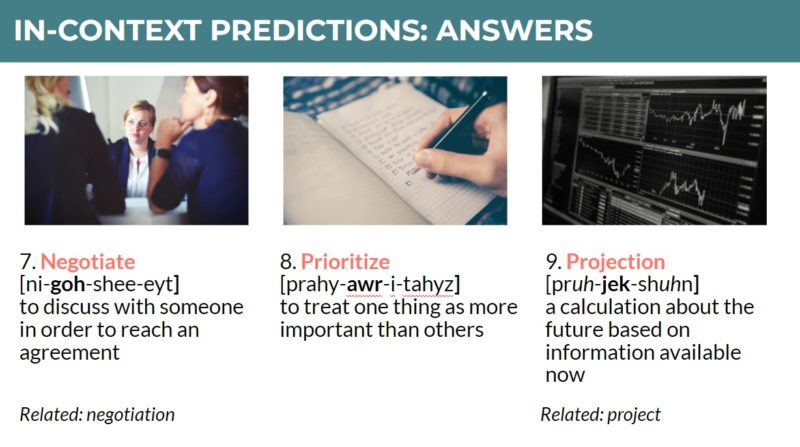
Going over some words in class today that might be new to some students (it was my remedial class), I started asking kids questions about the words.

“What might you prioritize as a student?”

“Your work!” someone responded. If only, young man, if only.

“What might I make projections about as a teacher?”

“Grades.” Yes, and if only you knew the projections — no, you probably do.

“With whom might you negotiate?”

“Your parents.” Of course.

“I don’t negotiate with my parents,” says one boy. “I do what I want.”

Bravado or inadvertent succint social commentary?

In Front of Them?

We're working on a tricky standard in school in my on-level classes. They'll have a TDA (text-dependent analysis) question as part of their year-end test, and it's often a question about how some text develops some idea or other. It might even provide an excerpt and ask specifically how that passage contributes to this or that idea. It's not a straightforward question, and while I'm not entirely sure it's a useful question to pursue with kids who have difficulty reading at grade level, I am obliged to some degree or other to teach to the test. That's what we've done the last couple of days. We worked through a text together and then figured out how to answer such a question. Today, students were working to do it on their own.

Part of the process, I taught them, is to take the main idea of the text and compare it with the passage the question wants us to analyze. "See what similarities they have, what differences. Think about the relationships between those." Since the first multiple-choice comprehension question for our article "Why I Refuse To Say I 'Fight' My Disability" was "Which of the following statements best expresses a central idea of the article?" I knew we could save time in determining the main idea for ourselves. We evaluated the four possibilities and realized it was the first option: "Hitselberger’s disability is an important part of who she is, not an enemy that she needs to defeat."

The analysis question didn't deal with just one or two sentences; it dealt with the entire final third of the article. "How do paragraphs 5-14 contribute to the development of ideas in the text?" At first I thought, "Great, the kids will have to comb through nine paragraphs to find the answer." Then I looked at the nine paragraphs. I didn't have to look closely: the relationship is literally plastered throughout the passage.

I will say I fight ableism and prejudice.

I will say I fight lack of access, stigma and ignorance.

I will say I fight discrimination.

I will say I fight these things, because I do. These are battles to fight, and win. It is ableism, prejudice, lack of access, stigma, ignorance and discrimination that prevent me from having the same opportunities in life as my able-bodied brother and sister, not my cerebral palsy, my wheelchair or my inability to walk.

I will fight to make this world a better place for future generations of kids just like me.

I will fight to make sure they are never told or led to believe their bodies are a problem or something they must do battle against on a daily basis just to fit in.

I will fight to make sure those kids have the same opportunities as everybody else, and never believe everything would be better if they could just change who they are.

I will fight for a world where the mere presence of disability does not make you extraordinary. Where disabled children are taught to aspire to more than just existing, and where being disabled doesn’t mean you have to be 10 times better than everyone else just to be good enough.

I will fight for a world where we talk about living with and owning our disabled bodies rather than overcoming them.

I will fight for a better world, and a better future, because those things are worth fighting for, but I will not fight a war against myself.

So it's simple, I thought. The main idea statement is "Hitselberger’s disability is an important part of who she is, not an enemy that she needs to defeat." Every single paragraph of the passage begins with "I will fight." It's not terribly difficult to see the connection between "fight," "enemy," and "defeat." So the main idea statement says that the author will not fight her disability while the passage gives a list of things the author will fight.

Most of them could not see it. I phrased it differently and rephrased it again. Many of them could still not see it.

I've been thinking about this all day, wondering what went wrong. Was it the presentation? I'd like to think I'd done a decent job scaffolding the learning: we'd practiced the very same thing with the very same question yesterday. The only difference was the text. Was it the students? Just as I'd like to think I wasn't responsible, I'd like to think it wasn't a question of student culpability because there are only two ways to explain it: they can't do it, or they won't do it. Neither one is appealing. Yet of all three options, I wonder if the truth isn't hidden in one of them. It's not a question of intelligence or reading ability; perhaps it's just a question of critical thinking.

Little Steps

Dear Terrence,

I read your letter and felt it really needed a reply: you touch on a lot of issues that got me thinking, gave me hope, and honestly caused me to worry a bit.

You wrote that you “feel like people criticize [you] because of [your] past,” something which “hurts [you] to even try to change.”I don’t know what you thought I might have known about your past, but I knew nothing. I’m also fairly sure the other teachers on the team knew nothing about you. Yet we can all accurately guess about your past because of your present. I don’t mean to be offensive or blunt, but despite your desire to change, you still exhibit a lot of behaviors that draw negative attention to yourself. I don’t know about other teachers’ rooms, but I can describe some of the things in your behavior in my room that makes it pretty clear that you’ve had a rough past in school.

  1. You often blurt out things that you’re thinking, things that might not help the classroom atmosphere. Sometimes you say things that are genuinely insightful, but it’s still disruptive.
  2. You sometimes get up and move about the room for this or that reason without asking permission or seeming to notice that doing so would be an interruption. Sometimes this is to do something genuinely helpful, but it’s still disruptive.
  3. You put your head down when you get frustrated, and even when you’re not frustrated, you cover your face with your hands and completely disengage.
  4. When I correct you, you often quickly develop a negative, disrespectful attitude that comes out in your tone of voice and your body language.

You write that you want teachers to “just give [you] a chance and stop messing with [you],” but if a teacher is correcting these behaviors, she’s not “messing” with you. You must understand that some of your behaviors genuinely disrupt the class, and a teacher cannot continue teaching over disruption.

I do have some bad news, though: while no one is messing with you, you’ve made it clear what gets under your skin, and if a teacher wanted to mess with you, wanted to provoke you so that she could write you up, you’ve made it easy for that teacher (whom I hope you never meet) to do just that. You’ve made it clear what your buttons are, what gets you heated and easily leads to a disrespectful outburst. All a teacher would have to do is push just a little and BOOM! there you go, and there’s the excuse to write a referral. In that case, such a teacher would have played you, controlled you. I hope you never meet such a teacher, but it’s entirely possible. It’s also possible that a teacher who wouldn’t normally do that might, in a moment of frustrated weakness, do just that to “get some peace” for a while.

Fortunately, I have some good news, too: letters like yours make a teacher’s day. It gives us hope that perhaps we can help make a difference in students’ lives. I don’t know a single teacher—especially the teachers on our team—who won’t go out of his or her way to help a student who wants to change his/her behavior to do just that. However (and it’s a pretty big “however”), you have to show that you are really trying to make these changes. You have to show progress on a regular basis. Not big progress; not 180 degree changes overnight. But teachers need to see that you are serious about something like this. Otherwise, we’re left wondering if you’re just playing us. I’m sure you’re not, but it has been known to happen, and teachers tend to be a bit wary about that.

Here’s what I suggest you do if you really want to be a “changed man” as you so aptly called it. First, make sure you go to each teacher and say as much to him/her. Look the teacher in the eye; make sure your facial expression is pleasant; be sure not to let yourself be distracted by anything other students might be doing; then say what you said in the letter. “I’m trying to change, but I might slip into old habits. Please be patient with me as I try to make these changes in my life.” Second, make your strongest effort to change right then. Show the teacher you mean business. Show the teacher that you are not just talking the talk but you’re trying to walk the walk. Sit quietly; stay in your seat; keep your head out of your hands; make sure you don’t use a disrespectful tone of voice. Third, when you slip up (and you will: you’re trying to change some habits that you’ve had for a long time, I suspect), apologize. Sincerely. But not right then! If you do, the teacher is likely to think you’re just trying to disrupt further. Just smile as best you can and comply. After class, you can go to the teacher and say, “I really messed up. I appreciate your patience with me. I’ll do better next time.” Finally, make sure all your friends know what you’re up to. If you’re trying to be Mr. Thug or Mr. Cool Dude with them but Mr. Nice Guy with your teachers, you’ll get those roles mixed up and cause yourself more trouble. Be a leader: tell your friends, “Hey, I’m sick of hating school, sick of dreading school, sick of feeling like I’m wasting time. I’m going to make some changes in how I act, how I think, how I see myself and the world.” Be a leader: show other kids how to do it. They’ll follow your example, because everyone loves to see a “troubled-kid-straightens-everything-out” story. We love it, all of us.

Understand that I’ll do everything in my power to help you. I have some tricks I can teach you about making a good impression, keeping your impulses in check, and having a positive affect. (If you don’t know what that means, ask me: I’ll gladly explain.) But as I said earlier, I and all the other teachers have to see change immediately. Not enormous change, but change. Effort.

Reading

Tuesday Unknowns

Unknown 1

We had an online meeting tonight with a company that helps student-athletes navigate the challenge of getting an academic scholarship. It’s something that I have absolutely no firsthand knowledge and little to no general knowledge about. The question is, given the cost of the service (it’s not cheap by any stretch), just how much will this provide us in the long run. Its cost would certainly be justified if we ended up with major savings to L’s college costs through a scholarship to play volleyball. Yet if we just get nothing for it — no real offer, no real scholarship, no real hope — then it was obviously money poorly spent.

Unknown 2

We had a teacher workday today, and the day concluded with a presentation from a therapist about trauma and its effects on learning. It basically boiled down to, “Don’t be a dick and compound these at-risk kids’ issues by taking everything personally and letting that trigger you into a power struggle that damages the relationship.” That’s laudable, and certainly a very basic best practice for classroom management, but it got me thinking about how much we never know about our students in a given moment: what taught a kid to react this way to this stimulus, what’s going on in the kid’s head at the moment, how we’re contributing to it, what other social forces, unseen and unknown, are contributing at that moment due to peer pressure and the idea of lost face — the whole miasmic mess we find ourselves in when an at-risk student is in full panic mode. Not an excuse for disregarding the processes we went over today. Far from it — a full admission to their basic necessity. Yet it still leaves me feeling a bit like Sisyphus.

Unknown 3

One of our final renovations on our house will begin tomorrow: the guest bathroom will get a complete makeover.

Heaven knows it needs it. In a lot of ways, it was always the room most in need of renovation. Ugly subway tiles on the counter, some god-awful trim around the sink, old toilet — it was all awful.

Was?! It is awful. It has been awful for years. And tomorrow, we start renovating it all. Well, we’re not doing anything — we’re hiring our Polish friend who’s done so much already in our home.

This last unknown is finally known: when will we ever get that bathroom done…

How Much Time?

Sometimes, I find myself wondering just how much time I need to give students to finish an assignment. If they're playing around and wasting time, then they're doing just that -- wasting time. Why should they get extra time? But if I assess what they do turn in, then it's so incomplete that it's more an assessment of behavior rather than skill.

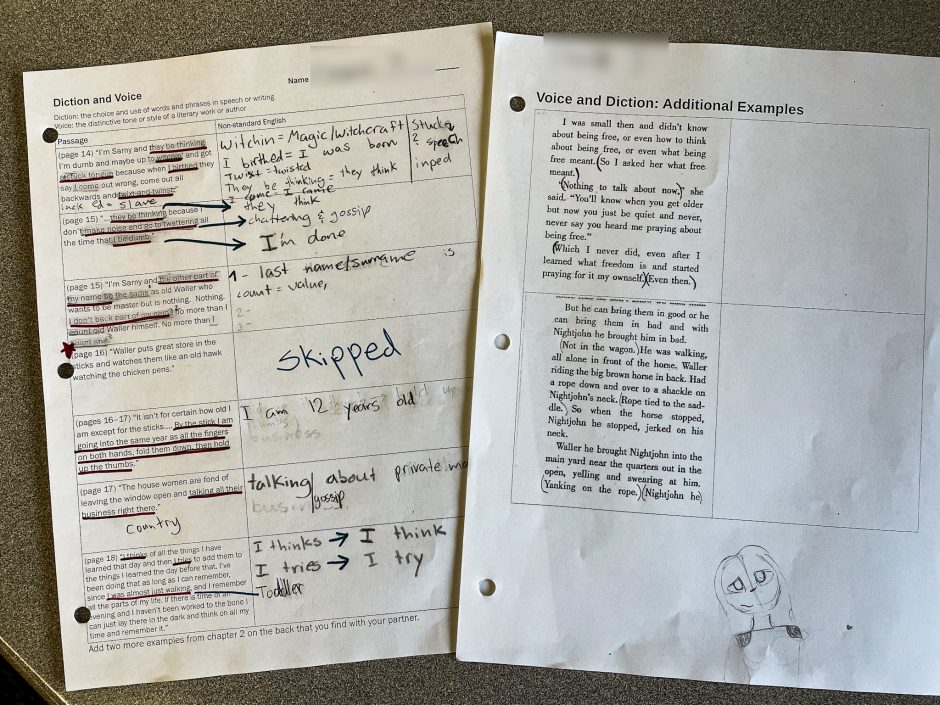
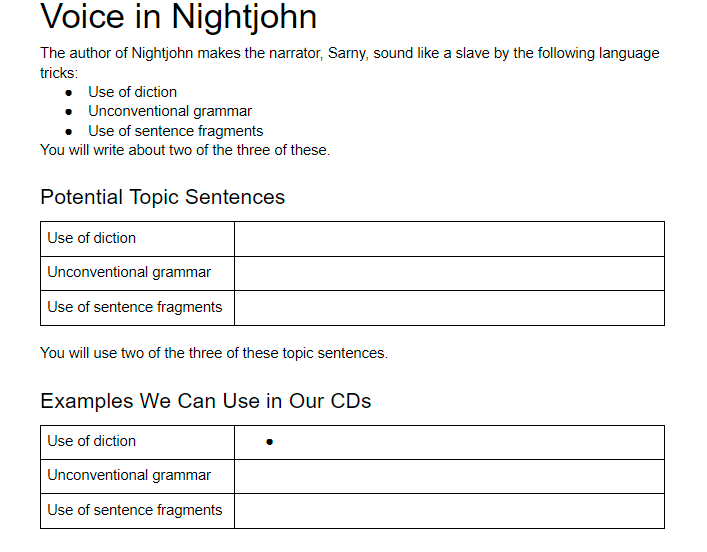
Take our current project: we're writing about how the narrator effectively creates the voice of an uneducated slave girl in Nightjohn by judicious decisions in diction, regularly irregular grammar, and extensive use of fragments. We've gone over all this stuff. We've practiced finding it. We've found it. We've noted it.

I've planned out everything so that what they have to do is less figuring-out-how-to-do-it and just doing it. We determined potential topic sentences as a class. We found evidence in groups. (Much of the evidence they already had -- it should have taken them about 5 minutes to find evidence because it was in earlier work.)

At this point, students who have been focused and working well are almost done; those who haven't are not close to done. They should work on it over the long weekend. Will they? Of course not. How do I know this? Fifteen years of teaching eighth grade at this school has shown me that 85% of the kids in on-level classes just won't do anything on their own at home. Anything at all.

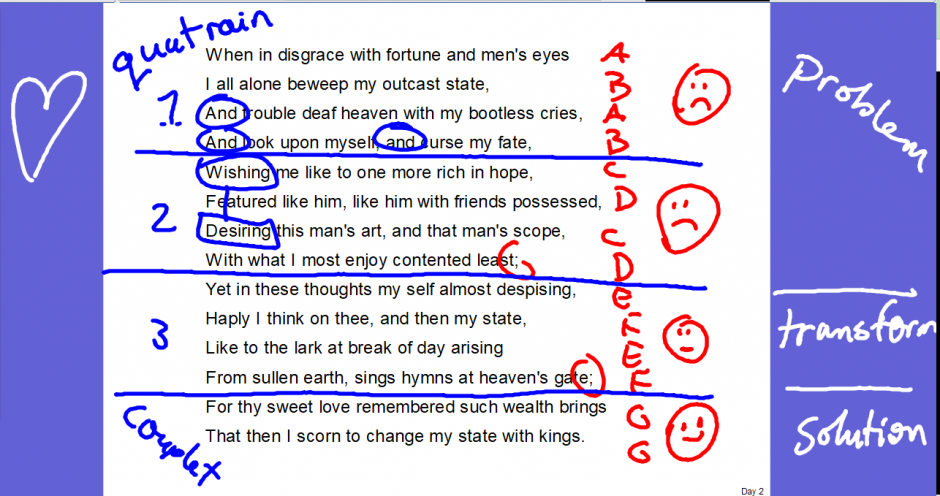
English I students, on the other hand, finished up their analysis of "Sonnet 29" with an examination of the elements of a sonnet:

We then turned our attention to "Sonnet 18" -- undoubtedly Shakespeare's most famous sonnet:

Shall I compare thee to a summer's day?
Thou art more lovely and more temperate:
Rough winds do shake the darling buds of May,
And summer's lease hath all too short a date:
Sometime too hot the eye of heaven shines,
And often is his gold complexion dimm'd;
And every fair from fair sometime declines,
By chance or nature's changing course untrimm'd;
But thy eternal summer shall not fade
Nor lose possession of that fair thou owest;
Nor shall Death brag thou wander'st in his shade,
When in eternal lines to time thou growest:
So long as men can breathe or eyes can see,
So long lives this and this gives life to thee.

The difference in what they're working on is striking, but it's less striking when you see the difference in how they work. The kids in the honors classes, by and large, are focused and studious. They do homework when I require it. They pay attention when I'm demonstrating. They stay on task when I ask them to cooperate on a task. They remain silent when I tell them I want them to do some step or other on their own.

Reading

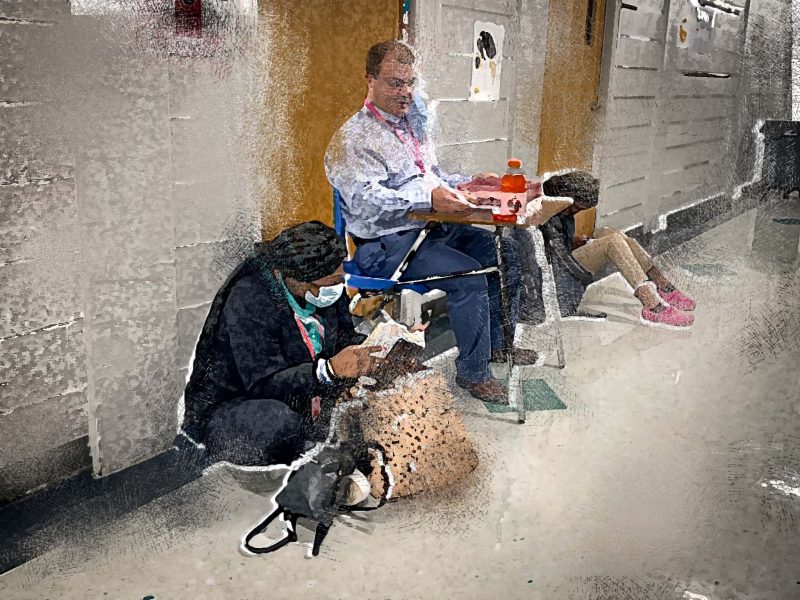
I knew taking the picture might break the spell: an at-risk student who, of her own accord without any prompting or suggestion, chose to read a book during free time after lunch might not be thrilled about having her picture taken. But on the other hand, it’s a picture of success, and when it’s a kid you’ve already grown to love in a way, a kid you’re already pulling your hair out over and cheering on and fussing at with a smile — you go ahead and take that chance.

Sure enough — “Mr. S! Don’t!” And the spell was broken. But unlike many magical moments, this one has evidence to back it.

Football Glory and Critical Thinking

When we lived in Asheville, I worked for one year at a day treatment facility for kids who'd been expelled from alternative school. It was a tough bunch of mainly fourteen- and fifteen-year-olds. At one point, though, two boys who'd known each other "on the outside" (as they'd referred to it) were in the program at the same time. At lunch they'd revel in their former football glory, recalling magnificent plays they'd been a part of and sharing in the sorrow of those losses that had stung so badly. At one point, one of the boys mentioned having a recording of one of those games.

"Really!?" The program director was incredulous, but he managed to talk the boy into bringing in the video.

A couple of days later, during afternoon free time, the kid put the video cassette into the VHS player and pressed play. Soon, the director was howling in laughter as he watched a little league game in full chaotic, cute glory.

"Man, I thought you were talking about games you'd played in middle school or something," he laughed. "I didn't realize you were talking about second grade!" He was just good-naturedly ribbing the kids, and they took it fairly well.

Soccer practice under a half-moon

Looking back on it this evening as I jogged laps in a parking lot while the Boy had soccer practice, it suddenly took on a newly instructive dimension for me. Had any of us really thought about it, we would have known it could not have been middle school football the boys were talking about. They'd experienced little success in middle school, showing out enough to be removed from the setting altogether. Even the most gifted player is going to have to meet certain standards -- administrators might bend some requirements for such a boy, but there are at least some requirements. These boys couldn't even make it through alternative school let alone the less structured setting of a typical middle school classroom, so there was no way we adults should have assumed they were talking about playing organized football in the last several years.

We made those assumptions, though, because they neatly and immediately fit our assumptions. When a fourteen-year-old boy is reveling in past glory, we don't expect it to be from early elementary school but from the recent past. It's an immediate and logical assumption that we make without even being aware that we've made such an assumption. The thing is, we make these kinds of assumptions constantly throughout the day. We couldn't function, I'd argue, if we were to give extended critical thought to each and every decision we make and every thought that flits through our mind. The trick is being aware enough of our thoughts to have as a conscious option the ability to switch on our critical thinking and go, "Now, hold on there."

It's one of the reasons I enjoy teaching literature to middle schoolers. It's just those "Now, hold on there" moments that critical reading encourages.