Matching Tracksuits

fun in fours

at risk

Mileposts

A kid who has gone from completely ignoring authority figures to complying but with a huff and a puff and an expression of disgust has still come a long way. A kid who has gone from cussing out staff when upset to merely walking away while being spoken to has begun developing coping skills.

I worry that some of our kids, despite the tremendous progress they made, will encounter less-than-perfect people in the world that will see their shortcomings and nothing else. They’ll be completely unaware of how far he/she has come and punish him/her in some way for lack of perfect social skills.

This possibility arises from the fact that the skills we’re teaching the kids are so basic that we don’t even notice when an adolescent uses them: eye contact; maturely disagreeing; accepting no. It’s the societal norm, the baseline. These socials skills are to normal life what reading is to majoring in English.
Change in Perspective

Some days at work, things are so hectic, so zoo-like, that I used to think, "There is no way I can survive another day at this place." Kids get wound up and call you everything you can possibly imagine--and several things you probably can't. Sticks and stones and all that, but there's only so many times a person can be called "f****** herpes-a** b****" by a fifteen-year-old before it starts to grate.

Today, someone literally screamed at me, "I don't have a problem with my voice tone!" It's hard to keep a straight face at times like that...

What a change a successful interview can make. Today, I was positively aglow, I'm sure. And though I shouldn't have, at least once I laughed when a kid started gnawing on my last emotional nerve. I thought, "I won't have to hear this for much longer."

And yet -- there's always an "and yet"...

I finally feel I've got the hang of this, and I do feel that my work has helped these kids. Sure, they call me all sorts of things; they yell and scream sometimes; they threaten; they defy; they deny -- but they've been doing it with decreasing frequency lately. Proof that something has been working.

Still, I am looking forward to the change. As is K -- she's already looking for houses...

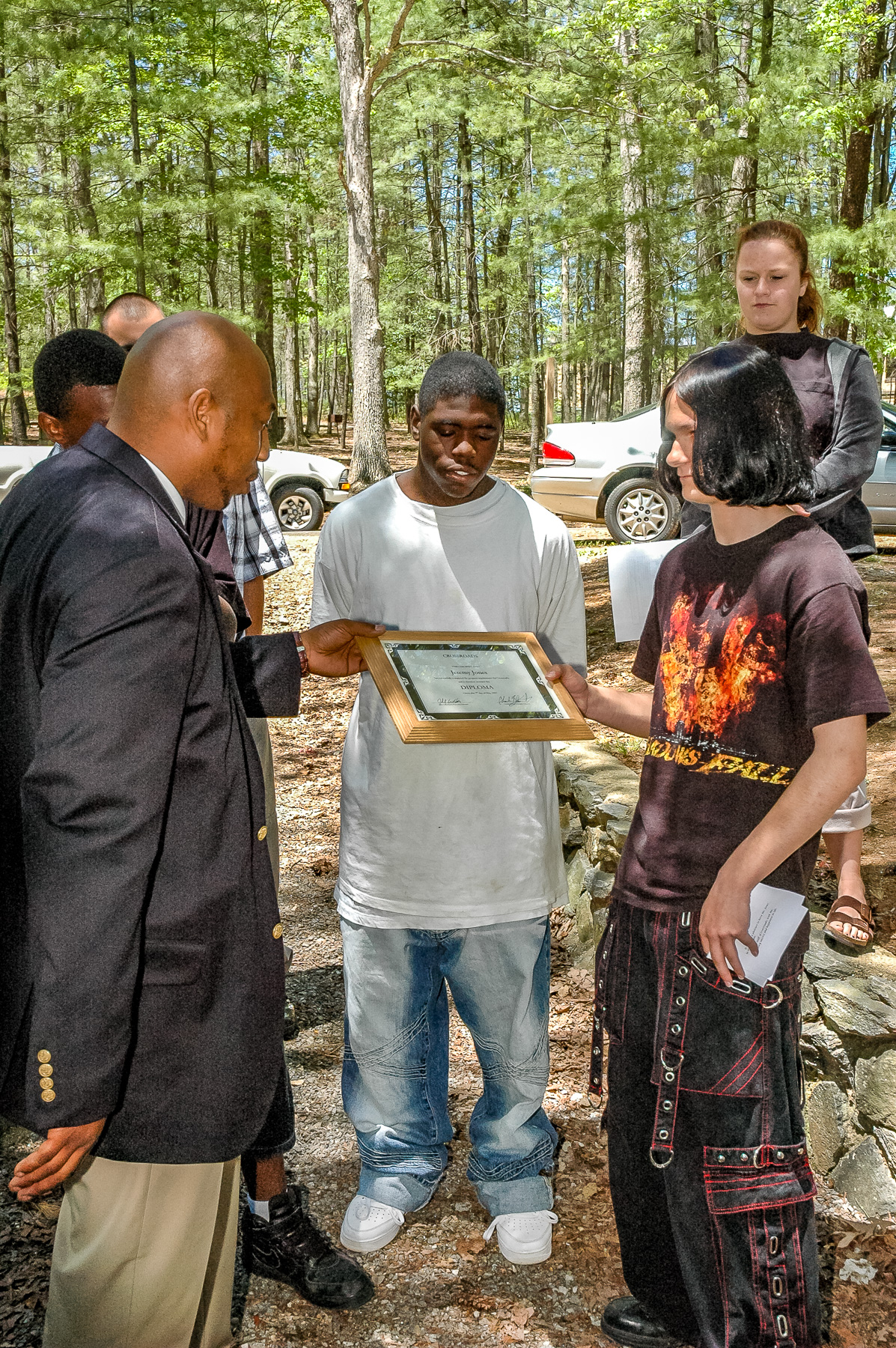
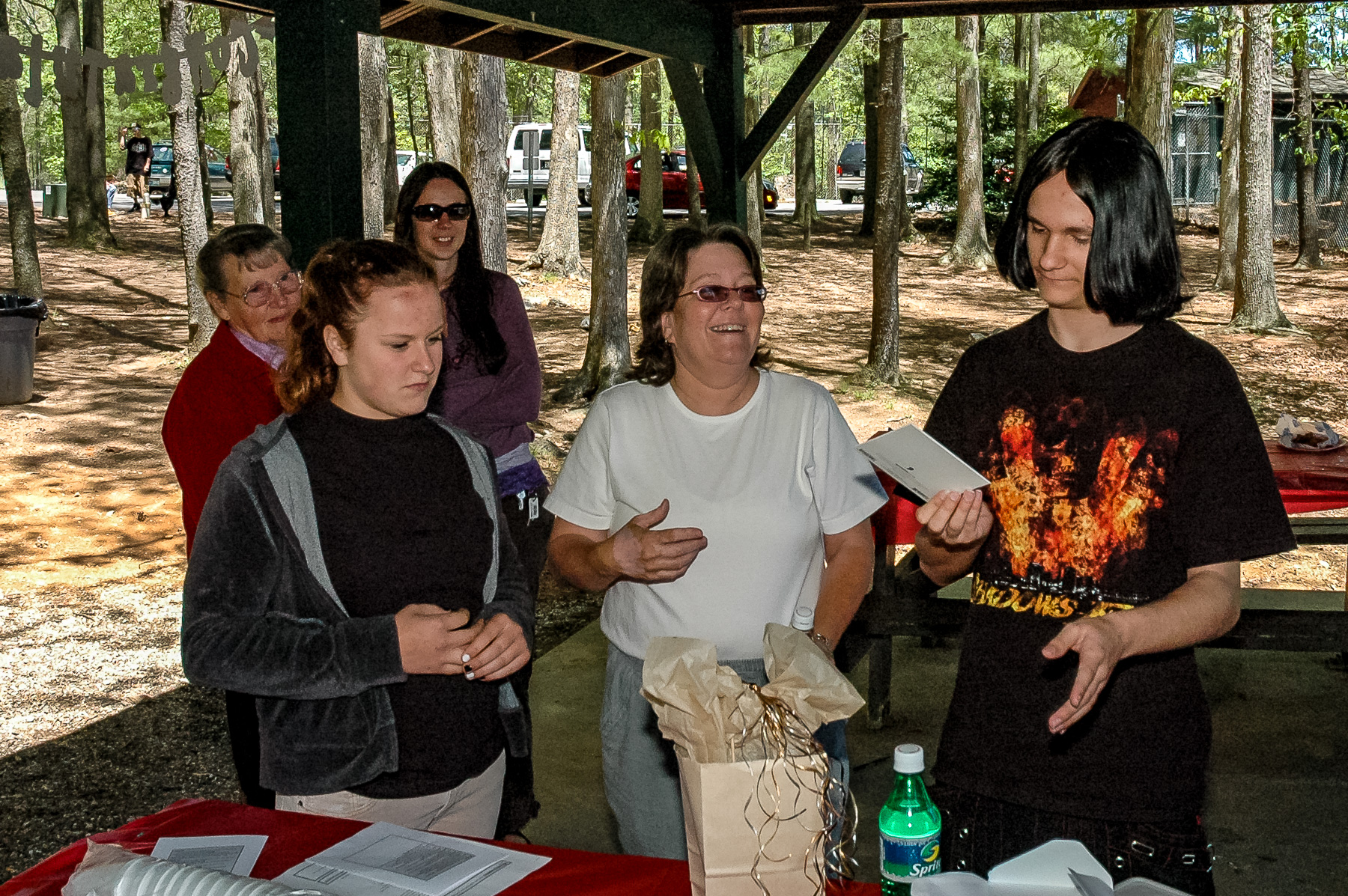
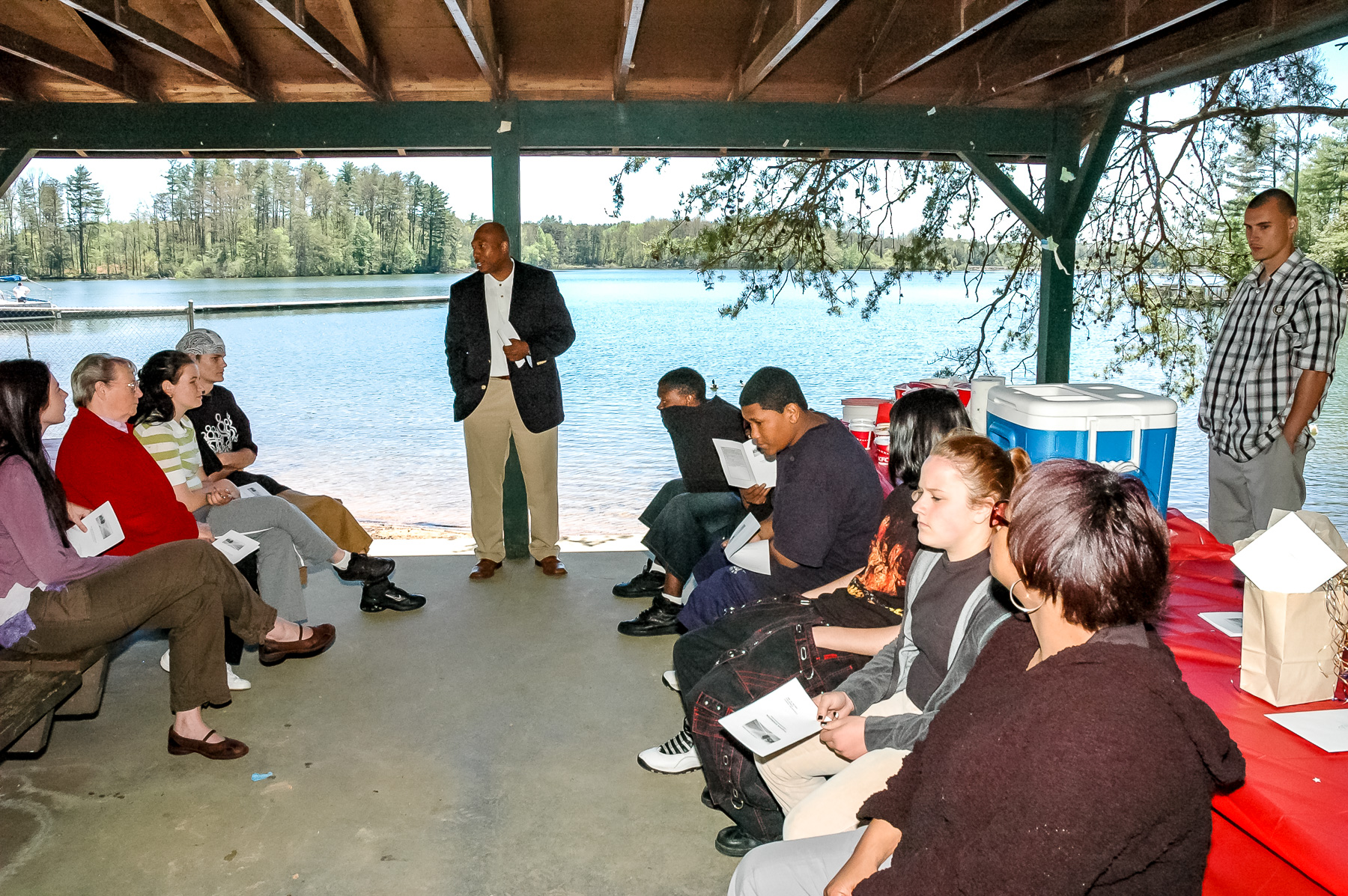
Program Graduation

Learning to say “Okay”

For many of the young people in the program where I work, one of the formal goals that forms part of the forest of paperwork about them is "Learn to say "Okay.'" What that means in practical terms is fairly simple: many of them are unable to accept criticism -- broadly defined as anything even apparently critical of them or their actions -- of any kind from adults.

A scenario from not so long ago illustrates how many things are going on that can make it difficult for someone just to say, "Okay."

Two boys, in class, are doing something disruptive. Fidgeting with something, throwing it back and forth (maybe a jacket?) or something. I couldn't see clearly what it was, but it caught my attention and I deemed it a distraction.

"Hey, guys, stop doing that, please."

"Doing what?" one asks simultaneously with the other's plea of innocence: "I wasn't doin' nothin'!"

Now it really doesn't matter what they were doing. It really doesn't matter if they were doing anything at all. The best response to bring the whole exchange to an end, to prevent it from escalating into something more serious, to ensure not getting into trouble, is to say, "Okay."

"If you have a problem with that," we tell them, "you can talk to the teacher afterward. If you don't know exactly what the teacher is asking you to do, you can ask for clarification after saying "Okay.' But getting defensive, taking it personally, exaggerating it into a personal affront will only make the situation worse."

And so going back to the above scenario, I reminding the boys that one of the skills they're working on is simply saying "Okay" and moving on.

"I ain't sayin' "Okay' to something I didn't do!" one replied indignantly.

"Why not?" I asked. "In saying "okay' you're not admitting to guilt. You're not doing anything other than acknowledging that you heard and understood what the person in authority -- be it a teacher or not -- is saying."

"But I didn't do nothin'!" he protested.

"But that doesn't matter." I responded. "In protesting it, particularly in the manner you're doing now, you're not doing anything to help your situation."

"Are you telling me that if someone accused you of doing something..."

"Whoa, wait -- I'm not accusing you of doing anything. I simply asked you both to stop. If you weren't doing anything, then clearly I wasn't talking to you. Even if I was addressing you alone and said "Stop doing that" and you were behaving perfectly, the best response is to say, "Okay' and move on."

"Move on?! You're the one making an issue of this" he said, voice pitching upward into a virtual screech, eyebrows raised just enough to say -- inadvertently or purposely -- "You're an idiot for saying that."

"No, I'm using this moment to remind you of a skill you're working on and to try to get you to practice it."

The boy couldn't accept that saying "Okay" even if you're completely innocent is anything more than an admission of guilt. And to prove his point, he brings up a most fascinating example: "So you're sayin' that if you walking down a street and cops come up to you and say, "You look like this guy who just robbed a bank,' and arrested you, that you'd just say, "'Okay.'"

The discussion is starting to get less and less productive as we range farther and farther off topic. Or are we off topic? Is this how the boy equates all these things? I decide to play along.

"Yes, I would. Or at least I hope I'd have a cool enough head to say that."

"But you didn't do it. Are you saying that if they said, "You robbed this bank,' that you'd just say nothing, that you wouldn't tell them you're innocent? They'll take you to jail and what -- you'll end up spending ten years in jail for something you didn't do?!"

Right here, though I suspected it moments earlier, I realize the young man didn't have a firm grasp on the workings of our criminal justice system. And another thing begins dawning -- we're really getting off track. Does this help the young man understand the situation? Is he just trying, like so many of the boys do, to get me so wrapped up in a discussion argument exchange that it's just a matter of whoosh! blink! and the whole class is over? I decide, somewhat against my better judgment, to continue.

"Just because they arrest me doesn't mean I'll be spending ten years in jail. There's a trial first, and in the meantime, I can be released on bail. But think of what they say, what you hear on TV, every time they arrest someone." Almost together we recite the Miranda warning. Then I continue, "Now if I'm an idiot, I'll start blathering on about how I'm innocent and how I didn't do anything and then, in court, that will be used against me, because the irony is, it makes me look guilty. If I'm smart, I'll shut my trap completely until I can get a lawyer."

"But if you didn't do nothin'""

"Especially if I hadn't done anything," I replied.

Finally things are winding down, and a boy enters from the other group.

"Hey, Mr. S, let's ask him if he'd just say "okay.' 'Eric, if someone framed you.'"

And now everything is mixed up. Nothing is as it started. We're no longer talking about whether or not saying "okay" helps you in a situation even if the request is relatively arbitrary; we're no longer talking about whether or not saying "okay" is an admission of guilt -- we've moved off into the netherworlds of arbitrary, six-sixty-degrees-of-separation tangents that suck up time and accomplish nothing.

Or is it simply that he doesn't understand what I mean? Are all these scenarios that we've been bouncing off of each other identical to him?

In the end, he simply says, "Well, if that's a skill, I guess it's a skill I won't use."

And I think, "Okay -- we'll try again tomorrow."

Suspension

The typical suspension length at my high school was three days. I'd heard of year-long, but I never actually heard of anyone getting it. It was always out-of-school suspension as well. To my recollection, there was no such thing as in-school suspension at my high school.

There is certainly a move away from out-of-school suspension, for a variety of reasons.

The unappealing idea of students serving out-of-school suspensions roaming their communities during the day, possibly getting into more trouble, prompted some schools to create or expand their in-school suspension programs. In Louisiana, state officials became so concerned about suspended students missing instructional time that the legislature began funding in-school suspension programs.

The Kentucky Department of Education encourages school districts to develop policies that include well-rounded academic offerings for those students who stay in school during suspension. (Education World)

But it still exists. If it didn't, I wouldn't have a job, for a majority of the clients in our program are there because of year-long, out-of-school suspension.

Out-of-school suspension (for simplicity, just "suspension" hereafter) is the lazy way out, though. It puts the burden of educating the most troubled students on someone else. In our organization's case, that "someone else" receives most of funding through "professional begging" -- that's what the organization's director likes to call his continual grant writing.

Suspension addresses only the behavior; it does nothing to correct the causes of the behavior. To be sure, those causes are myriad and most of them out of the effective reach of a public school system. If a child has been suspended for the remainder of a school year, the situation has reached a point at which therapists are probably necessary. Short of dealing with the causes, school systems are simply putting off the inevitable: a sense of failure so deeply ingrained and reinforced that the child gives up on doing anything other than fulfilling everyone's expectations.

An old saying comes to mind: "If you think you're going to succeed, you're probably right; if you think you're going to fail, you're still probably right." School systems that kick the tough kids out of school are feeding into the latter. Then organizations like ours have one more shell to break through before we can start reinforcing the former.

Perspective

In the switch from science to social studies at the day treatment program with teach in, I’ve gone from trying to follow the appropriate grade-level curriculum in science to allowing the kids (and myself) a bit of freedom in what we’re covering now in social studies. (We switch subjects every six-week grading period.) On talking to the lead teacher, I realized that it’s not as critical that we follow the curriculum because there’s such a mix of kids.

M-Jezzy, of science fame, has been asking about slavery. How did it begin? Who started it? How’d they get the slaves?

In explaining that we’d be looking at slavery next week, I got a response I’d been thinking I might hear, but had hoped to avoid nonetheless. Basically, a young man asked, “What can a white guy teach black people about slavery?” Now, to his credit, it was very polite — surprisingly maturely and subtly phrased, in fact. It was more like, “I don’t mean any offense or anything, but, you know, I’d rather hear about slavery from someone who’s experienced it, someone whose people experienced it.”

“That’s a very good point,” I said, thinking, “Am I glad I did some research before mentioning this,” for that’s exactly what I found:

In the 1930s, the Works Progress Administration (WPA) sponsored a federal project dedicated to chronicling the experience of slavery as remembered by former slaves and their descendants. Their stories were recorded and transcribed, and this site presents dozens of select sound recordings and hundreds of transcriptions from the interviews. Beyond the content of the interviews, little to no biographical information is available on the individuals whose interviews appear here.

These interviews are available at PBS’s site for their series Slavery and the Making of America.

An Agenda

Yesterday, one of the boys in our program asked if he could use the computer for a little while. “No problem,” I said. He’s had a great week, and it was a slow morning.

The week was much improved over the past. We were both frustrated about how things were going in my class — he much more than I. At the end of the last six weeks, when we were working on science (now we’ve switched to social studies for the second six weeks), M-Jezzy (his nom de plume at our program’s blog) was trying to make up some missed work, and getting very frustrated about it.

“Man, I just hate science,” he exclaimed.

“That’s fine,” I said. “Not everyone likes science. What we can do, though, is use that as a way to make up some of your work.” I instructed him to log into our blog, akacoolpeople.com, and write about science and why he hates it. “Explain three reasons you don’t like it, and we’ll count that as one of your missed assignments.”

He wrote,

I do not like science at all. And i,ve got three reasons why. One reason is because it is so confusing. likewhe gives the homework out. I dont know what he is talking about beause. They would be so many things that he is talking about. An the other reason iswhen he gives the i want know what to do because. It will be so many things that you would have to look for an you would have to do so much research. And the last reason is the things that he teaches in class i dont know wat in the world that hebe talking about. Likewe was talking about an atom an what i have to study about it is so hard because. The atom has so many things in it. And you will get mixed up with all the parts of an atom. Beceause you will not know how to put them in oder. An if you get this and you are really feeling wat i am saying to you then mail me back M-JEZZY out. I hate science so bad i wish i did not have it at all. (science)

I read it and thought, “What an indictment of me. I obviously don’t explain things for him, and I can’t even make myself clear when assigning homework.”

Depressing.

But fixable.

I talked to the head teacher about it; I talked to the program director about it; I talked to the head counselor about it. The consensus: M-Jezzy does not deal with ambiguity well (as if anyone really does). Like most people, he wants to know where he’s going and what he’s going to have to do to get there.

Starting this week, I began something new. Something obvious. Something basic. Something I should have been doing all along. I blocked off a portion of the white-board and wrote an outline of what we’d be doing, including information about what kind of activity it would be.

Next class, M-Jeezy was like a different young man — much more attentive, much more focused, much more involved. He asked penetrating questions, and he didn’t giggle too much.

A success, I thought.

Back to yesterday morning. M-Jezzy sits down at the computer and logs into “aka cool people,” and starts typing. This is what he writes:

now sence my teacher was started to put the agenda on the board i am starting to learn more in class and i know no wat to do.And i am not getting confused write me (Agenda)

I can’t remember the last time I felt so good.

Yet it was not what M-Jezzy wrote that made my day — it was that he did it spontaneously.

akacoolpeople.com

I work at a day treatment facility for troubled youth. They wind up in our program either through long-term suspension or via adjudication.

It can be a tough bunch of kids.

Recently, I set up a blog for the whole program with the aim of using it as a way for students to write for an actual audience, instead of just writing for the teacher, as is often the case.

But for that, we need an audience.

That’s obvious enough.

Since I’m just trying to get the kids excited about the idea of writing on a regular basis, I’m not having them do much of any correction. Small steps”

Read it with a smile. So I’m asking any willing readers to pop over to akacoolpeople.com and read what the kids have written so far, make a few comments (even if it’s “Hey, that sounds really great!”) and – most importantly – to keep checking back from time to time to make comments. It’ll be slow for a while (right now, there are only a few posts – two of them mine), but I’m hoping that as kids get comments, it will encourage them to write more. (And obviously enough, I’m looking for comments to the kids’ posts, not my own!)

Additionally, if you yourself have a blog or web site and would be willing, give “aka cool people” a mention and see if you can steer some more traffic our way.

Thanks in advance for your help.

2k

One of the young men I work with was doing afternoon chores today, and he asked me to show him how to tie up a garbage bag. When I finished, I asked, “Would you like me to help and take the trash out for you?”

“If you would, please.”

Such a simple response — something most of us might not pay much attention to. But when working with kids who sometimes demonstrate that, through no fault of their own, they have somewhat limited social skills, I notice.

Indeed, it’s my job, among other things, to notice.

I pointed out that I felt he’d earned 2,000 points for that interaction. He pulled out his point card and jotted them down, and after I signed it, I asked, “Do you know what you did to earn those points?”

He explained that he’d been polite.

“Correct.” I asked, “Do you know why it’s important to accept help politely like that?”

“Not really.”

Indeed, why? I paused for a moment, thinking about it. Why is it better to say, “If you would, please” than respond, “Yeah,” or “If you want to,” or any number of less-than-perfect formulations. It’s one of those things many of us parse without thinking, a response we expect to hear.

I thought for a moment, but not long. To be honest, I’m beginning to develop a skill for this explaining of social conventions.

“Because the next time you need help, I’ll be more likely to offer it. If you’d just said, ‘Yeah, if you want,’ I probably wouldn’t have felt that you really appreciated my help. But saying it like you did showed me that you really appreciated it, and so I’ll be more likely to offer to help you the next time I see you working on something.” Not a bad reason.
He accepted it and moved on.

The question is, will he remember it next time?

I’m starting to be optimistic enough about my job to think it’s quite possible. Dare I say, likely?

A’s

In science class, we’re learning about the atomic world and what makes different elements different. To their surprise, it’s just the number of protons. Some are somewhat interested, but we’re not yet to the interest level that produces questions like, “You mean mercury could turn into into gold if we just took away one proton and one electron.”

What I wouldn’t give for a question like that. But we’re getting there.

One thing I’ve done to try to keep interest levels up is to make as many lessons hands-on as possible. Thus, last Friday we put all our new knowledge to work by making clay models of atoms. Each student chose an element (from a list I provided — I didn’t want anyone coming up with protactinium, for example) and then devised a way to make a model. Forgetting about the number of neutrons, we made semi-anatomically-correct models of sodium, oxygen, neon, and others. And at the end of the lesson, I announced there would be a quiz Monday.

The young men I work with probably have made very few A’s in their lives. This is not because of a lack of ability or intelligence, but the fact that their behavior problems get in the way of learning. And so, to this point, the grades have been relatively low as I learn how to tweak my lessons and quizzes and homework assignments just so — they must be instructive, vaguely interesting, challenging, yet not defeatingly so.

The quiz was simple: I put each clay model on a piece of paper that had a number in the corner, gave the students a periodic chart and sheet of paper, and told them to identify the elements. I let them take the time they needed, because when I saw some counting protons, others counting electrons, I thought, “This could be it — the quiz everyone passes.”

Not only that, but everyone got an “A.”

There was some bravado, as showing pleasure at having aced a quiz would have been a sign of weakness to some of these kids. But their eyes told me that they were pleased.

With that positive start, it was difficult not to have a productive lesson