Matching Tracksuits

fun in fours

ameryka

iDontCare

For the last several months, I’ve been hearing more about the iPhone on NPR while driving to work than I really cared to.

The phenomenon is a fascinatingly, achingly-perfect example of our consumer culture. All of the reporting I heard on NPR was about the wonderous technology and gotta-get-it, gotta-get-it, gotta-get-it.

Or sometimes about people who feel they’ve gotta-get-it, gotta-get-it, gotta-get-it.

People standing in line; people paying people to stand in line. Lines, everywhere — if reports are to be believed. People waiting to buy; people waiting to try: to the former, “Do you have nothing better to do with your money?” and to the latter, “Do you have nothing better to do with your time?”

I really just don’t get it. It’s a phone that plays music, and accomplishes it without a keypad. Nothing revolutionary. Nothing that turns our conception of the universe on its head. Bohr, Plank, and Einstein would have all been impressed, I’m sure.

Perhaps I’m just one of those “old fashioned” types that thinks a phone that is just a phone is sufficient. My phone is two years old, and if I don’t have to get a new one to renew my contract, I probably won’t, because I just don’t care. It rings; I talk — end of story.

If I want to listen to music, I’ll use my iPod…

Ron Paul

Ron Paul is Exhibit A in the case of why we need more than two viable political parties. Granted, there’s the Libertarian Party, and that was RP’s party of choice some years ago, but now he’s running for the Republican party nomination — even though most of the Republican party shuns him.

He does seem fairly un-Republican in some ways. His ideas about Iraq win him more applause from Bill Maher than any of the Democratic candidates.

If we think we can do what we want around the world and not incite hatred, then we have a problem. […] They don’t come here and attack us because we’re rich and we’re free. They attack us because we’re over there. (Republican candidate debate)

I don’t know of any Democratic candidate who’s talking about blowback and 9/11. It sounds like something out of a Chomsky book, as do his comments about the folly of spreading democracy with a gun.

And yet, Paul was talking to Cobert, he indicated that he’d be more than willing to have a small a government as possible, eliminating various agencies such as the Department of Education and the Department of Homeland Security.

What he is, in reality, is a real Republican — an isolationistic, small-government, states’-rights, federal-government-butt-out, old-fashioned Republican. The Republicans have strayed so far from their original principles that a “real” one stands out.

Roan Mountain

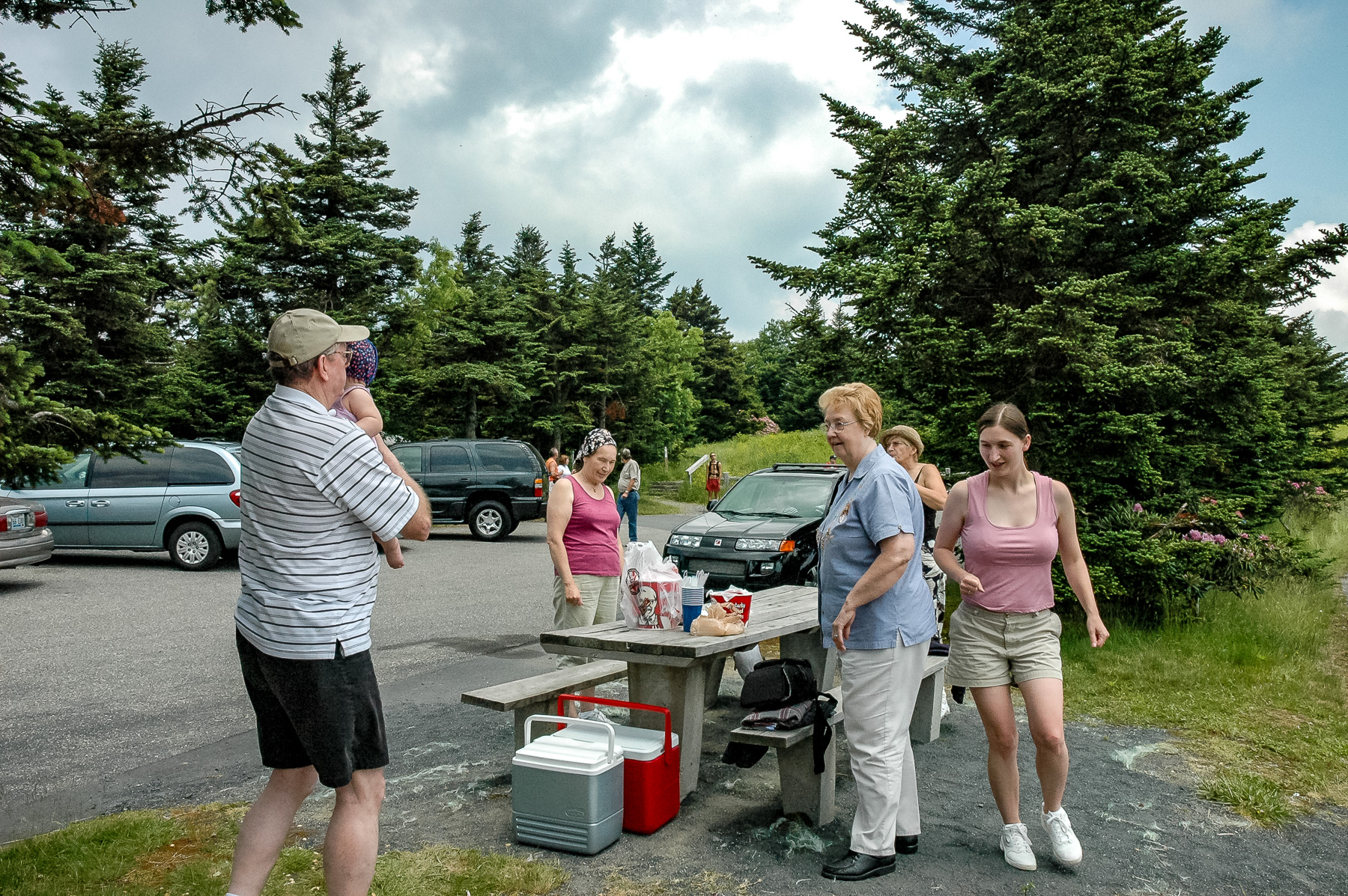
Over the weekend, we took J to see the rhododendrons on Roan Mountain.

The blossoms were a little past peak, and some of them were already wilting, but it was impressive nonetheless.

Maps

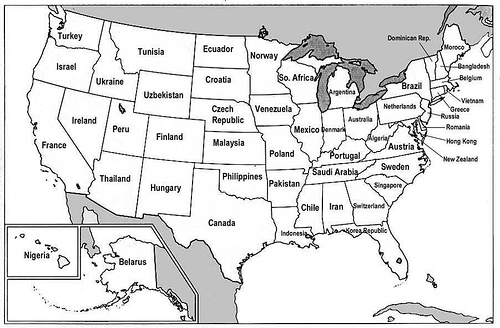
Via Kerim at Keywords, who found it at Strange Maps.

GDP Map

It is a bit misleading, though, as Strange Maps explains:

The creator of this map has had the interesting idea to break down that gigantic US GDP into the GDPs of individual states, and compare those to other countries� GDP. What follows, is this slightly misleading map � misleading, because the economies both of the US states and of the countries they are compared with are not weighted for their respective populations.

Pakistan, for example, has a GDP that�s slightly higher than Israel�s � but Pakistan has a population of about 170 million, while Israel is only 7 million people strong. The US states those economies are compared with (Arkansas and Oregon, respectively) are much closer to each other in population: 2,7 million and 3,4 million.

All the same, fascinating.

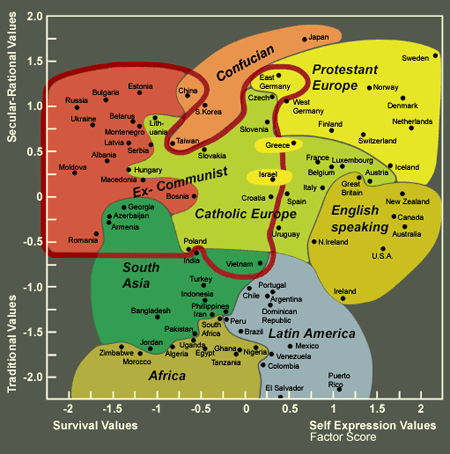
I went to Strange Maps myself (obviously) and found a map much more interesting, in my view: the Inglehart-Welzel Cultural Map of the World.

Cultural Map

How to read the map?

On this map, East and West Germany are next to each other, as one would expect. But Romania�s closest neighbour is Armenia? And Poland and India are side by side? Well, this is not a straightforward geographical map, but a cultural one. It plots out how countries relate to each other on a double axis of values (ranging from �traditional� to �secular-rational� on the vertical and from �survival� to �self-expression� on the horizontal scale). This makes for some strange bedfellows � for example: South Africa, Peru and the Philippines occupy almost the same position, although they�re on three different continents.

If I were a social studies teacher…

Improvement

When teaching English as a Foreign Language, I often wondered whether I would work in an educational setting that provided such clear evidence of progress. When you take a first year class that speaks no English and help turn it into a group of kids almost all of whom pass the English language exit exam with good marks, there’s a definite sense of achievement.

Then I spent seven months working with autistic children.

A couple of the students finished the year as completely different children than when they started. Gains in reading ability, social interaction, verbal expression, math skills, and general life skills left me simply astounded, and understandably proud that I had something to do with it. (Seven Months)

Now, working with at-risk kids, I get a third example.

A young man came up to me the other day to tell me something.

When he first arrived, he spoke to me only when he absolutely had to, he cussed me out on a fairly regular basis, and he never, in any circumstances, looked me in the eye. He had trouble getting along with other kids, and if you judged him just from that, you’d come away thinking he was a fairly unpleasant person.

This time, his eyes wide with a big smile, he said, “I done something good today, but you didn’t see it.” He then told me about how he’d managed to keep his temper under control with another kid in the program whom he finds irritating.

It was the first time I’d ever seen pride in his face.

NCLB

How effective is No Child Left Behind? Not very.

In fact, it harms our kids instead of helping them. How?

Here’s a letter from a parent who’s also a teacher with 21 years’ experience which explains the problems perfectly: Letter about Re-Authorization of NCLB.

Bush in that Country East of Germany

Bush went to visit Poland during the G8 summit. Yesterday in the car, I heard two different NPR news briefs about it — not whole reports, but simply a mention in the headlines.

Neither time did the reporter refer to the Polish president by name.

The first time was something about Bush going to Poland to visit “that country’s president.”

The second time, it was a mention of Bush meeting his “Polish counterpart.”

I’ve wondered why they didn’t use the Polish president’s name. Is the Bush’s Polish counterpart’s name so difficult to pronounce? Did the reporter not know the name of the president of Poland?

For the uninformed, it’s Lech Kaczenski. (That “n” should have an accent on it.) That would be pronounced “Ka-chenee-ski.”

Can they not pronounce it? Can they not remember it? At least they didn’t have to say “president of Poland” in Polish — that is a mouthful: “Prezydent Rzeczypospolitej Polskiej”

iParty

The internet has produced a lot of oddities, as well as its fair share of stupidity. When everyone thinks they’re being anonymous, they feel they have license to say and do whatever.

On the other hand, the opposite is possible (not to mention more popular): using the internet to make a name for oneself.

Occasionally, we find cases of the latter that should have been cases of the former. At least once, it’s cost someone quite a bit.

One such instance was a bust here in Asheville over the weekend.

A party invitation posted on MySpace.com that advertised all you could drink for $5 has led to charges against the hosts of aiding underage drinking and selling alcohol without a permit.

Agents who raided the weekend gathering at an Asheville apartment complex also discovered a pinata filled with condoms and sex toys, underscoring the danger of young people attending parties put on by strangers, said Allen Page, assistant district supervisor for N.C. Alcohol Law Enforcement. [...]

The agency was alerted to the party through an anonymous fax showing a printout of a MySpace page, he said.

The posting said the party would start at 11 p.m. Saturday at 161 Edgewood Road, Apartment 2. It said patrons could get all they wanted to drink for $5 and that a pinata would be broken during the gathering.

Two undercover officers paid the admission charge and went inside, where they found a keg of beer in the bathtub, he said. State agents and Asheville police officers made arrests early Sunday after getting a search warrant.

It's no longer unusual for ALE agents to learn about illegal house parties though Internet postings on Web sites such as MySpace, the popular social networking site, Page said. (Asheville Citizen-Times)

A 21st-century bust aided by 20th-century technology, abetted by a fair amount of stupidity from the perpetrators…

Teaching Trotsky

Given the fact that the lads in the program had a very weak grasp on recent history, I decided to do a six-weeks' grading period on 20th century history. A hundred years in six weeks means 16.7 years per week, and I knew it would be a very rough overview at best. That said, I started in 1917, with the Russian Revolution.

"Why are we studying this crap?" one asked. He'd been keen on learning about the 20th century, but an obscure revolution led by people with "weird" names in a country on the other side of the globe was not what he had in mind.

"Because what came out of the revolution, namely the Soviet Union and the totalitarian Communist state, shaped much of the 20th century." Already I knew that I was painting with broad strokes. The revolution had produced a communist state, but it wasn't immediately totalitarian -- unless you happened to be in the upper class. Value judgments aside, I went on.

We looked at the revolution, the outcome, and then spent most of our time on the Stalinist Soviet Union.

The classic free-market critique of communism is that it destroys incentive. If I'm going to get my needs met whether or not I work, why should I work? If I know that no matter how hard I work, I'm going to get the same rewards, why not just do what's necessary to get by? I used to think "Whether or not this argument is valid on a scale large enough to make an impact on society's production remains to be seen," but then I lived in Poland in the years just after the fall of communism. What I experienced were people who were supposed to be helping me -- after all, by my shopping in their store, I was paying their salary -- sitting and reading a newspaper, then looking up with an expression of disgust and saying, "What?"

A consultant who's been working with our program mentioned later, as an aside admittedly unrelated to his job description, that he felt I'd painted with strokes too broad and therefore misleading. He felt I'd blurred the lines between Stalinism and communism and that the lads would equate the two as being necessarily connected, synonymous even.

"Communism doesn't have to end in totalitarianism," he pointed out.

True enough, but I began thinking about this and realized something that one thing missing from the discussion is scale. To have a small-scale commune is one thing; to have an entire country that is communist is something entirely different. Small-scale communism can work because it can foster a tighter community spirit -- it can be more like "family." You're less likely to cheat someone whom you know, with whom you share common values, etc. Small-scale communism also tends to be more voluntary. Choice goes a long way in determining how much you'll play "within the rules" of a given society. Bottom line, because of the community sentiment and the voluntary nature, small-scale communism tends to be ideologically self-sufficient.

Marxism suffers from fatal oversimplification: all workers are saints and all owners are devils. There are saints and sinners among workers and owners alike, and communism cannot overcome the inherent selfish nature that so many of us have.

State-scale communism, however, is not ideologically self-sufficient, and it's largely anonymous. Corruption arises more easily when you have no idea whom you're cheating. Add the fact that communism historically has not been "voluntary" and you have an instant recipe for Animal Farm-type "cheating." And since it's not voluntary and the state has to keep a lot of people "in line," it's easy enough to evolve into a police state.

Talking with the consultant later about this, I sketched out the above thoughts, concluding that, to my knowledge, there's not a single modern communist state that hasn't evolved into a totalitarian regime.

He suggested Cuba. Aside from the imprisoned political dissidents, the fact that Cubans are shut up behind their own "Iron Curtain", and the lack of any oppositional political party, I guess I'd agree...

Good Job!

Before getting to work, employees gather for daily recognition. The supervisor gets up and says,

Today, we’re going to recognize a few people for their outstanding achievements of late. Bob, great job coming to work on time! We all appreciate that. Susan, excellent work meeting that deadline. We gave you plenty of time and you came through! Last but not least, Johnny — I asked you to write a report and you did it! Excellent!

A story the other morning on NPR showed that, ridiculous as it might be, such things are going on all over the States.

Companies are hiring consultants to help manage the “over praised” Me Generation. […] Forget Employee of the Month — how about Employee of the Day! Some managers are resistant, saying the only praise they ever got was a paycheck. (NPR)

The commentator — herself a twenty-something — mentioned that the Me Generation has grown up in an environment where parents are terrified that their kids are not going to develop self-esteem, so they praise them to death

The results, it seems, are quite the opposite. We seem to have a generation that can’t cope without constant praise. Instead of raising strong, independent people, these parents have created kudos-holics: people who can’t — or won’t — function without praised heaped on daily.