Matching Tracksuits

fun in fours

40 things

#9 — The Singularity of Mass

If a deacon participates, he reads the Gospel....

The first time I attended a church other than the one I grew up in, I was shocked at how utterly different the service was compared to what I was used to. When the pastor began, "Our scripture for today is...", I immediately began wondering how in the world one could possibly have a sermon with one scripture. I was so accustomed to sermons that often amounted to an artillery barrage of verses that having a sermon with only one verses seemed like having a car with only one wheel.

As I visited other churches, I found that not only did every denomination have its own liturgy but also every single church within a denomination might have its own version. Going to churches in other countries, I imagined, might uncover even more differences.

Today, one can find a liturgy to fit whatever mood one might be in. Looking for something heavy on entertainment? Head to the nearest mega-church. Looking for a calm, quiet, predictable service? Look for Methodists or Presbyterians. Want a little danger in your worship? Seek out the few remaining snake-handling, strychnine-drinking Pentecostals in the hills of Appalachia.

The Catholic Mass, however, is different because it's the same. No matter the country, no matter language, no matter the culture, the Mass is the same. Before Vatican II and the introduction of Mass in the vernacular, it would literally be the same wherever one went. And here's the thing that really impresses me: it's been that way for centuries. The Mass of today would be recognizable, more or less, to Thomas Aquinas as much as it would be to G. K. Chesterton. Certainly, the hymns would be different, and the use of the vernacular (as opposed to Latin) would probably seem odd, but the heart of the Mass itself would be comfortingly familiar to both men.

I realize I'm using broad strokes here: there are certainly minor cultural differences in the Mass, and the Catholic church isn't the only church to achieve this liturgical homogeneity. But one thing is certain: it's had this homogeneity longer than any other institution in the West, and there's something to be said for an institution that can be that grounded in the past and the present.

#8 — Cathedrals

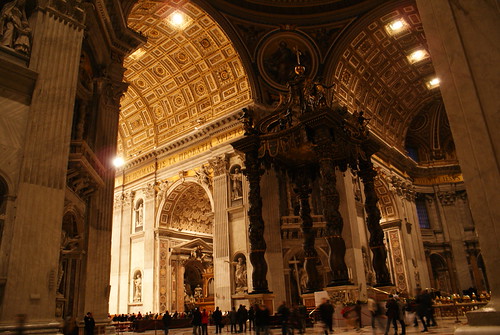
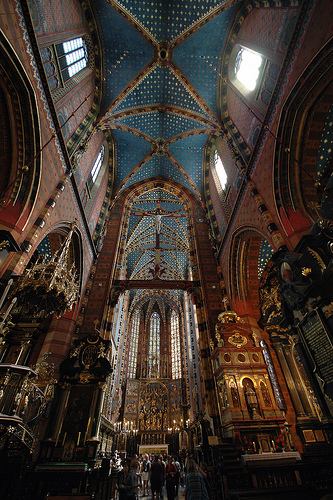
Even those who know nothing about Catholic theology know about Catholic cathedrals. Religions in general have a way of inspiring great architecture, for sacred objects and sacred time requires sacred space. St. Peter's, Notre Dame, Hagia Sophia, Canterbury, Chartres, Reims, St. John the Divine, Westminster Abbey, and seemingly countless others tend to be top tourist destinations even for non-believers. Everyone wanders in, looks about, and inevitably looks up -- which, at least in the case of Gothic architecture, was the whole point.

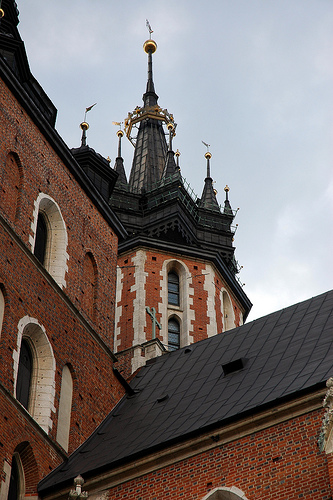
Basilica of St. Mary

The scale is impressive enough, but for the faithful, cathedrals can be only grand, for they house the "body, blood, soul and divinity" of Jesus, according to the doctrine of the Real Presence. Whether one believes the doctrine or not is somewhat irrelevant: the designers, builders, and curators of the cathedrals did, and those attending services did and still do believe it. If one believes that Jesus is really present in the host (which is the heart of the doctrine of the Real Presence), then it's only logical to build the best tabernacle imaginable to house said host.

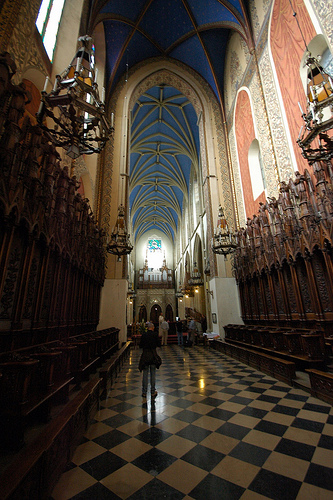
DSC_4274

This goes a long way in answering the objection a friend from the States raised as we wandered in and out of churches in Krakow just K's and my wedding. "How does this help anyone spiritually?" he asked. The Catholic answer is, "They weren't built primarily for man but for God."

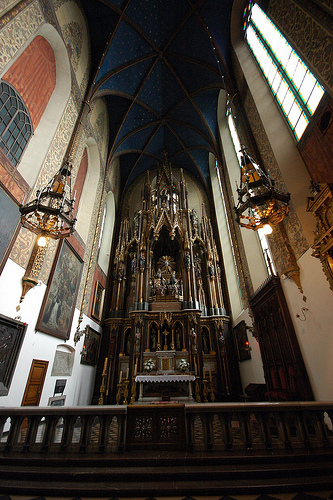
DSC_4693

Whomever they were built for seems almost irrelevant when I'm standing in the middle of a soaring cathedral, wondering at the engineering required both to design and to construct such spaces.

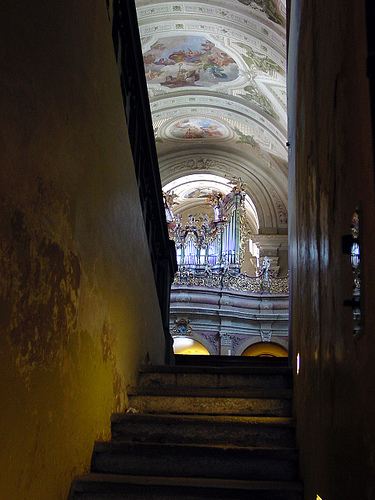
View from the Crypt

#7 — Sacred Objects

Breaking of the bread.
Image via Wikipedia

Among the elements that sets Catholicism apart from almost all other Christian denominations is the notion of the sacred embodied in the physical. There are a host of sacred objects in Catholicism, while Protestantism considers almost nothing on Earth sacred. Only God is sacred, say Protestants, and that was indeed one of the myriad motivations for the separation of the Protestant denominations from the Catholic church.

Having grown up in a Protestant group (though it would have never called itself "Protestant," it was: if it's not Eastern/Greek/Coptic/etc. Orthodox or Catholic, it's Protestant), the notion of a sacred object was completely foreign to me. It smacked of superstition, of primitive belief that bordered on idolatry.

Websters.com defines sacred as follows:

  1. dedicated or set apart for the service or worship of a deity
  2. a : worthy of religious veneration : holy
    b : entitled to reverence and respect
  3. of or relating to religion : not secular or profane

I grew up, I suppose, with only the second definition; the first definition is more Catholic, though.

In Catholicism, one can't help but be overwhelmed by the number of sacred objects. At the top of the list is the consecrated host, but there are numerous others: the Bible is sacred, especially the Gospels. One will notice this immediately in the how the priest handles the volume of Gospels the priest uses in the Mass reading. Yet it's not limited to the Bible and host: the church itself, the crucifix, the vessels used in Mass, the altar itself, rosaries, statues, and icons are all in their own right sacred.

This is where the Protestant accusation of idolatry arises, especially with the use of icons and statuary. It seems to be a direct violation of the commandments.  Yet Catholics aren't worshiping these objects (except for the consecrated host -- but that's an entirely different theological knot) and in fact condemns such as idolatry.

What I like about sacred objects is they force one out of normal routines and require a reverent thoughtfulness. In a culture in which only radical individualism seems to be sacred, such thoughtful moments are welcome.

#6 — Polyphony

Sacred music is without a doubt one of the most beautiful things Catholicism has given then world, and polyphony is the most perfect form of that music. Five, ten, fifteen, even forty individual melodies blended into a single composition that can only be described as angelic.  Strictly speaking, composers of sacred music did not “invent” polyphony, and many in the church at first balked, considering the harmonies superfluous. However, the vast majority of polyphony that I am familiar with is sacred in nature.

I first heard polyphony in “Man and the Arts,” a unique course I took as an undergrad that blended a historical overview of art, music, and philosophy. Our professor played for us a portion of Thomas Tallis’s “Spem in Alium,” a forty-part Renaissance motet, and I was instantly addicted.

Listening to this makes it difficult to believe that we are merely bags of fat and chemical reactions.


#5 — Silence

 Catholicism has silence built into it. Silence in Catholicism is everywhere. Walk into any medieval church in Europe and the silence is almost audible. It's as if the walls and icons of the churches produce their own silence, a counterbalance to everything going on outside its walls.

The traditional Tridentine Mass has moments of silence, and that silence even made it into the Novo Ordo Mass: the priest holds the consecrated host up and is silent; he lifts the chalice of consecrated wine and is silent.

A chapel dedicated to the adoration of the Sacrament is silent.

Monks and nuns take vows of silence.

The Catholic Encyclopedia writes of three spiritual principles behind silence:

  1. As an aid to the practice of good, for we keep silence with man, in order the better to speak with God, because an unguarded tongue dissipates the soul, rendering the mind almost, if not quite, incapable of prayer. The mere abstaining from speech, without this purpose, would be that "idle silence" which St. Ambrose so strongly condemns.
  2. As a preventative of evil. Senica, quoted by Thomas a Kempis complains that "As often as I have been amongst men, I have returned less a man" (Imitation, Book I, c. 20).
  3. The practice of silence involves much self-denial and restraint, and is therefore a wholesome penance, and as such is needed by all.

Silence is indeed "needed by all," particularly in today's techno-world. It's one of the great mysteries to me why so many people like the dazzle of multi-media mega-churches: these churches incorporate technology as liturgical baggage; it seems the church is to be a place of worship and contemplation that shuts out the world.

#4 — Location of the Pulpit

In most Protestant churches, it's always the center of attention. Front and center, the pulpit is the center of all eyes, all ears. In mega-churches, the stage has replaced the pulpit, but on the stage, there is a lectern of some sort, making it clear the high point of the service is the pastor's sermon.

Willow Creek Community Church

Protestants sometimes suggest that Christ is not the center of the Catholic Church, but it's hard for them to make such an argument when the pastor is the center of theirs. The sermon is the center of the church service, and so the pastor's personality, wit, or erudition is what ultimately brings congregants to this or that church. In mega-churches, it's often a combination of the show and the sermon.

Catholic Church in Krakow

In a Catholic church, the pulpit is always to the side. The priest's homily is not the reason people are in attendance, and as such, the pulpit is tastefully moved to one side.

#3 — The Sacred

The sacred -- an idea that, in the ancient world, was an everyday reality. To be sacred is to be "consecrated: made or declared or believed to be holy." It's only been in the last few centuries that this notion disappeared from the everyday life of Everyman.

In a Protestant church, the idea of the sacred is almost non-existent except in a historical, Biblical milieu. The Ark of the Covenant was sacred; the showbread and the Holy of Holies were sacred; God's name is, in some sense, sacred. But in the sense that time, space, gestures, words, or objects can be sacred, Protestantism proclaims loudly and, for its own part, definitively, "No!" Only God is sacred. Nothing on Earth is truly sacred.

The rest of the religions in the world beg to differ. And Catholicism (as well as the Orthodox East) in particular would argue that there is sacredness on Earth. Indeed, Catholicism is, in part, all about bringing that sacrality to humanity on a daily basis.

#2 — Community

Saint Peter's Basilica, Vatican City, Rome
Image via Wikipedia

It was in an undergrad course on Shakespeare that I first began thinking of Catholicism as an inherently communal religion. Our professor, an ABD who later left academia for construction, was having doubts about Christianity and mentioned that of all options, Catholicism and its strong sense of community appealed to him most. I had no idea what he was talking about: I'd never thought of Catholicism, knew little more of it than Marian devotion, and had no clue how community might play an important part in a religion.

It wasn't until I attended Mass for the first time in Poland and read Milosz's The Captive Mind that I understood. Milosz wrote of the wisdom of the Catholic church in its community prayer, pointing out that kneeling and crossing oneself often preceded faith and in fact led to faith. I, in my unbelief, understood this to mean that religious belief is a question of collective suggestion. Reading Peter Berger's Invitation to Sociology only further strengthened this belief. Yet Berger himself, in A Rumor of Angels, goes to great lengths to point out that something that seems to explain faith naturally does not preclude the supernatural. In other words, faith might very well be a product, to some degree, of a physically encouraged collective consciousness, but that fact alone doesn't disprove its legitimacy.

Attending Mass put it all in perspective. Seeing everyone moving together, gesturing together, speaking together, had a profound impact on me. The sense of unity and community was literally palpable.

I thought of the vast difference between this voluntary sense of community and the forced May Day parades that everyone behind the Iron Curtain were expected to revel in. I could explain the Catholic community's success and the wishful Communist community's failure in secular terms: after all, I could reason, the why's and where's of the gestures and motions of Catholicism are long since forgotten in the mists of antiquity whereas the germination of the Communist community lingers in the historical memory. There seemed to be something more, though, something ineffable.

Perhaps something divine?

#1 — Lent

Ashes imposed on the forehead of a Christian o...
Image via Wikipedia

Today is Ash Wednesday, and all throughout the blogosphere, people are writing about their Lenten sacrifices. I've decided to give Lent a try this year, but for today's post, what I'm giving up is not as important as what I'm incorporating.

I've been fairly negative about religion for much of my adult life. I thought I'd make an effort to be positive about it for a change. And since, by proxy with K, the religion I know best is Christianity, specifically Catholicism, I thought I'd embark on a daily posting schedule throughout Lent focusing on the positive things I see in Catholicism. Forty days, forty things I like -- even love -- about it.

The logical place to start is Lent.

The act of giving up something, of making a lengthy sacrifice in one's convenience, seems nothing but healthy. We tend to get stuck in routines, habits, and even addictions, and to take some time each year to break out of those confines forces us to look at our life from a new perspective. It highlights how some things have become so habitual that we're only aware of them through their absence.

Lent necessitates deliberation. Imagine, for example, that one decides to give up sugar. This is a monumental undertaking in today's processed-food world, for there's sugar in everything unless you buy and make it fresh. Imagine that one sacrifices caffeine. Morning and afternoon habits must disappear.

Lent simply forces awareness, and in our technologically numbed culture, I can think of few things more valuable.