Matching Tracksuits

fun in fours

Babcia’s Last Saturday of the Visit

Last night

An unpublished entry from the end of our 2022 visit to Poland.

The Boy’s stuff is spread throughout the house: toys on the living room, play money in the kitchen, shoes in a variety of locations. My stuff is spread just as widely. So much to remember tomorrow. I’ve got to clean and cover the fire pit in the gazebo. I’ve got to bring two bikes upstairs, remembering to take the pedals off my bike to take back to the States but remember to leave the shoes for next time.

ANd I sit here wondering if I’ve done all I could have here. Have I rolled in nostalgia enough?” Is another way to put it. I met almost no one from my side here—few former students (always a joy) and no former colleagues. It’s the first time that’s ever happened. We often come back just before the end of the Polish school year, and I simply have to drop in at my former school to meet a lot of people. This year, we didn’t arrive until a week or more after the year was over, so it was only a matter of chance whether or not I met anyone.

I did get to meet with my absolute best friend here, which I was unable to accomplish during our last visit in 2017. I’m not even sure if we got to meet in 2015. Still, we had a chance to sit around drinking beer and talking about nonsense like old times. Sort of. E was with me; neither of us touch cigarettes anymore; we didn’t listen to any music (no exclamations about the perfection of the coming guitar solo); it was in the afternoon in the gazebo he built on his parents’ property during his Covid lockdown. “I had to do something” he explained.

Again wallowing in nostalgia, I guess. Looking for the joy of repetition, even in the small things.

“And it doesn’t come back, but I’ll be looking all of my life.”

Spring 2024 Soccer Season

We've begun yet another season of soccer. We managed to get the Boy with the same coach he had last season, which made his day; several of the same boys rejoined the team as well, which made his day even more.

Valentine’s Day / Ash Wednesday 2024

We ate zurek:

We went to show Babcia Nana's and Papa's grave:

And surprisingly, no one went near a church...

Coping

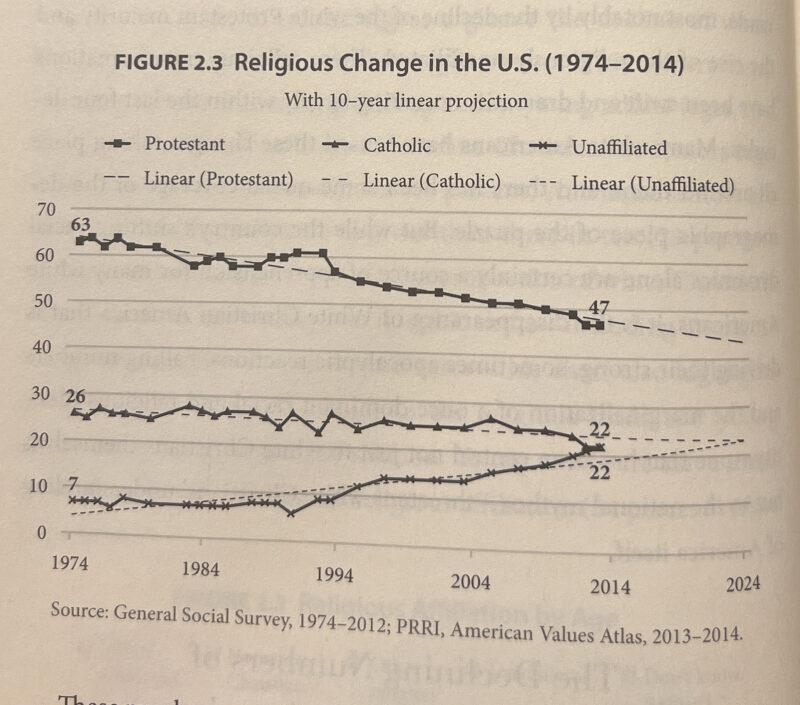
An article by Karl Vaters entitled "13 Reasons Not to Worry About the Future of the Church" offers insight into how Christians are dealing with the nosedive in attendance and affiliation they are experiencing in America. Vaters acknowledges this immediately:

The church is in trouble.

It must be. My blog feed keeps telling me it is.

For several years now, barely a day goes by without someone writing about the imminent demise of the body of Christ.

Everyone seems to have a different reason why they think the church is dying:

  • The “nones” are growing faster than the church
  • The “dones” are leaving faster than we’re replacing them
  • People aren’t singing together any more
  • Offerings are way down
  • Regulars attend less often than they used to

The post-pandemic turndown seems to be permanent in many places
But despite all the gloom and doom, I have not lost one moment of sleep over the demise of the church.

That Vaters feels no stress reveals the basic disconnect between believers and non-believers on this matter, and that gap is, I'm afraid, permanent and unbridgeable.

It's evident from the first of thirteen points he makes:

Point 1: The Church Belongs to Jesus, Not Us.

The explanation for this point is one sentence: "And Jesus knows what he’s doing." God is in control, believers insist, and so even if it looks bleak, his steadfastness is cause for calm. But this, of course, assumes that Jesus/God exists and operates the way Christians believe he does. They are not open to the possibility that the reason people are leaving religion is because they've realized the truth: gods don't exist. Instead, these people are somehow deceived or never were Christians to begin with. This seems a little obvious, perhaps even axiomatic, but the shortsightedness inherent in such a position ("We could be wrong!") means they will be in constant denial about the reality of the problem, and as it worsens, some of Vaters's more moderate positions might radicalize.

Point 2: The Picture Is Not As Bleak as We Think

His second point is an attempt to make things global:

While the European and North American church is dealing with significant issues, the church in many parts of the world is experiencing strong, steady growth. As reported at Lifeway.com, “There are fewer atheists around the world today (147 million) than in 1970 (165 million), and the Gordon-Conwell report expects the number to continue to decline into 2050.” Plus, “Not only is religion growing overall, but Christianity specifically is growing,” especially in the global south.

We could summarize this point as follows: Sure, in the West, where scientific literacy is steadily rising, religion is on the decline. But in the developing world, where scientific literacy lags, it's growing.

If the growth of your religion is most pronounced where scientific literacy is most lacking, it doesn't say much about the foundations of your religion.

Point 3: The Church Always Thrives Under Persecution

Christians have a persecution complex: they see it as inevitable because it's throughout the New Testament. True Christians suffer for their faith. This is so engrained in the Christian psyche that I'm not surprised it appears this early and only surprised that it wasn't the second point.

If persecution is coming to the American church (which is where almost all of this hand-wringing is coming from) it may reduce church attendance numbers and perceived cultural influence, but it won’t kill the church.

Prosperity is far more dangerous to the church than persecution has ever been. As the Puritan writer Cotton Mather put it in the early 1700s, “Religion brought forth prosperity, and the daughter destroyed the mother.”

This point seems more like pop psychology than measured reasoning. It also ignores the reality driving this decline. People aren't leaving the church because they have cushy lives -- not exclusively, anyway. They're realizing they don't need this in their lives anymore, and they have tools at their disposal (read: the internet) that put dissenting views and reasoning well within their grasp. They can begin by feeling church is just not for them anymore and fill that in later (as they so choose) with good critical analysis of Christian theology that makes them add, "Well, not only do I not need it but it also just doesn't really make a lot of sense when I think about it."

Point 4: Loss of Privilege Is Not the Same As Persecution

This point is actually refreshing.

The removal of the Ten Commandments monument from a courthouse is not persecution.

I’m not saying it’s good, but it’s not persecution.

There are Christians in places like Syria and Iran who know what real persecution feels like. When we claim persecution for what is a loss of privilege, we minimize the real persecution our brothers and sisters face all over the world today.

It does feel a little like Vaters can't make up his mind, though: are Christians facing persecution or not? As church attendance continues to dwindle, he might shift his opinion on this a bit.

Point 5: The Church Is at Its Best When We Are Counter-Cultural

I get the feeling that this is an attempt to be a little edgy, but it is in fact quite ridiculous:

The church doesn’t hold the reins of power well. We’re better in a burr-in-the-saddle role than being the conquering hero on the stallion. Let’s leave that role to Jesus himself.

Christianity has dominated the Western world for most of the last 1,700 years. It's had a near-total monopoly on the culture. Its myths fill our collective consciousness. For hundreds of years it had the power to compel compliance through various means (including torture). To suggest that at any time in modern history it's only been a "burr-in-the-saddle" of society is absolutely ridiculous.

This is why Christians are panicking. They are losing that monopoly. They are losing their political and cultural power. And they are going crazy about it.


Point 6: The Church Is Bigger than Our Buildings and Our Denominations

Churches are being turned into residential units, bars, and even skateparks. What are we to make of that?

We are likely to lose many church buildings in the coming decades. This will be especially challenging for churches with full-time pastors and a mortgage. I also foresee massive stress points coming for most, if not all, denominations.

I sympathize with those who love their church’s historic building and their denomination, only to lose one or both. But I’m grateful that buildings and denominations are not needed for the church to survive and thrive.

In fact, we may need to lean on our buildings and denominations less in order to lean on Jesus more.

This point is just to serve as a balm to those handwringing traditionalists who are upset about the material decline in the church, nothing else.

Point 7: The Church Is People Who Love Jesus, God’s Word, and Each Other

If churches aren't buildings, what are they?

This is one of the main reasons the church thrives under persecution. It forces us to turn to what really matters and can never be taken away – loving Jesus, following the Bible, and caring for each other.

Churches (particularly Protestant churches, especially those that align with the Evangelical movement) maintain their hold on people through the social cohesion they provide. Non-theistic churches are forming that attempt to fill this void, so this point is a non-starter from the beginning.

Point 8: The Church Has Faced Bigger Problems Than This (Whatever Your “This” May Be)

Besides, Vaters says, it's not all that bad:

Whatever your real or perceived church crisis may be, it is not “the greatest calamity the church has ever faced.”

We tend to magnify the severity of small pains that are close to us, while diminishing the reality of much larger pains that are further removed from us.

The church has faced far bigger problems than what most of us are currently experiencing, but those problems are so far away from us that they feel insignificant. The church survived them all.

But it is that bad. Christians fail, intentionally or unconsciously, to realize exactly what the problem is.

The internet is killing the church. It is exposing young people to more and more arguments against theism in general and Christianity in particular. These ideas weren't widely diseminated in times past. A thousand years ago, uttering such criticism would risk death. Now, it's everywhere. And content creators are getting better and better at presenting the dark and illlogical sides of Christanity, and Christianity just keeps throwing the same apologetics mud at them. And here, the internet applies something new: reactions to those apologetics. Discections of those apologetics. Critical analysis of those apologetics. So not only does the internet provide the initial explanation of why Christianity makes no sense, it provides answers to Christians' attempts to explain away those faultlines and fractures, and it shows apologetics to be hollow, shallow, and repetative.

Point 9: My Corner of the Church Is Not the Church

I'm not sure why Vaters put this one in here:

My segment of the body of Christ may be tied to a particular worship style, theological stance, historical background, denominational identity, or any of a wide variety of other distinctives. But the way I worship is not the church. It’s just my little corner of it. If the way I like to worship becomes less popular, that has nothing to do with the strength of the church as a whole.

In fact – brace yourselves – even if the church in America collapses, as tragic as that would be, it would not mean the end of the church.

Jesus has sheep that are not of this fold.

It's really a tweak of point 6.

Point 10: Maybe the Parts that Can’t Survive Shouldn’t

This point seems like it's going in a direction of critical self-examination.

I know that sounds harsh, and it may even be triggering for many small-church pastors who have heard something similar because of their lack of numerical gowth. But the small church is not the issue.

This is not a point about size, but of type.

Anything Jesus does will not just survive, but thrive. Eternally. So I have to wonder, if my favorite form of church is dying, maybe it’s because Jesus isn’t building it?

Everything but the church itself (as defined in point #7, above) has an expiration date. No denomination, worship style, or tradition is forever. Sometimes a congregation, tradition, or denomination dies because it has finished serving its purpose.

This point is not meant to trivialize the very real pain of a local church going through serious hardships. I stand with you. Like John said to the suffering saints in Philadelphia (Rev 3:7-13), “I know that you have little strength, yet you have kept my word and have not denied my name.” You have my heart, my prayers, and any help I can offer.

Instead, though, Vaters is simply using an old apologetics technique applied to those those who leave the faith to explain why some churches are failing: they weren't really Christian.

Point 11: The Church Is the Most Relentlessly Growing Organism In History

This, too, is a short point -- two sentences.

For almost 2,000 years of great triumphs and horrifying persecution, the church keeps going.

When Jesus builds something it tends to stand. And stand strong.

The fact that it's been dominate in the political and cultural machinary of Europe and America for centuries has nothing to do with its longevity. It's all Jesus's work.

Remember when we used to worshop Zeus? Neither do I. Worshiping Jesus will eventually seem as antiquated.

Point 12: Worry Doesn’t Work

Another one-sentence explanation: "In fact, worry makes it worse." This smacks of desparation, but I could be reading more into it than is really there.

Point 13: Jesus Told Us Not to Worry About Anything

The bottom line:

You can toss the previous 12 points. This is all I need to know.

To wildly (but hopefully not inappropriately) paraphrase Jesus’ words in the Sermon on the Mount from Matthew 5:25-33:

Therefore I tell you, do not worry about your church building, where you will worship or fellowship; or about your denomination, what decisions it will make. Is not the church more important than buildings, and the faith more important than denominational creeds? Who of you by worrying can add a single hour to his church’s life or a dollar to its offering basket? But seek first his kingdom and his righteousness, and all these things will be given to you as well. Therefore do not worry about tomorrow, for tomorrow will worry about itself. Each day has enough trouble of its own.

Whatever is of worry is not of faith.

And we need all the faith we can get.

Vaters is doing his best to cope with the coming reality, but he's still in denial, so he will never accept it when it comes.

karlvaters.com/future-of-the-church/

Monday Thoughts

School Thoughts

We received a new student on our team today: a fifteen-year-old boy from Central America who doesn't speak a word of English and has not been in school since the first grade.

I have reservations.

I'm not fussing about any extra work entailed by having such a kid in my classroom. I've already got two complete-non-speakers and a fourth kid who barely speaks English. My reservations are about how effectively I can really help these kids. They are, of course, in my lowest level classes, which means there are a lot of behavior issues in those classes. I'm supposed to create a new curriculum for these boys because they're so low with their English that modified materials don't do anything for them in my class. In science, yes. In math, certainly. In social studies, a qualified yes. In English class, though? It's impossible just to modify the curriculum. This newest student is illiterate in his first language: I can't modify my curriculum that includes standards like "Determine one or more themes and analyze the development and relationships to character, setting, and plot over the course of a text; provide an objective summary" and "Determine the figurative and connotative meanings of words and phrases as they are used in text; analyze the impact of specific word choices on meaning and tone, including analogies texts." You can't do this with pictures. Besides, I struggle teaching the native speakers these things because of their low motivation -- teaching a non-English-speaking student with the aid of pictures? Not going to happen. So I'll have to invent a curriculum for these boys.

Is that type of teaching really in these boys' best interest? Wouldn't a part-time immersion with classes like gym and art coupled with a couple of direct English instruction courses be more effective? The people at the district office downtown will say, "No, the data don't support that." But I think that's bullshit. I know from my own experience in Poland that dumping me into an environment where I didn't speak the language without any direct language instruction would have only frustrated me, and that's with me being 22 years old at that time. If I were only 14 in such a situation -- forget it.

Parenting Thoughts

The Boy's church league basketball team had their last game this evening, which sadly they lost 22-30. It was a tough season: they went 1-8. But it wasn't the losing that bothered the Boy so much; it was the unsportsmanlike conduct so many of the players on the other teams exhibited. Tonight, for example, there was one boy who screamed at every shot attempt our team made in an effort to distract our boys.

I had some choice words to say in texts to K about this kid's behavior.

"Just keep your cool," she gently reminded me.

"Of course -- he's just a kid," I replied. But that type of behavior doesn't come from nowhere. Either his parents never tried to correct him because they saw nothing wrong with it, or they actively encouraged and/or taught him to behave like that.

Were I to coach such a kid, I'd tell him and his parents, "Look, if you do that, I bench you for the quarter. You do it again, it's for the rest of the game. And every time after that, it's for the rest of the game."

The Boy's inherently empathetic outlook on things means such behavior would never enter his mind. Was that something we had to teach him? I guess we did, but I don't remember doing so, and I suspect his empathy would lead him not to do that even if we didn't explicitly teach him that.

Hearts

The Girl

School Drama

How much of drama in the school is from adult modeling, both in the popular media and the home? The norm is to be upset about something, to be stressed about something, to feel wronged by someone. It's a victimization mentality, a life lived in the passive voice and ordered by second and third conditionals. What we see on the tabloids while waiting to check out at Publix is what the kids try to emulate in their daily interactions with others, both because of what they see in the media and because the media informs the behavior of so many adults around them.

Watch any reality TV show: it is one constant conflict. Granted, it's a hyped, artificial conflict: this or that individual doesn't want to get kicked of this or that show, and the backstabbing and conniving of other participants creates conflict and heightens audience self-identification: "Hey, I've been stabbed in the back like that myself!" we say when we known someone's scheming on reality TV has paid off.

That ain’t us

"Every single kid in this class been suspended at least once."

It was a fair claim, and honestly speaking, I knew the girl who said it might actually be right. At least for half a second, that's what I thought. A quiet voice beside me reminded me that that probably wasn't the case.

"I haven't."

The shy words came from one of the best students in the class, a hard work boy who never has any behavior problems. The two girls with whom I was speaking -- with whom I'd drifted so off topic from our classwork that I felt somewhat guilty continuing it and did so only because of a perceived need to explain some basic facts to some confused girls -- the two girls just looked at him. I jumped in.

"And in fact I can show you a whole class of students that have never been suspended." I had in mind my honors group, but times are changing, and being in an honors class no longer necessarily means perfect behavior, so they argued, tossing a couple of names at me. Knowing they were likely right, I persisted nonetheless in asserting that none of them had been suspended.

Finally, the girls turned to the fatalistic refrain of at-risk kids: "Well, that's them, not us."

"But it could be you," I suggested, and one would think I'd suggested that they could fly to the moons of Jupiter by their own power, such was the looks of disbelief.

"That ain't us!" they insisted.