Three of the seven classes had a test today on passive voice. You all know what "passive" means, right? You remember getting those papers back from your high school teacher with "passive" scribbled in the margin and wondering, "What the hell does that mean?"
My handy-dandy, five-step, active-to-passive transformation guide.
1. What is the main verb?
2 .What tense is the main verb in?
3. What is the direct object?
4. What is the verb "be" in the tense from question two?
5. What is the past participle of the verb from question one?
And then -- 3+4+5=passive voice
If you're a non-native English speaker reading this, I'm sure you don't need this explained.
And that's the irony of it all. In many ways, non-native English speakers know grammar much better than thoseof us who grew up speaking the language.
There's a whole side of our native language that we native speakers don't naturally know. For example, if I were to challenge most Americans to construct a sentence in present perfect continuous tense in the subjunctive voice, there might be a bit of head scratching, even thoughthey would understand the sentence, "I would have been writing this forever if you hadn't helped." (Yeah, thatexample is a bit awkward, but it works.)
When I first came to Poland to teach English, I had no idea about many such things. For instance, what's wrong with the sentence, "I have done it yesterday"? Several years ago, though I was an English major in college, I would have had a hard time explaining. Now, it's simple: "I have done it" is in present perfect tense, and present perfect tense is used for the indefinite past. "Yesterday" is fairly definite, I would say.
Back to the issue at hand: passive voice. A sentence is passive if the subject is not the "doer" of the verb. For example: A ball was thrown. They ball had nothing to do with the action -- it indeed received the action. The active would be something like, "My mother threw the ball."
Today's test was designed to check students' ability to change sentences from active to passive, as well as to decide when a sentence should be passive and when active. Some samples from the test:
- (President / send / me / a letter of congratulations || Present Simple) A letter...
- (People / write / more books about computers / than about any other subject || Present perfect) More books . . .
Correct answers:
- A letter of congratulations was sent to me by the president.
- More books are written about computers than about any other subject.
Some involved just putting the verb in the correct tense. Sort of.
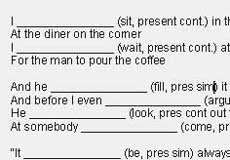
- This car ______. It's too old. (not/to steal - Future Simple)
- This street ______ because of snow. (already/to close - Present Perfect)
Among the English-to-Polish translation (a rarity in my tests) were "tree sap" and "unleaded." Results, thus far, are less than spectacular.

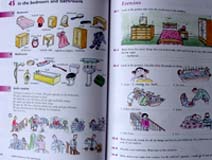
 Ever wonder what an EFL (English as a Foreign Language) textbook looks like? I certainly did as I was preparing to come to Poland for the first time back in 1996. After all, how often do you get to see a textbook teaching something you already know fluently? Naturally, after four and a half years' experience, I've seen and used more textbooks than I care to remember. I thought I'd share a little about the books I've been using.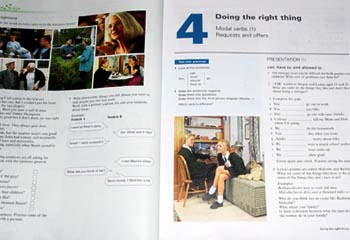
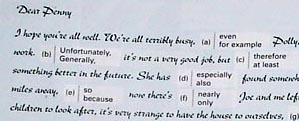
 I am a high school English teacher in a small village in southern Poland. One of the things that still amazes and annoys me, after more than six years of teaching here in Poland, is the culturally engrained habit of cheating. Simply put, the majority of students here will cheat in any and all perceived opportunities.
 Two examples show the tolerance Poles seem to have for cheating:
 But how do they do it?
 I even fail them if the appear to be cheating! I’ve told them, “If your lips move, you get a ‘1,’ because am I to know what you’re saying?” It’s excessive, in a sense, and even unfair, but I know if I’m not this strict, they’ll say, “I wasn’t cheating! I was asking for a pencil/tissue/eraser/whatever.”