This summer, the Girl developed an interest in the hula hoop.
Laughing Boy
It turns out the Boy is quite ticklish.
Making Me Smile
I was out sick today: it's hard to teach when one can't talk, and that was indeed the case for me today. Still, duty calls, and I updated my school web site to reflect the fact that I wasn't there and therefore there is no homework.

I shortly got a couple of responses from students wishing me well. It did more for my spirits than all the meds I'm now taking.
Cartoons: A Father’s Perspective
It was a gradual change, so gradual that we really only noticed it when it became a frequent-enough occurrence to get K and me talking about how much time the Girl had been spending in time out.
"Where did she get that?" we asked each other after the Girl had mouthed of again after just coming out of time out. It was a sassy, arrogant, and cruel tone of voice.
"No one talks to her that way here," I said, "so there's only one place she could have learned it: television."
For years, whenever I was walking in some department store and a voice from a little kiosk beckoned me over to look at all the advantages of Direct TV, I could stop the conversation immediately by stating semi-truthfully, "We don't have a television." It wasn't the whole truth: we had Nana's and Papa's old television in the computer room hooked up to a buggy DVD player, but "We don't have a television" was more convenient (and close enough to the truth) than "We have a television, but it's only hooked up to a DVD player; we have no cable service, and we're not interested in it." Somewhat reluctantly, though, we bought a small home theater system a year or so ago, and now that it's wirelessly hooked up to our Netflix account, we can sort of watch television like "normal" people. It led the Girl into whole new realms of cartoon viewing.

Ay, there's the rub.
"Where could she have gotten it" was only a rhetorical question because we both knew that she had spent time only with family and one close friend -- not enough to explain the attitude, the sass, the trying to act like a grownup in five-year-old shorts. We sat and discussed the situation, narrowing it down quickly to two cartoons in particular: Horseland and the newest incarnation of My Little Pony that includes the deceptive subtitle, "Friendship is Magic."

I thought back to all the snippets of these shows I'd watched -- and a couple of episodes I'd watched almost entirely -- and realized that both shows have characters that behave in just this sassy, nasty manner. "Well fine. I never liked it in the first place!" Things like that. Sure, by the end of the episode, all has worked out (after all, "Friendship is Magic"), but the behavioral model was still there, and the Girl had picked up on it.
We sat down with the Girl and talked about what was going on. Informed of our decision to eliminate Horseland and My Little Pony as well as to curtail general television watching, the Girl sniffled a little, but seemed fine.
A couple of weeks passed. I'd even forgotten about the two offending shows. Then:Â "Have you noticed how much L has changed in the last two weeks? The snotty, sassy little brat has disappeared and our sweet girl has returned."
This brings up the obvious question: what affect do media have on children's behavior? In many ways, it's certainly a chicken/egg mystery: culture influences what is acceptable in the arts (and I use that term loosely with most television programming), and the arts in turn teach members of society (often unawares) what acceptable society members find interesting and amusing. I know for certain, though, that the behavior modeled in the cartoons showed up in our daughter. This might be a function of age: younger children are less critical of the influences that affect them. Yet once a model, always a model: it seems that the longer one watches television uncritically, the more of an unconscious influence it exerts. Certainly that's what advertisers count on, to some degree.
But was it always like this? Were cartoons always issues of concern with parents? I certainly remember comments from my parents about how violent some cartoons are. Episodes of Tom and Jerry, Roadrunner, and many others always involve seemingly countless instances of extreme violence, acts which children are supposed to laugh at -- and do laugh at. Yet it seems more likely that a child will take on the sarcastic, disrespectful tone of voice she hears in an episode of Horseland than, say, she will drop an anvil on a friend's head. Then again, tone down the severity of the violence to a slap and I suppose they're equally likely. Still, tone of voice is something that is not even necessarily regulated automatically in children, so it seems more influential. To see the changes since I was watching cartoons, though, one only has to look in an average classroom to see that the uptick in general disrespect is significant, whereas there was never a real corresponding increase in violence (though there has been a significant increase).
The change is most noticeable when comparing today's cartoons to some created in the 1950's and 1960's. Still more noticeable are the differences compared to cartoons from that era that rely totally on visuals. I'm thinking here of two shows in particular.
Koziołek Matołek
Originally a comic from the 1930's, Koziołek Matołek ("Matołek the Goat") follows the adventures of Matołek as he searches out a mythical city were goat shoes are made. Matołek is goofy, clumsy, and a bit silly, but always naive and pure.
Krtecek ("Krecik" in Polish)
An import from Czechoslovakia, Krecik was the product of the 1950's, and it shows. The first episode shows a certain kind of self-reliance common to the times but strangely foreign to most of us today, and it certainly illustrates a kind of innocence lacking in many of the cartoons the Girl is drawn to.
Further Information
Saturday Break
We woke up to rain today. "We probably won't be going for soccer," I think as I poured my first cup of coffee. And the thought didn't break my heart. Still, knowing the Girl had the second game of the day, I decided to drive over to the field, only four or five miles from out house, to see if there were indeed games. I'd heard somewhere that the general rule for determining whether or not to play a soccer game is if the ball bounces when dropped from the waist. If it bounces, the game begins. But I wasn't sure what it would be like for four- and five-year-olds. I arrived at the field in a drizzle to find everyone playing as if nothing were happening. Still, the Girl has a way of getting a nasty cough very easily, so K and I decided it would be best not to go.

We were fairly certain the Girl would be a little disappointed. I saw the patch of dry pavement on the road and thought L would surely see that and certainly use that as justification. "See? It's drying." And so I was a little surprised when the reaction to "Sweetie, we're not going to be able to go play soccer today" was "Yippeee!"
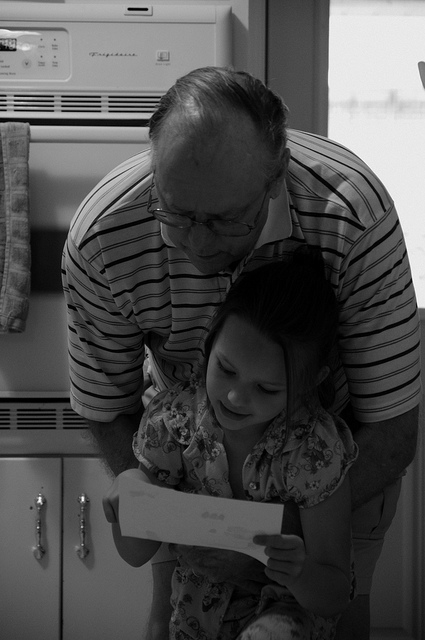
We ended up staying home most of the morning, with Nana and Papa coming for a visit and then L going to spend the afternoon at their place -- after a math lesson in the kitchen.

For E, there were very few changes in the routine. Eating, giggling, pooping, sleeping. Repeat.
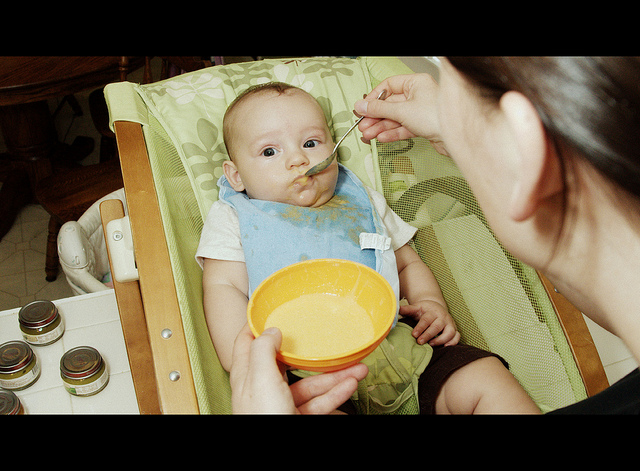
After some weeks, such a Saturday is just fine.
Punctuation
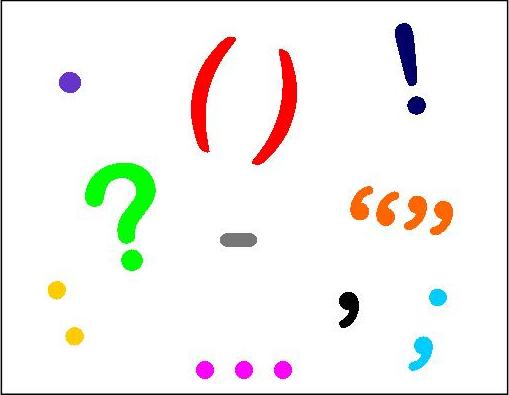
As a teacher, I see all kinds of creative use of punctuation. Some of it makes me smile at its novelty; some of it makes me groan. Each punctuation mark has its own difficulties.
The semicolon is something mysterious: students are a little in awe with its presence and slightly intimidated. The more ambitious students want to use it, and indeed try to use it, to varying degrees of proficiency. "It's a bit like a super-comma," I sometimes explain, "and kind of like a weak period." We do some work with it every now and then, but it's a little like taking young divers to the 10 meter platform when they're still nervous at 3 meters.
The comma is exhausted. It pops up in places where one never expects it. Sometimes, it appears after a form of be, lingering there to reflect the writer's reflective pause: "The problem is, I don't know what to say." And in between "is" and "I," the tell-tale comma lets us know what went through the writer's mind: "What is the problem? I'm not quite sure how to express it, or I'm not even sure what it might actually be."
The period is unreliable. Sometimes it goes AWOL for thought after thought, with a comma occasionally taking up the slack. Often it disappears without a trace. Every now and then, it gets over eager, jumping in at the end of prepositional phrases or subordinate clauses to create fragments.
The colon really is a phantom, a boogie man only rumored to exist and used to scare children into grammatical submission. "It's like a big arrow, a big pointer," I sometimes try to explain.
Quotation marks occasionally hang around, apostrophes are overly possessive, em- and en-dashes run about, and silly jokes abound. But most days a properly placed punctuation mark can make my day.
Over the Shoulder
It used to be something of an obsession. “What was I doing around this time X years ago?” I’d ask before opening up my journal for that month some years earlier and reading to see what happened. Yet what if I’d had a way to thumb through pictures the way I thumbed through my journal entries? For most of my life, I had about as much interest in photography as I had in basket weaving. Then I moved to Poland. And a couple of years after returning to the States, I moved back to Poland, then armed with a digital camera. And so I can open up a photo viewer and easily look over my shoulder.
September 2001: I’d just moved back, and I was still taking daily walks in the fields behind the house where I rented a room. Such pictures now seem almost unreal: did I really live there?
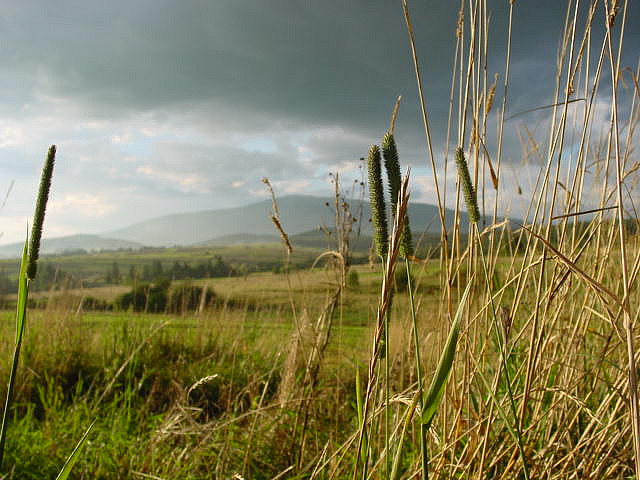
September 2002: The fascination remained. I was still talking almost daily walks in the fields, heading up to a small patch of trees known to locals as “Cats’ Castle”, watching the sunset from various locations, impressed that the church was visible from almost every point in the central part of the village.
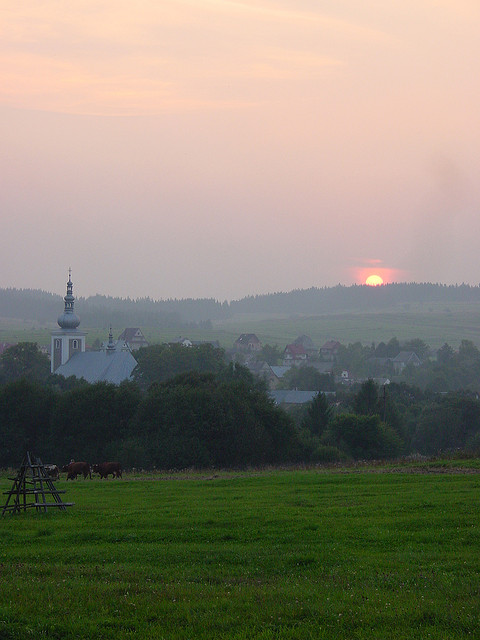
And then an empty year. Did my computer crash? Did I not take many pictures? Whatever the cause, September 2003 is void of pictures.
September 2004: K and I had just gotten married. We’d brought all our lovely wedding gifts — the glass paintings and various prints — to my apartment which was then our apartment. We looked through pictures of our wedding and spent lovely afternoons creating photo albums.

September 2005: Back to the States, to Asheville. “This is where I want to live,” K said the moment she saw the small town surrounded by mountains. It was understandable: it looked so much like her own home. And have a few lovely parks about didn’t hurt either.
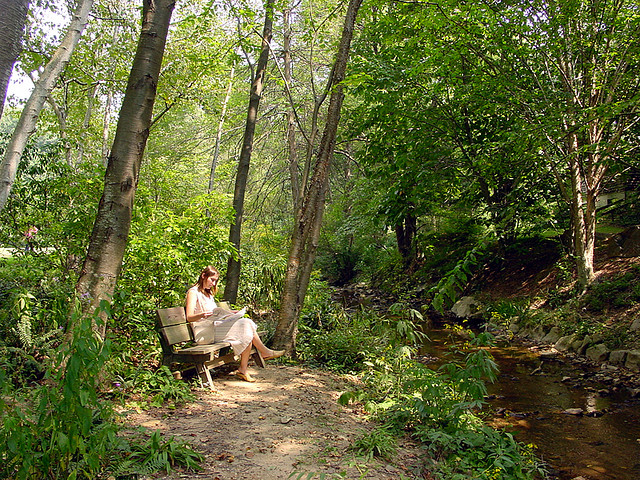
September 2006: The Girl was just a few months away. We’d heard all the stories, but who can really prepare for how a child is going to change one’s life?
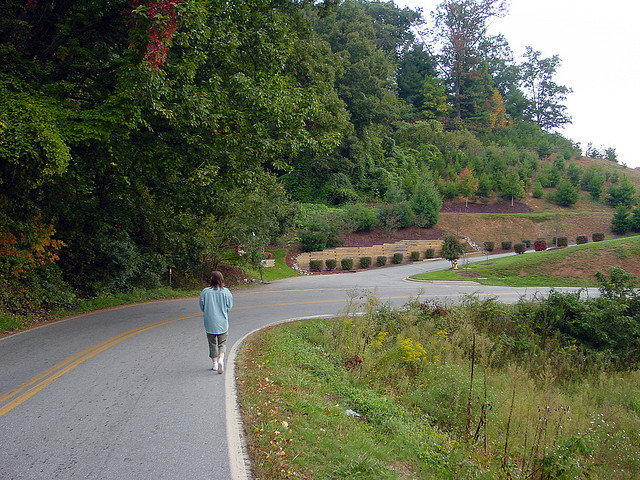
September 2007: The Girl was with us, and already showing her precocious nature. She sat only to roll; she crawled only to crash; she lived only to giggle and fuss.
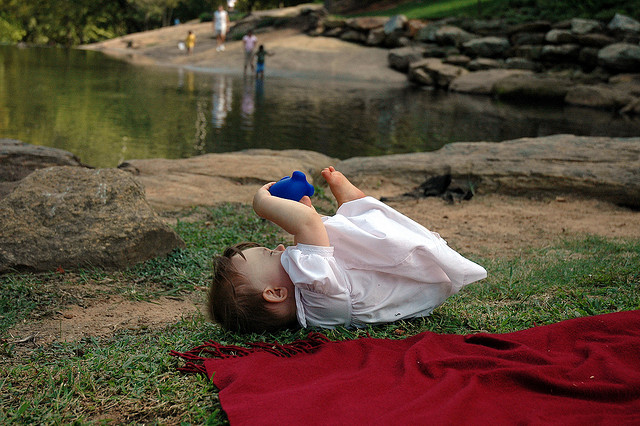
September 2008: L, able to walk, began asserting her independence. The innocence would surely linger?

September 2009: Independence increased.
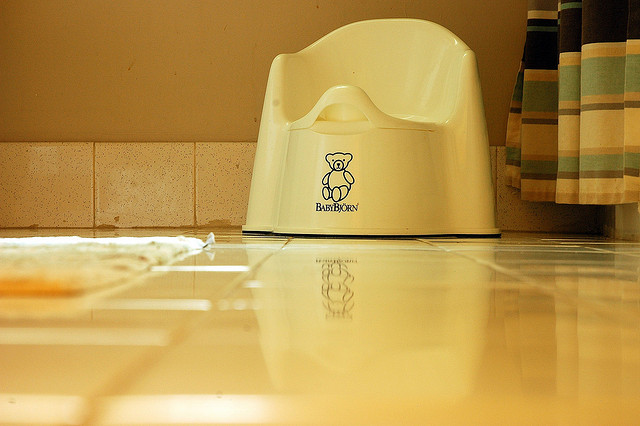
September 2010: We learned quickly that owning a house is owning a project. A never-ending, always-bank-account-draining, eternally-exhausting project.
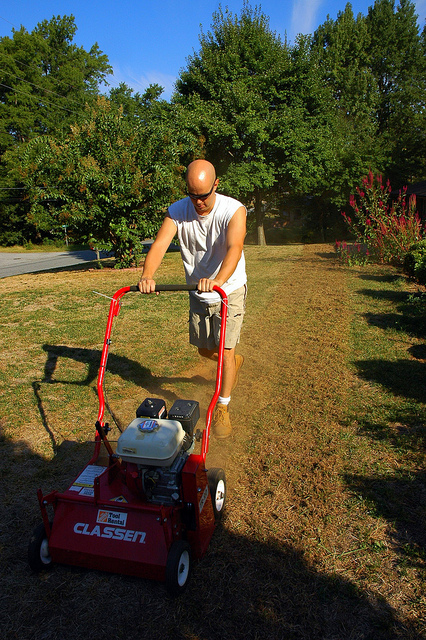
September 2011: Where did that baby go? Certainly she’s somewhere around here?
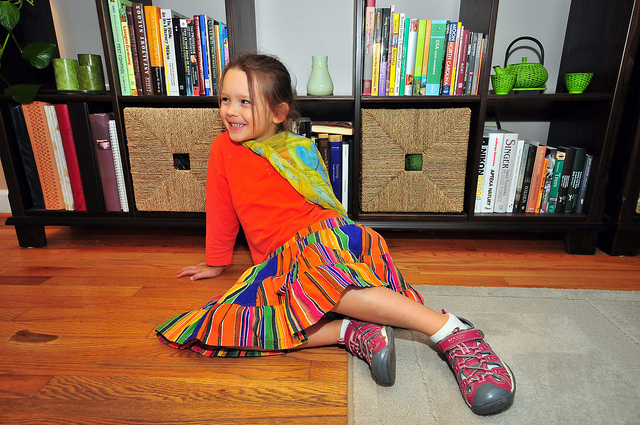
September 2012: If I could have glanced forward in time from 2001, surely a wife, two children, a house, and a cat on a tired Wednesday night would seem just as unrealistic as the fields of Lipnica Wielka seem to me now?
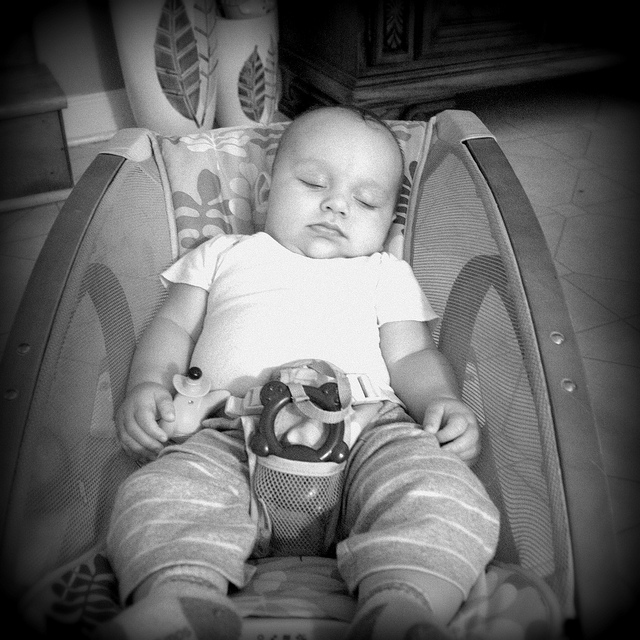
Down
Routine is everything. Naps come like the tide: they're regular and predictable, and there's no stopping them. We come home for the day, and fairly soon, the fussing starts. The tired fussing.

And soon enough...
Homework with the Girl
She sits at the table — fewer distractions — and draws. “Draw three pictures each of things that begin with the letters P, Q, R, S, and T.” It’s getting close to the Girl’s bedtime, and as we know she is a perfectionist, we encourage her to choose examples that are easily drawn.
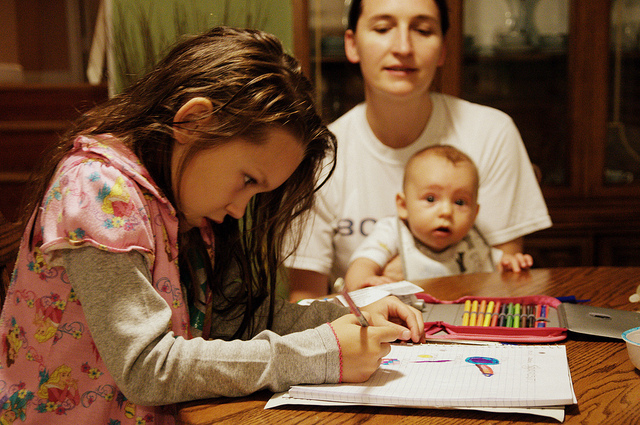
For “P” she settles on pot, pencil, and potato. “Q” seems tricky, but the Girl thinks of quilt, question mark, and Q-tip. “R” yields red (my own idea that got the Girl giggling), ring, and rain. For “S” she ends up with snake, sun, and star. At three objects per letter and twenty-six letters in the alphabet, we’re looking at more than seventy-five drawings over the next few days.
A bit much?
Autumn Sunday
The sky always seems somehow a little richer, a little deeper blue in autumn. I suppose it has to do with angles and refraction as the Earth tilts the northern hemisphere away from the sun and the southern hemisphere toward it.
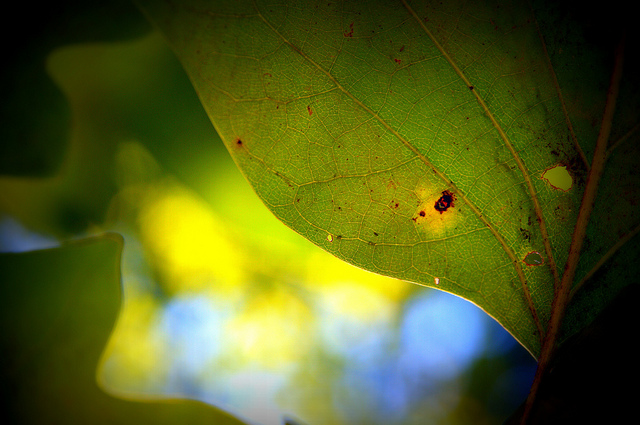
Somehow, though, the light just feels more relaxed.

We in the south finally begin coming out to play at this point in the year. Triple digit heat indexes don’t do much to encourage the average South Carolinian to spend time in the park, kicking a soccer ball around or playing on the jungle gym. (And even if one wanted to, the equipment would be much to hot to touch, and forget about the sliding board.)
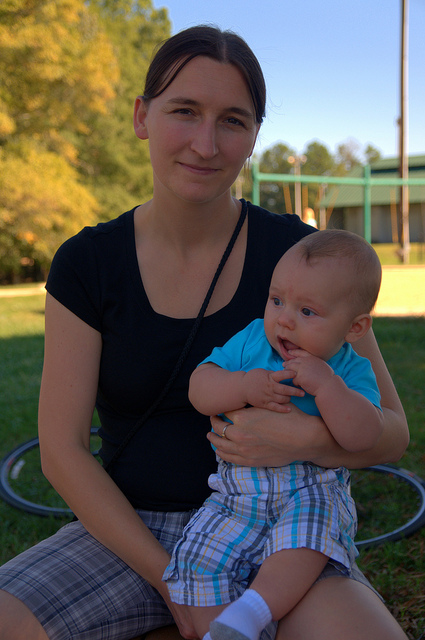
So today, with temperatures only in the mid-seventies, the four of us went to a favorite park for some swinging, sliding, and soccer practice.
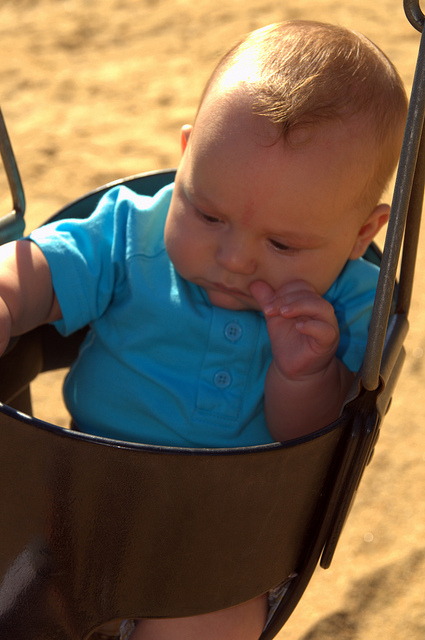
The Boy sat briefly in a swing for the first time. The seat seemed still to swallow him, and his general inability to support himself combined with his love of peering forward made the prospect short-term at best.
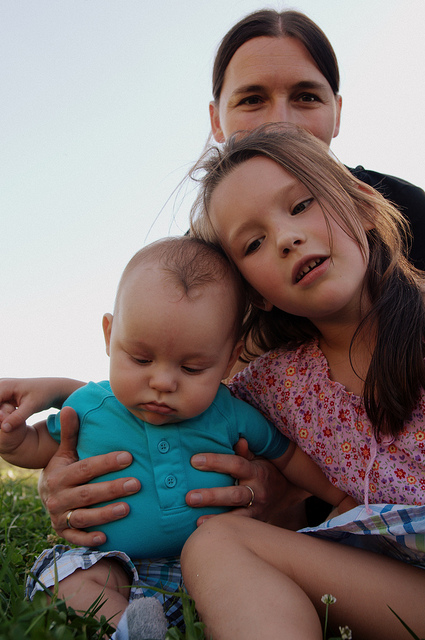
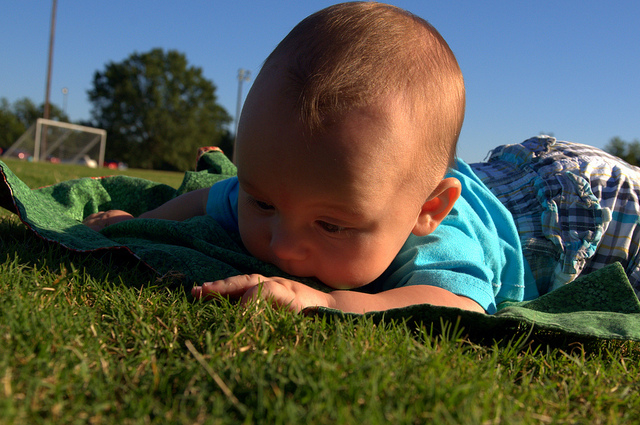
But there was always the grass. Fascinatingly green, unfamiliarly scratchy, generally puzzling for the Boy. He’d likely have put some in his mouth if he’d realized how easily it could be done. The whole world would go in his mouth if it could fit, piece my piece, chunk by chunk.
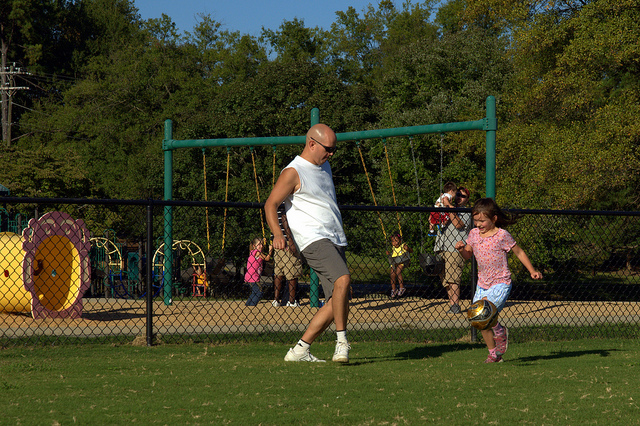
L and I, though, were ready for some practice. With her speed, she can easily outrun most of the players on the field in her Saturday soccer games, so we worked on a new tactic: running as fast as possible while still kicking the ball.
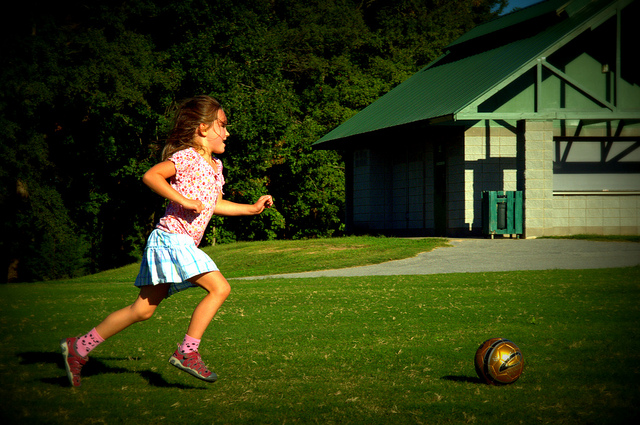
“Just kick it out in front as far as you can,” I explained, “then run — run as fast as possible. You’ll beat everyone to the ball. Then just do it again.”
We also worked a bit on defense.
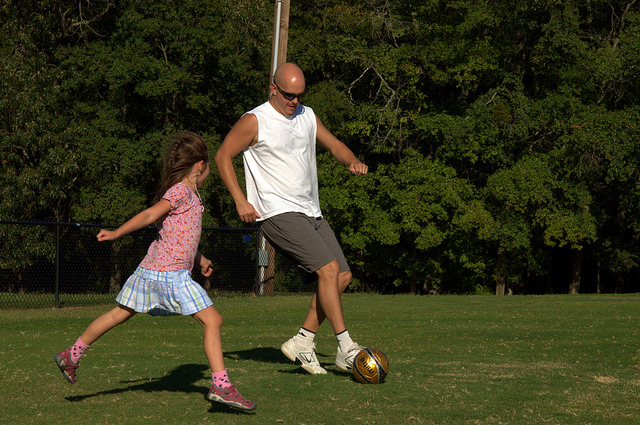
And the Boy finally got a closer look at that grass.
First Loss
It had to happen. And perhaps it was good that it did: L’s team lost their first match today, 8-2. With a point difference like that, it was a stinging first loss. Things just weren’t going as they usually do.

“That team was the best team we played,” L explained. Three young men in yellow managed consistently to stop red team’s offensive charges while also proving themselves to be exceptional ball handlers when on the attack.
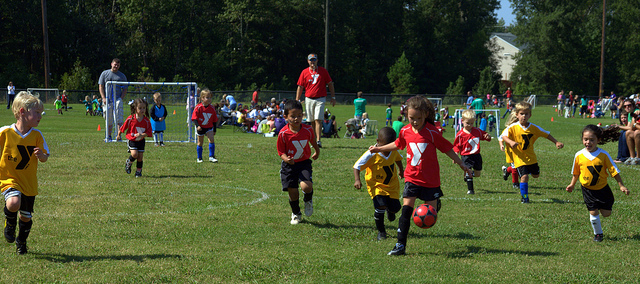
“There were some boys on that team that were really good,” L explained later in the day. It gave her, I hope, a view of what’s possible.
Boosterthon
It’s half bet, half bribe. It’s a fundraiser, an exercise event, and certainly for some, a bit of a pain.
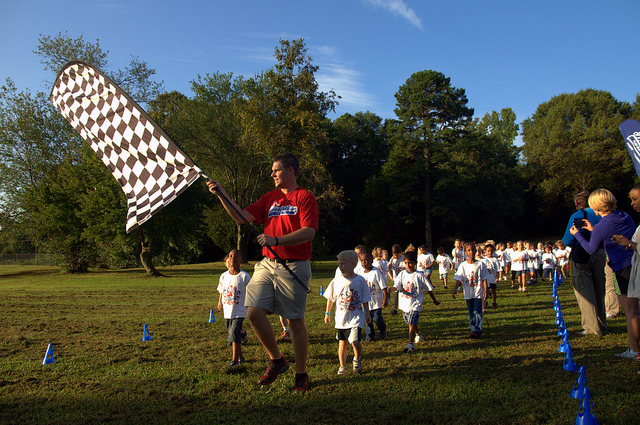
I suppose one might argue that it’s an exercise in school spirit and self-confidence. Elementary school activities, we’re finding, tend to combine several elements like that. Show, exercise, fundraising, dance party — I suppose it covers several state educational standards.
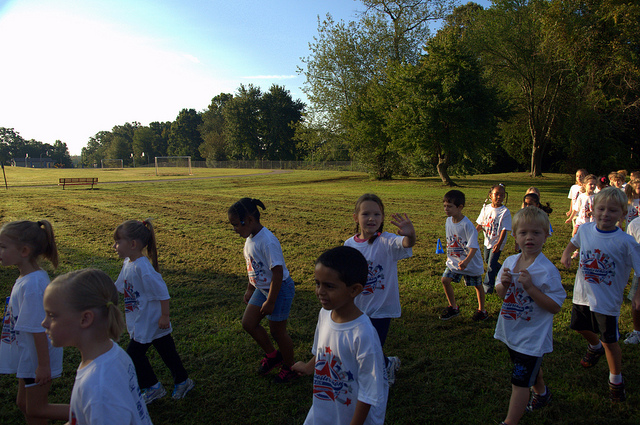
For “the biggest fundraiser for the year” at her school — so it was explained at a recent PTA meeting — L had to gather pledges for a run around a small, 1/16th of a mile route set up in the field behind the school. Nana and Papa pledged a significant amount per lap, adding a cap as assurance of not having to mortgage the house to pay their commitment.
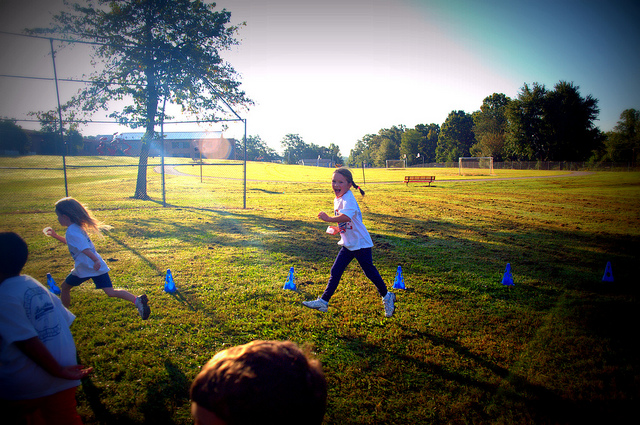
Sure enough, when it came time to run — and hop, skip, walk, dance — through the boosterthon, the Girl did the maximum 35 laps.
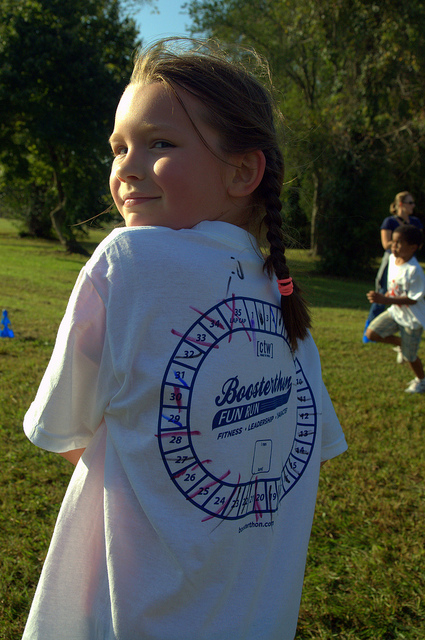
Which amounts to just over two miles, which is fairly impressive for a five-year-old.
Ritual
It is late, and K is trying to get the Boy to sleep. He tosses and moans, turns and groans, rolls over — his newest trick — and seems reluctant to cooperate.
“If I feed him one more time,” she asks, “will you be able to hold him?”I stop grading papers.
“Of course,” I say.
Soon after, I’m making laps, walking a now-well-worn path through our living room, past our front door, through our kitchen, past the carport door, and looping back into living room. Repeat.
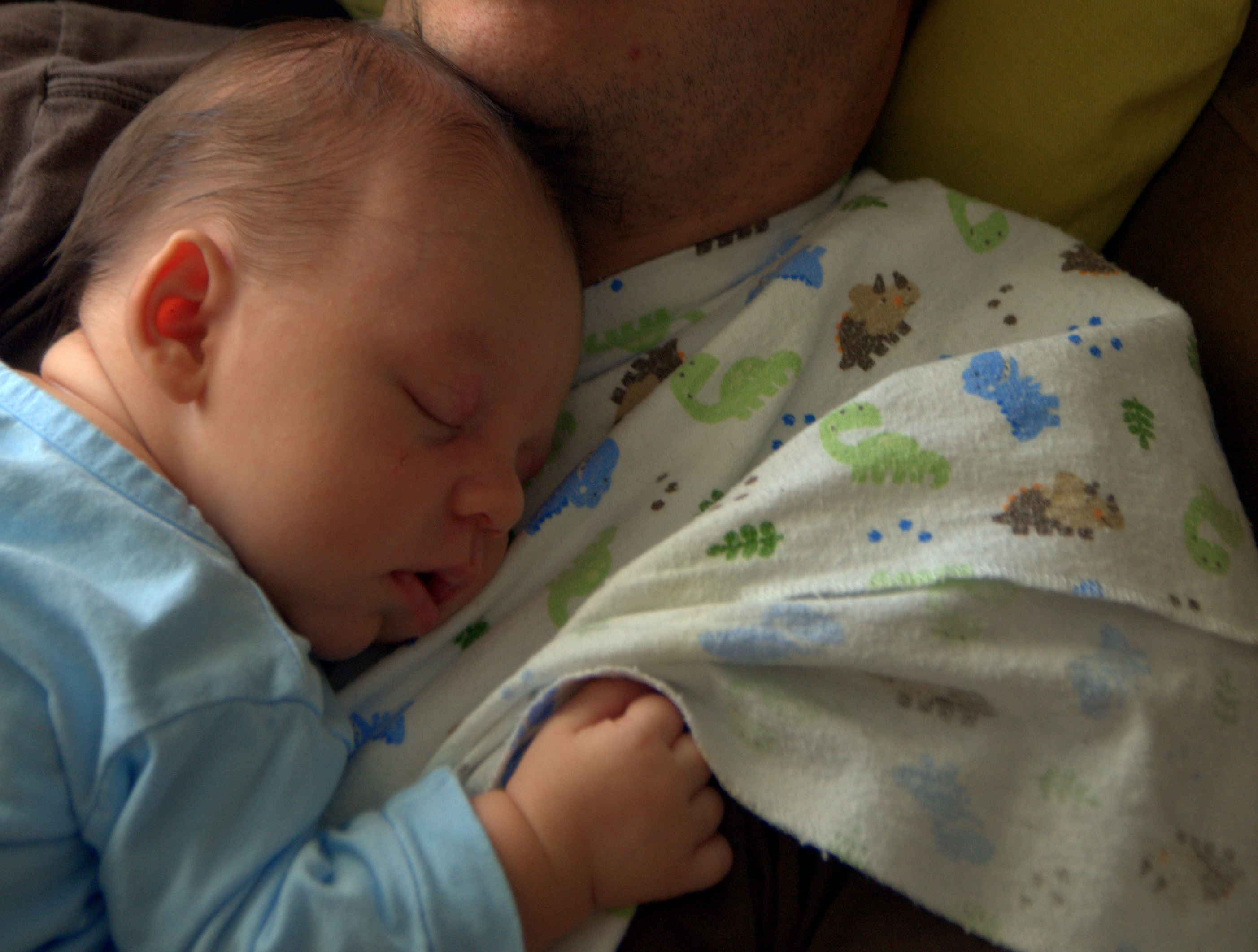
The Boy’s head rests on my shoulder. His arms dangle to the side. When the Boy was a newborn, K or I walked this lap every night, every morning. Eleven PM. One AM. Sometimes three AM. Five AM. Still shuttered in sleep, our consciousness had difficulty doing little more than counting the steps in the hopes that we could ultimately transform the exercise into a variant of sleepwalking. It has grown easier though he has grown heavier: the body grows accustomed to less sleep with time.
Now, all nineteen pounds rest in the crook of my left arm while my right hand holds an iPod into which I whisper this evening’s post. These solitary laps in near-darkness with a sleeping child on my shoulder lead to contemplation unlike anything else I know.
The floor creaks at a certain point and as the summer as progressed, the area which creeks seems to have expanded deeper and deeper into the living room. Every night when I make my rounds, I think to myself, “I need to look on the internet how to fix a creaking floor,” but I’m afraid the job will require more work and time than I am able to devote to it now. And so I simply keep walking, listening to the creak grow quieter, counting the steps it takes to reach silence, wondering if I’ll ever be able to fix it, doubting that the time will ever come. It’s just one of the countless projects that hangs over my head like Damacles’ sword. I know I must get there are some point. I know that while I’m building up the life of my son, I’m allowing other parts of life deteriorate. But it’s easier to fix a squeaking floor that has overtaken the entire downstairs area.
On the kitchen side of the round, where the floor doesn’t squeak and squak, E’s shallow, slow breathing marks a counterpoint to the padding of my feet. Perhaps we are establishing a rhythm between us, the rhythm of all fathers and sons: never quite in synch but like counterpoint, ultimately complementary.
Sitting
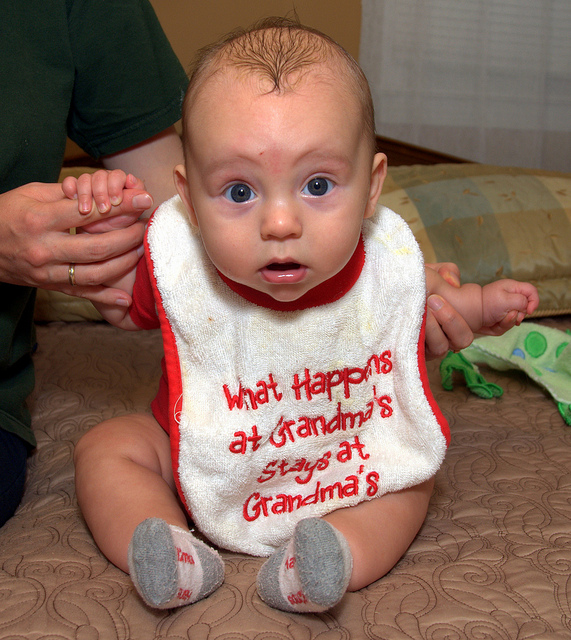
The Boy so wants to sit. If only he could keep his balance.
Goal! Again!
Game two. The Girl sits out the first quarter. After her adventures last game, perhaps that’s best — start slowly.
When she enters the game, she volunteers to be the goalie. It’s a potential disaster: I anticipate her frustration if she lets a ball get through. She’s doesn’t take mistakes very easily, and I know as goalie, she’s likely to experience them — especially with number five on the opposing team, who seems to steamroll through the defense like a panzer column.
Sure enough, within a few moments of the start of play, the Steamroller Five comes barreling at the Girl. She pulls up a little short and shoots; the ball approaches L with decreasing speed. She bends down; she’s in position.
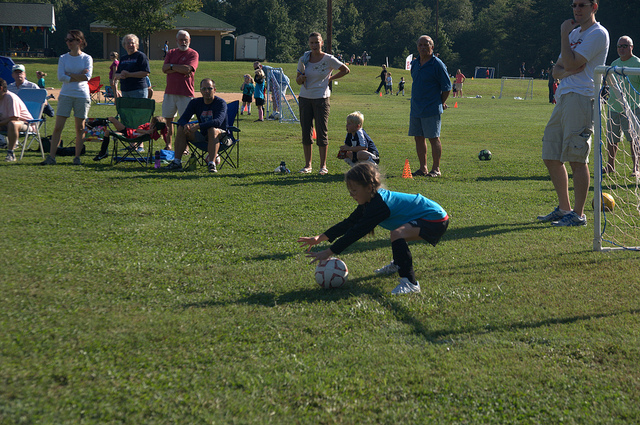
And the ball rolls right through. Instant frustration; intense irritation. She begins marching to the coach, tugging at the goalie jersey the team shares, when I call her back.
“No, sweetie,” I begin. “You have to stay in. This is your position. We can’t substitute right now just because you’re a little frustrated. But don’t worry — it’s your first time out. You’ll get the hang of it quickly enough.”
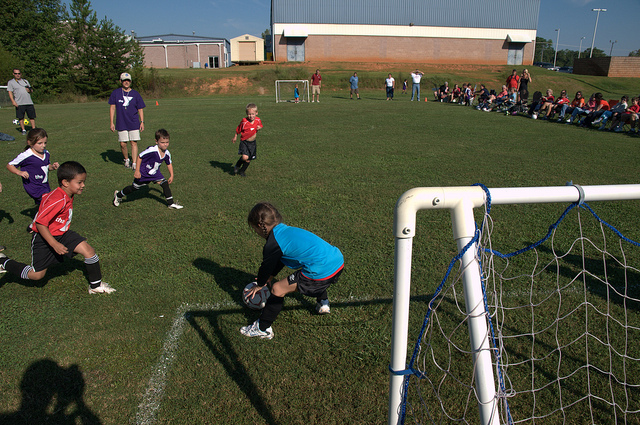
And the next time Steamroller Five shoots, the Girl makes the save. She makes a few more as the game continues, but come the second half, she’s ready to go on the offensive.
Her first goal is an act of pure aggression. The goalie makes the mistake of not controlling the ball fully, only gently resting his hands on the ball. L simply takes the free kick.
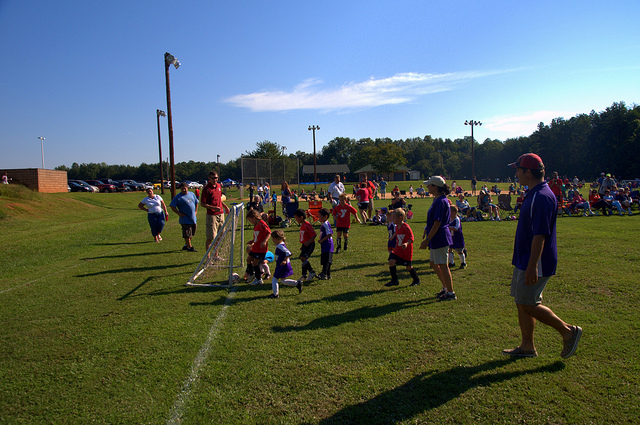
Her second goal of the the day, though, is a beauty, a joy to watch. She emerges from a pack of defenders and faces off with Steamroller Five, who’s been playing masterful defense the whole game. Just before Five can reach her, the Girl lets loose on a cross-goal shot.

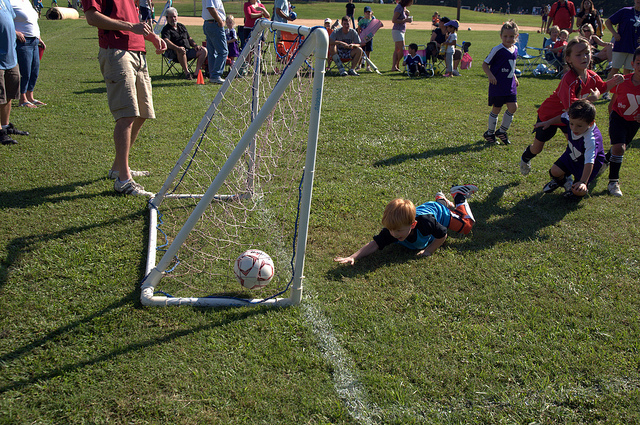
that blasts past the goalie — himself a wonder. He’s been stopping shots left and right, and he’s not afraid to dive
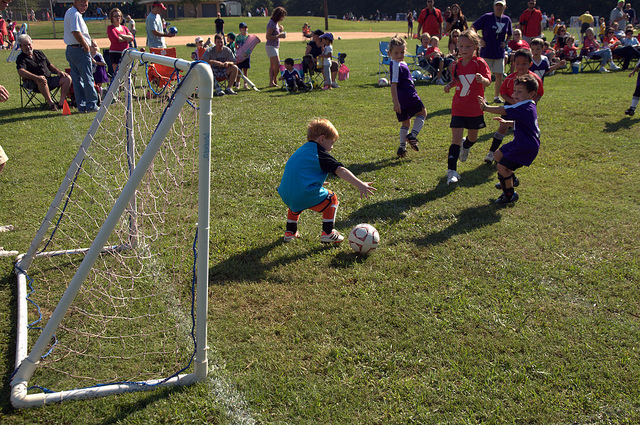
This time, though, he’s a little late. The ball squirts past; Steamroller Five looks on; L collides with a defender — it’s straight out of the World Cup.
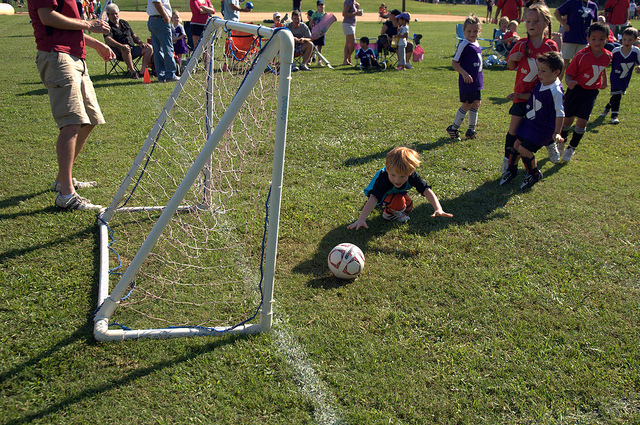
The shot just catches the bottom corner of the goal, with the goalie still refusing to give up and the Girl realizing fully she’ll be on the ground momentarily.
So with two games down, we have the stats that might just encourage her to continue. She’d probably like it more if she could wear a tiara, though.