matching tracksuits

fun in threes, sometimes fours

Fences and Guardrails

"God just puts these laws in place for our protection!" seems to be a common apologetic response to criticism of the laws of the Bible and the sense of absurdity some of them engender. There's even a cartoon about it.
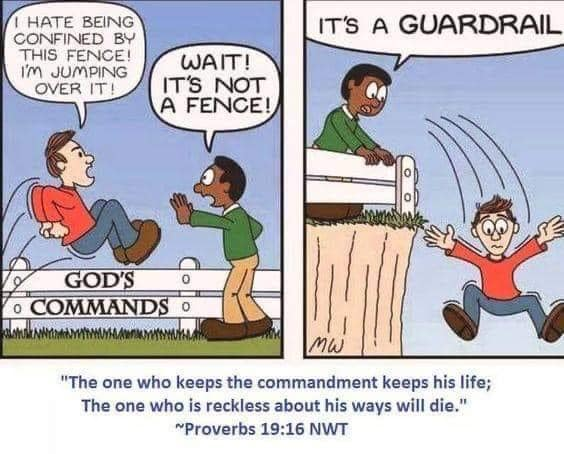
This is such a silly cartoon -- it shows the absurdity of the argument better than apologists recognize. Most basically, the things that this god's law supposedly protects us from were created by that god himself! He made all the universe, according to apologists. He created all the laws of physics. He created all the contingencies and consequences. In other words, to relate it back to the cartoon, he created the fence ("guardrail") and the cliff. And he put the guardrail right at the edge of the cliff.

To turn it back to Christianity itself, this god created the laws and the consequences for breaking them (i.e., eternal damnation). If it were any other way, he would be dealing with something he didn't create.

This also plays into the idea of Jesus's salvific sacrifice. He's saving us from the consequences of breaking some god's laws. The trouble is, according to the doctrine of the trinity, he is that god! He's saving us from himself.

No matter how many times I point this out to believers, they just don't see it. They bring up free will and all that: "God created us with free will, and we can abuse it and reject God."

"Yes, but this god put in place the laws and their consequences. He's the one sending you to hell and then saving you from it," I reply.

"Yes, but he loves us so much that he sacrificed himself for us, to pay our debt."

"Our debt to him!" I want to scream.

If I am beating a child and then stop beating that child, I haven't saved him any more than the mafia, when receiving payment, is not saving you from anyone other than themselves.

How do they not see this?

Experiments

The Boy and I were experimenting with the new phones.

Mine was somewhat less flattering.

Definitions

“I was just here a little while ago,” E lamented as we neared our parish church for basketball practice tonight.

“Why?” asked N, genuinely perplexed. N is a dear friend but not a member of the church.

“For religious education,” the Boy explained.

“What’s that?”

“It’s like school,” E said.

“What do you learn about?”

“Church.”

“That wasn’t a very informative answer,” N pressed.

“Well, we learn about,” the Boy pauesed for a moment before finishing, “well, it’s about everything church.”

“That still doesn’t tell me much,” N insisted.

“Well, today we learned about sacraments,” E clarified.

N thought for a moment before admitting, “I don’t know what that is at all.”

When I was N’s and E’s age, I, too, would have had no idea what a “sacrament” might be, and I certainly would have no idea what it’s supposed to do. According to the Catholic Church, sacraments are “outward signs of inward grace, instituted by Christ for our sanctification.” Even if someone told me that, I doubt I would have understood what any of that might mean.

Outward sign? Simple enough.

Inward grace? Not sure what “inward” means here, and even now as an adult, it's not clear. I suppose it's meant to be juxtaposed with "outward" to create an appealing bit of parallelism. But are we talking internal medicine "inward" or are we talking mental inward? Or are we talking spiritual? Of course, that doesn't even exist, but if they meant "spiritual" why not say "spiritual" instead of "inward"?

I certainly wouldn’t know what “grace” means here. I would have known "grace" from a basic Christian idea of forgiveness, but beyond that, I'm lost. And what's an "inward grace"? Are their other kinds of grace? What does the Catholic Encyclopedia say?

Grace (gratia, Charis), in general, a supernatural gift of God to intellectual creatures (men, angels) for their eternal salvation, whether the latter be furthered and attained through salutary acts or a state of holiness. Eternal salvation itself consists in heavenly bliss resulting from the intuitive knowledge of the Triune God, who to the one not endowed with grace "inhabiteth light inaccessible" (1 Timothy 6:16). Christian grace is a fundamental idea of the Christian religion, the pillar on which, by a special ordination of God, the majestic edifice of Christianity rests in its entirety. Among the three fundamental ideas — sinredemption, and grace — grace plays the part of the means, indispensable and Divinely ordained, to effect the redemption from sin through Christ and to lead men to their eternal destiny in heaven.

Source

Look at all those links -- they're all articles to offer further explanation about the various ideas.

“Sanctification?” No idea then as now. The Catholic Encyclopedia lists "grace" as "sanctifying grace" and has an article on the related topic of justification but nothing on sanctification. It's all just a confusing mess when you really look at it:

Since the end and aim of all efficacious grace is directed to the production of sanctifying grace where it does not already exist, or to retain and increase it where it is already present, its excellence, dignity, and importance become immediately apparent; for holiness and the sonship of God depend solely upon the possession of sanctifying grace, wherefore it is frequently called simply grace without any qualifying word to accompany it as, for instance, in the phrases "to live in grace" or "to fall from grace".

I suspect most adult Catholics wouldn’t be able to explain it beyond the memorized explanations they might have learned in religious education. Push these ideas a little and they begin to slip and slide for the average believer; shove and heave on these ideas and they begin to crack for the average parishioner.

Apologists would explain that this is due to “insufficient catechesis.” But eventually, even the most expert catechist is going to run out of answers. Or they're going to begin saying stuff like the quotes above, which sound elevated and sophisticated but which, when really examined, are empty and relatively meaningless -- when someone pushes back hard enough.

N, however, was content to sit in ignorance.

Greenville News Video

Discovered a video from the local paper about L's high school's big state championship win. And there on the thumbnail is the Boy.

Conestee

The Show

50

Village Reality

Conspiracy Theories

This woman has watched too much Scooby Doo.

Slippin’ and Slidin’

Got into a discussion on Twitter with a Christian about morality. I made the point that Christianity invents the idea of sin (the transgression of a diety's law) and then sells the solution (Jesus). My interlocutor quickly moved to the "you have no grounds for morality if you don't believe in a god" argument. I said,

I know what you're getting at. I've seen it all before. It's a tiresome road to travel down. Your god commands the stoning of incorrigible children (Deut 21:18-21), so I don't think believers in the Bible can take the moral high ground as you're trying to do.

The interlocutor replied,

What you just cited was never Carried out. Even the Talmud says this. This was stated by Moses to put fear into GROWN children to obey the commandments to love their mother and father.

To which I responded,

Carried out or not, it was commanded. By your god, no less. You can't deny that. The fact that it wasn't carried out goes against your assertion that morality comes from your god. If it wasn't carried out, it means people realized it's a sick command.

To which she replied,

How could my God command it if he doesn’t exist?

I answered,

Just because I say "Juliet made a bad decision" doesn't mean I have to believe she existed. I'm working within the framework of your holy book. It's that simple.

What I learned from this exchange is the slithery, slimy nature of religious discussions. One topic slides off to another and to still another. Exhausting.