general
Confirmation Bias
What does it take to change a "Stop the Steal" Trump supporter's mind about the election? What about an outside opinion, reported in the Wall Street Journal?
A team of international observers invited by the Trump administration has issued a preliminary report giving high marks to the conduct of last week’s elections--and it criticizes President Trump for making baseless allegations that the outcome resulted from systematic fraud. (Source)
But see, it's not so easy for Trump supporters who reject the election results. They're predominately Evangelicals. They read the Left Behind series as history written in advance. They believe in an antichrist -- probably the pope -- who will literally perform miracles. They think that all the world will bow down and worship this man. They won't see this as confirmation that the election is fair; they'll see this as proof that it's an international conspiracy. This culminates, they believe, in the creation of a one-world government that will strip America of its sovereignty as part of the coming tribulation.
They won't see this as confirmation that the election is fair; they'll see this as proof that it's an international conspiracy. They will see this as part of the grand prophetic end of the world.
You can't reason with that. It's a faith as strong as any other, as strong as their faith that God will somehow deal with the coronavirus (those who believe it's real, that is) and pray for it despite evidence to the contrary. Nothing counts against that faith. If someone goes through the pandemic without falling ill, it was through God's grace. If someone falls ill but doesn't become overly sick, it's due to God's mercy. If someone falls deathly ill and has lasting complications, it's God's grace that he didn't die. And if someone falls ill and dies, it's God's mercy because he's gone home to the Lord. Nothing counts as evidence against that kind of faith. If nothing counts against it, if there is no way to falsify it, it's not a rational belief but merely a warm feeling.
Transfer that to the election: these Evangelicals see conspiracy everywhere. It's in the DNA of their religion. To forsake that is to forsake their very faith.
The Girl, 2010
Ten years later and games with balls still hold a central spot in her orbit.

I look at three-year-old L and remember thinking, “What’s she going to be like in ten years? How will this young face develop? How will her personality develop?” Now we know, and we see all the seeds were already sprouting in the three-year-old L.
Chatting
Living with a thirteen-year-old is a challenge. “I don’t know how I survived your eighth-grade year,” Nana told me when I got my job teaching eighth graders. Now that I’m teaching them and living with one, I see her point. Their astounding knowledge puts to shame everything I ever thought I knew, and often they realize it’s just not worth it talking to an idiot like me.
Until they do.
Until they sit at the dinner table and chatter on and on about their school day simply because I told a story about playing dodgeball as a kid with the hard, unforgiving kickball balls we used.
“Don’t worry,” I tell L when her behavior frustrates me. “You won’t always be thirteen.”
“You always tell me that!” she responds.
“I’m not saying it for you; I’m saying it for myself.”
Those moments sometimes seem like the dominant moments in a family with a thirteen-year-old. And then, out of nowhere, a perfect dinner conversation that’s amusing and warm.
“They turn normal again,” one of my colleagues said to me today when she asked how school was going for our kids and was shocked to realize/learn that L is now in the eighth grade. But this is normal — for her age. And it is frustrating — sometimes. Yet we know we’ll miss this version of L, so we hold on while we can.
The Split
Today, conservative commentator Dinesh D’Souza tweeted the following:
I’ve seen the same sort of pronouncement in other places. Trump-supporting conservatives are heading to alternate social media platforms, with MeWe and Parler being the most often mentioned replacements for Facebook and Twitter. The reason for this is fairly succinctly summed up on Parler’s “Values” page:
Biased content curation policies enable rage mobs and bullies to influence Community Guidelines. Parler’s viewpoint-neutral policies foster a community of individuals who tolerate the expression of all non-violent ideas.
What they’re referring to is FB’s and Twitter’s policy of labeling misleading information as such. Groups based on ideas with absolutely grounding in reality (like QAnon and white supremacist groups) get kicked off; groups that share clearly factually incorrect information have labels slapped on the posts. Is this censorship? I don’t know. But I see value in this. We’ve all seen the mess social media has made in our lives: it’s easy to live in an echo chamber of our own making, and if someone promotes dangerously deranged ideas that threaten the very underpinnings of a democratic society, someone needs to point that out. Will this help? I doubt it will for most people. But for a few? To see that fact-checkers have determined this meme contains incorrect, inflammatory information? It might just give second thoughts to someone.
But with everyone heading off to “free speech” social media platforms, the echo of everyone’s self-created echo chamber will only resonate more and more loudly. If many people do indeed follow through with D’Souza’s idea, we’ll have two parallel societies in America in life and online, two distinct realities. And one of those realities at this point seems decidedly disconnected for facts.
It will only get worse.
Stories will be invented whole-cloth. Conspiracy theories will no longer be hidden in the dark like mushrooms; they’ll be out in the open, flourishing but, like mushrooms, still fed on shit.
Shit in; shit out. Parler is already in the news for an Arkansas police chief’s call to kill all Democrats:
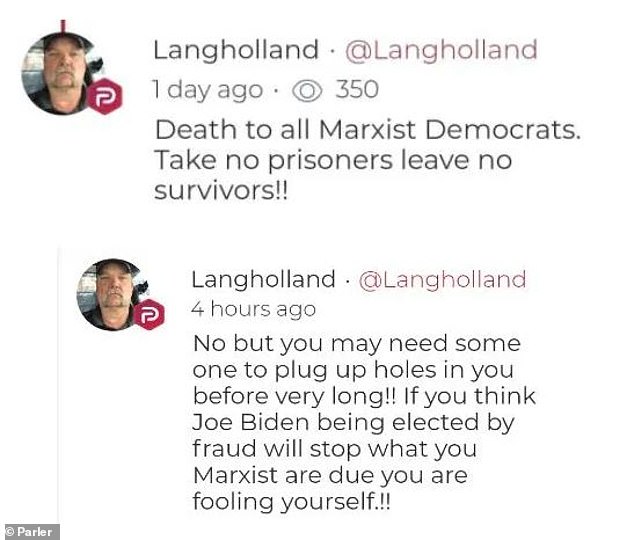
Would this have happened without Trump? Would these people have been as brazen in their ridiculously absurd notions, their shameless hatred, their unencumbered ignorance? Would QAnon have arisen without Trump? Would supporters of a non-Trump Republican president have come to doubt the legitimacy of the electoral system in America? Would this graph have looked the same?
Best case damage scenario: Trump takes down the whole Republican party. Massive restructuring and soul-searching takes place and the GOP emerges cleansed, humbled.
The LA Times thinks this might be impossible:
Because Trump’s narcissism was so profound, he responded to any criticism with the political equivalent of a nuclear counter-strike. And because Trump’s insecurity was infectious, his fan base — which had outsize power in primaries — would follow suit. This ensured that most Republican politicians shouted their praise of Trump and muzzled their criticism. […]
Institutionalized Trump narcissism probably cost him the election, because the superhuman image he insisted his loyalists embrace never reflected the reality on the ground. Many Republicans were in fact not that into him. They liked the judges, the tax cuts, even some of the “own the libs” bombast. But they were turned off by the self-indulgence, the conspiracy theorizing and the constant need for praise and attention. Still, few conservative politicians or media figures were willing to say so, at least not in a way, or on a platform, where the president would get the message. Trump believed his most fawning media and his fawning media told him again and again, “Never change.” […]
For four years, Donald Trump was president, which also meant he was the de facto head of the Republican Party. This allowed the acolytes of Trumpism — however you want to define that sloppy term — to marry Trumpism, nationalism, patriotism, populism, tribalism, MAGA, etc., to old fashioned party loyalty.
That marriage is over now. And the breakup is ugly and revealing in its ugliness. For many people, Trumpism wasn’t about the party. For a few it wasn’t even about the country. It was about him. His infectious narcissism and incessant victimhood fueled this cult of personality, which he valued more than the office he held. He’s lost his grip on the office, but he’s doing everything he can to hold on to the cult, by claiming he was robbed. It remains to be seen how many he’ll ultimately take with him. But we can be sure the answer will be too many.
Those of us who said Trump might indeed be an existential threat to our system shouldn’t be gloating over being proved right, in part because the people actively working to help Trump destroy our system — i.e., his supporters — don’t even see it that way. They’re saving democracy. Sort of like destroying the village to save it.
Sunday in the Fall
A perfect Sunday.


We had a lovely morning breakfast.
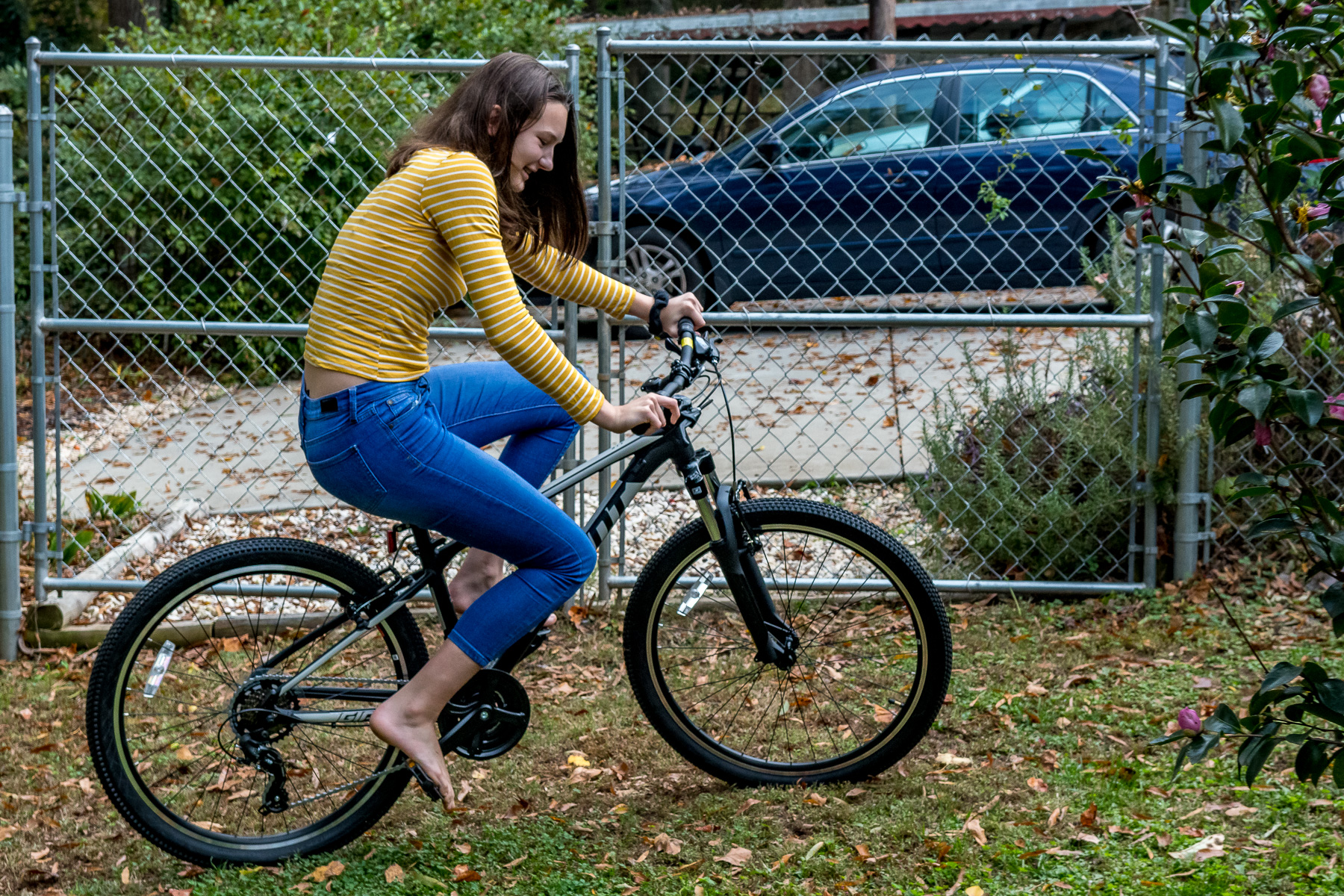
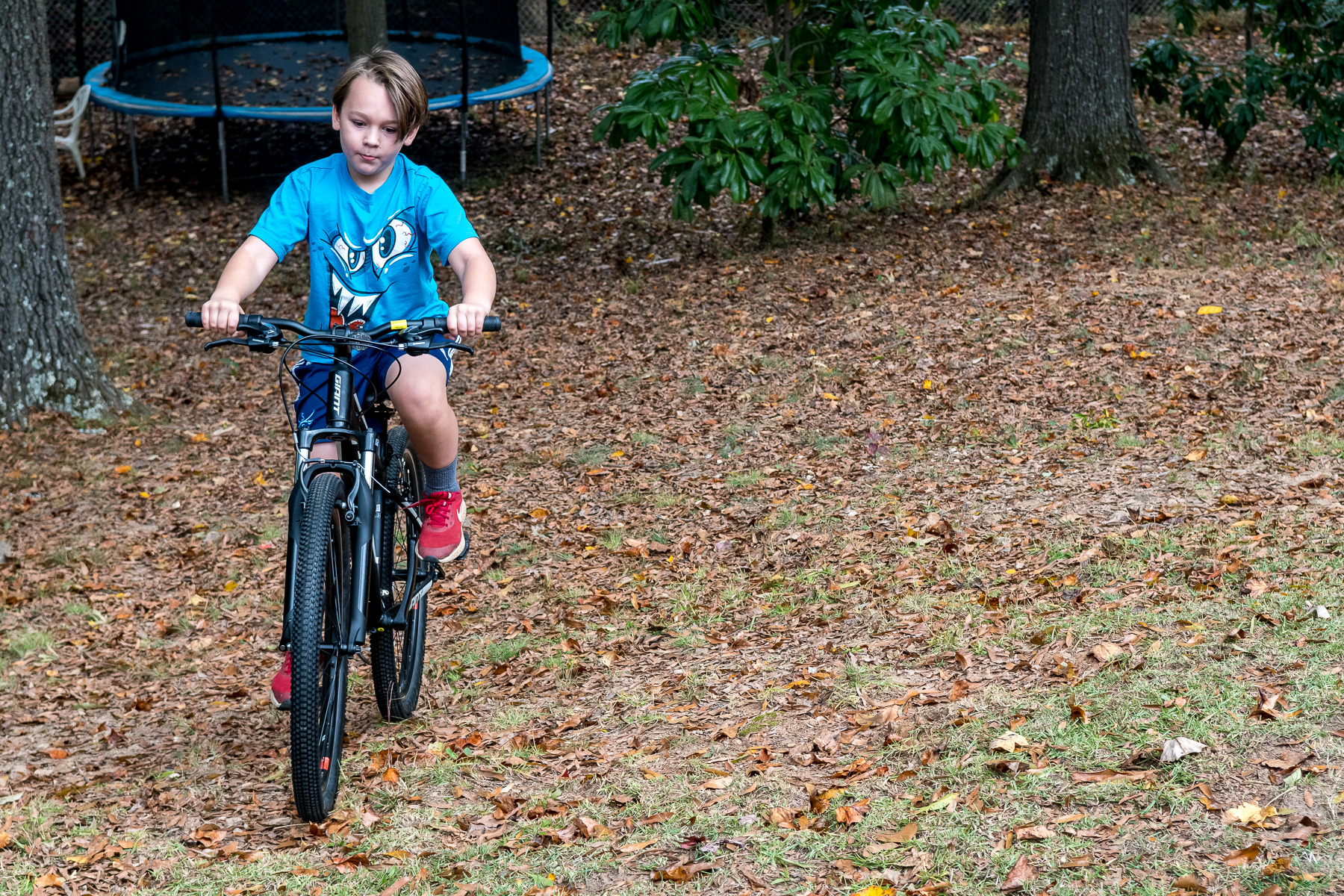
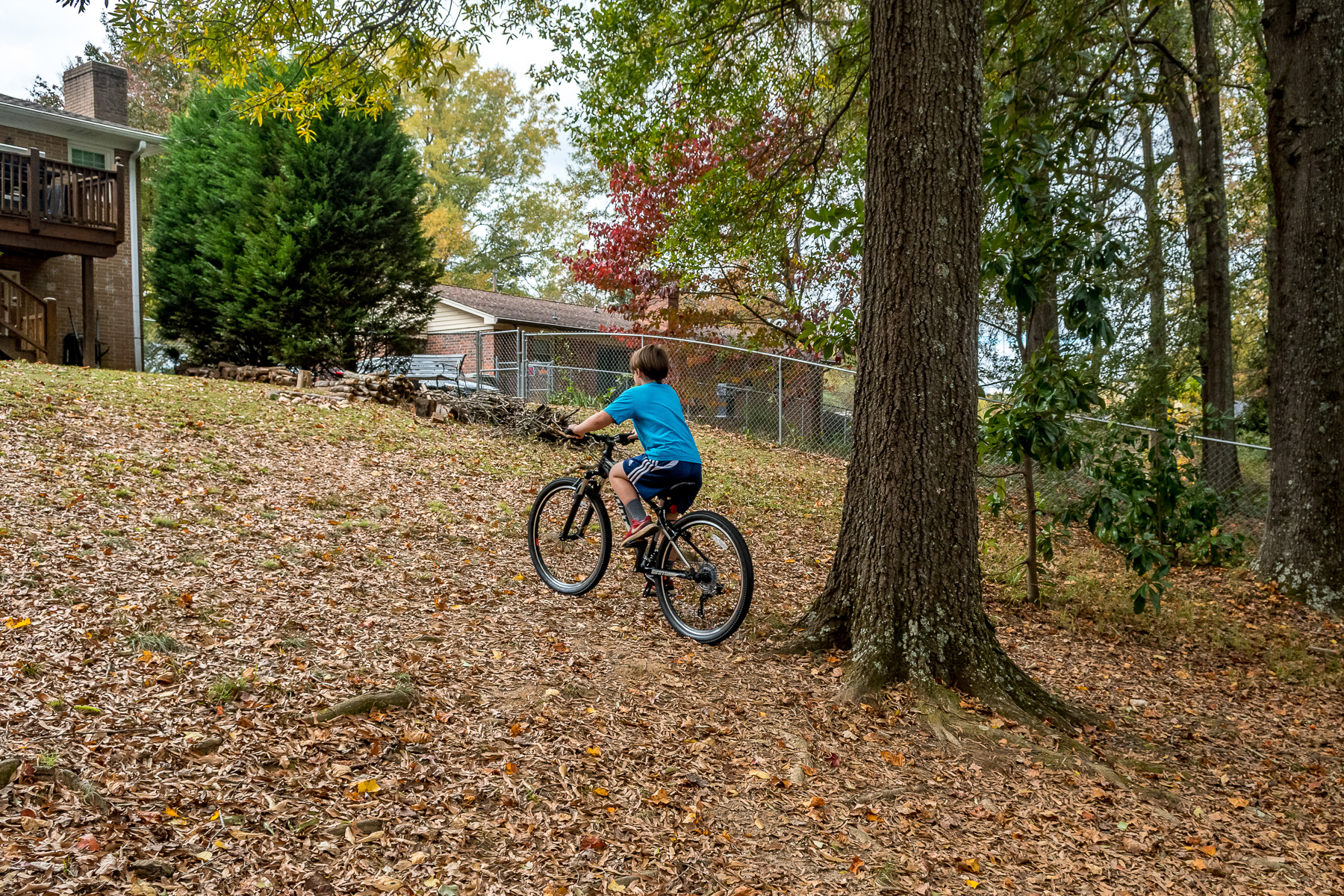
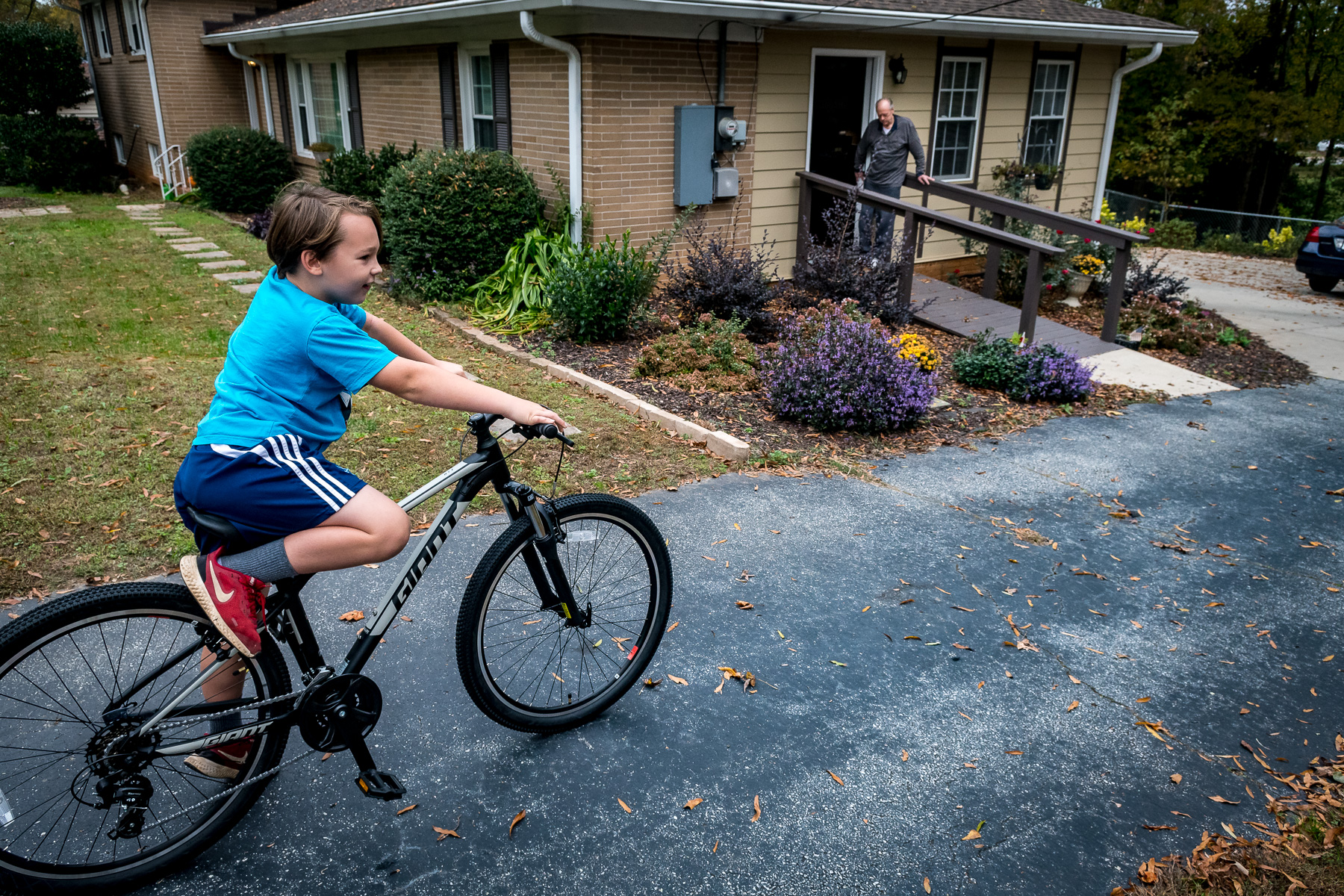
The Boy got a new bike.

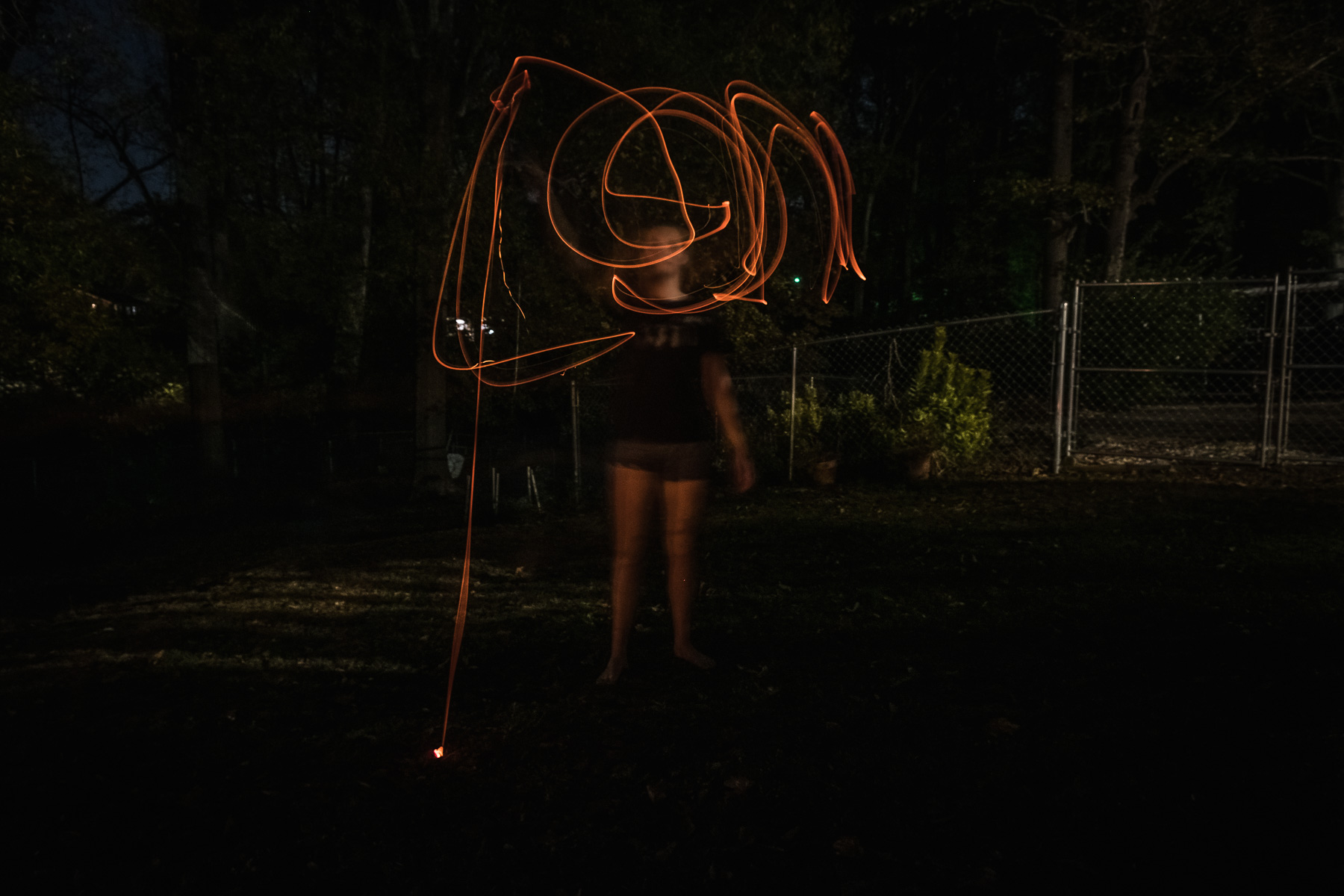






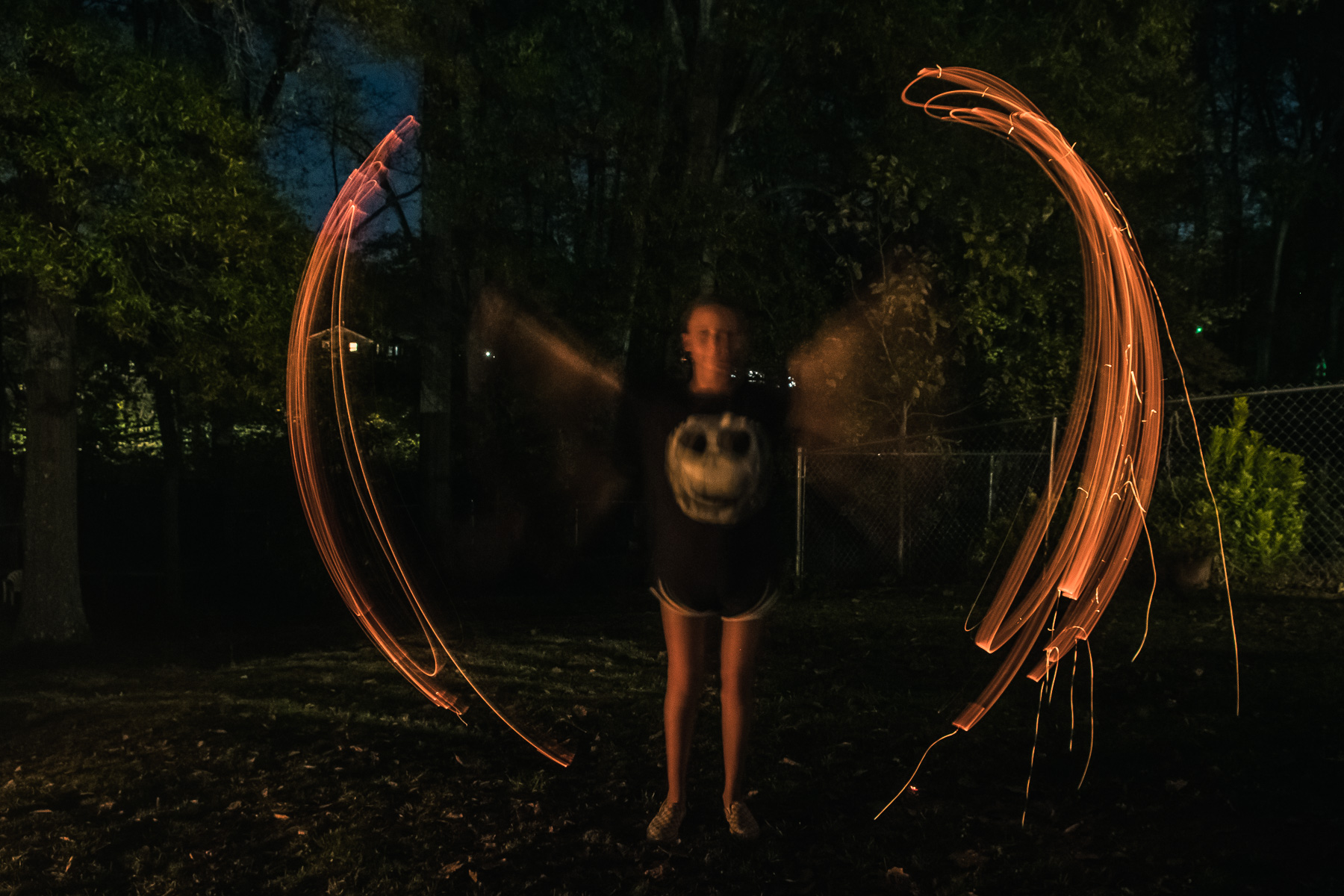

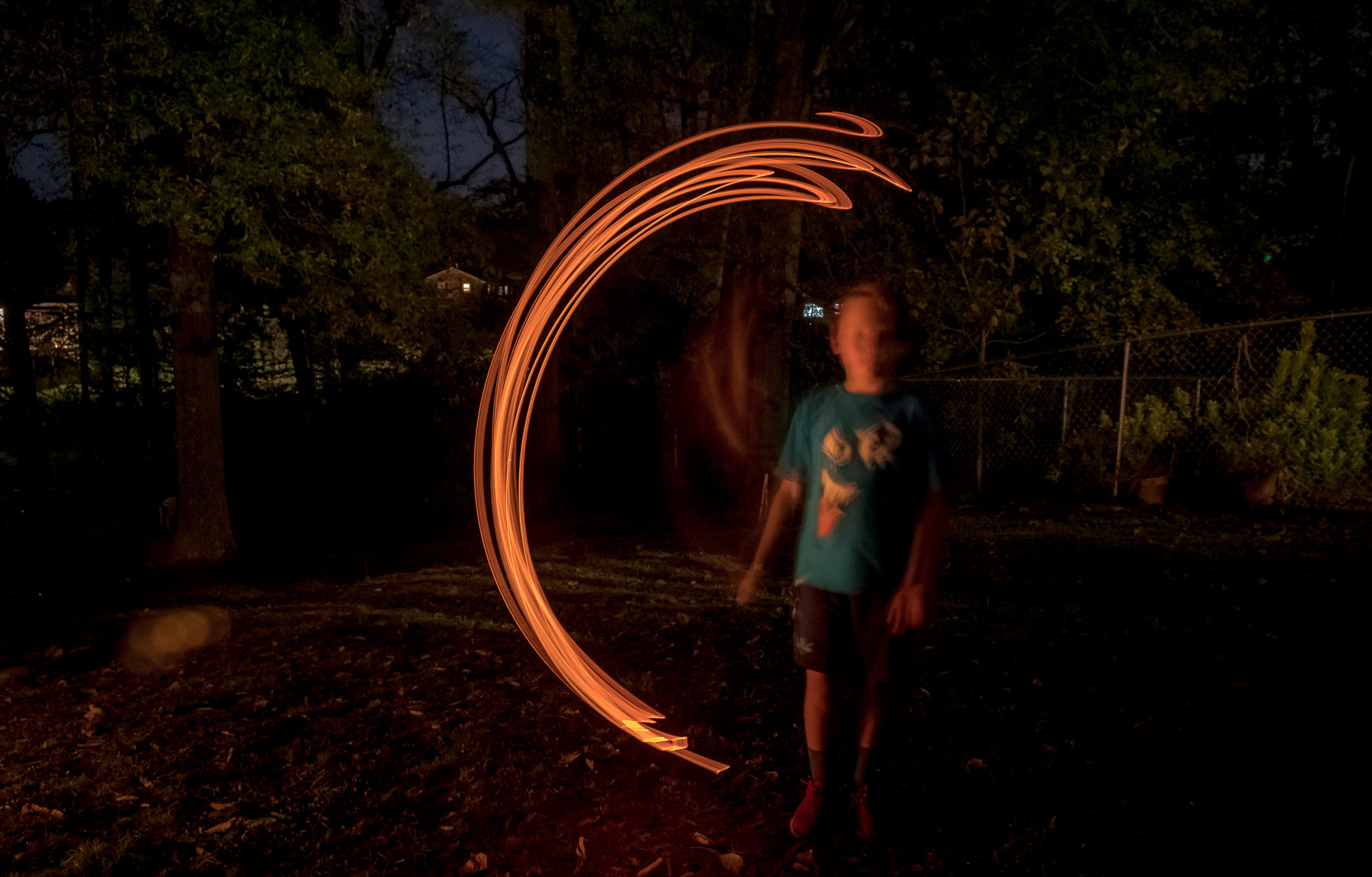


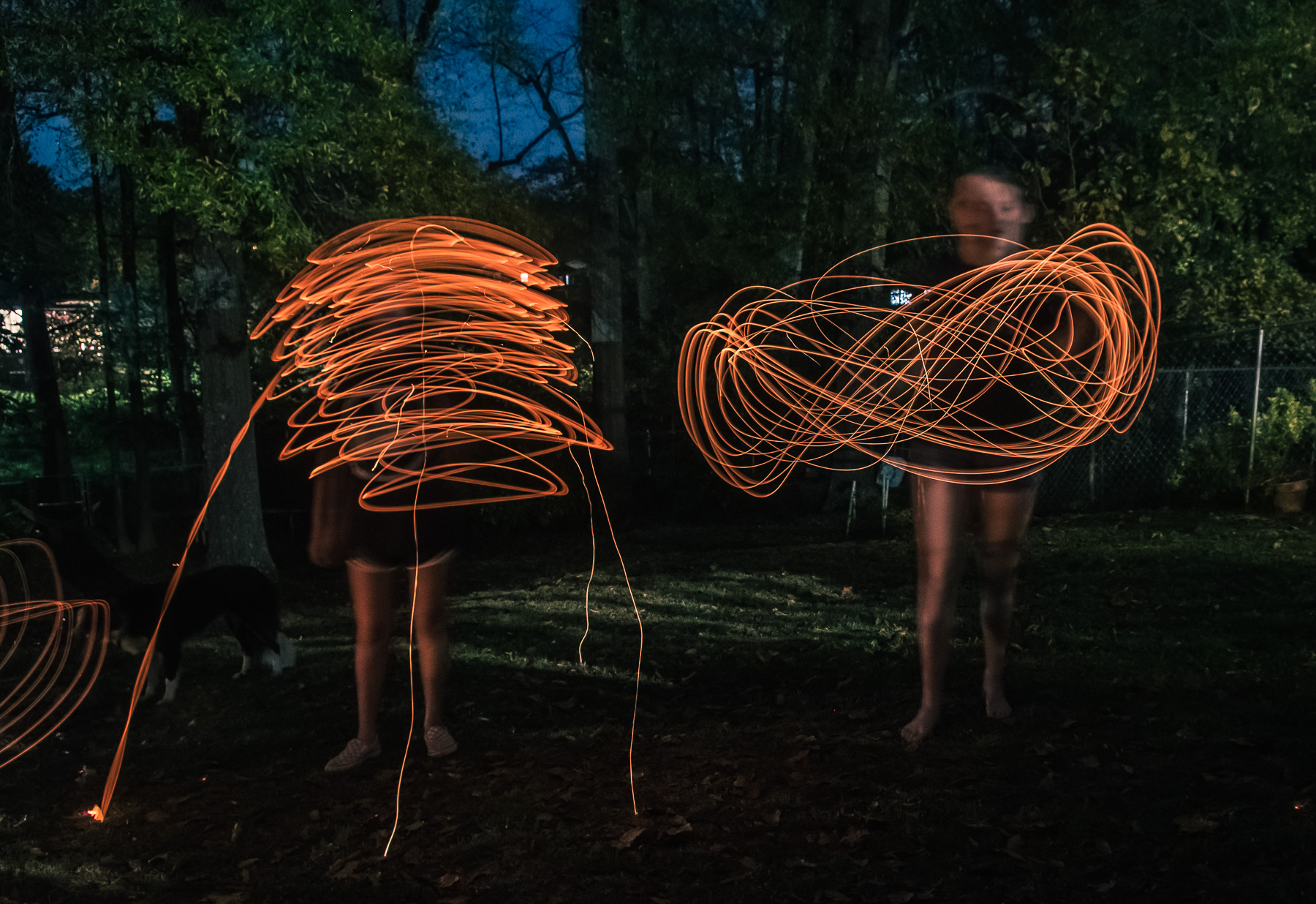
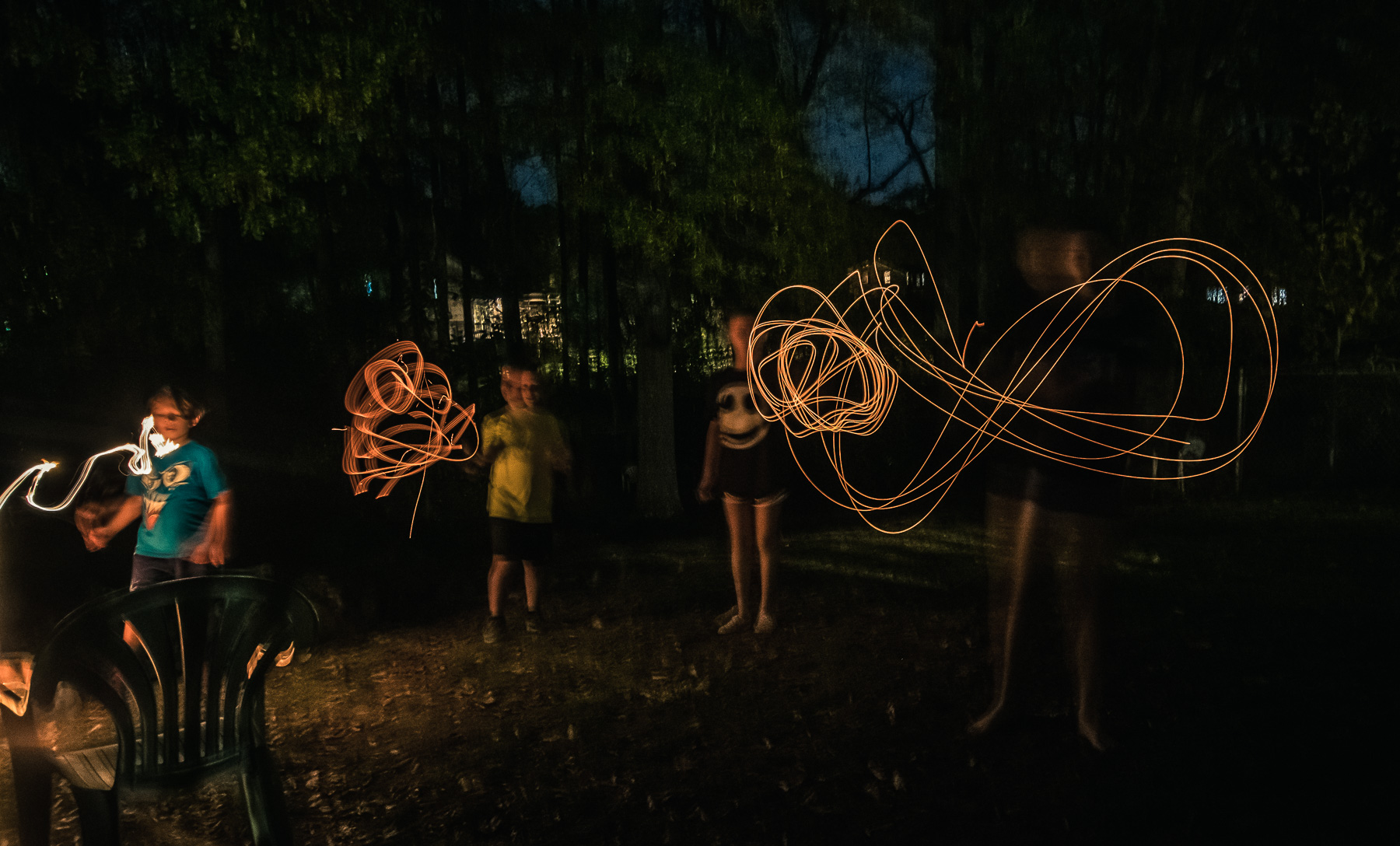
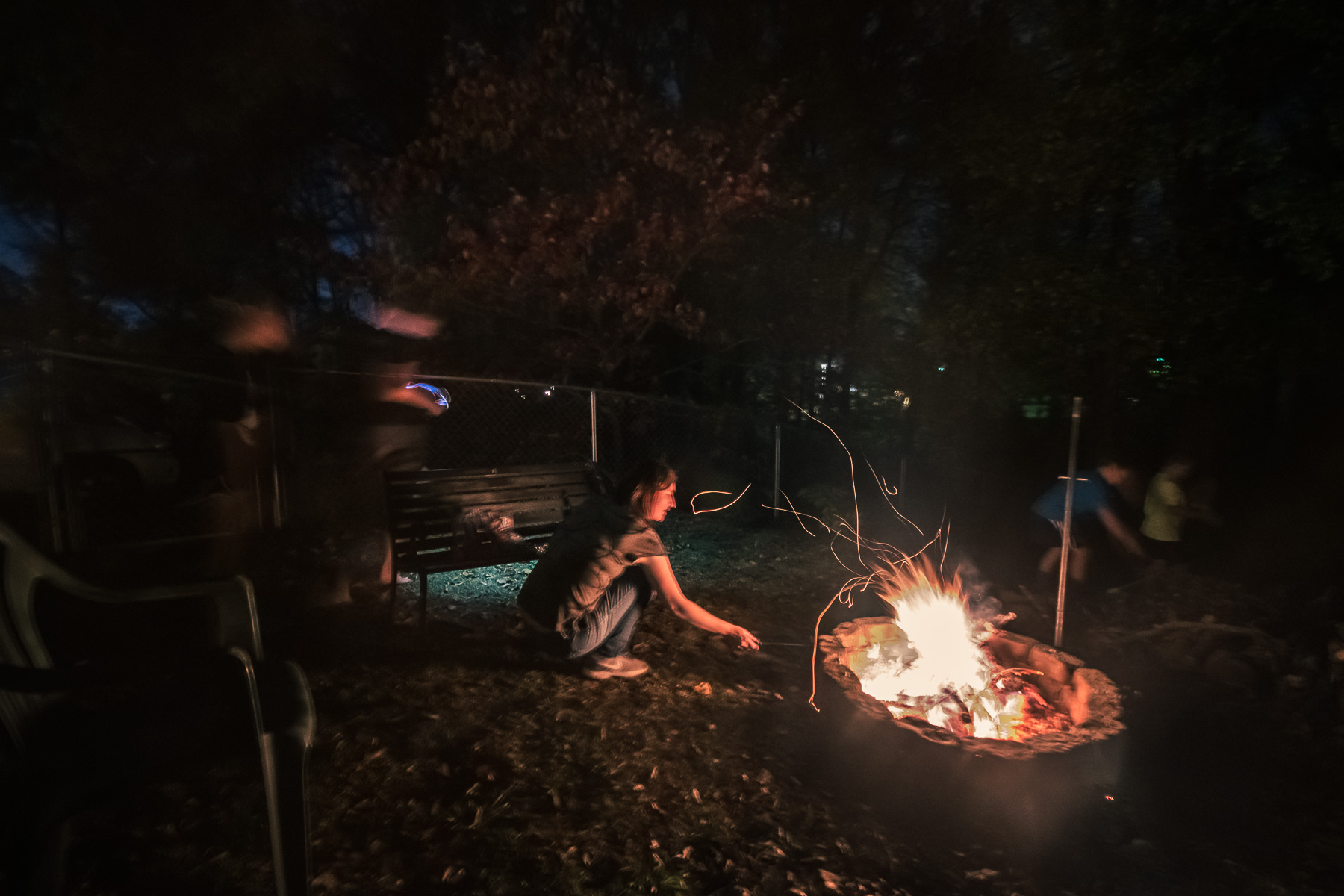

A couple of friends came over for a bonfire.
The Walk
had a different feel this evening.

I understand that there are a lot of people out there who are feeling the same worry I felt four years ago when Trump unexpectedly won. I feel for them, but I don't think their fears are as founded in reality as mine were. I guess that's natural, that bit of self-centeredness in one's thinking, but I really think the fears of Biden turning America into Venezuela are as unfounded as QAnon's fears of the "true" nature of the Democratic party.
Contrasts
The reaction of Trump supporters to the mounting crisis is firm evidence of two things:
- This is no longer the Republican party; it’s the party of Trump.
- The party of Trump is not interested in democracy or the will of the people; it is interested in power.
How to hold on to that power? Well, at the simplest and most benign level, they are praying. There’s nothing really radical about that. These women are “praying justice will be done and righteousness prevails,” which in this case means the re-election of Trump.
This might be achieved, I suppose, through some miraculous means, but it doesn’t necessarily entail overturning the will of the people.
Yet not all Trump supporters wish for divine intervention to usurp the will of the people. Some are willing to just beat the other side down.
https://twitter.com/RexChapman/status/1311413755633381381
Or kill them.
Or perhaps behead them.
All this stands in stark contrast to John McCain’s concession speech in 2008 in which he showed what a real leader looks like.
https://twitter.com/theJeremyVine/status/1324430854697922561
How did we devolve so far in just twelve years?
Starting the Bard
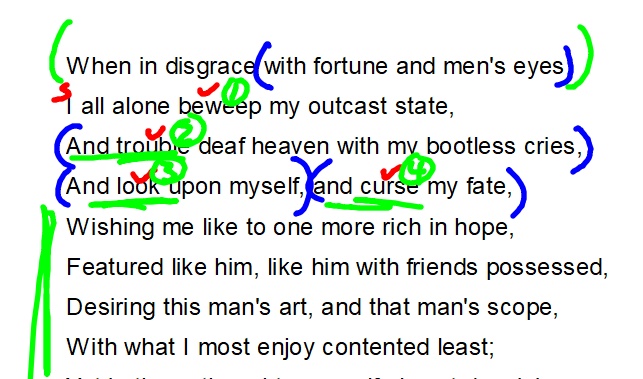
Students started the final series of poems in our poetry unit, turning to the poems of William Shakespeare in preparation for the next unit, which is on Romeo and Juliet. We began parsing Shakespeare’s twenty-ninth sonnet:
When, in disgrace with fortune and men’s eyes,
I all alone beweep my outcast state,
And trouble deaf heaven with my bootless cries,
And look upon myself and curse my fate,
Wishing me like to one more rich in hope,
Featured like him, like him with friends possessed,
Desiring this man’s art and that man’s scope,
With what I most enjoy contented least;
Yet in these thoughts myself almost despising,
Haply I think on thee, and then my state,
(Like to the lark at break of day arising
From sullen earth) sings hymns at heaven’s gate;
For thy sweet love remembered such wealth brings
That then I scorn to change my state with kings.
This is a particularly challenging piece with which to begin because it is one single sentence. We began by creating our own version of such a sentence, which in fact has an introductory subordinate clause with lots of other phrases connected to it.
Only the Beginning
One
“I’m so glad the election today, and it will all be over soon,” said K yesterday as we were cleaning up after breakfast.
I put down the dish I was rinsing. “Are you kidding? This is only the beginning. It won’t be over until the inauguration.”
It was a thought I’d had along with many others: Trump, in an effort to usurp the election, might try to stop states from counting votes before all absentee ballots have been counted. That appears to be exactly what’s happening, and predictably the corrupt Republicans (are there any other kind these days?) are going along with it.
Two
When I got to school today, students were buzzing about the election. They were checking the news every few minutes, watching it in realtime during lunch, completely engaged, so perhaps that is one benefit of this divisive election: it’s getting more people involved than ever before, at least in my memory.
Will this translate into political activity and engagement when they’re eighteen? We should all hope so. And yet, if they’re not informed and principled voters, will it really do anything to solve the problem?
Three
We’ve all heard this argument for the electoral college’s continuing validity: “If we got rid of the electoral college, then three states would decide the election.”
I simply don’t understand that “logic.” States don’t vote. People do. The electoral college simply means that some individuals’ votes (i.e., voters in less densely populated rural regions) carry more sway than others’ votes (i.e., voters in more urban states). It seems to me to be an intentional biasing of the electoral system to favor the rural areas over the urban areas. This always means favoring the conservative vote over the progressive vote. Every time a candidate has won the electoral college vote and lost the popular vote, it’s favored the conservative candidate.
Four
When the results of the 2000 election were dragging out, it became clear that more than just the presidency was on the line. The faith in our political institutions was also under fire, and when all legal means had been exhausted, Gore conceded. In his concession speech, he said:
Almost a century and a half ago, Senator Stephen Douglas told Abraham Lincoln, who had just defeated him for the presidency, “Partisan feeling must yield to patriotism. I’m with you, Mr. President, and God bless you.”
Well, in that same spirit, I say to President-elect Bush that what remains of partisan rancor must now be put aside, and may God bless his stewardship of this country. Neither he nor I anticipated this long and difficult road. Certainly neither of us wanted it to happen. Yet it came, and now it has ended, resolved, as it must be resolved, through the honored institutions of our democracy. […]
This has been an extraordinary election, but in one of God’s unforeseen paths, this belatedly broken impasse can point us all to a new common ground, for its very closeness can serve to remind us that we are one people with a shared history and a shared destiny. Indeed, that history gives us many examples of contests as hotly debated, as fiercely fought, with their own challenges to the popular will. Other disputes have dragged on for weeks before reaching resolution, and each time, both the victor and the vanquished have accepted the result peacefully and in a spirit of reconciliation. So let it be with us.
I know that many of my supporters are disappointed. I am too. But our disappointment must be overcome by our love of country. […]
President-elect Bush inherits a nation whose citizens will be ready to assist him in the conduct of his large responsibilities. I personally will be at his disposal and I call on all Americans — I particularly urge all who stood with us to unite behind our next president.
This is America. Just as we fight hard when the stakes are high, we close ranks and come together when the contest is done. And while there will be time enough to debate our continuing differences, now is the time to recognize that that which unites us is greater than that which divides us. […]
And now, my friends, in a phrase I once addressed to others, it’s time for me to go. Thank you and good night and God bless America.
He did not suggest there had been fraud. He did not suggest that elements within the government had conspired against him. He did not suggest that Bush was evil. He did not predict failure for Bush and therefore for America.
He stepped aside and accepted the results of our institutions. He called for healing and unity. His actions were guided by the simple principle that the country is more important than his personal political ambitions.
In a similar situation, can anyone imagine Trump doing anything even remotely similar?