
Portrait
fun in threes, sometimes fours
g
The Girl played her last volleyball game as a high schooler today. I thought her quarter-final game a few weeks ago was her final game, but she got an invitation to play in the state all-star game, and of course, she didn't pass that up! What an honor for our girl.
The game itself was as exciting as one could imagine. L's team (North) dropped the first two sets, but not terribly. They just couldn't get everything to click like South could. In the third set, though, they found their moment and took it, winning 28-26. They took the fourth set as well, and suddenly, instead of having their backs to the wall, they'd evened the game at two sets each. But it was not to be. The North team fell apart in the final set, losing 5-15.
But still -- what an honor for the Girl. What a way to end a high school volleyball career.












I saw a meme the other day that got me thinking about the nature of faith. A high school friend, who is a pastor and lovely human being in every sense, posted the following thought:
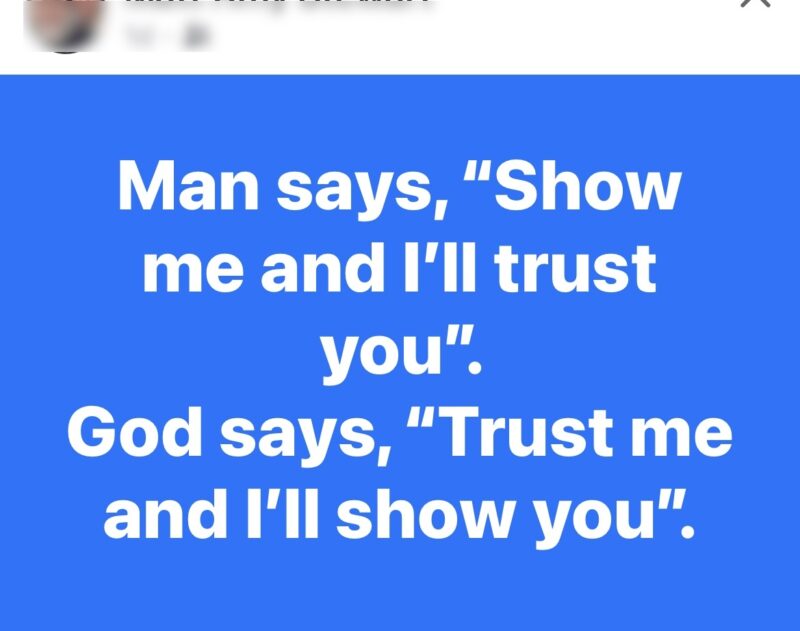
The problem with this is simple: this god never says anything. All we have are people saying that this god has said something. The meme should read:
Man says, "Show me, and I'll trust you." Some people say God says, "Trust me, and I'll show you."
That puts things in an entirely different situation. The dichotomy is not between a supposedly-fallible self and an supposedly-infallible deity. The division is between trusting your own senses and experiences versus trusting claims someone else makes about a deity. The first quote is asking for evidence; the second is asking for blind faith.
I'll go with evidence every single time.
Growing up, there were a lot of Bibles in our house. All were corrupt translations in one way or another, my father (on the teaching and authority of our little sect) assured me, and it was necessary to read a given passage in a number of different translations to understand it fully.
One of the Bibles we had was the Scofield Reference Bible. Our sect's leader, Herbert Armstrong, extolled it for its important commentary. It was, in essence, the King James Version with James Scofield's commentary and explanation.
The Scofield was a Bible out of step with what corrupt Protestants and whore-of-Babylon Catholics used. We were the only real Christians on the entire planet, see, and everyone else was corrupt in one way or another. The Protestants liked the King James Version, that's true, and that was a redeeming point in our eyes, but too many used the Revised Standard Version, or even worse, the liberal New International Version. Like other Christians, we referred to these versions by their initials: the KJV was superior, and the RSV was acceptable, but the NIV was an abomination. Above them all, though, was the Scofield Reference Edition, which I doubted any of my Protestant friends at school had ever heard of.
It turns out, several probably had. It was the favored edition of John Nelson Darby, a nineteenth-century Evangelical who came up with the idea of the rapture, the idea that Jesus would whisk his believers away just before all hell breaks loose on Earth at the end of time. These eschatological ideas come from various places in the Bible. Passages from the Old Testament prophets are mixed with passages from the New Testament epistles of Paul and then folded into the Book of Revelation to produce a horrifying image of the end of the world with something like three-fourths of humans dying in the misery. Scofield's ideas shaped Darby's ideas, and the idea of the rapture is a key component of Evangelical Protestants to this day. Most of the pastors serving as "spiritual advisors" to Trump during his first term held to this idea, which is somewhat terrifying: people advising the president were expecting the literal destruction of most of humanity, thinking that they might be playing a part in the prophetic nonsense that leads up to all of that.
Our sect had its own end-of-the-world scenario, but I was always taught that our vision of the future was original and, most significantly, correct. So I grew up not knowing about the idea of the rapture and how Evangelicals interpreted the Bible to create a picture of the end of the word. I certainly didn't realize how damn similar it was to ours. They even used terms that I thought were exclusive to our correct understanding of the Bible, terms like "The Great White Throne Judgement."
That's one thing I've learned as I study more about other sects and denominations of Christianity. Far from being unique, our beliefs were an amalgamation of just about every sect out there. Bits and pieces from the Mormons? Check. A little something from the Jehovah's Witnesses? It's right there. A touch of good old fashioned Evangelicalism? Got it. Our combination of these things was unique, to be sure, but there was nothing new in anything we believed. Contrary to the assurances of our ministers and leaders, we were not special or unique.
I got to thinking about all of this tonight because of a book by Bart Ehrman I'm reading. Armageddon: What the Bible Really Says About the End takes a scholarly look at the Book of Revelation and traces the history of some of the ideas modern Christians root in that book -- like the rapture. Suddenly I was reading about the Scofield Reference Bible, something I hadn't thought about in decades.

Papa's was in a leather cover with a zipper, and he had covered countless pages with endless annotations. When Papa moved in with us, we got rid of most of his Bibles (his choice -- "How many do I really need?"), but I found myself wondering if we still had his Scofield. I walked into his old room, looked at the top row of his bookshelf where I knew the Bibles lived.
And there was a Scofield.
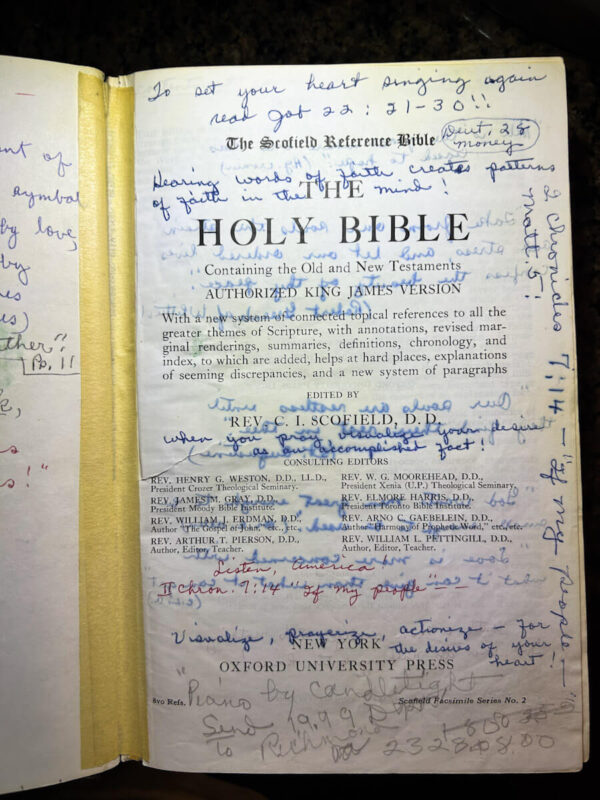
"I don't think that's his, though," I thought, remembering the leather cover. I opened it and saw it was covered in annotations. "But that's not Papa's writing," I realized. Sure enough, on the inside cover: Ruby Williams, Nana's mother. She wasn't a member of our sect. In fact, I think she rather disliked it. But she was an Evangelical and so shared a preference for the Scofied.
The annotations themselves are fascinating. On one page, there are all the signs of the interpretative practices we borrowed from Evangelicalism.
"The Bible is a jigsaw puzzle!" Herbert Armstrong, our sect's founder and leader, taught countless times. One had to piece together bits from here and bits from there to see the true picture. In serious (i.e., scholarly) study of the Bible, there's a term for this: proof-texting. The idea is simple: if you take bits randomly from the Bible (i.e., get your proof from throughout the text), you can prove anything.
On the above page of text from the Old Testament prophetic Book of Zechariah, we see my grandmother connected it to the Book of Revelation (chapters 17 and 18) as well as Paul's Epistle to the Galatians (chapter 1 verse 4). The vast majority of the text is underlined to indicate its importance.
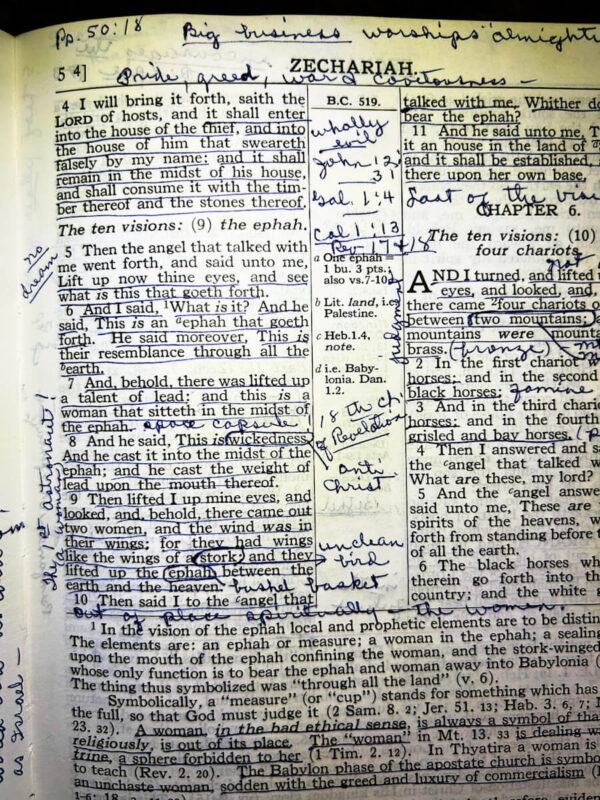
And along the foot of the page, the reason for everyone's love (or hatred) of this particular edition: James Scofield's commentary. He patiently explains that "Symbolically, a 'measure' (or 'cup')" is something that's full and "God must judge it." These are not usual study notes for a Bible. It's not explaining some ambiguities of the original Hebrew. It's not discussing the translation difficulties of a given term. It's telling readers what this particular passage symbolizes. It is interpreting the Bible, putting ideas in readers' heads that really don't come from the Biblical text but rather from Scofield's vision of the whole sweep of Biblical history.
Along the top, we also see it connected to contemporary social commentary: "Big business worships 'almighty dollar.'" On that single annotated page is the story of the Evangelical approach to the Bible, and while it would have pained me to admit it as a child (who doesn't want to be special? called out? unique?), it is the story of our interpretative technique as well.
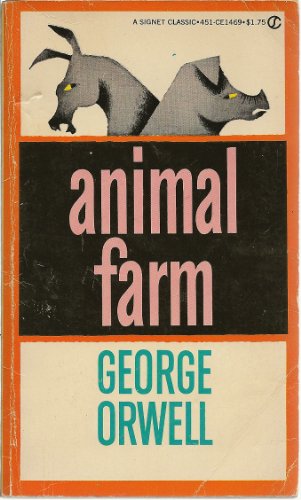
When teachers throughout South Carolina became significantly concerned that the state might ban, among other things, 1984, I'm sure I wasn't the only teacher who thought, "Now, when was the last time I read that? I should probably reread it." However, I just reread it a few years ago, and while I love re-reading favorite books, enough time has to pass between reading to make it enjoyable. It occurred to me, though, that, books becoming increasingly worrisome to the powers that be, I might like to read it to the Boy. I knew the Girl had already read it, but the Boy -- it's not a book he would read himself. Truthfully, though, he is a bit young for it. So I decided we'd do the next best thing: read Animal Farm.
We've been reading a chapter every few nights, and I've used it to teach the Boy a bit about the history underlying that fable. Tonight we read chapter 8.
A few days later, when the terror caused by the executions had died down, some of the animals remembered-or thought they remembered-that the Sixth Commandment decreed "No animal shall kill any other animal." And though no one cared to mention it in the hearing of the pigs or the dogs, it was felt that the killings which had taken place did not square with this. Clover asked Benjamin to read her the Sixth Commandment, and when Benjamin, as usual, said that he refused to meddle in such matters, she fetched Muriel. Muriel read the Commandment for her. It ran: "No animal shall kill any other animal without cause." Somehow or other, the last two words had slipped out of the animals' memory. But they saw now that the commandment had not been violated; for clearly there was good reason for killing the traitors who had leagued themselves with Snowball.
I told the Boy about the Stalinist purges, especially the Great Terror of 1937. I told him about Solzhenitsyn and some of the anecdotes he relates in The Gulag Archipelago. The Boy was shocked?
"Why did they do that?"
"To maintain power."
Napoleon was now never spoken of simply as "Napoleon." He was always referred to in formal style as "our Leader, Comrade Napoleon," and this pigs liked to invent for him such titles as Father of All Animals, Terror of Mankind, Protector of the Sheep-fold, Ducklings' Friend, and the like. In his speeches, Squealer would talk with the tears rolling down his cheeks of Napoleon's wisdom the goodness of his heart, and the deep love he bore to all animals everywhere, even and especially the unhappy animals who still lived in ignorance and slavery on other farms. It had become usual to give Napoleon the credit for every successful achievement and every stroke of good fortune. You would often hear one hen remark to another, "Under the guidance of our Leader, Comrade Napoleon, I have laid five eggs in six days"; or two cows, enjoying a drink at the pool, would exclaim, "Thanks to the leadership of Comrade Napoleon, how excellent this water tastes!"
I told the Boy about all the titles bestowed upon Stalin, all the awards, all the honorifics.
"What did Stalin try to do, then?" I asked.
"Make himself into a god." A bit simplistic, but not too far from the truth.
I explained the illogical thinking behind the claim that atheism is behind the most horrific events of the twentieth century because China and the Soviet Union were officially atheistic states. "They had the exact same dogmatic belief structure as the strictest religion," I explained.
In the late summer yet another of Snowball's machinations was laid bare. The wheat crop was full of weeds, and it was discovered that on one of his nocturnal visits Snowball had mixed weed seeds with the seed corn. A gander who had been privy to the plot had confessed his guilt to Squealer and immediately committed suicide by swallowing deadly nightshade berries. The animals now also learned that Snowball had never-as many of them had believed hitherto-received the order of "Animal Hero First Class." This was merely a legend which had been spread some time after the Battle of the Cowshed by Snowball himself. So far from being decorated, he had been censured for showing cowardice in the battle. Once again some of the animals heard this with a certain bewilderment, but Squealer was soon able to convince them that their memories had been at fault.
I explained to the Boy the idea of saboteurs in Soviet ideology: all the shortcomings of state-run enterprises (i.e., most of what happened in the USSR) were explained away by the idea of enemies of communism undermining the efforts of the Soviet government to create a utopia.

I can't help but see parallels in all of this with the MAGA cult. Just as the pigs were gaslighting the animals about the changes going on around them, Trump lies opening to his followers, and the true MAGA devotees, blinded by their devotion to Trump, don't even see the obvious inconsistencies and lies. Just as Napoleon's and Stalin's sycophants praised them with honorifics and virtual worship, so too the MAGA commitment to promoting Trump in literally messianic terms. Just as Squealer and the other pigs convince the animals to disbelieve their own memories, Trump's campaign brazenly called on his supports to cast Harris as a threat to democracy while painting the man who literally led an attempted insurrection as the savior of all.
Our country is about to be in a mess that might not be fully cleaned up by the time the Boy is nearly my age, and he needs to know it has happened before and will happen again.













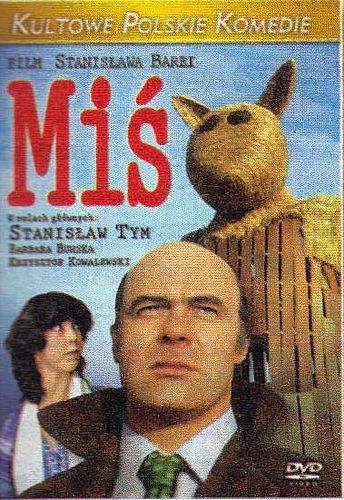
"I have a film you must see." We were sitting in a restaurant, waiting for the next bus back to Lipnica, when Janusz told me this. "It's a perfect film."
"What's it about?" I probed.
"Poland. It's about -- you just have to see it," came the response.
For the next few weeks, whenever we met up, Janusz brought up the film.
"When are you going to come see it?" he would ask. "You have to see it. It's a perfect film."
Little did I know: classic and perfect.
The first time I saw the Polish cult comedy Miś ("Teddy Bear"), I knew I'd have to see it again. I'd laughed so hard at some scenes that it was difficult to catch my breath, but I knew I'd only caught part of it. This was partially because of language -- my Polish, after all, isn't perfect -- and partially because of the layers of the film.
In the years since I first watched the film, I've seen it countless times. Those layers are still revealing themselves with each viewing: little touches like signs in the background and repeating musical themes, things you'll never get from one viewing. Indeed, I've watched it so many times now I can quote whole sections of it, and no matter one's situation, there's almost always a quote from Miś that is perfectly applicable.
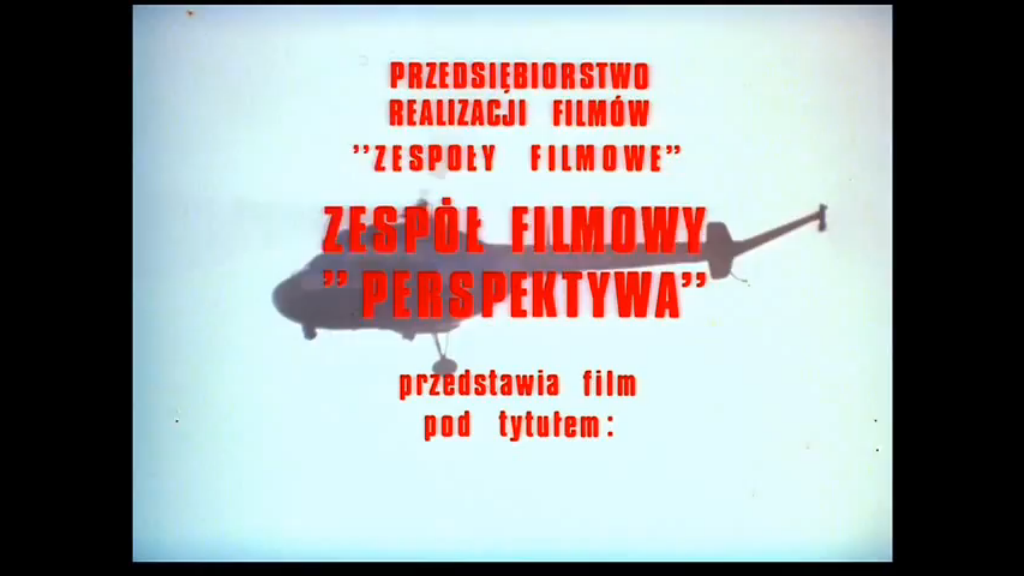
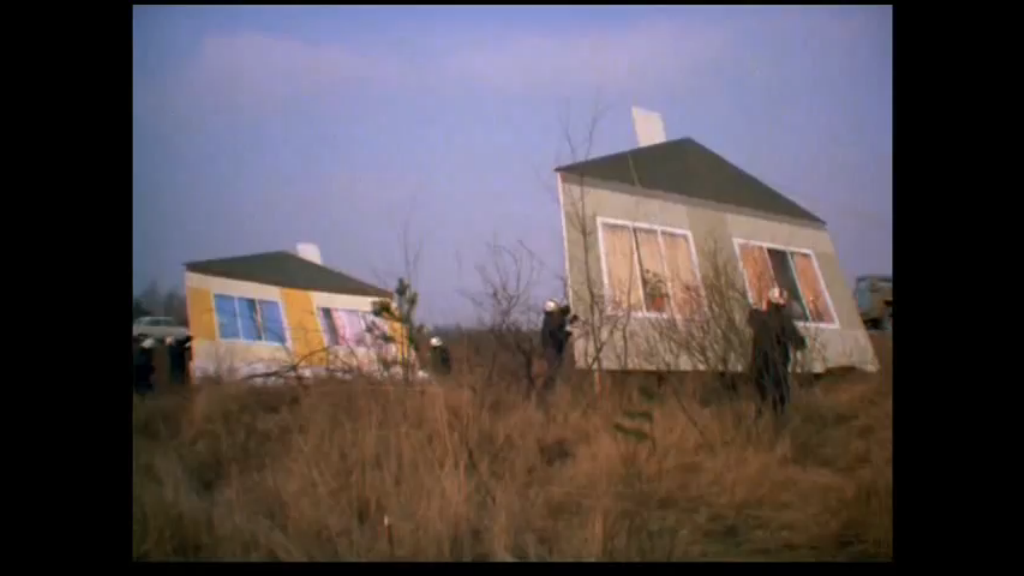
The first shot is of a helicopter, clearly working as a flying crane. We see the wire, but it takes a moment before we see what is hanging from it.
On the ground, it becomes immediately obvious: it is a fake building with police officers milling around, part of a suprise speed trap.
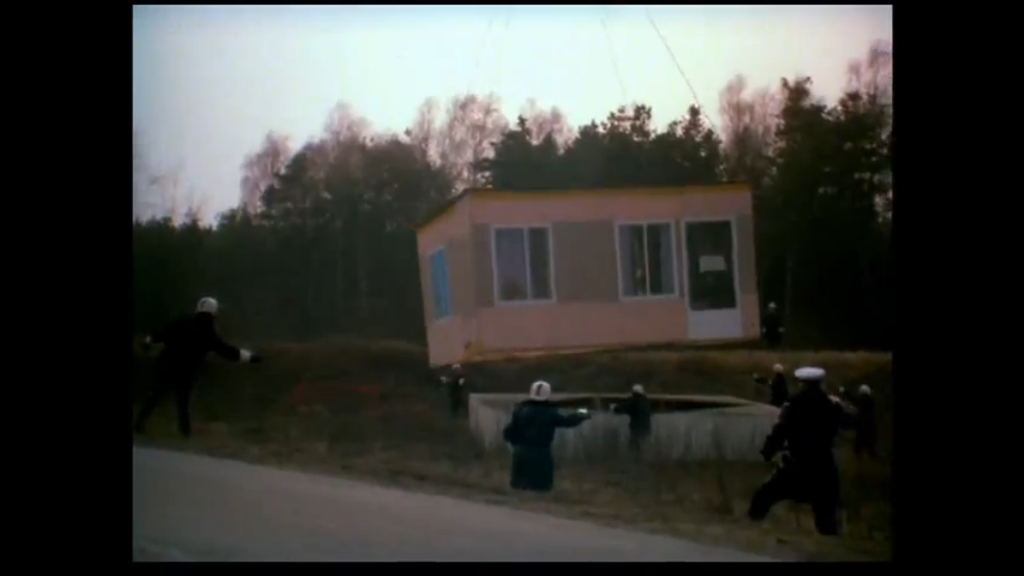
As the credits roll, other officers put up two-dimensional fake buildings to create a small "village" near the road. The reasoning is simple: Polish traffic law requires drivers to slow in a teren zabudowany.
Both words have as close a thing as a cognate as just about any words in Polish: "teren" means "terrain" and "zabudowany" derives from "budowac," which means "build." So teren zabudowany literally means "terrain built."

The trap, though, is incomplete without people. Other officers soon appear with variously dressed mannequins in hand. An off-screen ranking officer's voice instructs, "Put them in a line," and after a pause, we hear an explanation: "There must be some sign of life."
The opening scene concludes with a soon-to-be-critical officer announcing over the radio that they are ready and that "moze zaczynac!"
"We can begin!"
What is amazing about the film, made in the very early 1980's, is how much it mocks the Polish Communist reality and the effects of a state monopoly on everything from goods to ideas. That it made it past the censors is a minor miracle: I've really no idea how it could happen other than the notion that perhaps the Polish Communist party was more forgiving than Big Brother to the east. All the same, such blatant mockery?
The story, though, is simple: Ryszard Ochódzki, the director of a sports club, is trying to beat his ex-wife to London, where they have money under a joint account. Each knows the other will drain the account, and so it's a mad race to see who can get there first. When Ochódzki's wife, Irena, tears some pages out of his passport making it impossible for him to travel abroad, he devises one of the most complicated and convoluted schemes to get to the bank despite this seemingly insurmountable obstacle.
It's a miraculous film, and many of the scenes resonate with my own experiences in Poland in the mid-1990's.