I finished a book a couple of days ago that had been on my to-read list since college if not longer: Carl Bernstein's and Bob Woodward's All the Presidents Men. I knew a little about Watergate; now I know a bit more. Two conclusions I drew from the book: first, the Republican party, for at least half a century, has had many members who are primarily concerned with maintaining power by any means necessary. Watergate was the lowest point until January 6 and the GOP's unwillingness to convict, but those are just the things we know about. Second, while there were those who sought to stay in power at any cost, there were some Republicans who had at least a rusty moral compass and had some line somewhere that they considered beyond the pale. Today's GOP can watch the sitting president incite an insurrection and not only do nothing about it but also fall back in line when it's clear that their constituents require it.
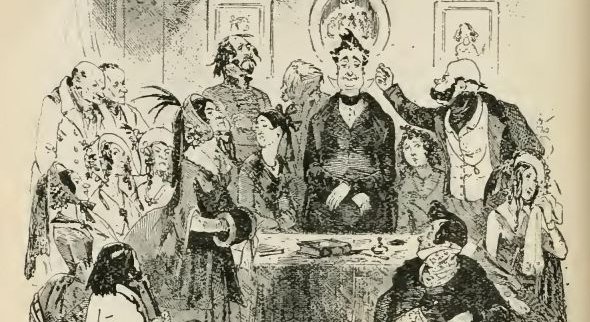
After such a depressing book, I needed a laugh, so I turned to Dickens's The Life and Adventures of Martin Chuzzlewit. Few people can so humorously and clearly introduce characters as Charles Dickens:
But when the company arrived! That was the time. When Mr Pecksniff, rising from his seat at the table’s head, with a daughter on either hand, received his guests in the best parlour and motioned them to chairs, with eyes so overflowing and countenance so damp with gracious perspiration, that he may be said to have been in a kind of moist meekness! And the company; the jealous stony-hearted distrustful company, who were all shut up in themselves, and had no faith in anybody, and wouldn’t believe anything, and would no more allow themselves to be softened or lulled asleep by the Pecksniffs than if they had been so many hedgehogs or porcupines!
First, there was Mr Spottletoe, who was so bald and had such big whiskers, that he seemed to have stopped his hair, by the sudden application of some powerful remedy, in the very act of falling off his head, and to have fastened it irrevocably on his face. Then there was Mrs Spottletoe, who being much too slim for her years, and of a poetical constitution, was accustomed to inform her more intimate friends that the said whiskers were ‘the lodestar of her existence;’ and who could now, by reason of her strong affection for her uncle Chuzzlewit, and the shock it gave her to be suspected of testamentary designs upon him, do nothing but cry—except moan. Then there were Anthony Chuzzlewit, and his son Jonas; the face of the old man so sharpened by the wariness and cunning of his life, that it seemed to cut him a passage through the crowded room, as he edged away behind the remotest chairs; while the son had so well profited by the precept and example of the father, that he looked a year or two the elder of the twain, as they stood winking their red eyes, side by side, and whispering to each other softly. Then there was the widow of a deceased brother of Mr Martin Chuzzlewit, who being almost supernaturally disagreeable, and having a dreary face and a bony figure and a masculine voice, was, in right of these qualities, what is commonly called a strong-minded woman; and who, if she could, would have established her claim to the title, and have shown herself, mentally speaking, a perfect Samson, by shutting up her brother-in-law in a private madhouse, until he proved his complete sanity by loving her very much. Beside her sat her spinster daughters, three in number, and of gentlemanly deportment, who had so mortified themselves with tight stays, that their tempers were reduced to something less than their waists, and sharp lacing was expressed in their very noses. Then there was a young gentleman, grandnephew of Mr Martin Chuzzlewit, very dark and very hairy, and apparently born for no particular purpose but to save looking-glasses the trouble of reflecting more than just the first idea and sketchy notion of a face, which had never been carried out. Then there was a solitary female cousin who was remarkable for nothing but being very deaf, and living by herself, and always having the toothache. Then there was George Chuzzlewit, a gay bachelor cousin, who claimed to be young but had been younger, and was inclined to corpulency, and rather overfed himself; to that extent, indeed, that his eyes were strained in their sockets, as if with constant surprise; and he had such an obvious disposition to pimples, that the bright spots on his cravat, the rich pattern on his waistcoat, and even his glittering trinkets, seemed to have broken out upon him, and not to have come into existence comfortably. Last of all there were present Mr Chevy Slyme and his friend Tigg. And it is worthy of remark, that although each person present disliked the other, mainly because he or she did belong to the family, they one and all concurred in hating Mr Tigg because he didn’t.
What wonderful description: we know so much about their appearance and personality just through a few lines of description. How anyone can feel anything but affection for Dickens is beyond me. (Granted, he does get longwinded at times, but as I always explained to my students, even great artists can succumb to their basest temptations and stretch things for sake of a few more quid in the bank.)
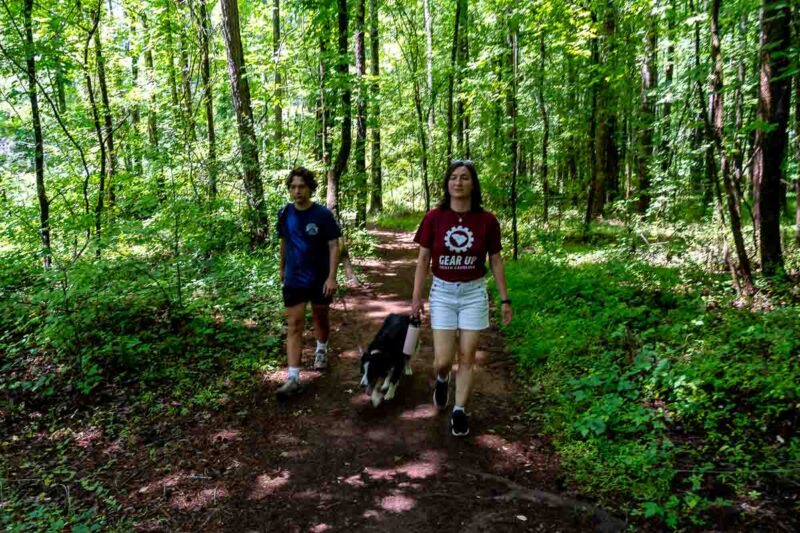
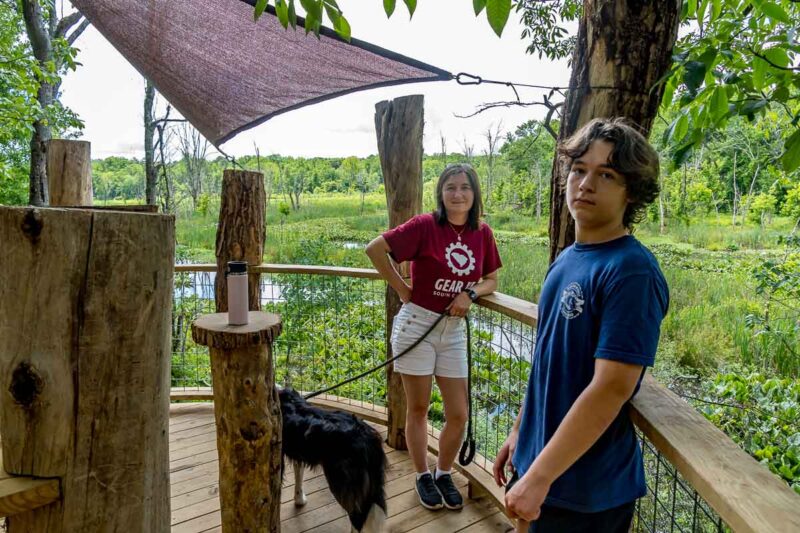
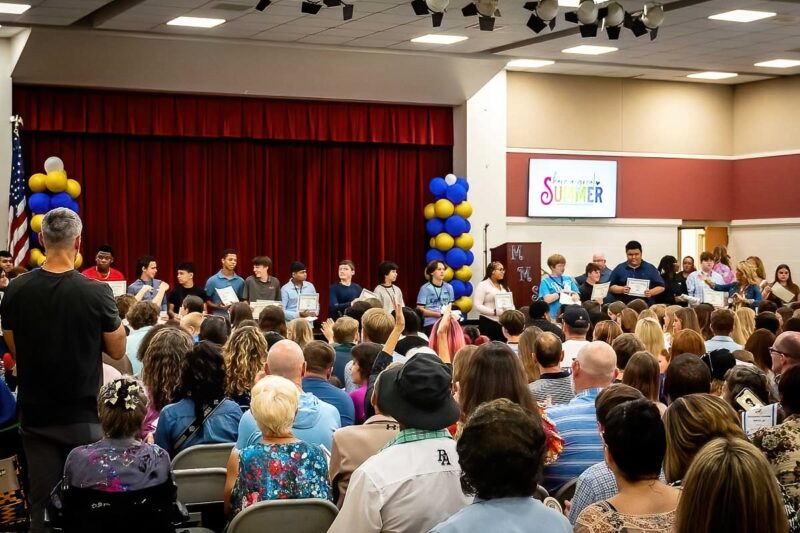
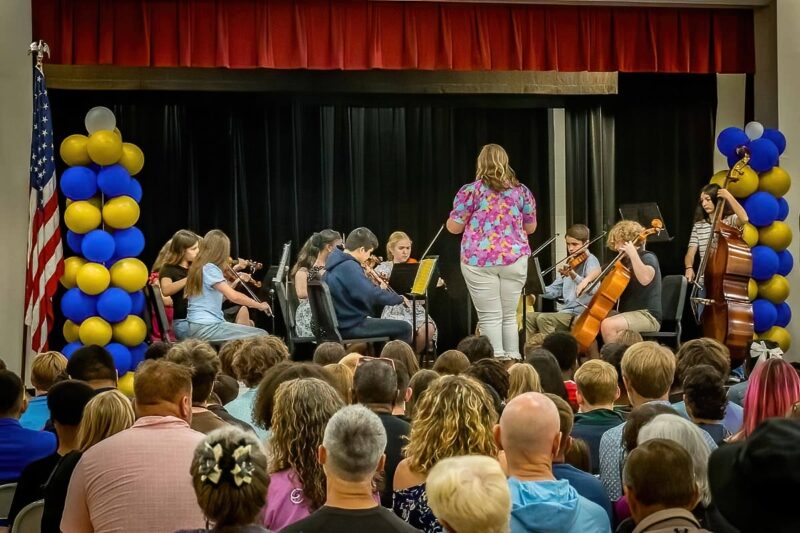
With the big end-of-the-year concert coming up this week, the Boy had an extended Carolina Youth Symphony practice this afternoon, going 2.5 hours instead of the usual 1.5 hours. K and I usually take a walk with the dog during that time, but today, I decided I should take a bike ride on the Swamp Rabbit Trail, our local rails-to-trails treasure that we use too seldom. I began by riding to the northern starting point in Traveler's Rest, then turned around and rode back to downtown Greenville before heading back to Furman University, where CYS practice is held. It was a total of 37 kilometers.
The height of my riding was when I still lived in Poland, and a 37 kilometer ride would have been a short ride from my village to Nowy Targ, the nearest (Polish) town. One of my favorite routes was a 50 kilometer ride around a lake just over the border in Slovakia. It usually took me a little under two hours.
Today's ride went 1:50, with a weak average speed of 20 km/h. I felt like I was flying. I felt my speed (I don't us a cycling computer -- I just track rides on my watch) was surely higher than an anemic 20 km/h. Then I remembered I'm 20 years older and a lot less practiced than when I would make an international circuit around a Slovak lake. Perhaps that's not a bad result, all things considered.
And there's more to be considered. Increased problems with cholesterol has been on my mind for the last year, and a few much-higher-than-average blood pressure readings had me heading to the doctor for some reassurance, which is why I'm heading to a local clinic for some tests tomorrow. Still, my watch reassures me: I've gotten no notifications about symptoms of elevated blood pressure, and other metrics suggest my cardio-health is above average.
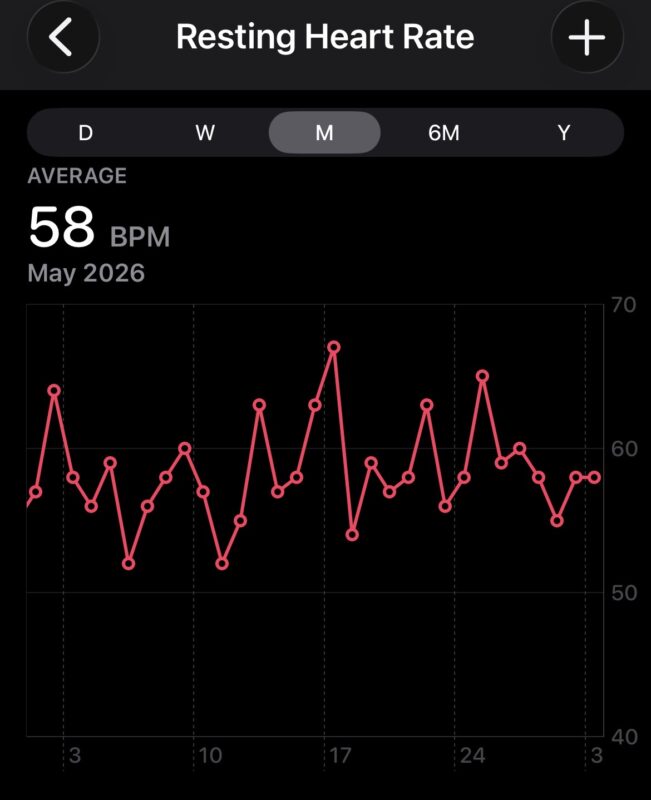
My resting heart rate has been under 60 for the last month, for goodness sake.
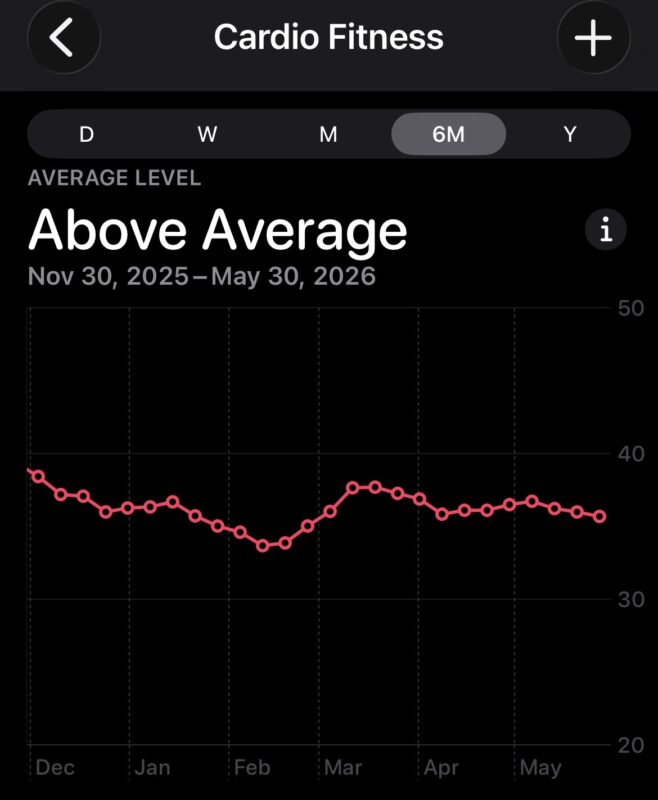
My VO2 Max is above average for the last six months, also suggesting that I have good cardio fitness.
The fact that I'm even giving this so much thought reflects the change in my thinking: in my fifties now, I have to think about my health in a way I never did before. It's nothing big, I suppose: everyone who wants to live a long and healthy life starts thinking about these things at some point, making changes and sacrifices along the way that would have been inconceivable a decade ago.
Tomorrow is the last day of school for our small charter school. It will be the final day of my twenty-eighth or twenty-ninth year as a teacher. (I can't recall recall; I don't really care to count them.) It is the end of my least stressful school year in recent memory. It is the first time in eighteen years that I've not worried about how my students will do on the state year-end test that is ostensibly to measure student mastery but is in fact an awkward and inaccurate measure of teacher effectiveness. It is the end of my first year of teaching primarily sixth graders. And it is the end of my first year teaching a new subject. Each of these firsts impact me differently.
For all the years I taught English, pacing was of utmost importance. The state gave me a list of topics that my students would be tested on at the end of the year; the district gave me a pacing guide that was to dictated the order and duration I taught each topic; I had my own classroom experience that often conflicted with the district pacing guide; and I had 180 days with the students. Add to this (or rather, subtract from that last element) all the testing days we had for worthless benchmark tests, even more useless common formative assessments (CFAs -- educators love acronyms), equally futile common summative assessments (CSAs, as one might guess), PSATs (actually useful for the students), and a handful of other required assessments, and it's easy to see why any unit that needed more than my planned time became an instant stressor. That time had to come from somewhere: more time on topic x means less time on topic y, which could easily affect the results of the ever-important end of year test. This year, though, if I felt we needed more time for a given topic, I simply added more time. No stress; no worries; no issues. Having that freedom was more liberating than I'd imagined.
The previous eighteen years of my teaching career were in an eighth-grade classroom. I knew eighth graders as well as I knew anything. I knew their likely behavior, their maturity, their level of abstract thinking, their enthusiasm (or rather, their lack thereof as often as not). Moving into a position in which two thirds of my students were sixth graders was initially stressful, but I soon realized that sixth graders are the best middle school group to teach. They are so very funky, silly, energetic, and excited that every day seems a dance more than a drudge.
Finally, teaching an entirely new course with only a very skeletal curriculum was a daunting prospect when I first accepted the position. What could I not teach?
In all, a great year that leaves me excited about next year instead of dreading it.