matching tracksuits

fun in threes, sometimes fours

g

Meter

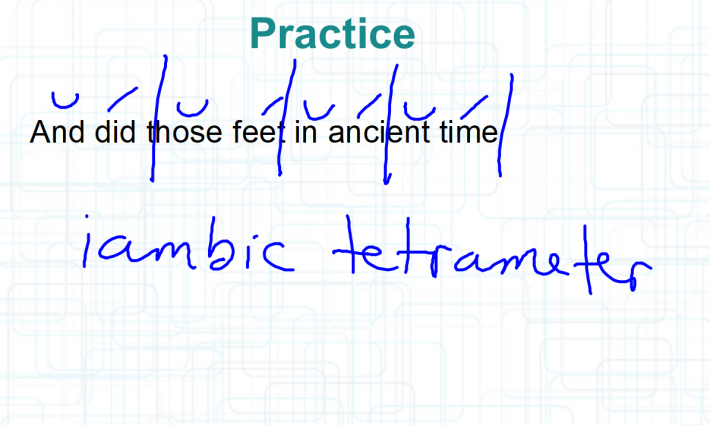
Today we finished up a quick day-and-a-half overview of meter after spending about a week on Shakespearean sonnets. I wanted kids really to understand the level of Shakespeare's achievement, how much he wrote in iambic pentameter.

"Remember, kiddos," I said, "he was not only choosing words based on the ideas he wanted to express; he was also having to take into account their length and rhythm."
In the evening, during L's club volleyball signing and uniform fitting, I ran into two of my students who are playing on L's team. They're having a test tomorrow on sonnets but not on meter. It's not in the standards in any sense, so I couldn't justify testing them on it, and I could just barely justify to myself spending almost two days on it. It's just on interpreting, on picking up on some of the rudimentary differences between modern and Elizabethan English. I reminded one of the girls to keep preparing for the test.

"We were going over it in the car," said her father.

Warship

I was reading The Power Worshippers: Inside the Dangerous Rise of Religious Nationalism this evening, a frightening look at some Evangelicals’ attempt (and often more than just an attempt) to inject religion into government; K was working on documents for a listing she’s preparing; L was Facetiming a friend; E was drawing and writing a story about clowns. I realized it was seven already and I hadn’t done much of anything with the kids other than talk to them at dinner. I headed to E’s room and suggested we play with Legos.

“Yes!”

We’ve built a number of things with blocks over the years. A church. A school. A prison. Multiple boats. Countless wheeled vehicles. A bridge. A few houses.

Today, we took the remnants of the bridge, destroyed part of a prison watchtower, and broke apart the remains of some cars and other nonsense to create a battleship. The ultimate battleship. Complete with gigantic booms coming off the side that can smash any vessel that comes too close, a number of guns, fore and aft, that could take out a small armada, and a newly-invented weapon:

The head canon — a forward-leaning Lego man whose head can be launched at will toward any enemy.

Cutting

Tonight, I spent a fair amount of time going through photos from the last year to create our yearbook. It’s a simple process: go to Lightroom; create a new collection with all flagged pictures from the year; begin deleting pictures. I started out with 1800; I’m down to 330 now.

It’s a good way to get an overview of the year. We had dozens of pictures of the family playing games (Sorry, Monopoly, hearts, etc.); we had dozens of pictures in the park going for walks; we had dozens of pictures of E and me exploring in our creek. How many nearly-identical pictures does one need?


Random Thoughts About Today’s Mass Reading

Today’s gospel reading was the famous parable of the talents:

Jesus told his disciples this parable: “A man going on a journey called in his servants and entrusted his possessions to them. To one he gave five talents; to another, two; to a third, one–to each according to his ability. Then he went away. Immediately the one who received five talents went and traded with them, and made another five. Likewise, the one who received two made another two. But the man who received one went off and dug a hole in the ground and buried his master’s money.

“After a long time the master of those servants came back and settled accounts with them. The one who had received five talents came forward bringing the additional five. He said, ‘Master, you gave me five talents. See, I have made five more.’ His master said to him, ‘Well done, my good and faithful servant. Since you were faithful in small matters, I will give you great responsibilities. Come, share your master’s joy.’ Then the one who had received two talents also came forward and said, ‘Master, you gave me two talents. See, I have made two more.’ His master said to him, ‘Well done, my good and faithful servant. Since you were faithful in small matters, I will give you great responsibilities. Come, share your master’s joy.’ Then the one who had received the one talent came forward and said, ‘Master, I knew you were a demanding person, harvesting where you did not plant and gathering where you did not scatter; so out of fear I went off and buried your talent in the ground. Here it is back.’ His master said to him in reply, ‘You wicked, lazy servant! So you knew that I harvest where I did not plant and gather where I did not scatter? Should you not then have put my money in the bank so that I could have got it back with interest on my return? Now then! Take the talent from him and give it to the one with ten. For to everyone who has, more will be given and he will grow rich; but from the one who has not, even what he has will be taken away. And throw this useless servant into the darkness outside, where there will be wailing and grinding of teeth.'”

I noticed a few things about this parable that I’d never seen before: first, the master leaves all these things and then “he went away.” There’s nothing in the text that indicates the master expected the servants to do anything with the money. Perhaps that’s implied, but it’s not explicitly stated that the master expected any growth on his investment or that it even is an investment.

Second, I find it entirely reasonable that the third servant hides the money. What if he invested it and lost it? Wouldn’t the master be even angrier then?

Third, what’s all this stuff about “harvesting where you did not plant and gathering where you did not scatter”? Just what are the master’s expectations? What kind of a man is this? He doesn’t seem very reasonable at all.

Finally, there’s the disturbing ending: why the severe punishment?

I know, I know — it’s a parable. It’s not really about the money at all but it’s about an individual’s talents. At least that’s how everyone has always interpreted it. That leads to a realization I’ve had recently: why did Jesus speak in parables? If his goal is to transmit information, metaphor and parable are not the most effective, efficient means of doing that.

Politics, As Always

Downtown Saturday

Bonfire

Confirmation Bias

What does it take to change a "Stop the Steal" Trump supporter's mind about the election? What about an outside opinion, reported in the Wall Street Journal?

A team of international observers invited by the Trump administration has issued a preliminary report giving high marks to the conduct of last week’s elections--and it criticizes President Trump for making baseless allegations that the outcome resulted from systematic fraud. (Source)

But see, it's not so easy for Trump supporters who reject the election results. They're predominately Evangelicals. They read the Left Behind series as history written in advance. They believe in an antichrist -- probably the pope -- who will literally perform miracles. They think that all the world will bow down and worship this man. They won't see this as confirmation that the election is fair; they'll see this as proof that it's an international conspiracy. This culminates, they believe, in the creation of a one-world government that will strip America of its sovereignty as part of the coming tribulation.

They won't see this as confirmation that the election is fair; they'll see this as proof that it's an international conspiracy. They will see this as part of the grand prophetic end of the world.

You can't reason with that. It's a faith as strong as any other, as strong as their faith that God will somehow deal with the coronavirus (those who believe it's real, that is) and pray for it despite evidence to the contrary. Nothing counts against that faith. If someone goes through the pandemic without falling ill, it was through God's grace. If someone falls ill but doesn't become overly sick, it's due to God's mercy. If someone falls deathly ill and has lasting complications, it's God's grace that he didn't die. And if someone falls ill and dies, it's God's mercy because he's gone home to the Lord. Nothing counts as evidence against that kind of faith. If nothing counts against it, if there is no way to falsify it, it's not a rational belief but merely a warm feeling.

Transfer that to the election: these Evangelicals see conspiracy everywhere. It's in the DNA of their religion. To forsake that is to forsake their very faith.

The Girl, 2010

Ten years later and games with balls still hold a central spot in her orbit.

I look at three-year-old L and remember thinking, “What’s she going to be like in ten years? How will this young face develop? How will her personality develop?” Now we know, and we see all the seeds were already sprouting in the three-year-old L.

Chatting

Living with a thirteen-year-old is a challenge. “I don’t know how I survived your eighth-grade year,” Nana told me when I got my job teaching eighth graders. Now that I’m teaching them and living with one, I see her point. Their astounding knowledge puts to shame everything I ever thought I knew, and often they realize it’s just not worth it talking to an idiot like me.

Until they do.

Until they sit at the dinner table and chatter on and on about their school day simply because I told a story about playing dodgeball as a kid with the hard, unforgiving kickball balls we used.

“Don’t worry,” I tell L when her behavior frustrates me. “You won’t always be thirteen.”

“You always tell me that!” she responds.

“I’m not saying it for you; I’m saying it for myself.”

Those moments sometimes seem like the dominant moments in a family with a thirteen-year-old. And then, out of nowhere, a perfect dinner conversation that’s amusing and warm.

“They turn normal again,” one of my colleagues said to me today when she asked how school was going for our kids and was shocked to realize/learn that L is now in the eighth grade. But this is normal — for her age. And it is frustrating — sometimes. Yet we know we’ll miss this version of L, so we hold on while we can.

The Split

Today, conservative commentator Dinesh D’Souza tweeted the following:

I’ve seen the same sort of pronouncement in other places. Trump-supporting conservatives are heading to alternate social media platforms, with MeWe and Parler being the most often mentioned replacements for Facebook and Twitter. The reason for this is fairly succinctly summed up on Parler’s “Values” page:

Biased content curation policies enable rage mobs and bullies to influence Community Guidelines. Parler’s viewpoint-neutral policies foster a community of individuals who tolerate the expression of all non-violent ideas.

What they’re referring to is FB’s and Twitter’s policy of labeling misleading information as such. Groups based on ideas with absolutely grounding in reality (like QAnon and white supremacist groups) get kicked off; groups that share clearly factually incorrect information have labels slapped on the posts. Is this censorship? I don’t know. But I see value in this. We’ve all seen the mess social media has made in our lives: it’s easy to live in an echo chamber of our own making, and if someone promotes dangerously deranged ideas that threaten the very underpinnings of a democratic society, someone needs to point that out. Will this help? I doubt it will for most people. But for a few? To see that fact-checkers have determined this meme contains incorrect, inflammatory information? It might just give second thoughts to someone.

But with everyone heading off to “free speech” social media platforms, the echo of everyone’s self-created echo chamber will only resonate more and more loudly. If many people do indeed follow through with D’Souza’s idea, we’ll have two parallel societies in America in life and online, two distinct realities. And one of those realities at this point seems decidedly disconnected for facts.

It will only get worse.

Stories will be invented whole-cloth. Conspiracy theories will no longer be hidden in the dark like mushrooms; they’ll be out in the open, flourishing but, like mushrooms, still fed on shit.

Shit in; shit out. Parler is already in the news for an Arkansas police chief’s call to kill all Democrats:

Would this have happened without Trump? Would these people have been as brazen in their ridiculously absurd notions, their shameless hatred, their unencumbered ignorance? Would QAnon have arisen without Trump? Would supporters of a non-Trump Republican president have come to doubt the legitimacy of the electoral system in America? Would this graph have looked the same?

Best case damage scenario: Trump takes down the whole Republican party. Massive restructuring and soul-searching takes place and the GOP emerges cleansed, humbled.

The LA Times thinks this might be impossible:

Because Trump’s narcissism was so profound, he responded to any criticism with the political equivalent of a nuclear counter-strike. And because Trump’s insecurity was infectious, his fan base — which had outsize power in primaries — would follow suit. This ensured that most Republican politicians shouted their praise of Trump and muzzled their criticism. […]

Institutionalized Trump narcissism probably cost him the election, because the superhuman image he insisted his loyalists embrace never reflected the reality on the ground. Many Republicans were in fact not that into him. They liked the judges, the tax cuts, even some of the “own the libs” bombast. But they were turned off by the self-indulgence, the conspiracy theorizing and the constant need for praise and attention. Still, few conservative politicians or media figures were willing to say so, at least not in a way, or on a platform, where the president would get the message. Trump believed his most fawning media and his fawning media told him again and again, “Never change.” […]

For four years, Donald Trump was president, which also meant he was the de facto head of the Republican Party. This allowed the acolytes of Trumpism — however you want to define that sloppy term — to marry Trumpism, nationalism, patriotism, populism, tribalism, MAGA, etc., to old fashioned party loyalty.

That marriage is over now. And the breakup is ugly and revealing in its ugliness. For many people, Trumpism wasn’t about the party. For a few it wasn’t even about the country. It was about him. His infectious narcissism and incessant victimhood fueled this cult of personality, which he valued more than the office he held. He’s lost his grip on the office, but he’s doing everything he can to hold on to the cult, by claiming he was robbed. It remains to be seen how many he’ll ultimately take with him. But we can be sure the answer will be too many.

Those of us who said Trump might indeed be an existential threat to our system shouldn’t be gloating over being proved right, in part because the people actively working to help Trump destroy our system — i.e., his supporters — don’t even see it that way. They’re saving democracy. Sort of like destroying the village to save it.

Sunday in the Fall

A perfect Sunday.

We had a lovely morning breakfast.

The Boy got a new bike.

A couple of friends came over for a bonfire.