matching tracksuits

fun in threes, sometimes fours

g

Final Speech

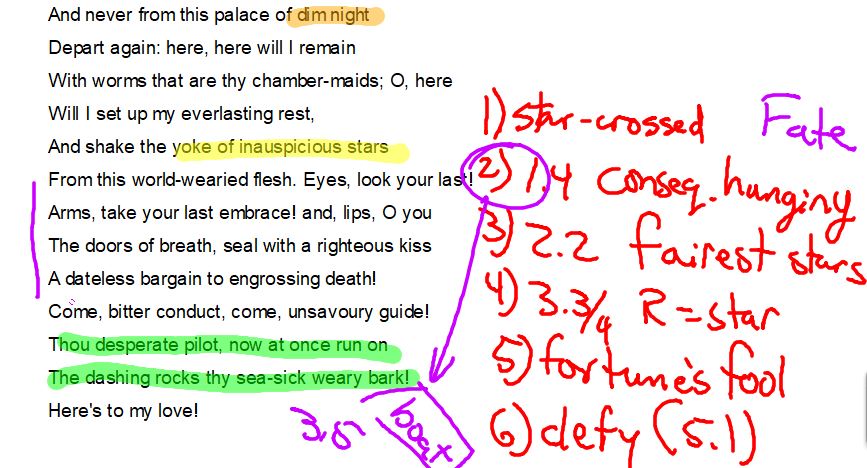
We looked at the final soliloquy in the play, when Romeo loses all sense of rationality and makes a horrible decision based primarily on emotion. We examined how Shakespeare develops this idea within the text by

  • extensive use of "O";
  • chaotic changes in the soliloquy's subject;
  • references to a loss of control;
  • and other techniques.

Students first presented their claims about the text, many of which led naturally into the observations I wanted students to have later in the lesson.
They were doing some pre-teaching for me, in other words.

It was a good day to be a teacher.

Darts and Games

I've neglected photos for almost a month now -- almost nothing new added to the Lightroom catalog.

I've been taking pictures -- a few of them.

They've just been sitting on the memory card in the camera.

Plus, I've been writing and thinking about politics and religion...


Emissions and Lapidation

"That can be a very challenging, challenging reading," Fr. Mike begins today's commentary, which I take to mean something like, "It's really tough to explain away these passages that seem so barbaric or seem so weirdly obsessed with relatively unimportant things. They seem to challenge the very goodness and wisdom of the god we worship." The reading was Exodus 22 and Leviticus 15, and he says that the Exodus reading seems to be more commonsensical.

The first part of the chapter has to do with the laws of restitution -- things like what to do if your bull gores another animal. That type of thing. Fr. Mike discusses these laws fairly quickly, and he's probably right: they are fairly commonsensical in a way. These passages, Fr. Mike explains are "revealing something about God's heart." These are "the principles according to justice."

What he says not a word about are the instructions in the latter half of the chapter, particularly the first set of so-called social and religious laws:

“If a man seduces a virgin who is not betrothed, and lies with her, he shall give the marriage present for her, and make her his wife. If her father utterly refuses to give her to him, he shall pay money equivalent to the marriage present for virgins.

“You shall not permit a sorceress to live.

“Whoever lies with a beast shall be put to death.

“Whoever sacrifices to any god, save to the Lord only, shall be utterly destroyed." (Exodus 22 16-20)

We're to stone incorrigible children. We're to stone witches. We're to stone those who change religions. Stoning is such a brutal, barbaric punishment that the fact that not only does this god justify it ("I'd rather you not do it, but I guess if you do it in these situations it's alright") but simply commands it -- that thought alone disqualifies this god of anything other than contempt from right-thinking people, from people who have a modicum of empathy and decency.

These are, remember, the "principles according to justice" instead of vengeance; this god is all about making sure the punishment fits the crime. So apparently, taking your child out, burying him to the waist, and bludgeoning him to death with stones is a just punishment. Stoning is appropriate for the imaginary crime of sorcery. And just as we see in Islam, the punishment for leaving the faith is -- you guessed it -- stoning.

Remember, too, that these things, according to Fr. Mike, "reveal something about God's heart." What it reveals to me is simple: this is not a just god; this is not a decent god.

But it is the god presented in the Bible, so all this behavior must be justified. We have to explain away this barbarity somehow. How does Fr. Mike justify it? Simple: he just doesn't comment about it at all. Not a word about any of the commands to stone anyone. Not one word.

He does go into detail about the passage in Leviticus, which is what all we're to do regarding menstruating women and semen-spilling men. It reads like this:

“And if a man has an emission of semen, he shall bathe his whole body in water, and be unclean until the evening. And every garment and every skin on which the semen comes shall be washed with water, and be unclean until the evening. If a man lies with a woman and has an emission of semen, both of them shall bathe themselves in water, and be unclean until the evening. (Lev. 15.16-18)

This is what the creator of the universe, the ground of all being, is concerned with: what to do after a wet dream.

Fr. Mike explains it this way: "The bodily emissions are important why? Because life is in the blood. They're important because they refer to very intrinsic and necessary parts of our relationships." But why would there be rules about this? Fr. Mike explains,

[It] is because the body is sacred. The emissions of the body refer to life but also because this particular kind of emissions of the body have to do with sex, have to do with reproduction, have to do with relationships. [...] There's some kind of guidance, some kind of restraint again placed upon people when a) they are engaged in sexual acts with one another, and b) they're in community with each other. And this is just part of the genius of God's word. God's word is saying "we're going to show restrait." And that restraint is not for restraint's sake alone and also not like "oh, gross!" -- that's not what uncleanness means. Uncleanness simple means whether this is an issue of blood, an issue of seman, whaterver this is, those are things that can bring forth life. But because they bring forth life, we have to be careful around them. This is something that's so important for us to rediscover in the twenty-first century that because there are things so connected to life we need to be careful around them.

What does that even mean? Why would we "be careful"? In what sense would we "be careful"? Is he talking about being careful with sex? I guess that's what he means, but the Levitical passages aren't solely about sex; they're about menstruation and simply ejaculation (not necessarily during coitus). It all just becomes a big confusing bundle of squishy words that don't seem to mean anything.

I feel like he's just providing an answer that he knows, consciously or unconsciously, is vague but will communicate enough to reassure believers who are troubled by this passage. They might not even understand it, but it gives them something to calm their worries about this passage. I can even hear someone saying something like this, then appending it with, "I'm not sure I explained it right. Fr. Mike does it better. You should just listen to the podcast."

Header image is a still from the film The Stoning of Soraya M.

Slavery in the Bible

K asked me to listen along with her has she goes through Fr. Mike Schmitz’s podcast The Bible in a Year. I’ve been eager to see how Fr. Mike deals with the more troubling parts of the Bible, and today, he hit Exodus 21, which deals with how to treat slaves:

“Now these are the ordinances which you shall set before them. When you buy a Hebrew slave, he shall serve six years, and in the seventh he shall go out free, for nothing. If he comes in single, he shall go out single; if he comes in married, then his wife shall go out with him. If his master gives him a wife and she bears him sons or daughters, the wife and her children shall be her master’s and he shall go out alone. But if the slave plainly says, ‘I love my master, my wife, and my children; I will not go out free,’ then his master shall bring him to God, and he shall bring him to the door or the doorpost; and his master shall bore his ear through with an awl; and he shall serve him for life.

“When a man sells his daughter as a slave, she shall not go out as the male slaves do. If she does not please her master, who has designated her for himself, then he shall let her be redeemed; he shall have no right to sell her to a foreign people, since he has dealt faithlessly with her. If he designates her for his son, he shall deal with her as with a daughter. If he takes another wife to himself, he shall not diminish her food, her clothing, or her marital rights. And if he does not do these three things for her, she shall go out for nothing, without payment of money. (Ex 21.1-11)

Fr. Mike explains it this way: it’s a difficult passage, but it’s important to understand Old Testament slavery in the proper context:

He’s not revealing himself to a people who knows who he is. […] He’s not revealing himself to a people who, for lack of a better term, are civilized. He’s revealing himself to a people who are familiar with a kind of Wild West justice. He’s revealing himself to a people who have a sense of what’s right and what’s wrong but don’t necessarily know how to pursue what’s right and what’s wrong in a way that’s absolutely just and fair. […] He’s teaching them, “I am a god of justice, a god who does hear the cry of the poor.”

Yet Fr. Mike contends that because slavery was so common in the ancient world, God had to take baby steps with them. First of all, slavery then wasn’t what we think of slavery. It was more like indentured servitude. So it’s slavery, but not slavery slavery. Next, he contends that God had to teach the Israelites that you can’t just do anything you want to your slaves. They’re human beings. That’s all fine and good, I guess, but it seems to me that that’s a pretty basic step, a pretty small step. Add to it the dimension of sexual slavery (“If she does not please her master”) and the thought of selling one’s daughter into this sexual slavery — it’s just astounding that someone can justify this.

More problematic is the realization that, if God was just taking these “baby steps,” we would expect to find an outright prohibition of slavery somewhere later in the Bible. After all, Christians are fond of explaining that Jesus did away with all that Old Testament stuff when he instituted the New Testament. And it seems to have caught on: Paul writes in Galatians 3.28, “There is neither Jew nor Greek, there is neither slave nor free, there is neither male nor female; for you are all one in Christ Jesus.” Surely that’s the next step implied by this baby-steps argument.

It’s hard, then, to understand why Paul himself would contradict himself and walk back this argument in Ephesians 6.5-8

Slaves, be obedient to those who are your earthly masters, with fear and trembling, in singleness of heart, as to Christ; not in the way of eye-service, as men-pleasers, but as servants of Christ, doing the will of God from the heart, rendering service with a good will as to the Lord and not to men, knowing that whatever good any one does, he will receive the same again from the Lord, whether he is a slave or free.

Even more troubling is the whole letter to Philemon, in which Paul returns a slave to his master In verses 12-18, he writes,

I am sending him back to you, sending my very heart. I would have been glad to keep him with me, in order that he might serve me on your behalf during my imprisonment for the gospel; but I preferred to do nothing without your consent in order that your goodness might not be by compulsion but of your own free will.

Perhaps this is why he was parted from you for a while, that you might have him back for ever, no longer as a slave but more than a slave, as a beloved brother, especially to me but how much more to you, both in the flesh and in the Lord. So if you consider me your partner, receive him as you would receive me. If he has wronged you at all, or owes you anything, charge that to my account.

Here would be a perfect chance to condemn and prohibit slavery. Here would be the perfect location to take that final step started with those baby steps in the Old Testament. Here would be the place to say something like this:

I am not sending him back to you. I would have been glad to keep him with me, but I gave him the choice to stay or to go, and he, being a free man not just in Christ but because slavery is itself vile and immoral, chose to leave. I preferred to do nothing without your consent, but because he has his own rights and liberty, I told him to go his own way.

Perhaps this is why he was parted from you, that you might realize how vile slavery is and repent of this evil. Understand me now: there is no place in the body of Christ of slavery of any kind, of any shape, of any definition. So if you consider me your partner, receive this news as you would receive me. If he has wronged you at all, or owes you anything, he paid it off long ago.

There. I fixed it.

Predictions

Back on October 3, my favorite cult leader, David Pack, predicted a definitive date for the return of Jesus. It would happen before October 13. It's now February.

Oops.

Earlier this month, though, he set a new date. During last week's sermon, he made a few assertions:

  • It's a perfect picture…only the whole thing crashes if Christ doesn't come this Friday.
  • God streamed this concluding list through my mind without notes or the Bible.
  • It's a divine act, if all these prophecies are at stake, would God let me mess up? He had to just stream it into me!
  • Sabat 24, is this Friday night. May we now see Christ, the kingdom, all the New Testament saints, and all Israel [resurrected] in just over 4 days. If it's wrong then you now understand why I kinda thought I was on to something. (Banned by HWA)

Well, it's now Sunday. What do we make of that? Was Pack wrong? Of course not. He sent out a memo late Friday night:

We have received numerous emails from the field expressing your amazement and excitement about what is upon us. Brethren here at Headquarters are right there with you!

As we enter the Sabbath, understand there is a case for Christ coming this side of midnight (Headquarters time). But the case grows stronger after midnight. And the most powerful case of all, with literally dozens of reasons just reviewed by 15 ministers at Headquarters, indicates Christ comes late in the day on the Sabbath tomorrow. So strong is this case, it appears virtually impossible that anything happens tonight. But do not stop watching! It is important to Mr. Pack that all of you remain on the same page we are, hence this brief update.

Rest assured, Christ coming later on the Sabbath in no way violates the intricate mathematical relationships between the key dates we have studied in God’s Plan.

We look forward to seeing you very soon!

Banned by HWA

Notice his phrasing: "As we enter the Sabbath, understand there is a case for Christ coming this side of midnight (Headquarters time). But the case grows stronger after midnight." Using "the case grows" indicates that Pack is watching and praying, watching and reading the Bible, watching and meditating, and even now, at this last moment, things are becoming clearer: his timing might have been off by just a few hours. How do clear-headed, skeptical observers interpret this? "The day I predicted Jesus's return is drawing to a close and, holy shit! He's not here yet!"

He says, "Rest assured, Christ coming later on the Sabbath in no way violates the intricate mathematical relationships between the key dates we have studied in God’s Plan." What he wants his followers to hear is simple: "This is complicated stuff, brethren. It's taken my years to understand this! It's math!" What we skeptis hear: "Please don't leave my church and take your money with you when this turns out wrong! Please! I'm not qualified to do anything else. How will I make my money? How will I afford my enormous house?"

Of course, it's written as if Pack himself isn't saying this: "It is important to Mr. Pack..." But is there any doubt really?

Then, yesterday afternoon, they posted this:

While it is a discussion beyond the scope of a short update, bear in mind the Sabbath has not ended in the far west. The math and science do not break! In fact, many principles and verses show we must reach the far end of the Sabbath as it exists worldwide—all the way through the time zones of the western islands of the Pacific.

More than a dozen Headquarters ministers who just met discussed this again thoroughly and none can see a way out of tonight. Believe us when we say that we have tried! If there is more to see, God will certainly reveal it. Any details would be passed along in the coming days.

Again, keep watching. Our wait cannot be long!

And now it's Sunday. And what?

Why do people continue with him? It's simple -- the sunken cost fallacy. Once you've invested so much in an idea, it's all but impossible to give that idea up.

Snowfall 2021

When you live in South Carolina, every snowfall is an occasion, a rarified event that deserves a bit of awe and praise.

Sadly, K had already made it to bed when the snow started, and the forecast calls for an increase in temperature, which means it might all be gone in the morning.

Evening Walk

And Repeat

Today, after some girls in homeroom were working on our door decoration for Black History Month (that’s Lisa on the far left), I went back to grading study guides. And I found four more in another class who were copying off a different paper. You’d think that, after all of the raging gossip about the incident yesterday, they would wonder if perhaps it wasn’t time to cut their losses and confess before getting caught — throw themselves on the mercy of the court and all that. But no. So I sent them to Mrs. D, and she ran them through the ringer, then sent them back to class. More gossip.

At the end of the day, when I went back to grading the final batch of study guides, and, well, you probably know what I discovered…

Reputation

The last question for the act three study guide was to complete a paraphrase of lines 94-103. It was one of the few questions I actually check -- the rest of them, I skim and make sure they put something close to correct. This one I read.

One young lady (we'll call her Lisa) turned in the following:

I'm so upset about my cousin's death that I'll never be satisfied with Romeo until I see him dead. Mother, if you could find a man who sells poison, I would mix it myself so that Romeo would be dead. My heart hates hearing his name and not being able to go after him, not being able to avenge the love I had for my cousin.

The second part wasn't as simple: explain the paradoxical/ironic phrases in this passage.

This passage is ironic because Juliet has to pretend that she hates Romeo and wants to kill him even though in reality she loves him and wants to protect him. Juliet says that she will never be satisfied until she sees Romeo dead when in reality she won’t be satisfied until she sees Romeo and can hug him and be with him. Juliet tells her mother that she wants to mix up the poison to kill Romeo but she really wants to mix up the poison so she can protect Romeo and make sure that the poison doesn’t kill him. Also, Juliet hates to hear Romeo’s name and not go after him, but she says that she hates hearing Romeo’s names and not being able to avenge Tybalt’s death to cover-up that fact that she loves Romeo.

My comment: "Good work. A thorough examination of all the levels of irony." Lisa is, in all respects, a star student. She never gives less than 115%, and she absolutely hounds me to death for extra feedback and additional help. As a result, she finished the second quarter this year with an eye-popping grade of 100. She had a 99 without the extra credit for the quarter, but she did every possible bit of extra credit so I was more than happy to give that one point, though she didn't have to do everything to get that point. But she would have done it all even if I'd told her she didn't have to. "I just want to make sure," she'd likely say.

A couple of students later, I was skimming through the answers, thinking how much more complete these answers seem than what I'm used to receiving from the boy (we'll call him James). Then I get to the paradox question and read his answer:

This passage is ironic because Juliet has to pretend that she hates Romeo and wants to kill him even though in reality she loves him and wants to protect him. Juliet says that she will never be satisfied until she sees Romeo dead when in reality she won’t be satisfied until she sees Romeo and can hug him and be with him. Juliet tells her mother that she wants to mix up the poison to kill Romeo but she really wants to mix up the poison so she can protect Romeo and make sure that the poison doesn’t kill him. Also, Juliet hates to hear Romeo’s name and not go after him, but she says that she hates hearing Romeo’s names and not being able to avenge Tybalt’s death to cover-up that fact that she loves Romeo.

A few more students later, I read another boy's work. We'll call him Nate. Nate has been struggling with the class, but he's constantly saying he wants to do better. I read his paradox answer:

This passage is ironic because Juliet has to pretend that she hates Romeo and wants to kill him even though in reality she loves him and wants to protect him. Juliet says that she will never be satisfied until she sees Romeo dead when in reality she won’t be satisfied until she sees Romeo and can hug him and be with him. Juliet tells her mother that she wants to mix up the poison to kill Romeo but she really wants to mix up the poison so she can protect Romeo and make sure that the poison doesn’t kill him. Also, Juliet hates to hear Romeo’s name and not go after him, but she says that she hates hearing Romeo’s names and not being able to avenge Tybalt’s death to cover-up that fact that she loves Romeo.

At this point, there was only one thing to do: go back through all the other papers and check. Nothing else seemed suspect, but these Lisa's, James's, and Nate's study guides were, upon closer inspection, identical. Completely. Perfectly. A medieval scribe would be jealous of the letter accuracy.

I was puzzled, though. I couldn't get a single thought out of my mind: "This just does not seem like something Lisa would do." James and Nate -- maybe. Conceivably. But Lisa? Never.

I took the three papers to Mrs. D, the eighth-grade vice principal, and she sweated a couple of more names out of them. I got a call during my planning period asking if I'd print out Sam's and Jacob's paper. I did so, but they were identical to the other three. Mrs. D applied a little more pressure while I stood there: "You want to tell me what happened or should I immediately just start suspending people?" It turned out that both James and Nate had gotten the study guide from Jacob.

While they were providing details, I looked down at Lisa. Her brow was furrowed in confusion; her eyes glistened; her chest was heaving slightly. She was utterly terrified.

It wasn't difficult to understand why: here was a girl who'd probably never gotten in trouble at school. Ever. For anything. She's chatty because she's so very bright, and she just wants to share all the thoughts she has. (She puts Post-It notes on her article of the week in addition to all the marginal comments. "I just have a lot to say," she explained with shrug of the shoulders when I asked her why she was doing so much more than was required.)

I left the room to get ready for class -- their class. Students began filing in, and I heard the talk:

"Who else got called to the office?"

"Lisa's in there."

"Then it must be some star student thing or something."

"No, I think she's in trouble."

Just before class started, the vice principal came down to my room to tell me that Jacob had rather casually admitted that he'd swiped the study guide from Lisa. While she had gone to the restroom, he noticed the study guide was up and quickly jumped on her computer to send a copy to himself. He then shared it.

Poor Lisa, I thought.

I went back into the classroom and made sure everyone was working, then called Lisa outside.

"Are you okay?" I asked.

"Yes. Did Mrs. D tell you what happened?"

"Yes, and I'm glad it all came out. I'm sure you were quite confused."

"Very," she said, shaking her head vigorously.

"Well, this should serve as a lesson to you that's a little different than the lesson the boys are going to learn." I asked her if Mrs. D had told her what I'd said initially.

"No, not really."

"Well, I told her that it just didn't seem like you. That I doubted you'd just shared this. I didn't have any way to explain it, but I really didn't think you would do something like this." She smiled, and I continued, "So the lesson I hope you learn in a very real way is how valuable the reputation you've created for yourself is, how important it is to maintain such a reputation because it will serve you well in ways you probably didn't previously imagine."

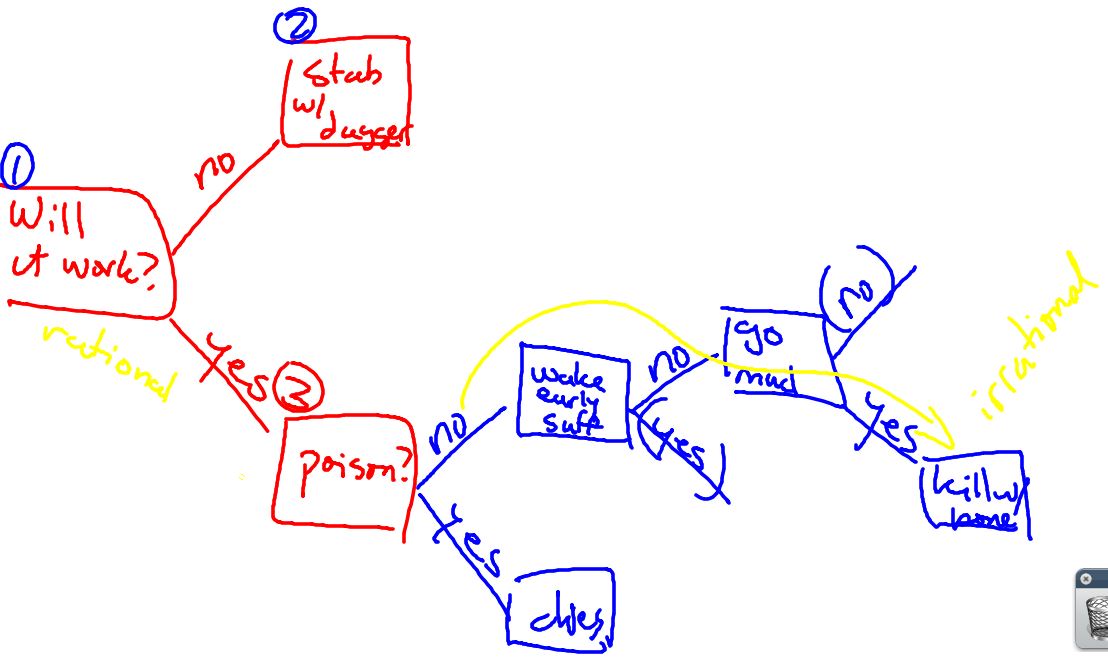
She smiled again, and we went back inside and had a great class, making a decision tree of Juliet's concerns about taking Friar Lawrence's potion.

Farewell! God knows when we shall meet again.
I have a faint cold fear thrills through my veins,
That almost freezes up the heat of life:
I'll call them back again to comfort me:
Nurse! What should she do here?
My dismal scene I needs must act alone.
Come, vial.
What if this mixture do not work at all?
Shall I be married then to-morrow morning?
No, no: this shall forbid it: lie thou there.

Laying down her dagger

What if it be a poison, which the friar
Subtly hath minister'd to have me dead,
Lest in this marriage he should be dishonour'd,
Because he married me before to Romeo?
I fear it is: and yet, methinks, it should not,
For he hath still been tried a holy man.
How if, when I am laid into the tomb,
I wake before the time that Romeo
Come to redeem me? there's a fearful point!
Shall I not, then, be stifled in the vault,
To whose foul mouth no healthsome air breathes in,
And there die strangled ere my Romeo comes?
Or, if I live, is it not very like,
The horrible conceit of death and night,
Together with the terror of the place,--
As in a vault, an ancient receptacle,
Where, for these many hundred years, the bones
Of all my buried ancestors are packed:
Where bloody Tybalt, yet but green in earth,
Lies festering in his shroud; where, as they say,
At some hours in the night spirits resort;--
Alack, alack, is it not like that I,
So early waking, what with loathsome smells,
And shrieks like mandrakes' torn out of the earth,
That living mortals, hearing them, run mad:--
O, if I wake, shall I not be distraught,
Environed with all these hideous fears?
And madly play with my forefather's joints?
And pluck the mangled Tybalt from his shroud?
And, in this rage, with some great kinsman's bone,
As with a club, dash out my desperate brains?
O, look! methinks I see my cousin's ghost
Seeking out Romeo, that did spit his body
Upon a rapier's point: stay, Tybalt, stay!
Romeo, I come! this do I drink to thee.

I've always loved this lesson: the decision tree helps them literally see how increasingly irrational Juliet is becoming:

Lisa was classic Lisa: she took control of her group; she offered her ideas enthusiastically but humbly; she listened to others and helped everyone synthesize their thoughts. Back to normal. Classic Lisa. The Lisa everyone was thinking of, scratching their heads, wondering, "Lisa, in trouble?"

And the boys? Well, I didn't talk to them. After all, what could I say that Mrs. D hadn't already said?

The End of the Swimming Lesson