







fun in threes, sometimes fours
g
Growing up, birthdays were never of any importance to me. Our sect taught that the celebration of birthdays was a sinful vanity and that those truly trying to “be like Christ” would have no interest in shallow self-adulation. So I never once had a birthday party growing up, and I don’t really recall much acknowledgment of my birthday than “Hey, you’re nine today. Really growing up fast!”
One outcome of this is my apathy toward my own birthday. I've managed to adapt from my upbringing and realize that it is important for other people to have their birthdays recognized and celebrated, but I just don't really care that much about my own. I might use it as an occasion to splurge and buy a cigar that's a little pricier than what I normally have (time this evening for a beloved Partagas Black Label -- a beast of a cigar), but that's about it.
Saying all of that, though, makes me feel I'm somehow condemning Nana and Papa. But they were only following orders: the church taught; they followed. They thought they were doing the best for me. And really, how is it different from anyone else in any other religion? The religion has strictures; either its adherents follow them or they don't. "It's Friday. I really shouldn't eat meat," Babcia said just yesterday, illustrating that point perfectly. So I don't blame my parents in any sense of the word. But I am glad that I'm not raising them in such a strictly religious environment.
Is there a substantial difference between "Nobody's like me" and "Nobody likes me?" Is there anything more valuable than a friend, a real friend you can trust, and who can make your day brighter? Can there be anything more difficult to a young sixth grader than losing the only friend he's made in his new school (where either his elementary school friends don't go or they are on a different team)? No, the Boy's friend didn't die, but he's moving, and the Boy can't take it.
He's having such a hard time making friends because, in part, despite what I said above, we are raising our kids differently than most people around here. Football? I never watch it; E knows next to nothing about it. Video games? We never bought a console for either child. Restaurants? We rarely eat out. All the little things that kids can connect on, our kids don't have. L has made up for it. In high school, she's found her spot, and she even goes to Friday night football games. "I have no idea what's going on," she cheerily admits, "but I'm not going there for the game."
So the Boy has been having a hard time with his social life, a hard time with one boy in particular who seems to be using him, a hard time with so many things. And the Girl has been having some ridiculously painful (but thankfully, not long-term serious) medical issues that make it difficult to sleep at night. And last night, they both exploded, leaving all four of his sleep-deprived and exhausted -- physically, emotionally, and mentally.
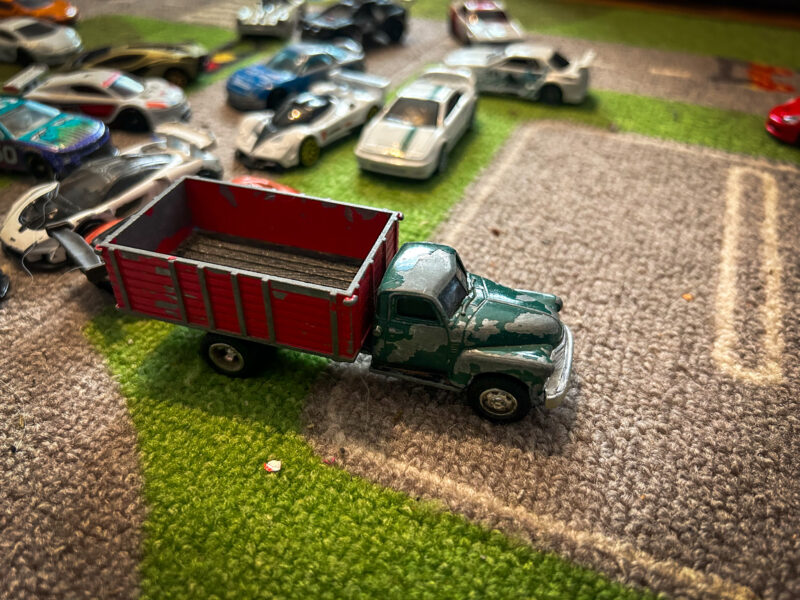
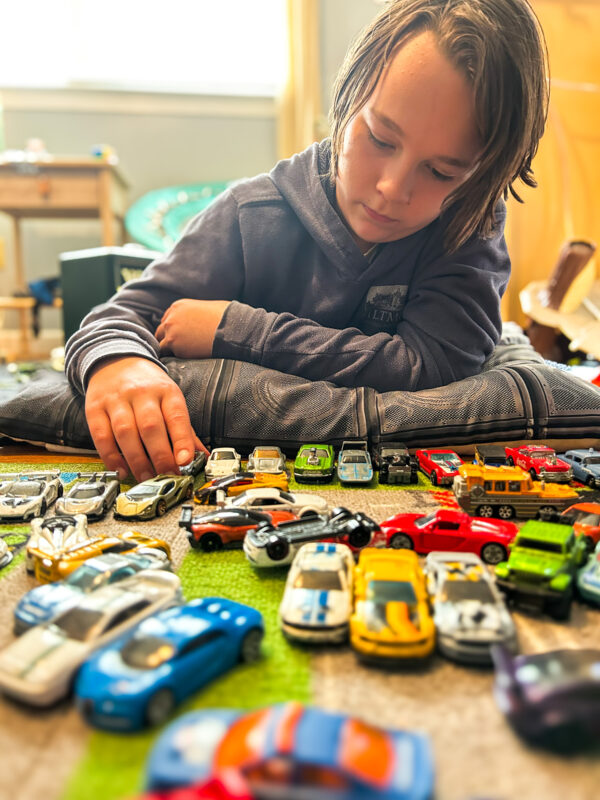
That's why for most of the day, we stayed home, doing as little as possible. L's pain finally calmed down and she was able to sleep; K did some grocery shopping and then spent the rest of the day relaxing as the Girl slept, Babcia watched Polish TV on the computer, and the Boy and I played with his cars (first time in a long time we've done that).
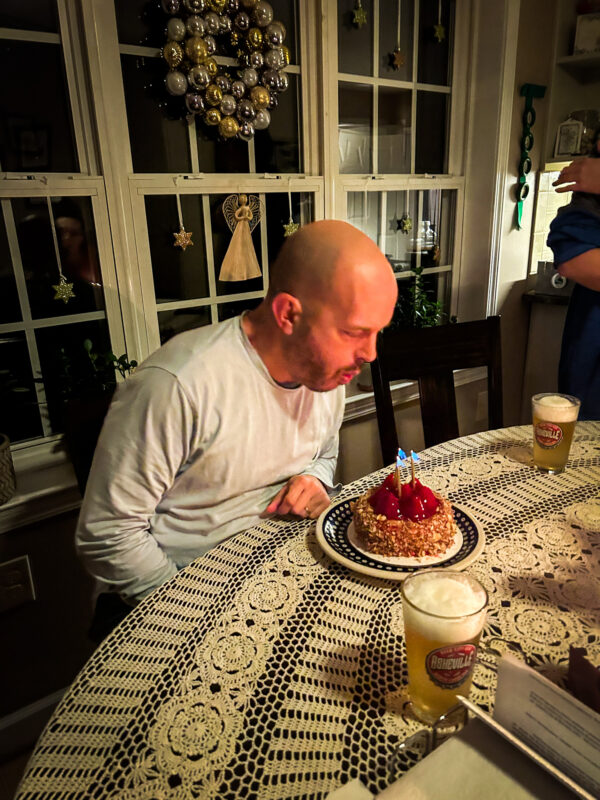
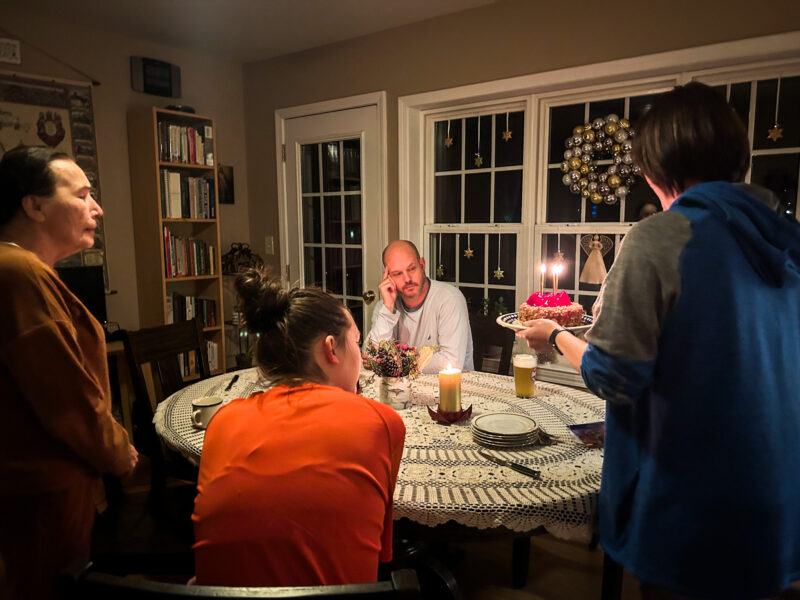
In the evening, K wanted to head back to the store to get some kind of cake for me. The Girl, feeling better than she's felt in probably a week, decided to go with her. And so they lit some candles and sang "Sto Lat" for me.
And then the Boy gave me his gift: a bespoke card with a twenty dollar bill in it. I looked at K, thinking maybe she'd given it to him to tuck in there, but as little surprise as I, she shook her head. He was giving me his own money.
I just about lost it right there...
If only you knew the hell coming in the late evening…
Looking for something to read, he picks up a book he recommended but his wife abandoned ("Just not my thing"). It's a short book, a lovely piece of historical fiction, and he decides to read it again. In opening it, he finds the slip of paper his wife had been using as a bookmark: a drawing in a childish hand. A heart and some flowers. His daughter's name scribbled in the lower corner.
He studies the drawing for a moment, unable to place when or where his daughter drew it. At school? At daycare? At the grandparents'? At home?
Pictures of the past are one thing, but this sends him back into the past so completely that he sits and stares at the drawing for some time, tracing the lines with his finger, a small smile curling into the corners of his mouth.
Now seventeen, his daughter is edging up against adulthood, sliding one foot after another closer and closer, ever so surreptitiously. In truth, she's been doing this since she was a little girl: sliding one foot a little closer to the threshold of whatever comes next, with it all ending in the inevitable: moving out, starting her own life, being separate from her parents in the most complete way possible.

Just like years ago...


Taking your daughter to the ER at 11 in the evening is one of those things you never want to do but you seemingly spend most of your time as a parent implicitly fearing. We took her when she was about two or three and hit her head with a loud thud that was terrifying. It turned out to be an unnecessary trip, and after the visit, what the doctor said seemed like something we could have figured out on our own: the large bump — unnaturally large, it seemed — was actually the best sign we could hope for. But we were new parents and inexperienced.
When you make the decision to take her after she’s already been to two different doctor’s visits within the last few days about the same thing — that might seem like the same reaction to an outside observer. But that pitiful crying, that obvious pain that doubles her over for hours — you can only take so much before worry overwhelms you.
Yet knowing the whole story is critical. And we didn’t. And that new information, when we get it, is itself another worry. Another pack of worries. Did we do our best as parents over the last few months? Years? What we discover from parents of her friend calls all that into question.
We’re supposed to get a hell of a storm through here tomorrow, with wind gusts up to 60 miles per hour and three to five inches of rain. Two separate concerns.
We have a forest in our backyard: wind gusts of 60 miles an hour could take down one of those beasts, and some of them are so big they would do significant damage to the house — like having to move out level of damage.

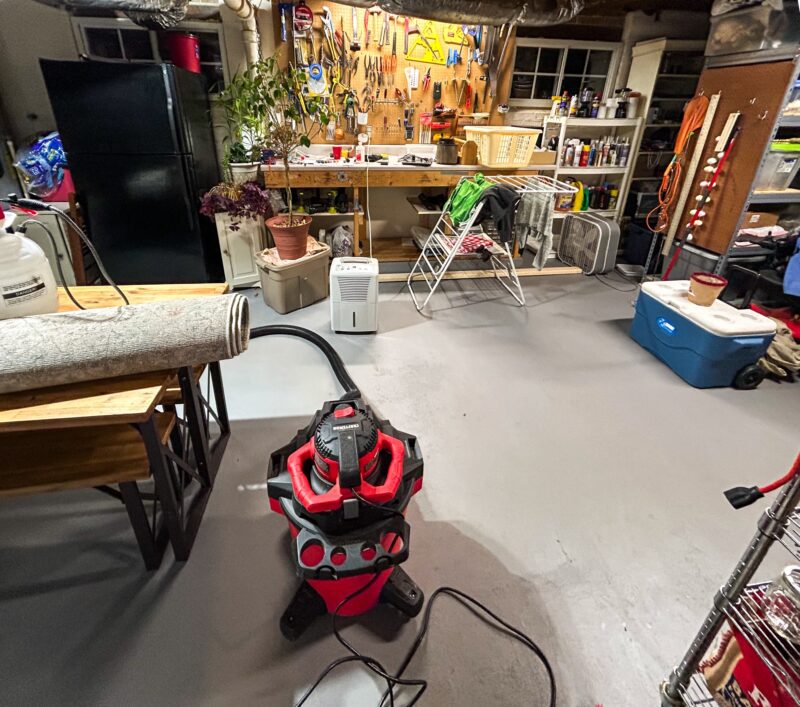
And we know how easily we can flood with less rain than predicted.
And so we went ahead and got ready for what’s sure to be come tomorrow.
Tomorrow is going to be rough.




On the way to the basketball game, the Boy makes a comment about how many churches are around, and then turns the discussion to religion, remarking that Jesus has been dead 2000 years and has still not returned.
"Two thousand years is a long time," he suggests.
I simply agree.
He continues: "How do we even know that all that stuff happened?"
"What do you think?" again trying to remain non-committal.
"Well, they say they were there," he suggests.
"How do we know that?"
“Because that’s what they wrote." He stops to think about it for a moment and then asks, "But how do we know those documents are authentic?”
The short answer is, we don’t. The Gospels, despite the purported authorship the Bible affixes to them, are anonymous. Those names — Matthew, Mark, Luke, and John — appear only in documents from the third or fourth century if memory serves. But I say none of this. Instead, I simply respond, “That’s a very good question. What do you think?”
“Well, all the Christian scientists trying to prove that are biased. They want to prove it.”
For a moment, I think, “Wait, how did we get onto the topic of Christian Science, but I realize quickly what he means: he’s referring to apologists and Christian New Testament scholars who consistently make the arguments that support Christianity, explaining away the problems like the one of the gospels’ anonymous authorship. But his point is very salient: apologists are indeed biased. They are not seeking truth as much as seeking ways to buttress Christian belief, and many skeptics suggest that apologists are almost exclusively preaching to the choir, so to speak, giving believers answers to questions they might have rather than providing skeptics with evidence to overcome their skepticism.
These are all very good questions that will lead to some answers that might lead the Boy away from church teaching, but I am trying my best not to provide any answers.
We get to the game and immediately see what we’re up against: a bunch of guys eighth graders who are enormous and merciless. They tower over most of our boys.

Their brutality comes from the coach down: They begin applying full-court pressure in the second half when they already have a significant, and they would only begin doing that (I think) because their coach has instructed them to do so. Every time the opposition scores, the coach whoops and hollers like it's the greatest comeback in history. The final score is 13-22, and I hear the say to his team, "That was okay, but you missed a lot of easy baskets." Translation: "You beat them badly, but you should have beaten the ---- out of them." At least that's how I interpreted it as an objective observer...