
fun in threes, sometimes fours
g
www.ncregister.com/commentaries/jimmy-akin-being-precise-about-catholic-church-teaching-on-hell
Pope Francis recently sparked a discussion when he told an Italian television program, “What I am going to say is not a dogma of faith but my own personal view: I like to think of hell as empty; I hope it is.”
I was not surprised he would have this view. It is common in some ecclesiastical circles and was proposed by theologian and priest Hans Urs von Balthasar in his book Dare We Hope That All Men Be Saved?
Given how Pope Francis’ comments often function as a lightning rod, I was not surprised by the discussion that followed, and one contribution was a recent article by Ralph Martin.
Although framed as a piece about what the Church teaches on hell, Martin spent much of it arguing for his own view, which is the traditional one, that hell is both a real possibility and an actual reality for many people. He explores this further in his book Will Many Be Saved?
I wish Martin well in arguing his case — and arguing it vigorously. The thought that hell might be a real but unrealized possibility is a comforting one that can be attractive to many today. However, Scripture contains serious warnings about hell that do not sound hypothetical.
As a result, the theological field should not simply be ceded to what we moderns find comfortable and reassuring. If there is to be any reassessment of the traditional view of hell as an actual reality for many, Scripture’s statements need to be taken seriously and both sides need to be argued vigorously.
(I’d note, in particular, that in his book von Balthasar never even addresses Luke 13:23-24, where in response to the question, “Lord, will those who are saved be few?” Jesus responds, “Strive to enter by the narrow door; for many, I tell you, will seek to enter and will not be able.”)
My sympathies are thus with Martin, but I would refine a few things about his article.
First, regarding Pope Francis’ statement that what he was about to say was “not a dogma of faith,” Martin offers a definition of dogma that could suggest it is restricted to revealed truths connected with salvation. I would point out, by contrast, that in current theological jargon, a dogma is any truth that the Catholic Church has infallibly defined to be divinely revealed, whether or not it has any direct connection with salvation. (Culpably rejecting a dogma is a mortal sin; but the truth itself doesn’t have to have a direct connection with salvation.)
Second, there is a passage where Martin conveys a misleading impression about the views of Cardinal Avery Dulles. First, he says that “the traditional interpretation ... by the Church’s greatest theologians is that it is very likely that many people go [to hell],” then he identifies Cardinal Dulles as “perhaps the leading American theologian of the 20th century,” and then he cites a 2003 article that Dulles wrote in First Things.
The problem is that Martin quotes a part of the article in which Cardinal Dulles refers to several passages of Scripture and says, “Taken in their obvious meaning, passages such as these give the impression that there is a hell, and that many go there; more in fact, than are saved.” The impression is thus that Cardinal Dulles is firmly in the line of “the Church’s greatest theologians” who believe that “many go there; more in fact, than are saved.”
However, this is not Cardinal Dulles’s view. He notes the obvious interpretation of various Bible passages without asserting that the obvious one is the only possible one. In fact, he concludes:
The search for numbers in the demography of hell is futile. God in His wisdom has seen fit not to disclose any statistics. Several sayings of Jesus in the Gospels give the impression that the majority are lost. Paul, without denying the likelihood that some sinners will die without sufficient repentance, teaches that the grace of Christ is more powerful than sin: “Where sin increased, grace abounded all the more” (Romans 5:20). Passages such as these permit us to hope that very many, if not all, will be saved.
All told, it is good that God has left us without exact information. If we knew that virtually everybody would be damned, we would be tempted to despair. If we knew that all, or nearly all, are saved, we might become presumptuous. If we knew that some fixed percent, say fifty, would be saved, we would be caught in an unholy rivalry. We would rejoice in every sign that others were among the lost, since our own chances of election would thereby be increased. Such a competitive spirit would hardly be compatible with the gospel.
Martin’s article thus conveys a misleading impression of Dulles.
What does the Church actually teach? This is found in the Catechism of the Catholic Church, which says, in part, “The teaching of the Church affirms the existence of hell and its eternity. Immediately after death the souls of those who die in a state of mortal sin descend into hell” (1035).
The Church thus teaches that hell is a real possibility. If you die in mortal sin, you go there. But does the Church leave room for the idea that God might rescue all from mortal sin — even at the last moment?
The Catechism states, “The Church prays that no one should be lost: ‘Lord, let me never be parted from you.’ If it is true that no one can save himself, it is also true that God ‘desires all men to be saved’ (1 Timothy 2:4), and that for him ‘all things are possible’ (Matthew 19:26)” (Catechism, 1058).
The Catechism thus seems open to the possibility that God — for whom “all things are possible” — might be able to rescue all from mortal sin and thus hell might be empty.
This view seems to be permitted on other grounds. After von Balthasar proposed it in Dare We Hope, Pope St. John Paul II named him a cardinal — specifically for his theological contributions — though Father von Balthasar died before the consistory.
Further, as Cardinal Dulles notes in his 2003 article, John Paul II seemed to have a change of view on this subject. The cardinal notes that in his non-magisterial 1995 interview book Crossing the Threshold of Hope, the Pope raised Father von Balthasar’s view and says, “yet the words of Christ are unequivocal. In Matthew’s Gospel he speaks clearly of those who will go to eternal punishment.”
However, as the cardinal notes, in a magisterial text in 1999, Pope John Paul seemed to have shifted, saying, “Damnation remains a possibility, but we are not granted, without special divine revelation, the knowledge of whether or which human beings are effectively involved in it” (General Audience, July 28, 1999, emphasis added).
Based on what he said, John Paul was open on the question of “whether” human beings actually go to hell, and Cardinal Dulles concludes that “the Pope may have abandoned his criticism of Balthasar.”
It should be noted that in the version of the audience currently on the Vatican website, the words “whether or” have been deleted. However, this does not alter what John Paul II apparently said, and we cannot know why the words were deleted or whether John Paul II gave his approval to this edit.
For his part, Pope Benedict XVI also took an optimistic view regarding hell in his 2007 encyclical Spe Salvi. He states:
There can be people who have totally destroyed their desire for truth and readiness to love, people for whom everything has become a lie, people who have lived for hatred and have suppressed all love within themselves. This is a terrifying thought, but alarming profiles of this type can be seen in certain figures of our own history. In such people all would be beyond remedy and the destruction of good would be irrevocable: this is what we mean by the word hell (45).
He then contrasts these with people who are so pure they go straight to heaven and then concludes:
Yet we know from experience that neither case is normal in human life. For the great majority of people — we may suppose — there remains in the depths of their being an ultimate interior openness to truth, to love, to God (46).
This latter category goes to purgatory to be purified. Pope Benedict thus thought that “we may suppose” that few go to hell, few go directly to heaven, and “the great majority of people” go to purgatory before heaven.
We thus see the three most recent popes taking optimistic views of hell, with the later John Paul II seemingly open to the idea it may be empty, Benedict holding that we may suppose those who go there are few, and Francis hoping that it is empty.
I’m firmly convinced of the value for theological discussion of vigorously arguing the traditional view that some and even many go to hell — and hearing what the optimists have to say in response.
At the same time, when presenting the teaching of the Church, we should be aware of the flexibility that is being displayed on this matter, including by the recent popes.
I was on my way out to my car when the two little Muslim sisters (I knew this because they both cover their heads with scarves) passed me. I greeted them and somehow, we began talking. A group of their friends, all girls, gathered around us, all talking to me at almost the same time. I asked them where they're from, and one girl said that she's from Afghanistan.
"Do you speak Dari or Pashto at home?" I asked. Her jaw dropped.
"You know those?!"
"No, no, not how to speak them. I just know they exist. I know they're the primary languages of Afghanistan."
She smiled ear to ear: "We speak Pashto."
"I'm from Iran," another girl said. "I speak Persian at home."
"Oh -- Farsi, right? Isn't 'thank you' in Farsi 'Mersi'?" I asked.
Another jaw dropped.
"I just always found it strangely beautiful that it's a loan word from French."
"Do you speak French" the lone boy asked.
"Un peu," I responded, winking, hoping he wouldn't push me beyond my meager limits in the language.
But before that could happen, one of the young covered girls announced, "I'm Fatima!" They'd been telling me their names, and she finally got hers squeezed in.
"Oh, like the prophet Mohammed's daughter, right?" I asked.
Her eyes got enormous and she ran back into the classroom, presumably to tell someone.
The fact that I know these little tidbits seemed to me simply basic education about other cultures. I know Dari and Pashto were Afghan languages because of our country's involvement in that country and learning a little about it and its history at that point. I know "mersi" was one way in Farsi to say "thank you" because I sat next to an Iranian woman and her child on a flight from Charlotte to Munich in 2015 when I followed K and the kids to Poland a few weeks after they'd left. I know Mohammed's daughter was Fatima because I read parts of a book about the supposed apparitions of Mary at Fatima. I know a bit of French because I too two years of it in college. Just a few tidbits of knowledge about these girls' (and one boy's) language and culture, but it seemed to make their day.
So little to create so much.
“We’re just trying to teach the responsibility,” she said, explaining the reasoning her son’s teacher gave for assigning some work that the mother felt was unnecessary.
The words had hardly left her mouth when her interlocutor jumped in with how he would have responded and perhaps in doing so, suggesting how she likely replied or wanted to respond: “That’s my job.”
So many ideas packed into that handful of words.
The overarching notion is that there are some things that a teacher teaches, but there are some things that only a parent teaches. This notion of non-overlapping domains is popular with those who lean right, and it is fast becoming a key right-wing talking point. Whether it’s issues of race or questions of gender, the right is quick to point out that there are things that parents teach and it’s hands-off for everyone else.
I’m certainly not suggesting that there aren’t things that are predominantly in the domain of parents. Religion, for example, is something that as far as proselytizing is strictly off-limits for teachers, and rightly so. The problem with religion and issues about science is that the right is constantly redefining what is acceptable. It’s no longer acceptable, some feel, merely to teach students the beliefs and rituals of other religions for them to be educated about the beliefs and motivations of others. This is growing to include ideas like scientific literacy. Young Earth creationist parents resist the teaching of evolution in schools as an infringement on their religion as much as they do about teaching students the basics of Buddhist belief. If it contradicts or threatens Christian faith, they want it out.
Perhaps none of this applies to the individuals I overheard. Perhaps it all is. (Living in the South and overhearing this at a Scouting function, I would suspect it’s likely that at least some of it is.) What I found most interesting was the realization I had on hearing this that many parents in America have no idea at all what’s going on in schools. Teaching responsibility might very well be something the parent I heard does regularly and well, but schools are filled with students who are not taught these basic things at home. Teachers have to pick up the slack that negligent parents, overwhelmed parents, single parents, and any other parents leave.
Some time ago, I was looking for something in the Wayback Machine, and it struck me that I might grab a few shots of what this site has looked like.
As many changes and as radically different (yet the same) as the subjects of the blog itself...
First, there was the original look:

It was running on Text Pattern, which was basic. And my design was basic. Because my skills were basic. But there was that classic header:

I still kind of like it...
Some years were unavailable in the Wayback Machine, so suddenly, we jump seven years to 2010:
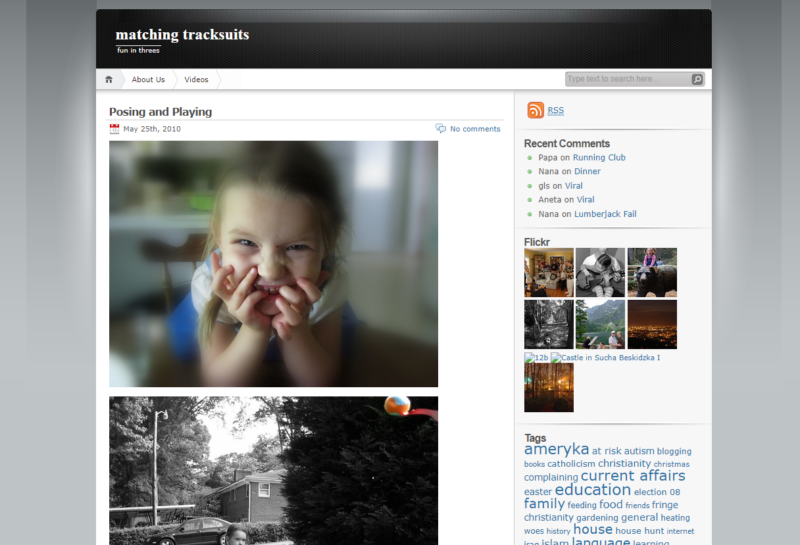
By then, I'd switched to WordPress, which gave me a lot more options as far as design goes.
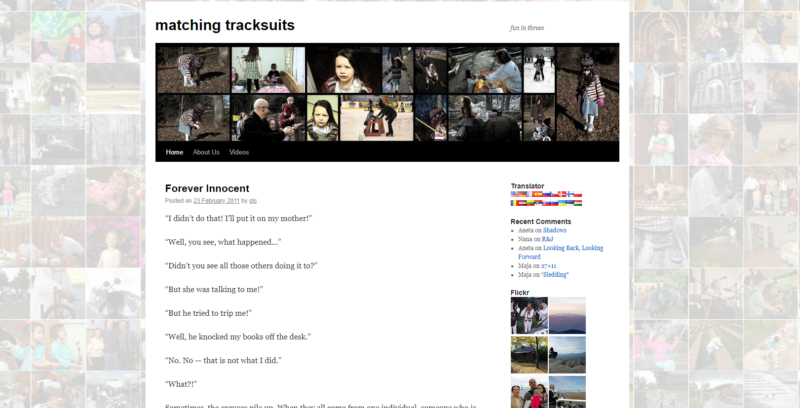
And with that freedom, I began to change the design regularly.

With this being day 1500 of my daily posting streak, I thought it might be good to reflect on the site itself.

I tried everything: magazine layouts,

minimalist layouts,

seasonal layouts, everything.

Then I started using the Divi theme, and for about 6 years now, I've stuck with it.

I've changed the header image,

and I messed a bit with other design elements, but since about June of 2021, I've found something that I like and just hang with -- except for the yearly change of the header image...

One of the things we accomplished this weekend was getting a new computer for the Boy. The Girl needs one, too, but we still don't know the specs she'll need for what programs she might be running in college. So today I got the computer set up and snapped a picture to text to E. He was at his friend's house having some needed buddy time. However, he'd left his phone at home. So it was for naught. But I got a picture for the day out of it...

The Boy's team finally got their first win of the season today, and the Boy scored.

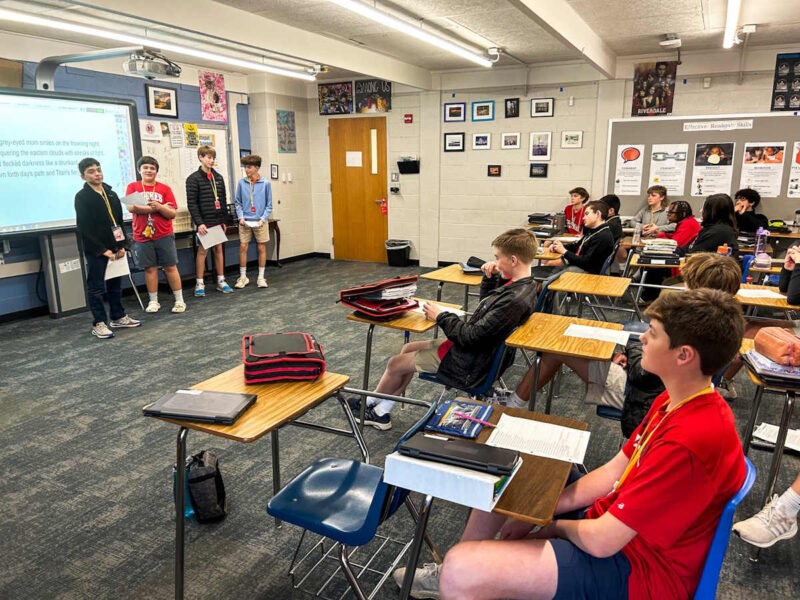
We're reading the balcony scene and looking closely at Romeo's famous monolog (almost a soliloquy) when we get to the second half where he begins comparing Juliet's eyes to stars:
Two of the fairest stars in all the heaven,
Having some business, do entreat her eyes
To twinkle in their spheres till they return.
What if her eyes were there, they in her head?
"What would happen if that exchange happens? If Juliet's eyes were replaced by stars and vice versa?"
"Um, she would burn up from the heat of the stars, Mr. Scott," says Mr. Literalist in the front row.