matching tracksuits

fun in threes, sometimes fours

g

Genocide

The commands to genocide in the Old Testament are particularly troubling for most people except for the most basic, literal-thinking fundamentalist (Protestant or Catholic). For them is simple: God said it, so it's morally right. Most other Christians take a little more nuanced approach -- at least the ones who know about the passages and want to deal with them honestly.

Capturing Christianity -- a YouTube apologetics channel -- invited Dr. Randal Rauser, who describes himself as "progressively evangelical, generously orthodox, rigorously analytic, [and] revolutionary Christian thinking," to discuss the troubling passages. He wrote Jesus Loves Canaanites, a book that deals with the various Christian attempts to explain these passages. I listened to the interview on my run this evening, and two things stood out.

How do we make sense of the fact that God is supposed to be love and yet he commands all these awful things? Surely this creates some cognitive dissonance that Christians want to deal with. How do we deal with it?

Rauser explains that, in dealing with these passages, Christians need to "develop different reading strategies to minimize the cognitive dissonance that is created when we read these passages." Earlier he mentions a new convert who discovered these passages and found them troubling, and Rauser suggests that new converts who haven't been "inculcated" with these reading habits might find these passages to be stumbling blocks to their faith. It's interesting that he uses the word "inculcated" because the definition Oxford is "instill (an attitude, idea, or habit) by persistent instruction." Persistent instruction -- drilling this into one's head. So in order to deal with these issues, one has to have drilled into one's head certain reading habits. What are these habits?

One of them is to ask if a given interpretation develops a love of God and man. If it doesn't, it's not the intended interpretation. But this puts the cart before the horse: one should not have to read the Bible with an ideal interpretive framework in place that automatically defaults to erring on the side of the Bible. That's not critical study; that's mindless acceptance.

Another reading technique is to apply what we know about God and ask if a certain interpretation reflects that.

He uses the extreme example of Dena Schlosser, who in 2004 used a knife to amputate the arms of her eleven-month-old baby because it was a sacrifice God had asked her to make. Rauser insists that

the vast majority of people today, we don't even give it a moment's consideration that God possibly willed such a thing to happen because we believe it is fundamentally inconsistent with who God is. And we would say, maybe she was influenced by a demonic entity or she is mentally ill, schizophrenic or something else, but what we don't think seriously is that God maybe or possibly commanded that.

Yet I don't see why we can't imagine God commanding that: he did command Abraham to do just the same thing. If we're going to accept that Abraham was justified in what he did, we have to at least consider that Schlosser was justified in what she did. After all, who are we to say that God wasn't talking to her?

But of course, we will say that because it's the only thing we can say. To suggest that God might be getting back into the business of having people slaughter each other at his bidding opens up such potential chaos and terror that it's unimaginable.

A favorite question of skeptics when the story of Abraham and Isaac comes up is to ask the Christian, "What would you do if God commanded you to kill your child?" Most Christians will hem and haw and suggest that they'd have themselves checked into a hospital to check for mental illness and yet at the same time deny that possibility for Abraham.

I commend Rauser for dealing with the issue, but like Trent Horn, he seems just to be offering possible ways out that allow a Christian some breathing room from the crowding cognitive dissonance that rattles thinking Christians' faith.


Strawman

This whole discussion starts with a sort of ad hominem attack on Harris, suggesting his view is "naive" and (later) silly. That's amusing since all Harris was doing was paraphrasing the basic core of the Biblical account of the ascension and second coming. There's a literal up motion and a down motion: Up toward the sky for the ascension, down toward earth for the second coming. All this "vast" and "rich" and "nuanced" theory that Davis presents is simply modern apologists' attempts at recasting these events in a way that doesn't so clearly contradict science. The fact is simple: for most of Christian history, a literal upward motion to heaven above us and vice versa was the only understanding. If you're criticizing Harris's view, you are in fact criticizing the Biblical account. All the theories Davis presents are simply speculative apology that has absolutely no support in the Biblical text.

Return

The Girl has been sidelined for three weeks with a badly-sprained ankle. She did physical therapy the entire time, and last week she was hoping to get the go-ahead to return to play. Instead, her therapist told her, "You can return to practice, but don't play."

She was heartbroken.

Tonight was her first night back. It was their first region game -- all the other teams they've been playing have been out of region. They won in three straight sets: 25-6; 25-15; 25-17. Or all-told, 75-38, just under a 2-1 scoring ratio.

The Girl got to play about 1.5 sets. She indicated she was pleased with how things went, but I know she wanted more, wanted to do better. Still, after three weeks of not playing, she did a fantastic job. And as always, hers were the loudest cheers on the team.

Sapiens Thoughts

I've been reading Yuval Harari's Sapiens, and two early passages have led me to see religion in a whole new way. Unfortunately, neither epiphany is ultimately flattering for religion, but at least one thought from the book got me thinking that religion was a useful tool in our development.

The first realization comes from the argument religionists make about the existence of morality being ultimately due to the existence of a law-giver that created a conscience in us all that is somewhat similar. Murder, theft, and lying seem to be universally bad -- how could this be unless some god "wrote that on our heart" to use a Christian apologist metaphor. Harari points out, however, that because we Homo sapiens walk upright, our hips have to be narrower, which led to an evolutionary preference to earlier birth. But human babies need much more care and development time than babies of other species, and this necessitated help from others. This need, in turn, led to evolutionary selection for people more likely to cooperate and live together peacefully. And this would eventually result in a moral system that prized compassion and cooperation -- without the need for a god.

The second realization came from Harari's contention that Homo sapiens development into a species that can coexist in large groups, much larger than our closest evolutionary relative, the chimp, has to do with our ability to use language to describe things that aren't actually there. To create fiction, in other words. He writes, "Large numbers of strangers can cooperate successfully by believing in common myths." He continues,

Two Catholics who have never met can nevertheless go together on crusade or pool funds to build a hospital because they both believe that God was incarnated in human flesh and allowed Himself to be crucified to redeem our sins. States are rooted in common national myths. Two Serbs who have never met might risk their lives to save one another because both believe in the existence of the Serbian nation, the Serbian homeland and the Serbian flag.

This common myth enables large-scale cooperation that doesn't appear in the societies of other apes.

The problem, though, is that we are at a point in our development in which the competing myths can go to war with each other with catastrophic effects for the entire plant...

Sunday at Home

Jam and Fan

Finished

Sometimes, there's a certain relief when we realize we've finished a unit of study.

Gaga Ball

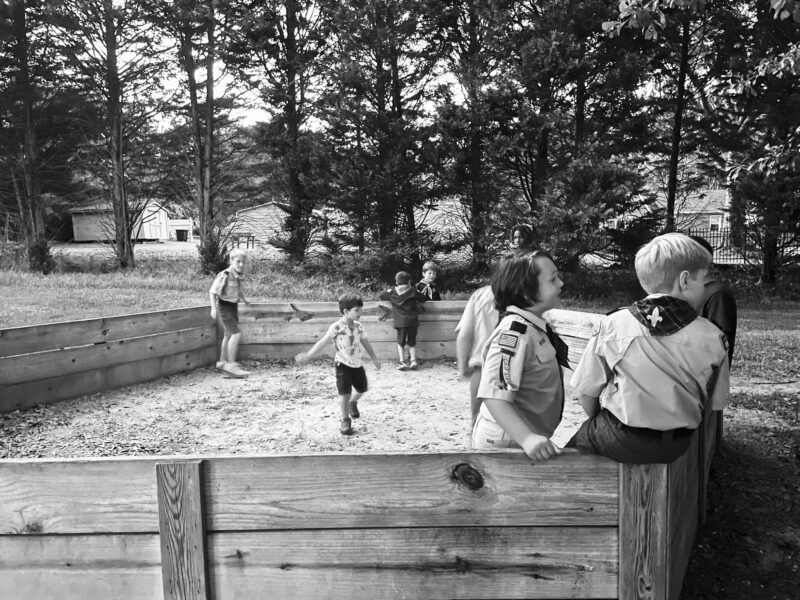
The first pack meeting today -- the meeting two weeks ago was technically just a get-together, I suppose. The boys, as always, played Gaga ball afterward.

"This game hadn't even been invented when we were kids," one dad laughed as we watched them play.


Class today was excellent again. The main difference: like Tuesday, I tried a long, breathing-based mindfulness activity early in the lesson. Amazing how calm it made a bunch of otherwise-antsy kids.

Fluke?

I was so excited about how well things went with my toughest class yesterday: we did such good and focused work, though, that I should have expected today. Frustrating all around.

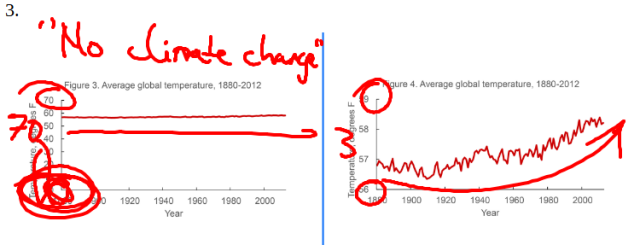
During the bell ringer, when we were going over some of their work, trying to get a student to say that the highest value on the Y axis of a graph (we're reading a cross-curricular text about deception in graphing) was 70. Even when I pointed to it. Even when I said, "The first number is seven." Even when I added, "The second number is zero." Even when I said "70." Even when I said, "Say '70.'"

My Promethean Board pen was acting up...

Later in the lesson, when we were going over how to do something, I did the first half of the work for them -- for all intents and purposes -- in the name of modeling, even though we should be past modeling now. Be all that as it may, some of the kids didn't even make use of the modeling -- and really all they had to do is copy what we came up with as a class.

Every class has tough days, I guess. But they're even tougher when the happen on the heels of a great day.

K pretending to drown this weekend

Mindfulness

I tried something today, sort of spur of the moment, with one of my more struggling classes. It's filled with impulsive students who are generally very sweet (at least toward me) but can be very chatty. Very focused on other things than the work at hand. So before we started our main part of the day's lesson, I had the kids do a little mindfulness work.

"Close your eyes," I told them.

"Did they trust you enough to close their eyes?" my principal asked when I was telling him about the experience later in the day.

"Yes, they did," I replied, thinking of what his question suggested about the relationship I have with the kids already.

"Close your eyes," I said, a few times. There were some stragglers. Some were still focused on something else. "Just close your eyes and breath slowly for a moment." I led them through some slow breathing, then had them visualize the work we were about to do, seeing themselves working in a focused manner and meeting success instead of frustration.

They opened their eyes, we began the main part of today's lesson, and they had the most successful day we've had so far.