Matching Tracksuits

fun in fours

Month: January 2024

Overheard

“We’re just trying to teach the responsibility,” she said, explaining the reasoning her son’s teacher gave for assigning some work that the mother felt was unnecessary.

The words had hardly left her mouth when her interlocutor jumped in with how he would have responded and perhaps in doing so, suggesting how she likely replied or wanted to respond: “That’s my job.”

So many ideas packed into that handful of words.

The overarching notion is that there are some things that a teacher teaches, but there are some things that only a parent teaches. This notion of non-overlapping domains is popular with those who lean right, and it is fast becoming a key right-wing talking point. Whether it’s issues of race or questions of gender, the right is quick to point out that there are things that parents teach and it’s hands-off for everyone else.

I’m certainly not suggesting that there aren’t things that are predominantly in the domain of parents. Religion, for example, is something that as far as proselytizing is strictly off-limits for teachers, and rightly so. The problem with religion and issues about science is that the right is constantly redefining what is acceptable. It’s no longer acceptable, some feel, merely to teach students the beliefs and rituals of other religions for them to be educated about the beliefs and motivations of others. This is growing to include ideas like scientific literacy. Young Earth creationist parents resist the teaching of evolution in schools as an infringement on their religion as much as they do about teaching students the basics of Buddhist belief. If it contradicts or threatens Christian faith, they want it out.

Perhaps none of this applies to the individuals I overheard. Perhaps it all is. (Living in the South and overhearing this at a Scouting function, I would suspect it’s likely that at least some of it is.) What I found most interesting was the realization I had on hearing this that many parents in America have no idea at all what’s going on in schools. Teaching responsibility might very well be something the parent I heard does regularly and well, but schools are filled with students who are not taught these basic things at home. Teachers have to pick up the slack that negligent parents, overwhelmed parents, single parents, and any other parents leave.

Changes

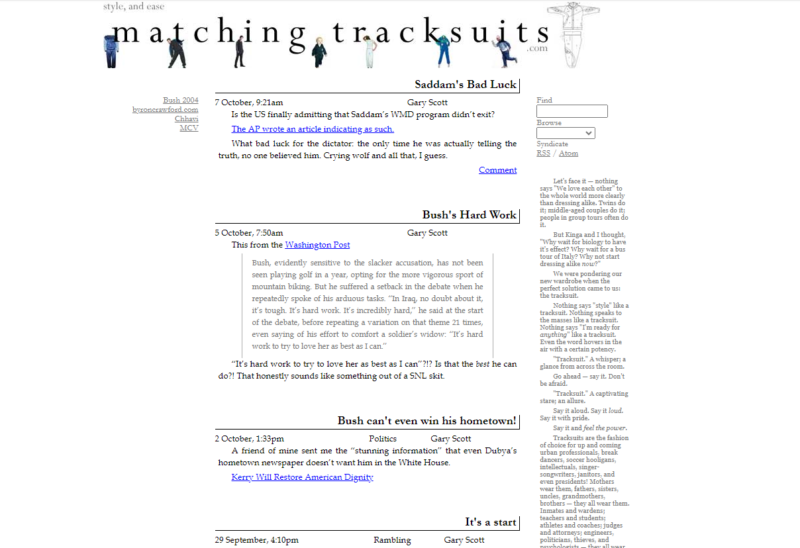
Some time ago, I was looking for something in the Wayback Machine, and it struck me that I might grab a few shots of what this site has looked like.

As many changes and as radically different (yet the same) as the subjects of the blog itself...

First, there was the original look:

November 2004

It was running on Text Pattern, which was basic. And my design was basic. Because my skills were basic. But there was that classic header:

I still kind of like it...

Some years were unavailable in the Wayback Machine, so suddenly, we jump seven years to 2010:

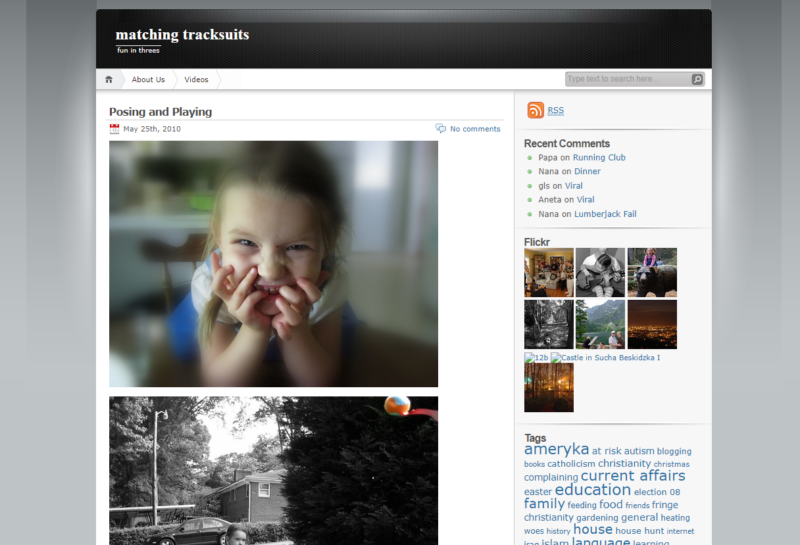
May 2010

By then, I'd switched to WordPress, which gave me a lot more options as far as design goes.

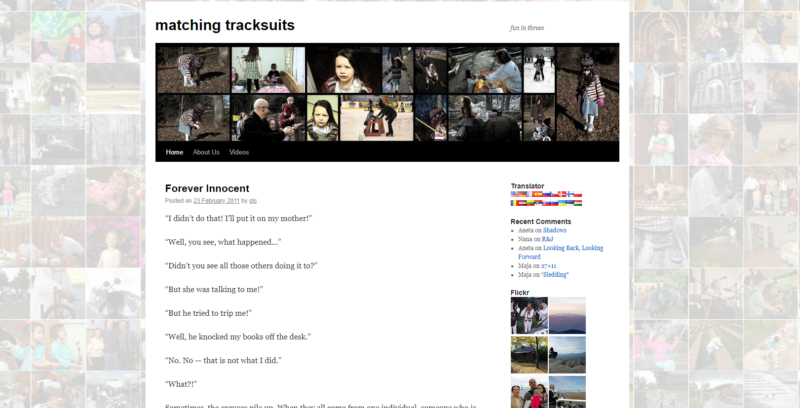
February 2011

And with that freedom, I began to change the design regularly.

October 2011

With this being day 1500 of my daily posting streak, I thought it might be good to reflect on the site itself.

January 2013

I tried everything: magazine layouts,

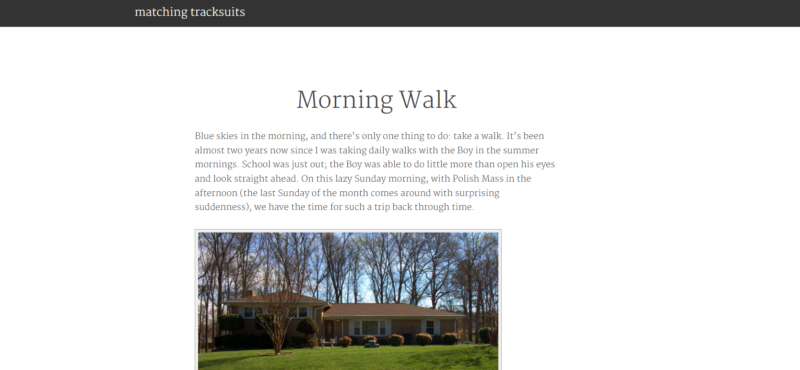
March 2014

minimalist layouts,

December 2014

seasonal layouts, everything.

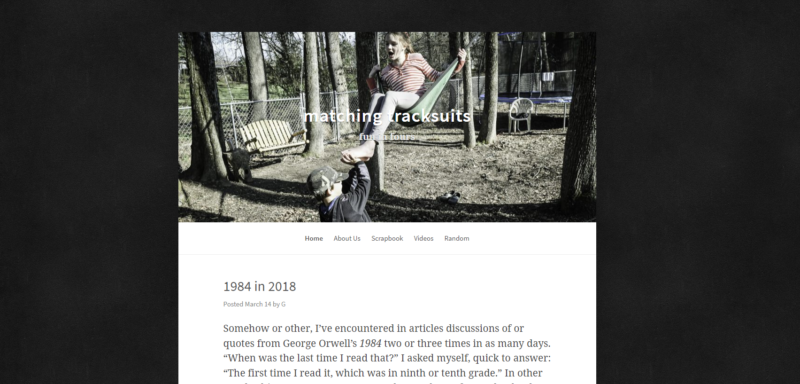
March 2018

Then I started using the Divi theme, and for about 6 years now, I've stuck with it.

May 2019

I've changed the header image,

June 2021

and I messed a bit with other design elements, but since about June of 2021, I've found something that I like and just hang with -- except for the yearly change of the header image...

From Babia

Today’s Only Picture

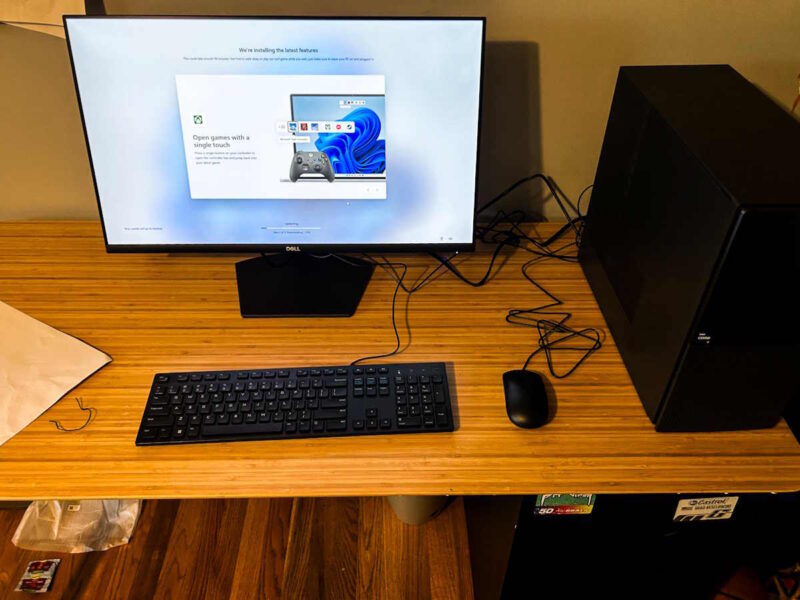
One of the things we accomplished this weekend was getting a new computer for the Boy. The Girl needs one, too, but we still don't know the specs she'll need for what programs she might be running in college. So today I got the computer set up and snapped a picture to text to E. He was at his friend's house having some needed buddy time. However, he'd left his phone at home. So it was for naught. But I got a picture for the day out of it...

Win

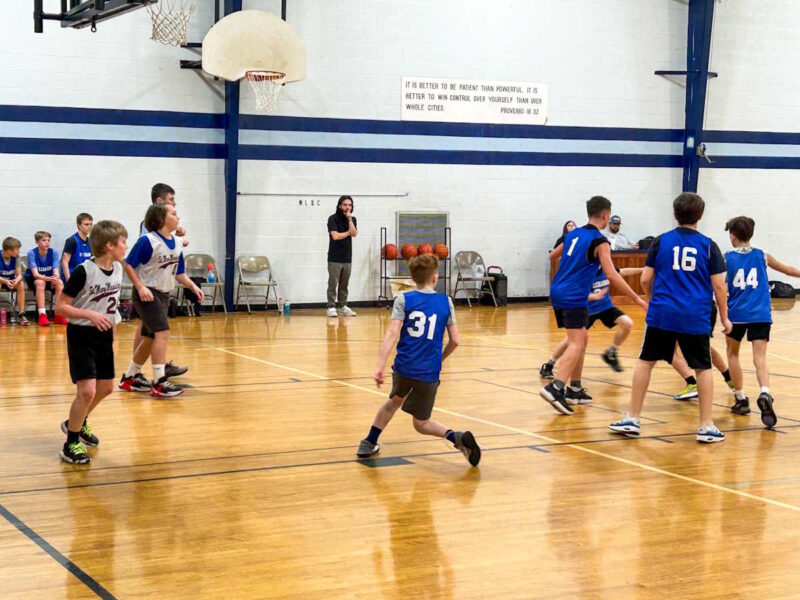
The Boy's team finally got their first win of the season today, and the Boy scored.

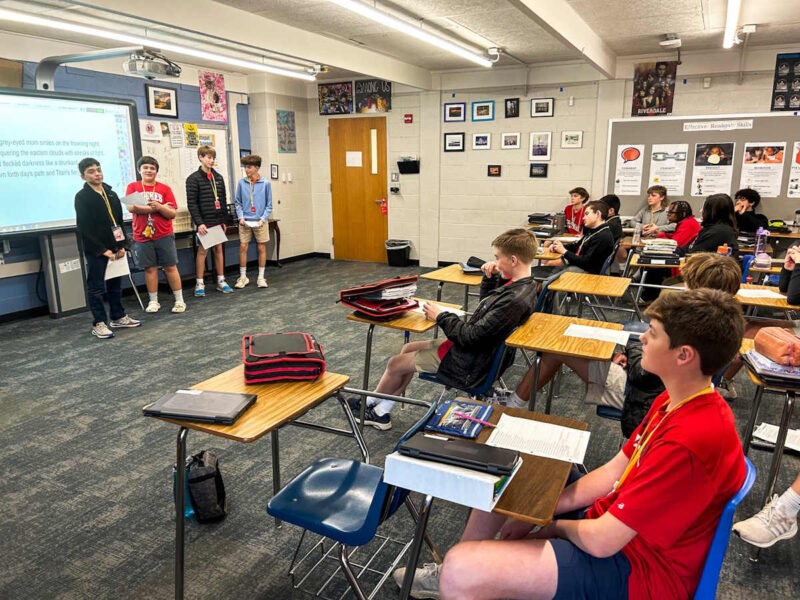
Presentations

Literal

We're reading the balcony scene and looking closely at Romeo's famous monolog (almost a soliloquy) when we get to the second half where he begins comparing Juliet's eyes to stars:

Two of the fairest stars in all the heaven,
Having some business, do entreat her eyes
To twinkle in their spheres till they return.
What if her eyes were there, they in her head?

"What would happen if that exchange happens? If Juliet's eyes were replaced by stars and vice versa?"

"Um, she would burn up from the heat of the stars, Mr. Scott," says Mr. Literalist in the front row.

Sentence Frames

It’s a tough prompt: the analysis required might be too much for my students even at the end of the year; at this point in the year, it’s an impossibility. But I can apply various supports that will help them ease into the whole argument unit.

“What evidence does the author use to support the claim that MLK was the right man born at the right time?”

We’re not evaluating the argument: we’re not even looking to determine the claim. The claim is settled: MLK was the right man born at the right time.

I look over the passage and realize that the key idea is that he was born at the right time. It’s a question of context. He rose to prominence after Excecutive Order 9981 desegregated the military and Brown v. Board did the same (in theory) for schools. The author also points out that the rise of television helped King and the civil rights movement as it made it impossible to ignore the brutality directed at the African American community.

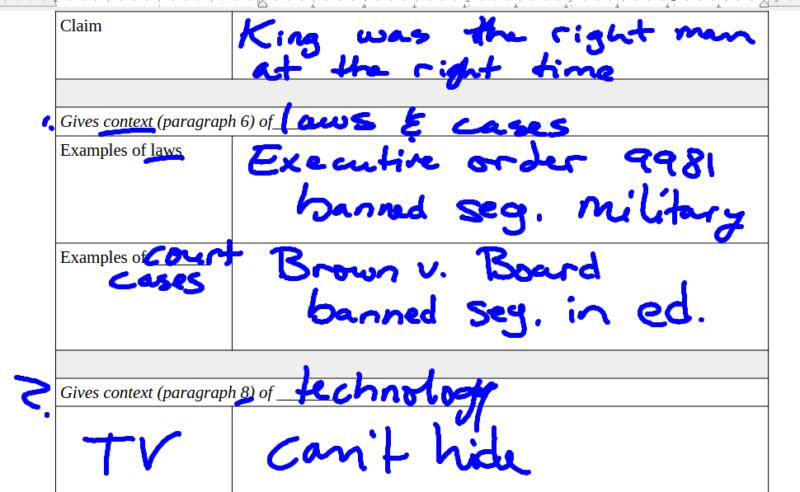
I help the students see all this, creating a graphic organizer to put this information into manageable form.

At the end of the lesson, I wrap up how our planning would form an answer:

The author supports the claim that King was the right man at the right time by showing the context of his leadership. For example, the author gives the context of laws and court cases. He explains Executive Order 9981, which banned segregation in the military. He also explains how Brown v Board ended school segregation. In addition, the author gives the context of technology. He points out that television made it impossible to hide how African Americans suffered.

As I say this, I point to each part of the organizer to show where the ideas are coming from.

The next day, I plan for an easy task. We’re simply going to take our graphic organizer and turn it into sentences. “I gave them all the answers yesterday,” I think to myself. “How much of a challenge can this be for them?”

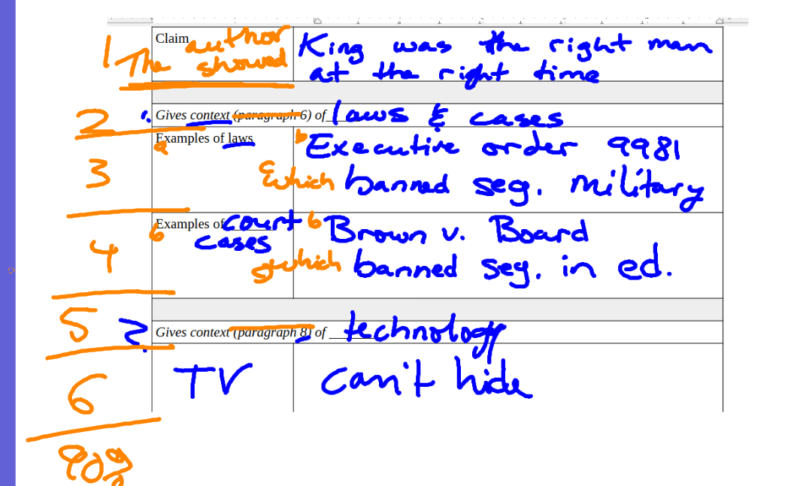
We begin reviewing our work, and I add some more schaffolding: I number the sentences they need to write and add some transitional elements to help them connect things:

Each line, each numbered element becomes a sentence. I remove the parenthetical annotations to make it even easier. So I’m hoping students will see “Gives context of laws and cases” and realize the only thing missing is the subject. I don’t even expect or even hope that they will think in those terms. All they have to do is read it and think about it:

“‘Gives context of laws and cases.’ Who gives the context of laws and cases?” That’s the first step, but some of them struggle even realizing this.

One young man comes to me for help.

“I don’t know what to do with number two,” he admits.

“Well,” I begin, “read the text for number two.”

“Gives context of laws and cases.”

“What’s missing? What question do you have when you say that?”

He looks at me, a completely blank expression suggesting that there’s so much he doesn’t understand about it that he doesn’t even know where to begin. I decide to simplify.

“Imagine I walk up to you and say, ‘Gives her an apple.’ What question comes to mind when I say that.”

How hard can it be for this kid to see that we have an action here and we have no idea who’s doing it? How difficult can it be to realize that the simplest question in response to this “Who”?

I finally help him to see that we don’t know what’s going on there and that the questions, “Who gives her the apple?” And I think we’re ready to return to my original question.

“So, when I say ‘Gives her an apple,’ the obvious question is ‘Who gives her an apple.’ So if I say ‘Gives the context of laws and cases,’ what’s the obvious question?” I don’t even bother looking up at him because he should catch this almost immediately. It’s the same problem. He just stares at me.

Even after I get through to him that we’re trying to figure out who provided the context, he can’t take the next step. I’ve had this problem with other students, and they get confused about what we’re really writing about. They ask, “Martin Luther King?” sheepishly.

This is a deceptively complex question we’re working on: we’re not asking a question about the contents of the text itself — what it’s about — but the decisions the author made in creating the text. It’s not an analysis of the contents of the text but of the structure of the text, of the process and thinking behind the writing of the text.

But this level of questioning is not even our ultimate goal. We’re ultimately supposed to get students ready to answer questions about evaluating the claim and evidence of an argument. Here, I’m giving the claim and the paragraph in which to find the evidence. I’m just asking them to figure what the evidence is. I’m not asking them to find the claim. I’m not asking them to find the evidence among all the paragraphs. And I’m certainly not asking them to make decisions about the quality of the evidence provided. And as far as potential counterclaims — forget it. I just want them to find the evidence.

While I’m working with this boy, a handful of students realize the relatively straightforward nature of what I’m asking them to do and how it’s all on the board and write beautiful (although simple and short) paragraphs about it.

These kids are in the same class along with a boy who speaks very little English and a boy who speaks no English at all, and the state expects me to get them all to the same place in nine months: analyze the argument in an eighth-grade level text and evaluate its effectiveness.

And they are struggling to do it when I’ve already done it with them. Using a fifth-grade level text.

Blasphemy in Warsaw

There's a new cafe in Warsaw called "Madonna." It uses images of Mary and Jesus as decorations, and it's driving the fundamentalist Catholics crazy. Just look at the list of blasphemies they're committing:

  • The figure of Our Lady invites you for drinks among vulgar neon signs.
  • Rosaries hang on vodka bottles.
  • Blasphemous images depict Our Lady smoking cigarettes.
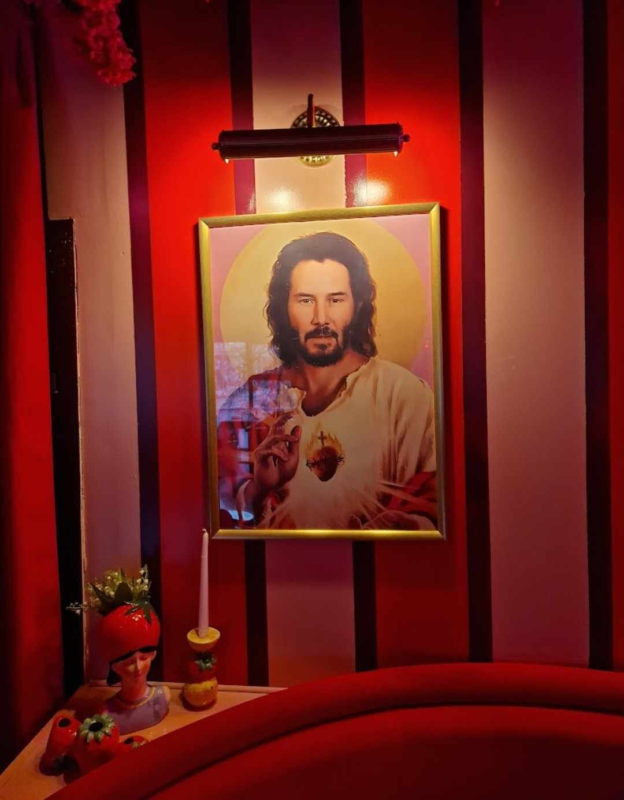
  • The face of actor Keanu Reeves was placed in the image of the Sacred Heart of the Lord.
  • The face of singer Rihanna was substituted for Mary's face.
  • There are statues of Mary on the tables with a QR code for the customer to download the menu.
  • There is a confessional in the restaurant where you can take photos.

The horrors!

Just look at the pictures:

It's unbelievable.

The price of democracy can be steep for fundamentalists.

Spirit Week

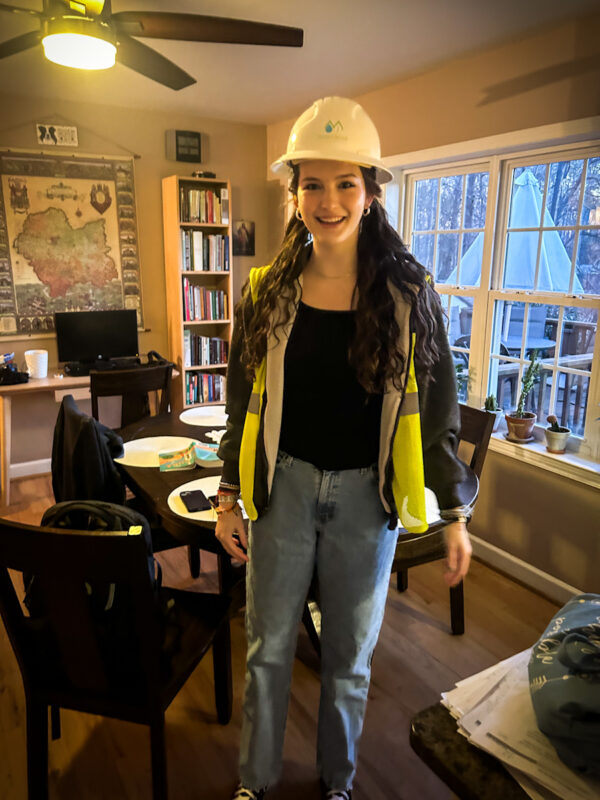
It's Spirit Week at the Girl's high school, and today's theme was rhyme without reason. She explained it to me when I asked why she was wearing a yellow vest. She was pairing with a friend for the rhyme part: L's portion was construction worker. I can't remember what her friend's outfit was the rhymed. At any rate, I off-handedly mentioned that K probably still had her hard helmet from her previous job.

The Girl's eyes light up.

"Really?!?" And off she sprinted to our bedroom. "Mama, do you still have your hard helmet."

She was thrilled to find that she indeed still has her hard helmet.

It was wonderful to start the day with such a smile.