
Ready for the first large-venue concert I’ve been to since 1999.
fun in threes, sometimes fours
Month: November 2021
Ready for the first large-venue concert I’ve been to since 1999.




We're working on a tricky standard in school in my on-level classes. They'll have a TDA (text-dependent analysis) question as part of their year-end test, and it's often a question about how some text develops some idea or other. It might even provide an excerpt and ask specifically how that passage contributes to this or that idea. It's not a straightforward question, and while I'm not entirely sure it's a useful question to pursue with kids who have difficulty reading at grade level, I am obliged to some degree or other to teach to the test. That's what we've done the last couple of days. We worked through a text together and then figured out how to answer such a question. Today, students were working to do it on their own.
Part of the process, I taught them, is to take the main idea of the text and compare it with the passage the question wants us to analyze. "See what similarities they have, what differences. Think about the relationships between those." Since the first multiple-choice comprehension question for our article "Why I Refuse To Say I 'Fight' My Disability" was "Which of the following statements best expresses a central idea of the article?" I knew we could save time in determining the main idea for ourselves. We evaluated the four possibilities and realized it was the first option: "Hitselberger’s disability is an important part of who she is, not an enemy that she needs to defeat."
The analysis question didn't deal with just one or two sentences; it dealt with the entire final third of the article. "How do paragraphs 5-14 contribute to the development of ideas in the text?" At first I thought, "Great, the kids will have to comb through nine paragraphs to find the answer." Then I looked at the nine paragraphs. I didn't have to look closely: the relationship is literally plastered throughout the passage.
I will say I fight ableism and prejudice.
I will say I fight lack of access, stigma and ignorance.
I will say I fight discrimination.
I will say I fight these things, because I do. These are battles to fight, and win. It is ableism, prejudice, lack of access, stigma, ignorance and discrimination that prevent me from having the same opportunities in life as my able-bodied brother and sister, not my cerebral palsy, my wheelchair or my inability to walk.
I will fight to make this world a better place for future generations of kids just like me.
I will fight to make sure they are never told or led to believe their bodies are a problem or something they must do battle against on a daily basis just to fit in.
I will fight to make sure those kids have the same opportunities as everybody else, and never believe everything would be better if they could just change who they are.
I will fight for a world where the mere presence of disability does not make you extraordinary. Where disabled children are taught to aspire to more than just existing, and where being disabled doesn’t mean you have to be 10 times better than everyone else just to be good enough.
I will fight for a world where we talk about living with and owning our disabled bodies rather than overcoming them.
I will fight for a better world, and a better future, because those things are worth fighting for, but I will not fight a war against myself.
So it's simple, I thought. The main idea statement is "Hitselberger’s disability is an important part of who she is, not an enemy that she needs to defeat." Every single paragraph of the passage begins with "I will fight." It's not terribly difficult to see the connection between "fight," "enemy," and "defeat." So the main idea statement says that the author will not fight her disability while the passage gives a list of things the author will fight.
Most of them could not see it. I phrased it differently and rephrased it again. Many of them could still not see it.
I've been thinking about this all day, wondering what went wrong. Was it the presentation? I'd like to think I'd done a decent job scaffolding the learning: we'd practiced the very same thing with the very same question yesterday. The only difference was the text. Was it the students? Just as I'd like to think I wasn't responsible, I'd like to think it wasn't a question of student culpability because there are only two ways to explain it: they can't do it, or they won't do it. Neither one is appealing. Yet of all three options, I wonder if the truth isn't hidden in one of them. It's not a question of intelligence or reading ability; perhaps it's just a question of critical thinking.

Dear Terrence,
I read your letter and felt it really needed a reply: you touch on a lot of issues that got me thinking, gave me hope, and honestly caused me to worry a bit.
You wrote that you “feel like people criticize [you] because of [your] past,” something which “hurts [you] to even try to change.”I don’t know what you thought I might have known about your past, but I knew nothing. I’m also fairly sure the other teachers on the team knew nothing about you. Yet we can all accurately guess about your past because of your present. I don’t mean to be offensive or blunt, but despite your desire to change, you still exhibit a lot of behaviors that draw negative attention to yourself. I don’t know about other teachers’ rooms, but I can describe some of the things in your behavior in my room that makes it pretty clear that you’ve had a rough past in school.
You write that you want teachers to “just give [you] a chance and stop messing with [you],” but if a teacher is correcting these behaviors, she’s not “messing” with you. You must understand that some of your behaviors genuinely disrupt the class, and a teacher cannot continue teaching over disruption.
I do have some bad news, though: while no one is messing with you, you’ve made it clear what gets under your skin, and if a teacher wanted to mess with you, wanted to provoke you so that she could write you up, you’ve made it easy for that teacher (whom I hope you never meet) to do just that. You’ve made it clear what your buttons are, what gets you heated and easily leads to a disrespectful outburst. All a teacher would have to do is push just a little and BOOM! there you go, and there’s the excuse to write a referral. In that case, such a teacher would have played you, controlled you. I hope you never meet such a teacher, but it’s entirely possible. It’s also possible that a teacher who wouldn’t normally do that might, in a moment of frustrated weakness, do just that to “get some peace” for a while.
Fortunately, I have some good news, too: letters like yours make a teacher’s day. It gives us hope that perhaps we can help make a difference in students’ lives. I don’t know a single teacher—especially the teachers on our team—who won’t go out of his or her way to help a student who wants to change his/her behavior to do just that. However (and it’s a pretty big “however”), you have to show that you are really trying to make these changes. You have to show progress on a regular basis. Not big progress; not 180 degree changes overnight. But teachers need to see that you are serious about something like this. Otherwise, we’re left wondering if you’re just playing us. I’m sure you’re not, but it has been known to happen, and teachers tend to be a bit wary about that.
Here’s what I suggest you do if you really want to be a “changed man” as you so aptly called it. First, make sure you go to each teacher and say as much to him/her. Look the teacher in the eye; make sure your facial expression is pleasant; be sure not to let yourself be distracted by anything other students might be doing; then say what you said in the letter. “I’m trying to change, but I might slip into old habits. Please be patient with me as I try to make these changes in my life.” Second, make your strongest effort to change right then. Show the teacher you mean business. Show the teacher that you are not just talking the talk but you’re trying to walk the walk. Sit quietly; stay in your seat; keep your head out of your hands; make sure you don’t use a disrespectful tone of voice. Third, when you slip up (and you will: you’re trying to change some habits that you’ve had for a long time, I suspect), apologize. Sincerely. But not right then! If you do, the teacher is likely to think you’re just trying to disrupt further. Just smile as best you can and comply. After class, you can go to the teacher and say, “I really messed up. I appreciate your patience with me. I’ll do better next time.” Finally, make sure all your friends know what you’re up to. If you’re trying to be Mr. Thug or Mr. Cool Dude with them but Mr. Nice Guy with your teachers, you’ll get those roles mixed up and cause yourself more trouble. Be a leader: tell your friends, “Hey, I’m sick of hating school, sick of dreading school, sick of feeling like I’m wasting time. I’m going to make some changes in how I act, how I think, how I see myself and the world.” Be a leader: show other kids how to do it. They’ll follow your example, because everyone loves to see a “troubled-kid-straightens-everything-out” story. We love it, all of us.
Understand that I’ll do everything in my power to help you. I have some tricks I can teach you about making a good impression, keeping your impulses in check, and having a positive affect. (If you don’t know what that means, ask me: I’ll gladly explain.) But as I said earlier, I and all the other teachers have to see change immediately. Not enormous change, but change. Effort.






















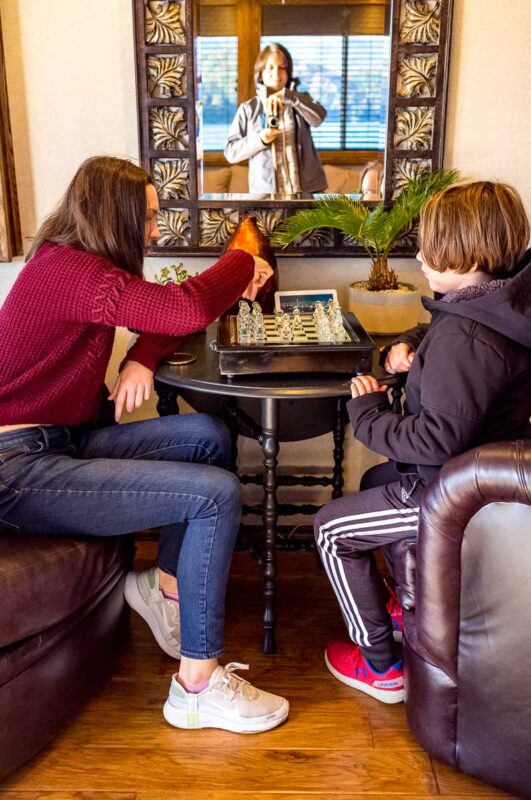






We had our second meeting of chess club this afternoon. It was scheduled to go from 3:30 to 4:30, but at 4:50, I finally had to tell two sweet but slightly nerdy girls (after all, we’re talking about chess club here) that they’d have to photograph their game and finish it next week.
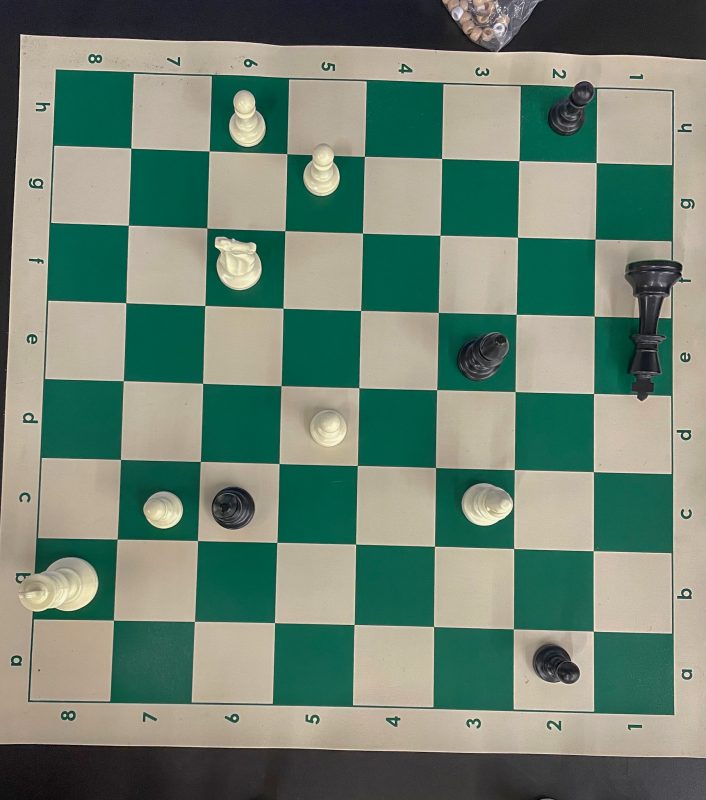
The position is not terribly hopeful for black, but she does have a passed pawn. However, it’s only on the second rank, so it’s not passed all that much. White has a two-pawn advantage but might have a bit of difficulty getting the G and H pawns rolling before the black king can get over to help move that passed pawn along.