Matching Tracksuits

fun in fours

Month: May 2020

Day 48: Scarlet Projects

This morning I had a little epiphany that I should have had months ago: "I'll bet there are lots of audiobooks on Spotify." I know -- an obvious thought I should have had long ago, but I am sometimes a little slow on the up-take. I did a quick search and discovered that almost any classic one could imagine is there. Shouldn't have been a surprise.

A month or so ago, I'd pulled from the bookshelf a novel I've been wanting on and off to re-read since college, The Scarlet Letter. I hadn't really liked it a lot then, and I liked it even less in high school, but I reasoned that, being twenty-five years older than when I'd last read it, I might see something more in it.

For one thing, it's been a different read because I finally made it through the opening section, "The Custom House." When we read it in college, we were supposed to read that seemingly disconnected introduction but I didn't. Today, I listened to it while I worked on our broken smoke, cleaning off the base blocks before screwing down the barrel that serves as the body of the smoker and then covering all the base in concrete. The job took about an hour and a half because I spent some time trying to pry off the leaking quick-connector on the hose before mixing the concrete, to no avail; the intro itself took considerably longer to complete.

And what of "The Custom House"? It's a fictionalized attempt at making the story seem authentic by making it something of a found-footage type novel (mixing media there, I know). Was that novel (no pun in intended)? I really don't know.

When the novel began, I was back in familiar territory. I'd initially forgotten about that opening, with the rose outside the jail door, but once that portion began, it was like hearing a long-forgotten-but-once-loved song again after twenty years:

[O]n one side of the portal, and rooted almost at the threshold, was a wild rose-bush, covered, in this month of June, with its delicate gems, which might be imagined to offer their fragrance and fragile beauty to the prisoner as he went in, and to the condemned criminal as he came forth to his doom, in token that the deep heart of Nature could pity and be kind to him.

This rose-bush, by a strange chance, has been kept alive in history; but whether it had merely survived out of the stern old wilderness, so long after the fall of the gigantic pines and oaks that originally overshadowed it,—or whether, as there is fair authority for believing, it had sprung up under the footsteps of the sainted Ann Hutchinson, as she entered the prison-door,—we shall not take upon us to determine. Finding it so directly on the threshold of our narrative, which is now about to[53] issue from that inauspicious portal, we could hardly do otherwise than pluck one of its flowers, and present it to the reader. It may serve, let us hope, to symbolize some sweet moral blossom, that may be found along the track, or relieve the darkening close of a tale of human frailty and sorrow.

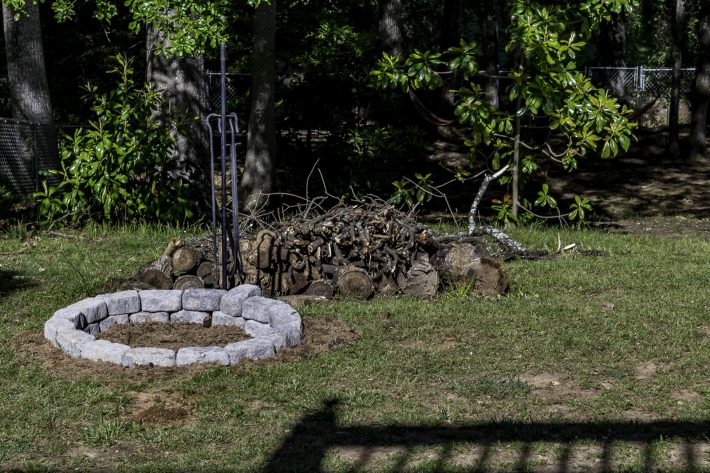
While I was working on the smoker, the Boy was working to remove the last bit of flaking paint from the bench we brought from Nana's and Papa's to use by our firepit.
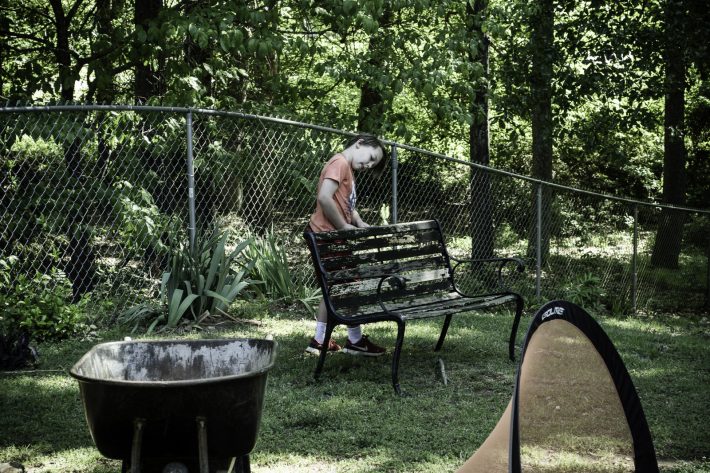
I went inside to get the drill and impact driver and by the time I came back out, he'd disappeared.

"It's too hard!" he exclaimed. I think he understood that I expected him to get all the paint off.
By the time I was ready to work on the next project of the day, the novel was introducing its heroine, Hester Prynne.

The young woman was tall, with a figure of perfect elegance on a large scale. She had dark and abundant hair, so glossy that it threw off the sunshine with a gleam, and a face which, besides being beautiful from regularity of feature and richness of complexion, had the impressiveness belonging to a marked brow and deep black eyes. She was lady-like, too, after the manner of the feminine gentility of those days; characterized by a certain state and dignity, rather than by the delicate, evanescent, and indescribable grace, which is now recognized as its indication. And never had Hester Prynne appeared more lady-like, in the antique interpretation of the term, than as she issued from the prison. Those who had before known her, and had expected to behold her dimmed and obscured by a disastrous cloud, were astonished, and even startled, to perceive how her beauty shone out, and made a halo of the misfortune and ignominy in which she was enveloped. It may be true, that, to a sensitive observer, there was something exquisitely painful in it. Her attire, which, indeed, she had wrought for the occasion, in prison, and had modelled much after her own fancy, seemed to express the attitude of her spirit, the desperate recklessness of her mood, by its wild and picturesque peculiarity. But the point which drew all eyes, and, as it were, transfigured the wearer,—so that both men and women, who had been familiarly acquainted with Hester Prynne, were now impressed as if they beheld her for the first time,—was that Scarlet Letter, so fantastically embroidered and illuminated upon her bosom. It had the effect of a spell, taking her out of the ordinary relations with humanity, and enclosing her in a sphere by herself.

The scarlet letter is a double symbol: it is a symbol to the characters in the novel of Hester's sin and depravity as well as a symbol for Hester herself of her resistance. For readers, it's both these things, but it also represents the hypocrisy of Puritans, among other things.

At this point, I'm about halfway through the novel, though completely through the day's projects (as is L). More thoughts coming later, I'm sure.


Day 47: Quartets and Cars

Quartets

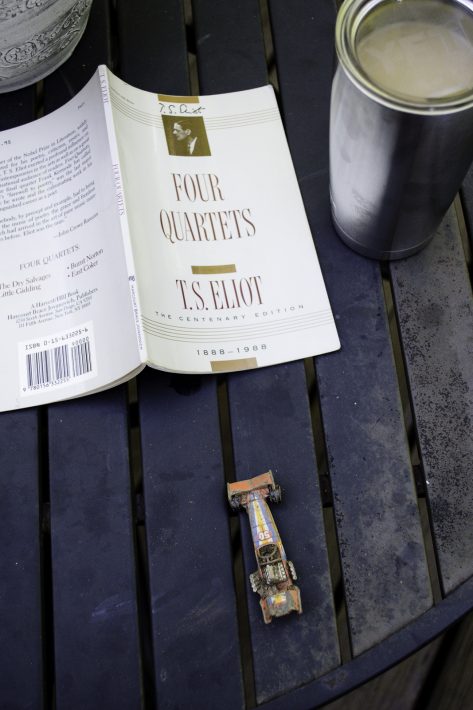
This afternoon, while cleaning up the kitchen, putting away groceries, and just generally puttering around the house, I discovered a BBC culture podcast that talks about, among other things, T. S. Eliot’s Four Quartets, a cycle of four poems that have, from the very first time I encountered them during my freshman year in college, utterly enthralled me. Naturally, I listened to it; naturally, halfway through, I was rooting around in the bookcase where we store such books for my thin volume of the poems.

Some passages of those poems seem pulled from the very fabric of existence itself, so fully do they capture the experience of being a finite human. In “Burnt Norton,” the first of the poems, Eliot writes of the frailty of the one thing that links us humans one to another: language.

Words strain,
Crack and sometimes break, under the burden,
Under the tension, slip, slide, perish,
Decay with imprecision, will not stay in place,
Will not stay still.

I read those lines in college at a time when I was growing very distrustful of language having been in a relationship that I ended largely because I felt like the young lady was lying incessantly, for no reason whatsoever. Was it compulsive lying? Was it even always conscious lying? Was it even lying? I could never figure that out, but I learned I couldn’t trust her, and when that happens, there’s only one thing to do.

The second poem in the cycle, “East Coker,” returns to this motif:

So here I am, […]
Trying to use words, and every attempt
Is a wholly new start, and a different kind of failure
Because one has only learnt to get the better of words
For the thing one no longer has to say, or the way in which
One is no longer disposed to say it. And so each venture
Is a new beginning, a raid on the inarticulate
With shabby equipment always deteriorating
In the general mess of imprecision of feeling,
Undisciplined squads of emotion.

“Is he reading my mind?” I thought. The poem seemed to be a summary of my growing interest in the idea of language itself. Such a strange thing — it’s the only thing we have that connects us to other people, yet it’s such a fragile connection, so easily manipulated and bent.

The Buried Car

This evening, as I was reading the poems again after dinner, the Boy brought me a little car he’d found buried in the backyard.

“I found it buried in Mommy’s flowers,” he explained.

“It was my car,” I said, wondering if he would remember that it had been among the mass of cars that Nana had saved from my childhood just to give to a grandchild.

“Really?!” He couldn’t believe it. “Why did you bury it out there?”

It’s so rare that we can see someone’s entire faulty thinking process from just one sentence, the entire line of thought backing up neatly, step by step, until the whole story is clear, and it was so different from reality. That was such a moment. I knew I could utterly perplex him with one short sentence.

“I didn’t bury it out there; you did.”

I could almost hear the gears clicking. He wrinkled his brow, cast his eyes upward, and his breathing quickened. “I did?”

Back to Eliot — the very next lines:

And what there is to conquer
By strength and submission, has already been discovered
Once or twice, or several times, by men whom one cannot hope
To emulate—but there is no competition—
There is only the fight to recover what has been lost
And found and lost again and again: and now, under conditions
That seem unpropitious. But perhaps neither gain nor loss.
For us, there is only the trying. The rest is not our business.

I had not really lost the car; he had not really gained it. He discovered something that he himself had owned, had played with, had possibly even treasured.

“Yes, you must have been playing with it when Mommy was working out in the flowers and you accidentally left it there. Or maybe you even buried it on purpose, and you just don’t remember.” More thinking.

“I did?”

“Yes.” And I could even imagine how it happened: E, with more than a handful of cars, following K around as she planted flowers or pulled weeds, never willing to let her get very far away from her, picking up everything to follow closely behind.

Nana told me I was the same way. Probably, we all are.

“You must have been playing with it when Mommy was working in the flowers.”

He shrugged, not convinced, still wondering, I think, how I knew it was mine. “Was it one of your favorites?”

True, I think I can remember when I got that car, which means an event likely forty years ago. When we went to our church’s annual fall retreat, we had two-hour church services every day. To keep me quiet when I was a child, Nana and Papa gave me a new Matchbox car every day at the start of the service. I believe that’s where this one comes from. But it could simply be that I just remember playing with that old car.

Are there any of my old toys I wouldn’t recognize? I rather doubt it in a way. Toys are so precious to children — at least they were to me and to my own children — that they form an integral part of our identities. Like the music we listen to as adolescents, the toys we love as children reflect our interest and how we see ourselves.

I didn’t tell him all that, though. Too much back story, and so much of it so very different from the reality the Boy experiences.

“Two-hour church every day?! Why would you do that?” I can hear him ask. Why, indeed.

Back to the Quartets, this time, from “Little Gidding”:

There are three conditions which often look alike
Yet differ completely, flourish in the same hedgerow:
Attachment to self and to things and to persons, detachment
From self and from things and from persons; and, growing between them, indifference
Which resembles the others as death resembles life,
Being between two lives—unflowering, between
The live and the dead nettle. This is the use of memory:
For liberation—not less of love but expanding
Of love beyond desire, and so liberation
From the future as well as the past.

It’s attachment to things that makes us remember those toys, I guess, and the sense that they are part of us — thus, attachment to self.