Matching Tracksuits

fun in fours

Month: May 2019

Almost

Almost is a word that has so much wiggle room that it is almost meaningless. It can mean anything from "nowhere near" to "just moments from."

"How are you doing with that project?" I ask a student.

"I'm almost done," he replies, and depending on the student and what he's taught me to expect, I understand that to mean "not even started" to "doing final proofreading."

"How are you doing with that project?" K asks me.

"I'm almost done," I reply, and that means nearly done or no where near done, but most often it means, "This is taking me a lot longer than I had anticipated or planned for."

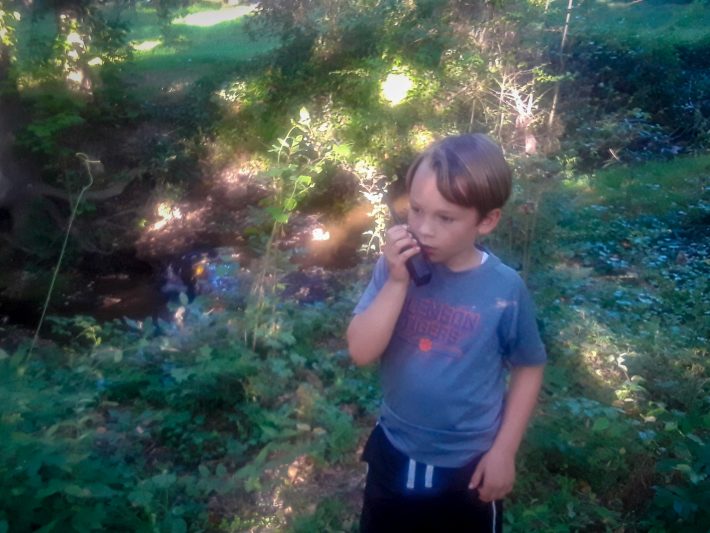
Seven years ago, the Boy was almost here. It was just after we'd gone to bed on a Sunday night that K woke me with, "My water broke." By about half past eleven that Sunday (Mother's Day), we were at the hospital. By one in the morning, we were holding E.
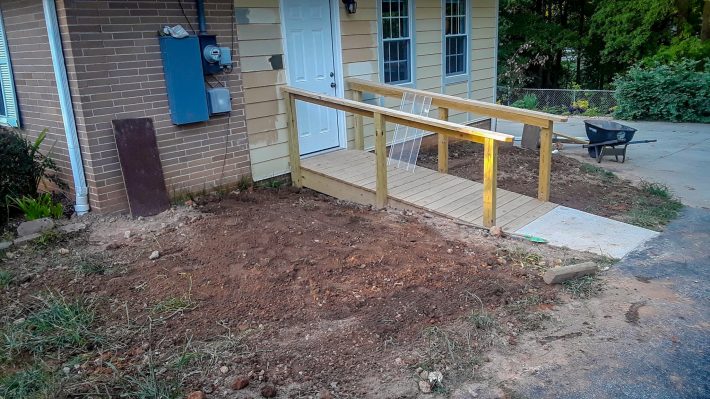
For the last few weeks, we've felt like we're almost done with this renovation, almost ready to move Nana and Papa into their little apartment as they've taken to calling it. The floors are done everywhere; the power is on; the lights are hooked up; the washer and drier are installed; the sink is almost ready. Yet so much remaining. The bed for Papa sits in parts in our living room, with the headboard and footboard set to arrive later this week. The toilet sits in its box, ready for installation. The shower needs to be completed, and the exterior needs painting. There's still so much to do, and so little to do.

Tonight, with a little help from the Boy, I got a little more done: the drainage system is 99% complete. We need a new downspout for the back corner, and as such, I've yet to make the final cuts on the PVC for the drainage outlet there.
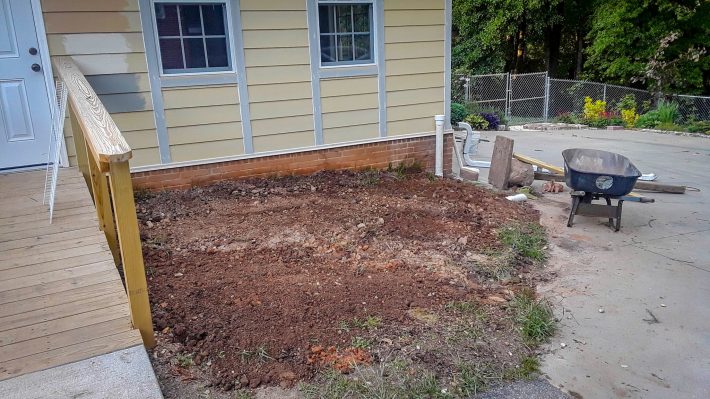
I stuck some PVC in to keep dirt from getting into the system while I filled in the gravel and dirt, but ti' about 24 inches too tall at least.

It's relatively smooth, relatively done. Almost -- just like every other almost.
What They Deserve

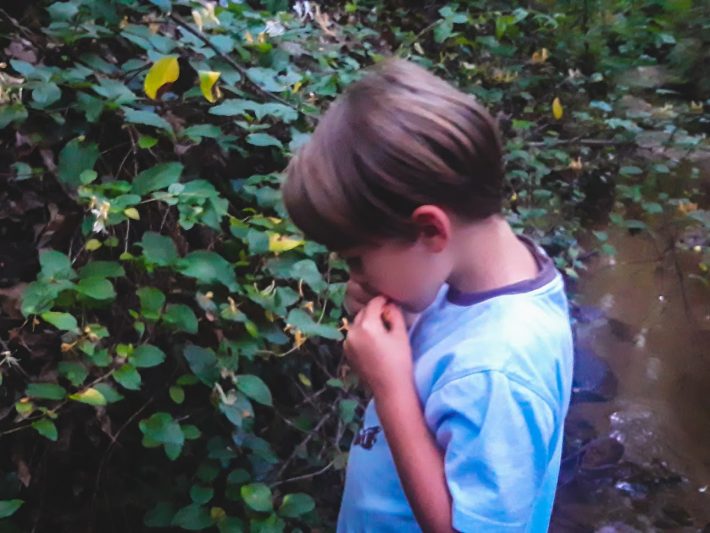
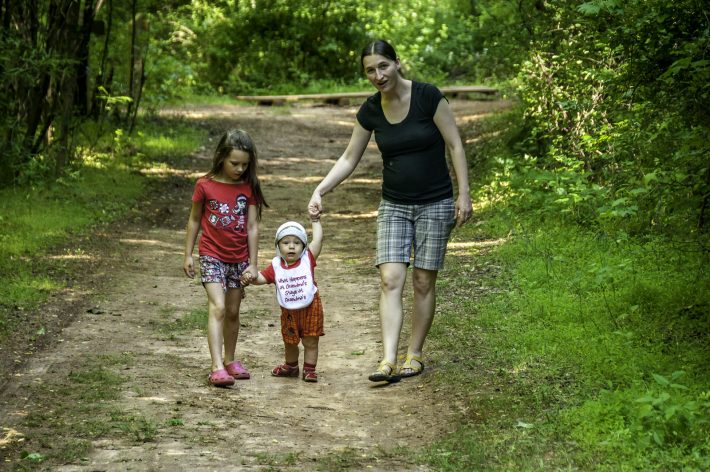
Six years ago today, it was Mother’s Day, and we went to Conestee Park, probably our favorite park in the area. L was six, the same age as E now. As E and I do so often now, L and I were riding out bikes during this particular visit.

L is now twelve and snarky. Part of that is the age and part of it is environment: she comes by her sarcasm honestly. I teach her through example, when I’m sarcastic with her, when I’m sarcastic with K, when I’m sarcastic with drivers who can’t even hear me and wouldn’t care what I have to say even if they could. It’s one of those areas in parenting that I think I could have done a lot better.

The Boy is six and not snarky, but he tries on a bit of bravado every now and then because he learns it from his sister, who learns it from me.

Through it all, K has remained the steadfast example of patient and sarcasm-less parenting. Of the two of us, she’s the one I’d rather my children emulate. Of the two of us, she’s the one doing less to screw them up; in fact, she’s doing all she can to balance out what I’ve messed up. She is the wife I most often feel I don’t deserve and the mother I feel my kids most deserve.

Honeysuckle

Out Sick

Exactly six years ago to the day, it was the same thing…

Caught

Reading All-Stars

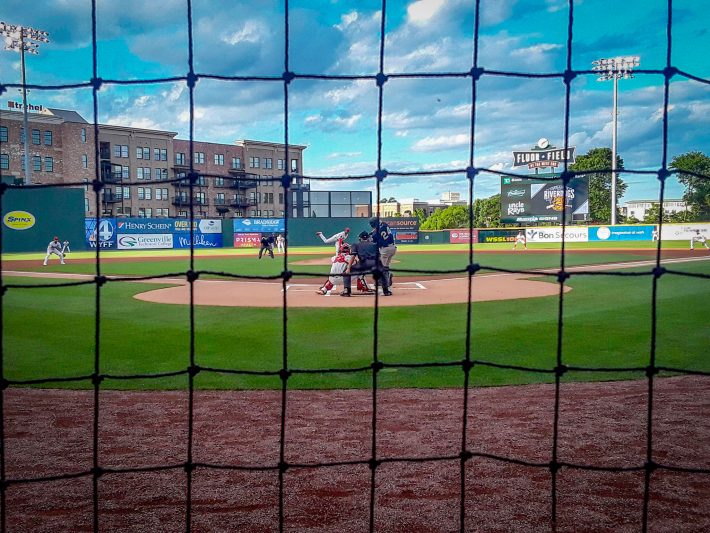
Today was the Reading All-Stars game for the local minor league team. The Boy qualified -- I don't even remember the parameters -- and I got a free ticket as well because several of my students participated. As we watched the game, I realized how little E understands about baseball. That's not surprising: we never really watch it at home. Still, I found myself explaining things that I feel like I just always knew about baseball. I didn't watch a lot of it growing up, and I don't really have any memories of my father teaching me about it (though he must have), but I remember playing baseball with kids in the neighborhood. I was always the worst player, but that must have been how I picked things up.

We stayed through the fifth inning. Our hometown heroes were down 7-1 when we left. I just checked the score: it's 12-4 in the bottom of the ninth. But no matter: the Boy had fun and is eager to go again.

Digging, Mowing, Sealing

We put the new bed in a year ago -- exactly a year ago today.

End of Spring 2018 Soccer

The day's first victim

It's tempting to fall into the obvious reflection: the "so much has changed in a year" cliché. A lot has changed in a year, but the majority of it has changed in the last five months, all starting December 4 with a phone call at around 9:30 in the evening while I was out walking the dog. "Nana is going to the hospital." And from that moment, it all changed. No one knew just how much it would change, of course. No one has any real clairvoyance in medical emergencies. But here I am, a day past five months after it all started, exactly a year after we put them in, taking out the last vestiges of a garden.

It doesn't happen often, but every now and then, Saturday work spills into Sunday. We try to keep Sunday as a day for the family, but with the last five months begin what they have, that in itself is a challenge.

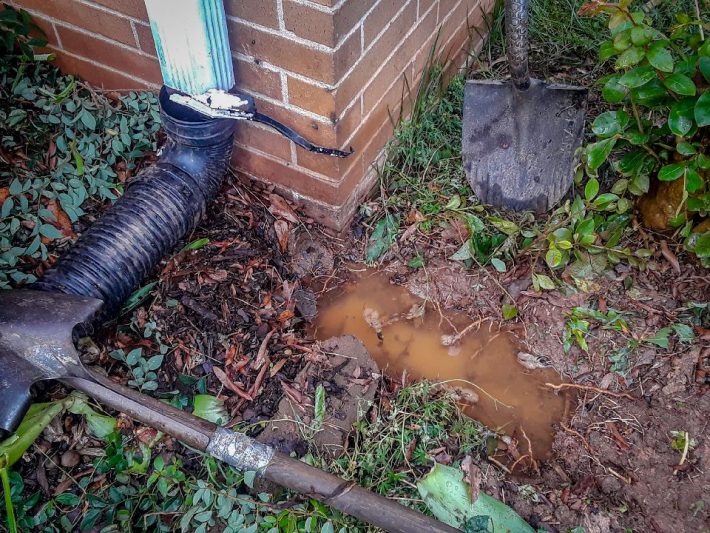
Today's job was simple but critical: deal with the recently created drainage issue at the front corner downspout.

Yesterday's mess before it got really bad

Visions of it seeping through the brick into the now newly created concrete-slab crawl that would offer no outlet at all haunted me, and when the rain woke me at three in the morning, I went to check and found the hack I'd created didn't work either and set about digging, in a downpour in my underwear and Crocs at three in the morning, a quick trench to direct the water away from the house.

Crepe Myrtle free

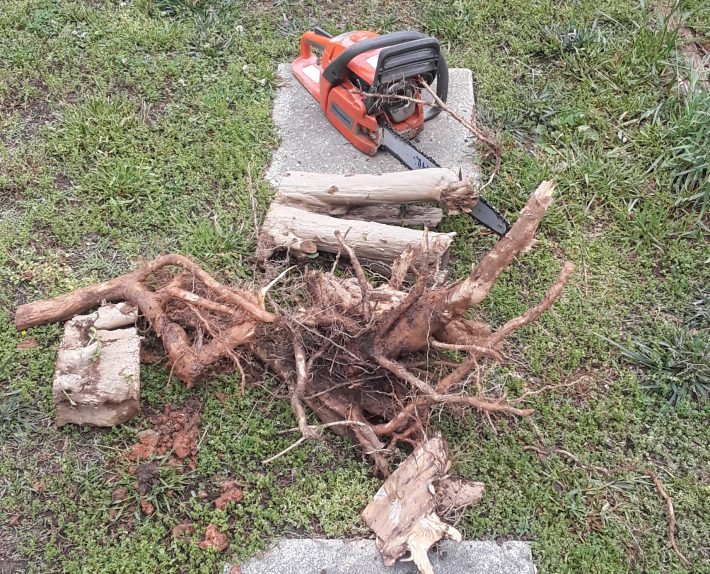
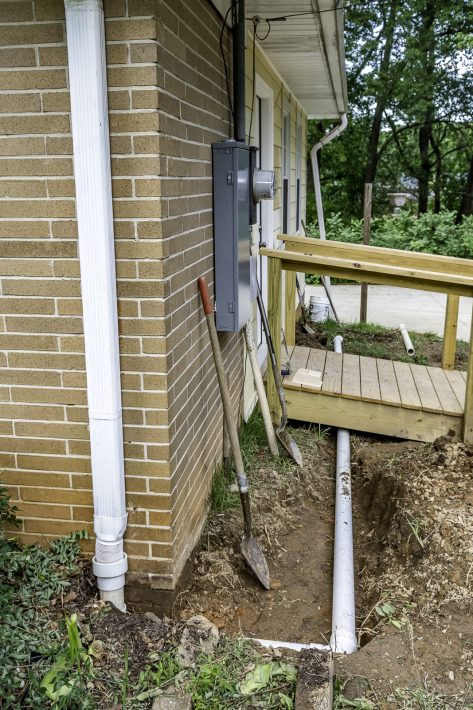
Today, then, was the day to solve the problem once and for all. The first task: dig up the Crepe Myrtle at the corner of the house. That took a couple of hours. Then, the trenching, including a trench under the newly built ramp. Why not do it before they built the ramp? Simply -- I didn't know it would be necessary.

For now, everything is simply laid out and pushed together. I'm far from done and not even sure how I'll terminate it for effective discharge.

Next, after several hours of digging, I turned my attention back to the yard and the hedges three-quarters trimmed. I'd cut my power cord yesterday and decided to put it off until Sunday -- and the torrents of rain that were by then falling didn't do much to avoid said procrastination.

The Boy for his part was upset and thrilled about it all. Digging is one of his favorite things, and he was disappointed that he missed out on so much of it. Mowing, though, is equally enjoyable for him, and he reached a milestone today: he can now start the mower himself. He ran over the trimmings that remained around the yard, always looking for a reason to turn the mower's engine off so he could turn it back on.

(The hard rain really did a number on our plants -- they're beaten into submission.)

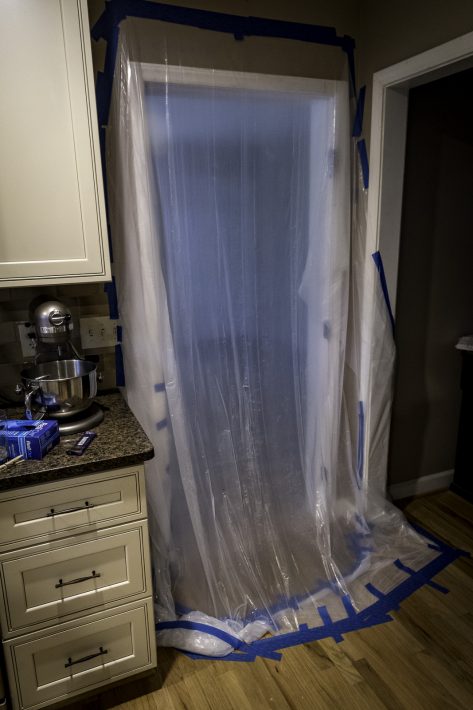
The final task was indoors: sealing up the entry to the new room. The floor guys are going to be here tomorrow, and the thought of sawdust throughout the kitchen and living room was none too appealing.

Crawling in from the back side before it was sealed: "This would make a great little fort..."

Finally, dinner without the girls: leftover soup and a salad. The Boy, being the wonderfully odd eater than he is, was disappointed with the soup (he's grown tired of all soups, I think) and thrilled about the salad.

Borders, 2013 — Part 1

Random memory from the past, brought about by Lightroom playing…

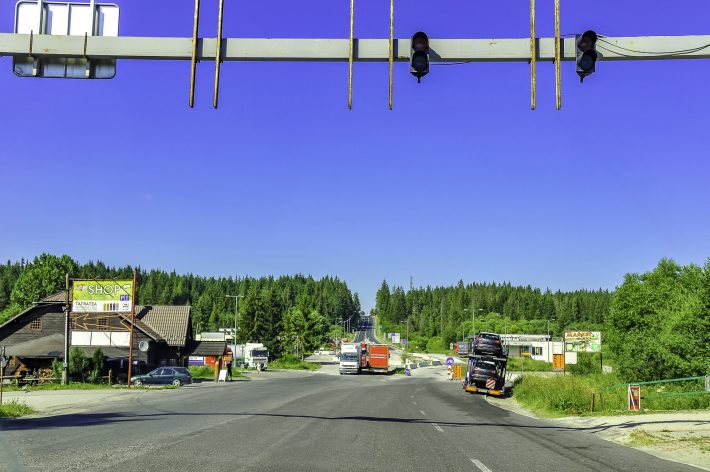
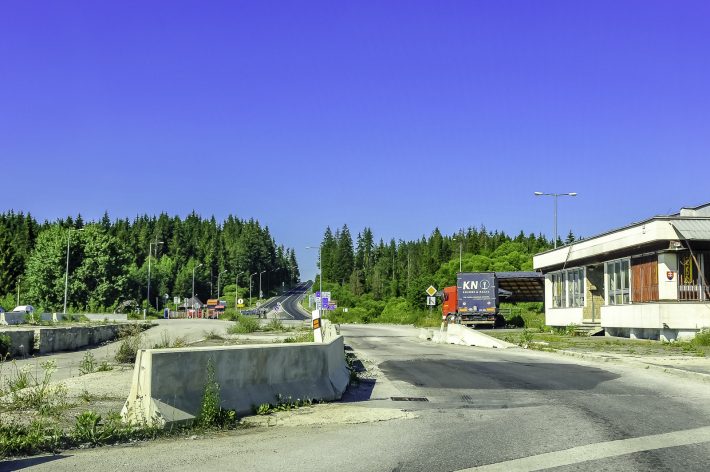
Living in the south of Poland for several years, I had occasion to cross the border into Slovakia countless times. Theoretically, could have walked out of the teachers’ housing where I lived and walked across the border behind the complex in less than an hour. That would have likely been a bad idea: had I been caught…well, better not to think about it.

The nearest border crossing was down the road in Chyzne. It was a border crossing that looked like something out of a film — gray, concrete, depressing.

By the time I went back to Poland in 2001, it was all but free-passage. Border crossing took only a few minutes as opposed to over an hour if there was a long-enough line.

By the time we were living in the States and visiting only every two years, it had been torn down. All that remained was, well, nothing.

Reread

The sign of a good book is that when you reread it, you notice something new in it -- no matter how many times you reread it. My favorite book of all time passes that test easily: I've read Absalom, Absalom! at least six times, maybe more, and every time, I catch something new. And with language like this, who cares if you see something new:

From a little after two oclock until almost sundown of the long still hot weary dead September afternoon they sat in what Miss Coldfield still called the office because her father had called it that-a dim hot airless room with the blinds all closed and fastened for forty-three summers because when she was a girl someone had believed that light and moving air carried heat and that dark was always cooler, and which (as the sun shone fuller and fuller on that side of the house) became latticed with yellow slashes full of dust motes which Quentin thought of as being flecks of the dead old dried paint itself blown inward from the scaling blinds as wind might have blown them. There was a wistaria vine blooming for the second time that summer on a wooden trellis before one window, into which sparrows came now and then in random gusts, making a dry vivid dusty sound before going away: and opposite Quentin , Miss Coldfield in the eternal black which she had worn for forty- three years now, whether for sister, father, or nothusband none knew, sitting so bolt upright in the straight hard chair that was so tall for her that her legs hung straight and rigid as if she had iron shinbones and ankles, clear of the floor with that air of impotent and static rage like children's feet, and talking in that grim haggard amazed voice until at last listening would renege and hearing-sense self-confound and the long-dead object of her impotent yet indomitable frustration would appear, as though by outraged recapitulation evoked, quiet inattentive and harmless, out of the biding and dreamy and victorious dust. Her voice would not cease, it would just vanish. There would be the dim coffin-smelling gloom sweet and oversweet with the twice-bloomed wistaria against the outer wall by the savage quiet September sun impacted distilled and hyperdistilled, into which came now and then the loud cloudy flutter of the sparrows like a flat limber stick whipped by an idle boy, and the rank smell of female old flesh long embattled in virginity while the wan haggard face watched him above the faint triangle of lace at wrists and throat from the too tall chair in which she resembled a crucified child; and the voice not ceasing but vanishing into and then out of the long intervals like a stream, a trickle running from patch to patch of dried sand, and the ghost mused with shadowy docility as if it were the voice which he haunted where a more fortunate one would have had a house.

What an opening to a novel!

This year I'm teaching Lord of the Flies for the first time in probably five years, and so as might be expected, I'm rereading it. Goodness, that is a great book with layer upon layer upon layer.

I was reading it today when I noticed anew the change: the boys at first change “Kill the pig! Cut it throat! Spill its blood!” but then change it to "Kill the beast! Cut his throat! Spill his blood." That got me thinking about the nature of the beast itself.

Finally trying out the "new" (i.e., from Christmas) equipment

At first, it's just the littleuns' fears, but with the landing of the dead pilot still attached to his parachute, the beast becomes something they can see. The beast is unknown. There is a logical explanation, a perfectly natural explanation, but the boys turn immediately to the supernatural.

This first happens when the twins are reporting about their encounter with the beast. In reality, all they do is see the decaying body of the pilot from a distance. When the wind pulls on the parachute, the body pulls up, and the boys panic and run. They make it back to the other boys and explain:

“That was awful. It kind of sat up—”

“The fire was bright—”

“We’d just made it up—”

“—more sticks on—”

“There were eyes—”

“Teeth—”

“Claws—”

“We ran as fast as we could—”

“Bashed into things—”

“The beast followed us—”

“I saw it slinking behind the trees—”

“Nearly touched me—”

At this point, even the bigger boys become convinced. Without realizing it, they create a cult of worship around it. They make a sacrifice for the beast and create a ritualistic dance and chant.

Later, Jack uses the beast to maintain control.

"—and then, the beast might try to come in. You remember how he crawled—”

The semicircle shuddered and muttered in agreement.

“He came—disguised. He may come again even though we gave him the head of our kill to eat. So watch; and be careful.”

Stanley lifted his forearm off the rock and held up an interrogative finger.

“Well?”

“But didn’t we, didn’t we—?”

He squirmed and looked down.

“No!”

In the silence that followed, each savage flinched away from his individual memory.

“No! How could we—kill—it?”

"If I ever suggest I'm not teaching this book again," I told a fellow English teacher this morning, "slap me."

Beginning Lord of the Flies

My kids are reading Lord of the Flies as their final selection in English I Honors. It's been years since I last taught it; it's been even longer since I actually read it.

As I reread it, passages that never stood out as significant take on new importance. For example, Ralph laments the fact that there are no adults who "could get a message to us," expressing a fear that many of the boys have: "If only they could send us something grown-up.. . . a sign or something." The next paragraph reads:

A thin wail out of the darkness chilled them and set them grabbing for each other. Then the wail rose, remote and unearthly, and turned to an inarticulate gibbering. Percival Wemys Madison, of the Vicarage, Harcourt St. Anthony, lying in the long grass, was living through circumstances in which the incantation of his address was powerless to help him.

Young Percival is doing exactly what his parents taught him: he's lost, and he's simply reciting his address.

"If you're ever lost," we can imagine his parents calmly telling him, "find a police officer and tell him your address."

"The Vicar- vicar," Percival, who is six, struggles.

"Vicarage," his father, obviously an Anglican priest, prompts.

"The Vicarage, Hardcourt..."

"No, son. No 'd.' Just 'Harcourt."

"Harcourt..."

They practice it a while. It becomes a morning chant with breakfast, an afternoon game, an evening blessing.

When he has it, he's got it for good. He recites it at blistering speed a few days later through smiling lips.

"That's wonderful!" his mother applauds.

And now, trying to come to grips with the terrors that plague him endlessly, he falls back on his incantation -- what a wonderful choice of words -- and tries to will himself out of the place. He can't be convinced that there is no beast lurking on the island, but he has no idea what he should really fear.

The older boys do, though. Jack and Ralph have begun their irrevocable split, with Jack resorting to his first violent act: punching Piggy in the stomach and then knocking his glasses off, simultaneously blinding Piggy and cutting all the boys off from civilization, as it was Piggy's glasses they used to light the signal fire.

"I know there isn’t no beast—not with claws and all that, I mean—but I know there isn’t no fear, either.”

Piggy paused.

“Unless—”

Ralph moved restlessly.

“Unless what?”

“Unless we get frightened of people.”

I imagine my own six-year-old in this situation, watching the closest things to adults around him -- the boys of thirteen and fourteen -- descend into fighting and arguing, with chaos unimaginable just days away, and I shudder.

When we reach this part of the book, I'm going to break with tradition and help the kids see all the foreshadowing. "If you're not terrified imagining yourself in this situation, you're not really reading this book."