Matching Tracksuits

fun in fours

Month: October 2016

Curve

Recently, our school district changed its grading scale for all high schools and middle schools, switching from a seven-point scale to a ten-point scale. In the past, the lowest A one could get would be a 93; now it’s a 90. Not a big change at the top end of the scale. But by the time you get to the bottom, it’s ten points. To pass with the old scale, you had to get a 70; now, it’s a 60. There was a grading floor of 61 with the old scale — the lowest grade a teacher could give was 61. That’s now a D. The new grade floor is a 50, which is the lowest F as well. In other words, a student can do absolutely nothing for an assignment and be 10 points from passing.

How does that affect the overall curve? When I put my quarter’s grades into the handy-dandy spreadsheet I use to calculate the letter grade spread of the class, I realized that I hadn’t updated the look up table that determines whether grade X is an A or a B, and so before I updated that table, I saved the old version for comparison.

A B C D F
16 33 39 46 33 26 17 21 34 13

It more than doubles the number of A’s and cuts by almost 67% the number of F’s. On the bright side, look how much better kids these days are doing!

1-fullscreen-capture-10222016-85031-am

Mixed feelings on this. On the one hand, a lot of the people getting D’s now instead of F’s might need a bit of a confidence boost that finally not failing might give some of them.

On the other hand, most all of the students who have F’s have them because they don’t complete a significant number of assignments. It’s not that they’re trying, struggling, and failing — they’re not even make it past the “r” in “trying,” let alone the rest of the sentence. So what does this teach them?

I can’t help but feel that this is just another example of trying to rig the system so that the results look better. How do we decrease the number of high school drop-outs? Lowering the standards for passing might be one way. But in the end, what does that do?
Arriving Home

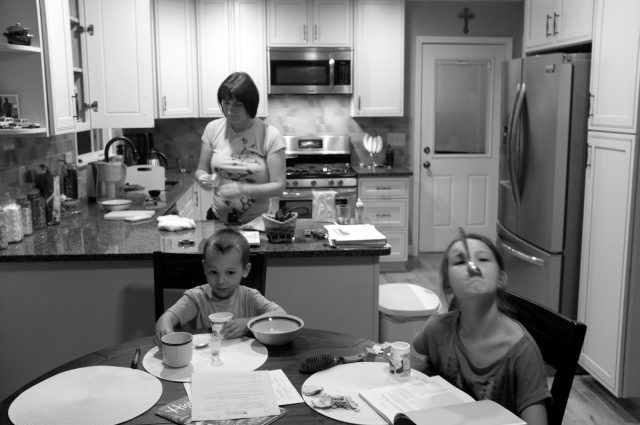
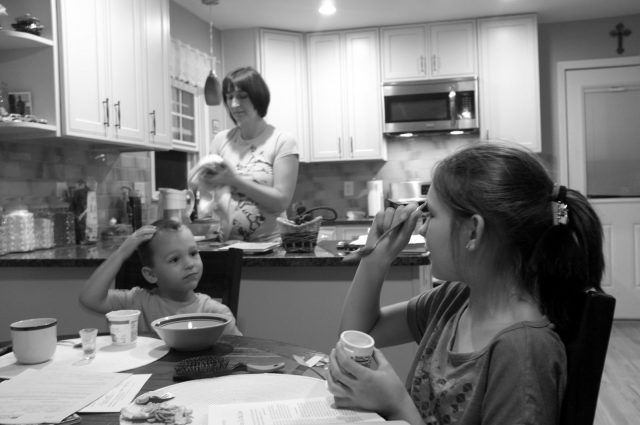
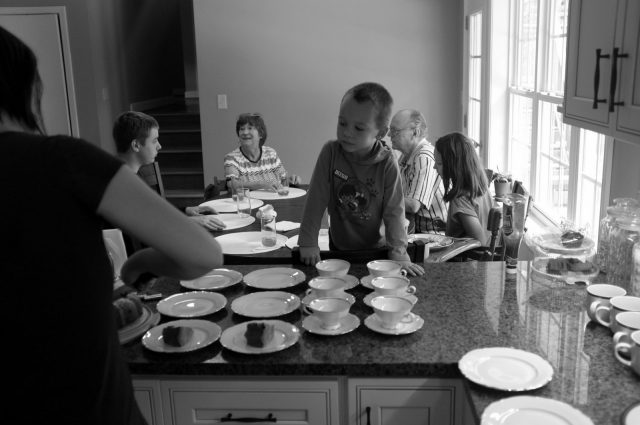
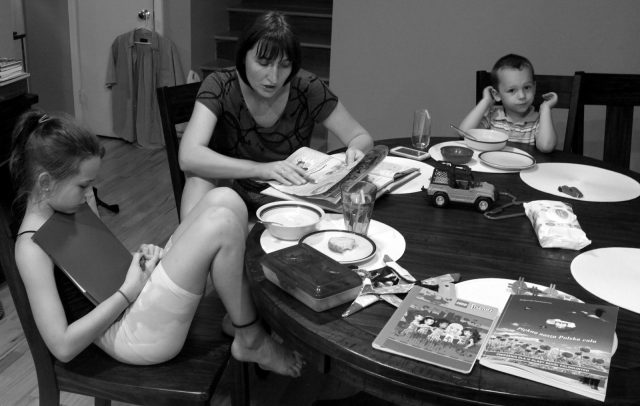
After a long day, arriving home at almost eight because of an open house event at the school, I find my family still all around the table.

“Still eating dinner?”

“No, they said they weren’t hungry, so they saved it for later.”

1-dscf1026

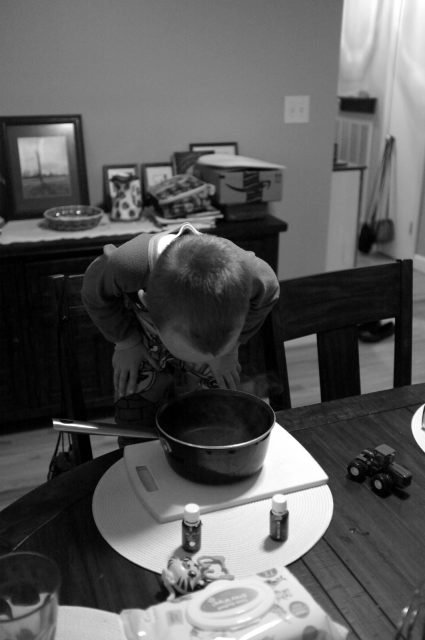
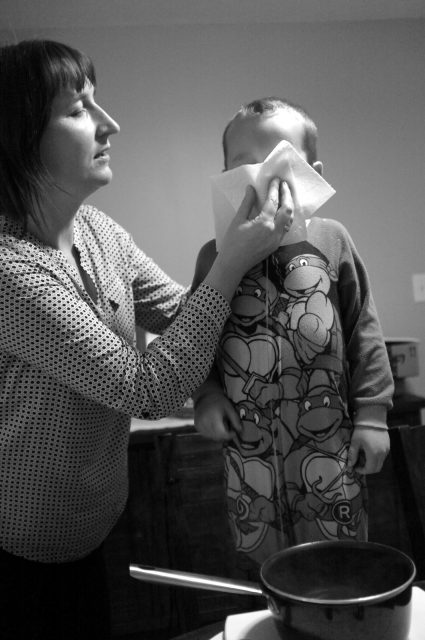
Creamy cauliflower soup with bacon bits — what’s not to love about that little bowl of goodness? Perhaps next time.

Helping

Evening Snack

"I'm hungry." It can come has a plaintive request, a frustrated fuss, or a simple statement of fact, but come bedtime, come bath time, it's always the same.

1-dscf0969

It doesn't matter how much dinner they ate. It doesn't matter whether we had watermelon, ice cream, cake or anything else as desert. They're always hungry.

The Boy pulls the step ladder we've added to our kitchen due to the high shelves and begins rummaging through the refrigerator. The Girl takes a yogurt, adds a graham cracker, then tops it off with a mandarin orange. The Boy sees the orange and wants to add one of his own.

1-dscf0967

It's a moment to offer thanks that we have food for our kids whenever they get snacky.

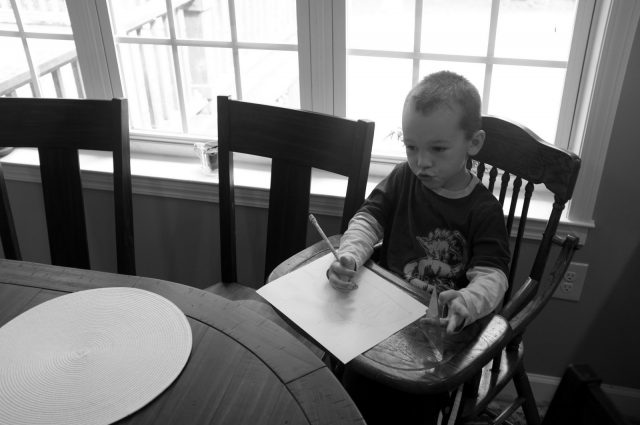
Drawing

1-dscf0931

Sunday Lazy Sunday

Sick Saturday with Old Friends

"Door" in Polish is a strange word. Like "pants" in English, it's always plural -- drzwi. It's likely because it's etymologically connected to "tree" and "wood," and since old doors were made of planks, it makes sense to call them something like "planks" (though that's not what drzwi translates to literally).

1-dscf0906

This morning, the Boy went to tell K as she was getting ready for a shower that he'd heard a scratching at the door, that it was Bida, our cat, who was trying to get his attention so that he would let her in, that he heard it and wondered what it was, that he'd figured it out, and that he let her in. K stood patiently, towel wrapped around her, listening to this whole story patiently, then asked, in Polish, for privacy: "Could you please shut the door so that I could shower?"

2-dscf0914

He replied, in English: "I'll close them and lock them so no one will come in." He applied Polish grammar to English, pluralizing a word that would be plural in Polish but is singular in English.

3-dscf0900

The Nap

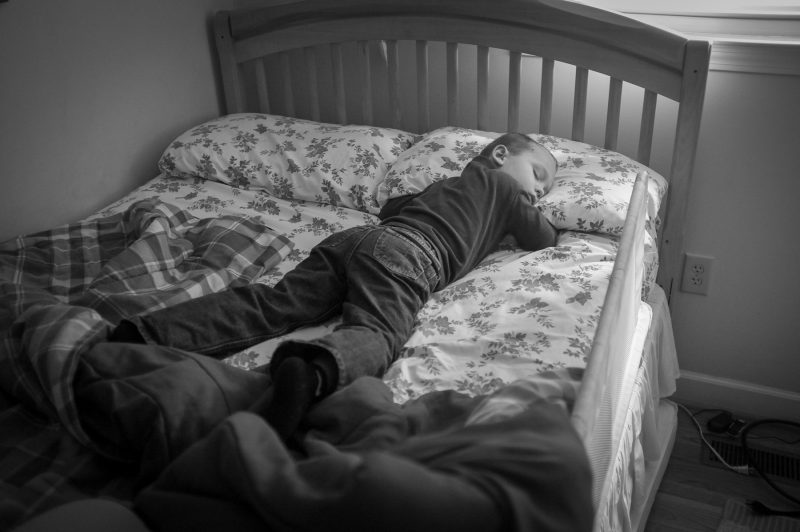
Some days, no matter how good you feel when you wake up, no matter how bright the sun, how promising the day, the thought of going back to bed just seems to linger throughout the entire day.

It’s not the haze of lack of sleep I speak of, that fog that seems to be almost physically discernible in the mind, as if a heavy set of drapes were spread across your brain. That is something that you shake off with your first cup of coffee, or on cold winter mornings, with that first bracing encounter with the early air.

This is somehow different.

Somehow, but not much.

Muffins

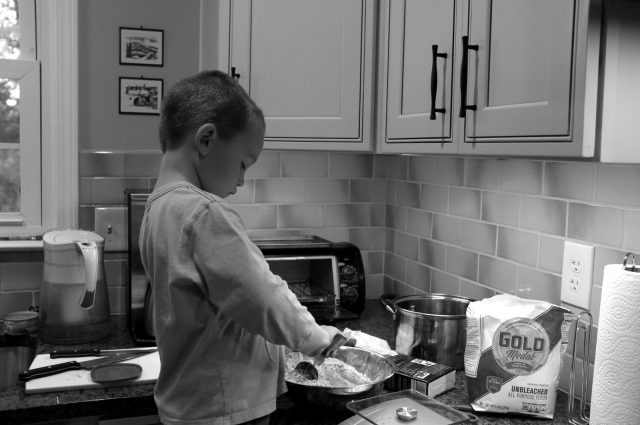
Tomorrow is the Boy’s snack day at pre-school. He’s making triple-chocolate muffins.

1-dscf0887

Leki

Our family seems to be a blended family in one sense: immunity to illness. It seems I never really get sick. K said the other day that she thought she could probably count all the times I've been really sick -- not just feeling a little bad and going to bed early one night -- during our marriage. Unfortunately, the reverse is not true: it seems that K makes up for my relative lack of illness.

dscf0871

So we were both a little curious regarding who would most influence our children's genetics in this regard. Obviously, the best case scenario would have been to take my immune system in its entirety and leave K's behind. Equally obviously, the worse case scenario would be the opposite.

dscf0872

The obvious happened: the kids got a bit of both, probably making them fairly normal.

dscf0877