Matching Tracksuits

fun in fours

Month: March 2013

#19 — Refusal

Weil writes,

God gave me being in order that I should give it back to him. It is like one of those traps whereby the characters are tested in fairy stories and tales of initiation. If I accept this gift, it is bad and fatal; its virtue becomes apparent through my refusal of it. God allows me to exist outside himself. It is for me to refuse this authorization.

It's not something I pretend to understand. Even with a conversion to Catholicism and resulting reading and studying, the whole reason for a deity to create anything confuses me. If God is perfect, why create anything? What does that provide a perfect being that said being doesn't already possess?

#18 — Future Pleasure

2012 Calendar

When we are disappointed by a pleasure which we have been expecting and which comes, the disappointment is because we were expecting the future. And as soon as it is there, it is the present. We want the future to be there without ceasing to be the future. This is an absurdity of which eternity alone is the cure (66).

As a kid, I used to look forward to the autumn with almost visible excitement. Every fall, we headed off for the closest thing to a vacation we ever had: a week-long religious festival that included enough relatively free time to make it feel like vacation. It meant missing school, which made it all the better, and given the fact that we saved all year for the one week, the relative affluence I experienced made it seem like Christmas every day. Yet every year, a strange melancholy overtook me ever so briefly at the beginning: it had finally arrived, and while I was thrilled about that, I also knew that I had nothing else to look forward to afterward.

Yet I think Weil is talking about more than the mere excitement of being in a metaphorical candy store. Underneath this longing for the future, this “absurdity which eternity alone is the cure,” is a very serious attempt to sketch out what some have described as a hint of the beyond, or as Peter Berger might have called it, a rumor of angels. That sense of never being fulfilled is a hint, Catholic writer Peter Kreeft argues, that there is something more to fulfill it.

Photo by danmoyle

#17 — Evil and Duty

Evil when we are in its power is not felt as evil but as a necessity, or even a duty.

He stood in the hallway, thinking I don't really know what. Was he not aware that I'd heard the profanity coming from his mouth? Was he not aware that the profanity, misogynistic and vile. had indeed come from him mouth? Was he bluffing, hoping for some -- what?

If I had asked him what possessed him to say those things, to call the female student a b----, to become enraged, he would probably (indeed, likely, even predictably) justify it.

"She started it."

"Did you see what she did to me?"

"Nobody's going to do that to me and get away with it."

A thousand and one excuses. A million and one reasons why the evil was not evil, but a necessity. A duty.

Third Sunday of Lent 2013

With the Boy, schedules and perspectives on them change. It was the same with with L, but you forget over time. The Boy reminded us quickly, and the reminders continue daily. Among the things that change of course is the notion of what it means to sleep in. That has changed gradually as we've left behind the carelessness of childhood and adolescence.

VIV_9008

These days, sleeping in until half past seven is a luxury indeed, especially for for K. Sunday mornings.

From there, the rituals, old and new, take over. Sundays are days filled with ritual, both sacred and recreational.

VIV_9016

Mornings lean toward the former; afternoons edge toward the latter.

VIV_9027

#16 — Imagination and Fiction

Imagination and fiction make up more than three quarters of our real life. Rare indeed are the true contacts with good and evil.

Weil's words read like a quote out of The Matrix or Inception, and it's easy to brush them off as metaphorical theorizing:

And it's easy to pass it onto the "madding crowd" and insist that we ourselves are not imagining things, not asleep. We are fully aware of the reality around us and can separate it from wish and fantasy, but the materialistic hordes around us can't. It's easy to think that way.

VIV_8847
Afternoon at Bounce House

Surely, with rarefied reality all around us -- the screams of delight of children at play, the hard crack of a helmet against plexiglass, a blast of cold air when we get out of the car -- we are awake.

VIV_9005
A visit to the ice next to the Bounce House

Of course Weil doesn't mean anything so cinematic. She's simply pointing out our uncanny ability to deceive ourselves and fall for the farce completely, to create worlds out of our irrational fears and project them on everyone and everything, to believe that the way we see the world is the way everyone sees it and indeed the only true way to perceive it. I see the effects of this every day at school: some students have mastered already the art of fully deceiving themselves, convinced that they can do no wrong and that all the trouble they find themselves in can easily be laid at the doorstep of others (read: adults; read: teachers).

I'm not sure what the kick (to borrow a term from Inception) for this dream might be, especially when we're not even sure we can kick ourselves awake. Perhaps awareness is the first and, paradoxically, last step. An afternoon spent with the Girl at a birthday party followed by a bit of first-time exposure to live hockey should be enough to separate fiction from good, imagination from evil.

That's the secular answer.

I think Weil might not entirely agree, though. Like Inception, we need someone who doesn't share that same reality, someone who's at a level higher (literally in the film and in Catholicism too, I suppose) to help jar us out of the fictions we create for ourselves.

#15 — Temptation and Energy

The use of temptations. It depends on the relative strength of the soul and of time. To go on for a long time contemplating the possibility of doing evil without doing it effects a kind of transubstantiation. If we resist with merely finite energy, this energy is exhausted after a certain time, and when it is exhausted, we give in. If we remain motionless and attentive, it is the temptation which is exhausted -- and we acquire the energy raised to a higher degree.

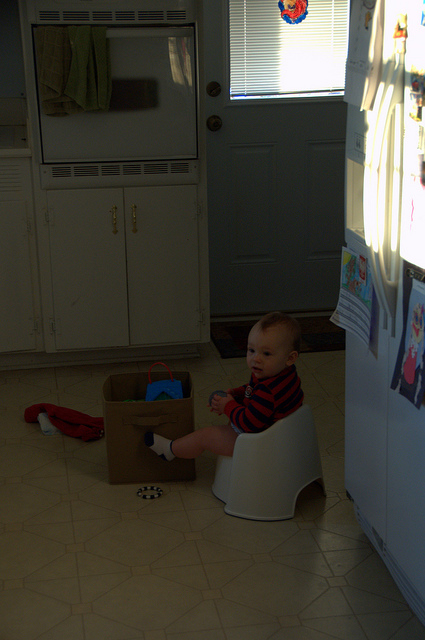
For a little boy, temptation is a simple thing; for a little boy who can move about under his own volition, it's a simple thing that's simply everywhere. Closets hold treasures. Desks sit over snaking cables and wires.

VIV_8802

Cabinets hold bags of flour, sugar, and other mysteries. Desk cabinets conceal pencils, markers, and other goodies. 

The Boy doesn't resist temptation, reaching his pudgy fingers toward dangers and toys alike.

VIV_8803

But he's at that lucky point in life when temptation is all about learning, and vice versa.