Matching Tracksuits

fun in fours

parenting

Decisions

Sometimes, there are no right decisions; there's only a queue of increasingly wrong -- sometimes increasingly harmful -- decisions, all standing patiently in line for us to inspect them, reinspect them, obsess over them, fret over them, stress over them, reexamine once again, reconsider yet again, and constantly feel crushed by them.

Sometimes, there are no good decisions; there's only a pile of increasingly worse decisions -- often increasingly harmful -- and we just have to look them over and decide which of these awful decisions we will take, which of these awful harms we will inflict.

It's never something as morally abstract as the trolley problem. It's always direct harm to a relationship we treasure. It's always choosing one hurt to inflict over another to someone we don't want to hurt at all. And so it always doubles back on us and causes us as much pain as we doled out. Perhaps more. Perhaps it's only with a little experience and a few years that we see that.

Sometimes, there is no way to juggle all the things we're required to keep flying overhead in never-ending arcs. Focused on keeping the chainsaw's roaring blades away from our hands, we lose sight of one thing or another, and the knife comes clattering down to the floor, damaging something. Or worse, someone.

I feel like this teaching throughout the day: there are little decisions I have to make constantly (Do I let her go to the bathroom now or would it be better later? Do I let him go to the vending machine?) and some only seem little (Do I call him down now, knowing how he'll react and knowing the disruption that will cause -- which will be the bigger disruption? Do I correct her writing now, even though her mistake has only a tangential connection to the topic at hand? Do I try to force this kid to work with someone or let her work on her own again this time even though we've had the discussion about the merits of collaboration and made an agreement to try the next time we're in groups?). But there is always -- always, always -- a decision just lurking.

Nowhere else is this more true than in parenting. Things glide along fine until they don't, and then someone is always going to be disappointed; someone is always going to be hurt.

This is especially true, I'm discovering, as one's child moves closer and closer to that magic number: eighteen. It's especially true, I'm seeing, as one's child becomes increasingly cognitively developed and is no longer making arguments like, "I just want to," but sound, logical arguments that acknowledge their own shortcomings in the present situation and yet make a good case for getting what she wants. It's especially true, I'm learning, when she fights back tears of frustration and tries her level best to keep her emotions in check and act like an adult.

"Because I said so" is no more a legitimate reason than "I just want to." At least it's not anymore, because the power of logic: what's going to change in the next two and three-quarters months? Is she going to be any more cognitively developed? Emotionally developed?

K and I love being parents, truly we do, but even after nearly eighteen years of it, we're still wondering if it will ever get any easier.


Tuesday Back

The Girl went back to school today for the first time since Friday before last, as in January 5. It's been a tough ten days, and we still have issues ahead of us, but at least we're to a point where something of a normal life can return. I never missed ten days for an illness, but I missed significant time in the first semester because of having to go to the Feast of Tabernacles every year (along with the Feast of Trumpets and Atonement, which meant missing more school days). If I'd been as worried about my grades as L is about hers, that probably would have caused me more stress than it did. But then, the founder of our little sect died (38 years ago today, in fact), the new leader made a few changes, and the FOT (as we called it) became a thing of the past. Something the Girl doesn't have to worry about.

The Boy is still frustrated with his schedule this semester, particularly that he doesn't have PE anymore. In middle school, I hated PE. In the mid-eighties in Virginia (maybe not the whole state, but at least in our area), there was none of this "you can only fail once before high school" mentality that's the standard here. (There are benefits to that, to be sure, but I've had kids tell me, "I've already failed once. There's nothing you can do to me," and then promptly do nothing the entire year.) But we didn't have that, so kids could fail two or three times before getting to high school, which is why when I was in seventh grade (it was a junior high, with only two grades), there were two sixteen-year-old eighth graders. Dodgeball, which we played with those stinging rubber kickball balls, was utter hell. Those kids were strong. But fortunately, E doesn't have that worry, so he consequently loves PE.

Two ways my childhood was so very different from our children's.

Saturday Evening Downtown

We spent the evening downtown, the five of us -- the two kids and the dog. It's so rare that everyone's schedules work out to let us do something like this. We'll take every opportunity we have.

Our stroll eventually led us down to the river and the new Grand Bohemian hotel which is the latest highlight of the ever-developing downtown Greenville.

Eventually we made it down the the rocky area of the river just at the edge of the main downtown park, the place both of our kids loved to run about on the rocks as little kids.

"Those days are long gone" K and I constantly remind ourselves. And yet, every now and then, the stars align,

the kids are both fascinated with the same thing, and for a brief moment, we pop back a few years in the past.

First House

The last time L and I were in Rock Hill for a volleyball tournament, and Papa was still alive, I managed to find the first house I remember living in, the house Nana and Papa owned when they brought me home.

In the front was the same railroad-tie planter that Papa had built decades and decades ago, sometime in 1976 or 1977 I would imagine: I say this because I remember him building it, in vague, hazy memories that might be more the product of suggestion than actual memories.

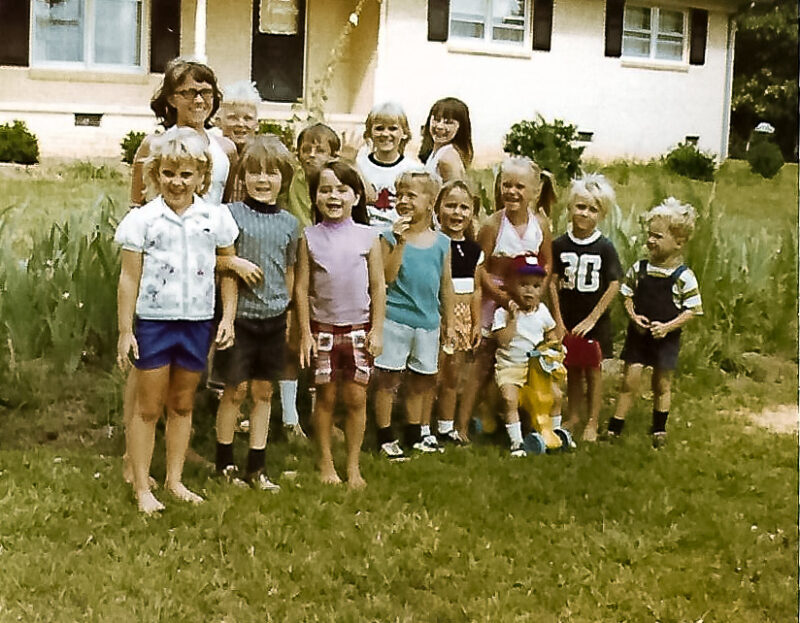
Image from 1975

When Nana passed away and I was going through all the old photos we'd taken from their condo, I found one of us cousins in front of that house. I'm on the little horse toy toward the far right; that's my cousin C behind me. This was from a family reunion that we had at our house. I remember a family reunion there, so it must have been a second one: I'm far too young in this picture to remember anything from that time.

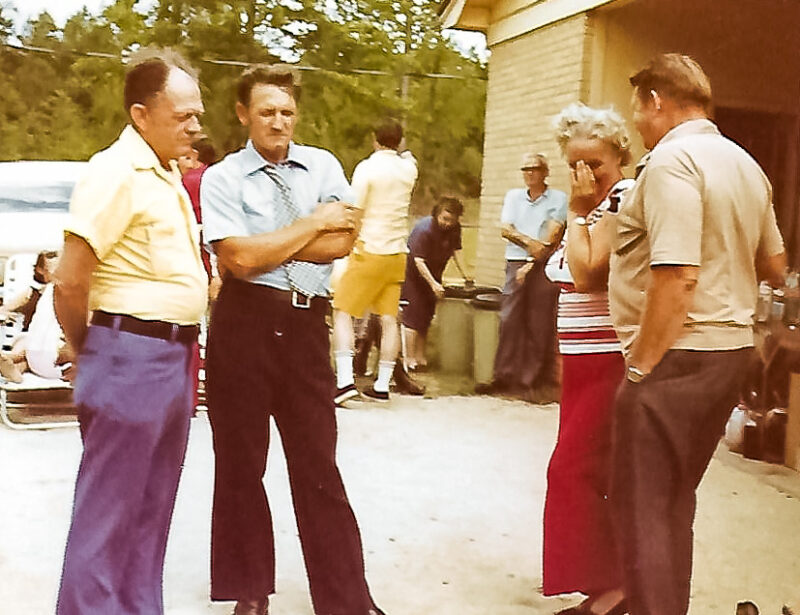
From the same series of pictures is one of my grandparents: Papa's father is on the far left; Papa's mother is the only woman in the foreground.

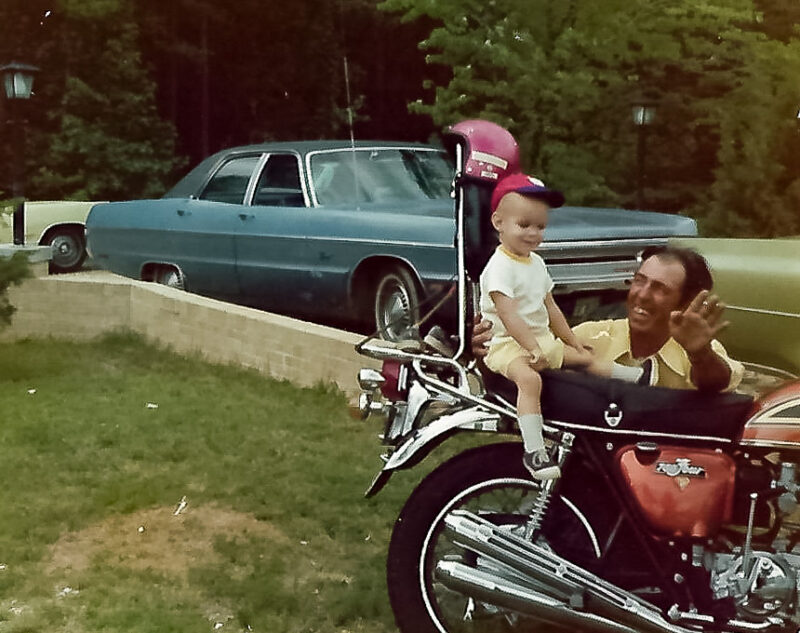
And yet another one from that day, this time on someone's motorcycle. I'm not sure whose, and I'm not sure it was the owner posing with me in this shot, and I'm not sure who the man in the picture is. These are all just things that exist in my past but not in my memory.

And the obvious move: what pictures will have this same effect on my own children? Probably none -- their lives are so completely documented here that they would have no problem figuring out who was holding them on a motorcycle...

An Apt Poem for Now

To My Favorite 17-Year-Old High School Girl

by Billy Collins

Do you realize that if you had started
building the Parthenon on the day you were born
you would be all done in only two more years?
Of course, you would have needed lots of help,
so never mind, you’re fine just as you are.
You are loved for simply being yourself.
But did you know at your age Judy Garland
was pulling down $150,000 a picture,
Joan of Arc was leading the French army to victory,
and Blaise Pascal had cleaned up his room?
No, wait, I mean he had invented the calculator.
Of course, there will be time for all that later in your life
after you come out of your room
and begin to blossom, at least pick up all your socks.
For some reason, I keep remembering that Lady Jane Grey
was Queen of England when she was only fifteen
but then she was beheaded, so never mind her as a role model.
A few centuries later, when he was your age,
Franz Schubert was doing the dishes for his family,
but that did not keep him from composing two symphonies,
four operas, and two complete Masses, as a youngster.
But of course that was in Austria at the height
of romantic lyricism, not here in the suburbs of Cleveland.
Frankly, who cares if Annie Oakley was a crack shot at 15
or if Maria Callas debuted as Tosca at 17?
We think you are special by just being you,
playing with your food and staring into space.
By the way, I lied about Schubert doing the dishes,
but that doesn’t mean he never helped out around the house.

Finals

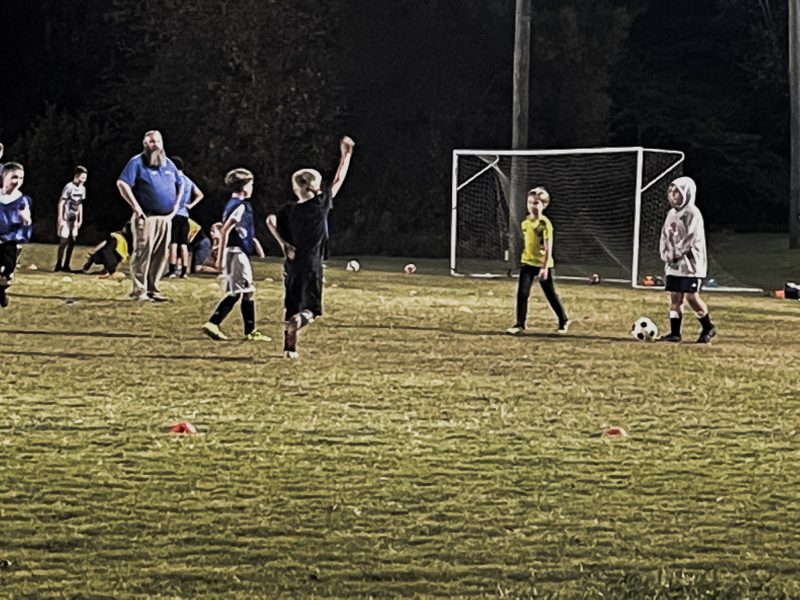
It’s nearly the end of the fall soccer season: we’re in the final week of practice before the final game on Saturday. It’s been a tough season: no wins except through forfeit (does that even count?) and only one tie (last week thanks to E’s hat-trick). There’s been a little tension within the team as a result of it all. One boy, arguably the strongest player on the team, started taking things into his own hands (or rather, feet) and trying to be a one-boy show at times, not passing or even appearing to be aware of the other players. This frustrated some boys and comforted some boys: as long as he had it, things rose or fall on his shoulders. A win would be due to him, but a loss could also be attributed to him. Perhaps they didn’t think that, but I’ve no doubt it was at least an unconscious relief for some when it was A that was losing the ball in a move that ultimately ended in an opposing team’s goal rather than their “screw-up.” But now A has been out for a few weeks due to injury, so the boys have had to gel without him. As a result, there’s been better team play, and now that everything has gelled to some degree, it’s almost over.

That’s a fairly frequent pattern in life, though: as soon as everyone gets used to the year’s teachers, for instance, and everything is clicking seamlessly, the year ends. This is even more the case in block scheduling, like at L’s high school, where classes meet for 90 minutes a day but only for one semester. By the time everyone really knows how the class works and has found their place in it, the class is over.

In the repetitions of the seasons and holidays, it’s the same. As soon as we’re comfortable in the hustle of the Halloween/Thanksgiving/Christmas/New Year’s quartet, it’s over and we’re all exhausted from it.

“In my beginning is my end,” wrote TS Eliot

Questioning

At some point recently, K was reading to the Boy about Moses and the plagues, and as children are wont to do, he zeroed in the most shocking one: the death of the firstborn male. He was trying to figure out who in the family would be the firstborn male.

"Would it be Papa?" he asked.

How does one respond? How does one say the obvious: "No, it would be you"?

"But why would God do that? It's against the commandments."

This is the crux of the issue of me of late: how are we to incorporate all those horrible things the god of the Old Testament does with the notion that the Bible supposedly comes from the mind of an omnipotent, omniscient, all-beneficent being? (The story of the death of the firstborn is problematic both for God's beneficence and his omniscience: the Hebrews are to mark their doorway with the blood of a sacrificed lamb in order to indicate that the angel doing the killing is to pass over that house -- why wouldn't the angel know without that?)

Believers start with the premise that the Bible is from an omnipotent, omniscient, all-beneficent being, and then they work backward to try to explain these horrible passages. A skeptic like me starts with the premise that the Bible is supposedly from an omnipotent, omniscient, all-beneficent being and looks for evidence of that within the pages. The clear evil that the god of the Old Testament does, then, is clear and damning evidence against the supposition that the Bible reflects the mind of an omnipotent, omniscient, all-beneficent being. That god is petty and selfish, jealous and immature, narcissistic and self-absorbed, and above all, that being as portrayed in the Old Testament is evil, toying with some by demanding human sacrifice and then rescinding the order at the last minute (thinking of Issac here) and accepting human sacrifice in other situations (I'm thinking of Jephthah here). He is murderous and rampaging on both an enormous scale, commanding the Israelites to wipe out whole nations, men, women, and children, and a small scale, sending bears to maul children:

He went up from there to Bethel, and while he was going up on the way, some small boys came out of the city and jeered at him, saying, “Go up, you baldhead! Go up, you baldhead!” And he turned around, and when he saw them, he cursed them in the name of the LORD. And two she-bears came out of the woods and tore forty-two of the boys. From there he went on to Mount Carmel, and from there he returned to Samaria. (2 Kings 2.23-25)

Believers have to become apologists for God, coming up with reasons why these horrible actions are perfectly reasonable and in fact good. (Here's an attempt to explain the bear mauling.) They resort to explaining what it means in that time and culture, failing to realize that they've just placed a limitation upon this supposedly-divinely inspired book that counts against their argument. They discuss the nuances of the original Hebrew, failing to realize that they've just placed a limitation upon this supposedly-divinely inspired book that counts against their argument. They produce wildly different interpretations and explanations, failing to realize that they've just placed a limitation upon this supposedly-divinely inspired book that counts against their argument.

For the skeptic, things are so much simpler. Occam's razor simple. We mark these passages in the "Against" column and move on. In the end, we look at how many marks are in the "For" column and how many are in the "Against" and make a summary judgment from that. And there are vastly more things in the "Against" column.

The Challenge

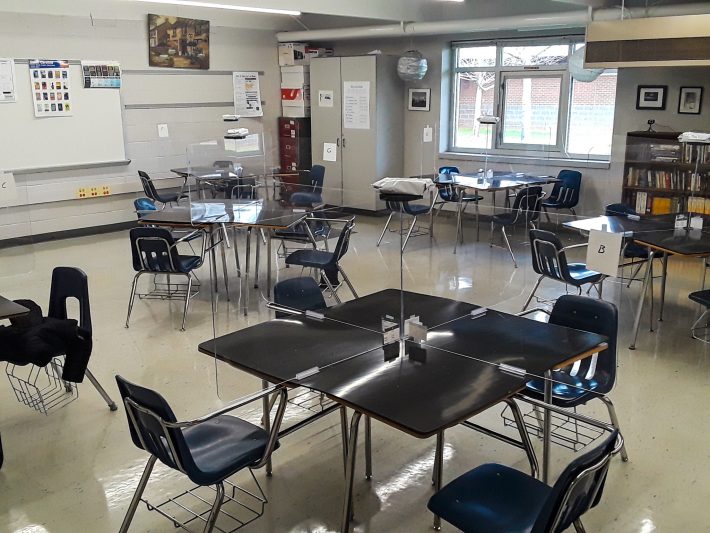
I texted a picture to K this morning: “This is what my classroom looks like now,” I said.

“Wow — no more rearranging rooms, I guess,” she replied.

I know a lot of teachers are concerned about the impact this will have on their teaching style, on the types of lessons they can do. I for one am not terribly worried about that because this year I’m teaching only honors classes, and most honors students are relatively mature and somewhat adaptable. There are some things that will take getting used to — not as much motion, more teacher-based lessons, etc. — but overall, I think they’ll do fine.

When I got home, I noticed a little paper with Shakespearean insults on the table. Remembering that L’s class has just started Romeo and Juliet, I thought it might have been from her, but the Boy filled me in when he got home from swimming lessons: “The kids in challenge today were working on Shakespearean insults,” he said. He told me about how funny it was when his friends who went to challenge shared it with him, and I’m assuming he got K to help him find a list of insults on the internet and print them out.

It was only then that I realized: E didn’t get an invitation to join challenge when he started this year. The invitations are based on standardized test scores from second grade, and I immediately thought that the Boy must feel a little left out, a little, well, stupid compared to the others.

K had the same concerns, and we talked about it in the evening when the Boy was sound asleep. “He wanted to know if we could sign him up,” she said forlornly, “and I had to tell him you don’t sign up for it; you get an invitation.”

I remember seeing the challenge kids leave — our district was a little worse in their naming: it was the “gifted and talented” group, which makes everyone else feel less gifted, less talented, and that’s exactly how I felt. I watched them troop out of the classroom in elementary school, wondering what they do there, wondering why I wasn’t a part of it.

I got an invitation at the end of fifth grade and spent sixth grade with the GT kids who’d been doing it for several years by that time. I didn’t feel any different, really, and I don’t really recall doing anything all that spectacular. Of course, that was over 35 years ago, so I can justifiably be a little fuzzy on the details, I’m sure.

Throughout high school, I was most decidedly average. I was in the “advanced” classes only insofar as I was not in remedial English or remedial math. I didn’t take algebra until ninth grade; I never took a single AP course; I had no “Honors” affixed to my class names; I didn’t graduate anywhere near the top 10, and I highly doubt I was even in the top 10%. And yet for high school superlatives (how I loath to this day that idea), my peers voted me “Most Intellectual.” (I was tempted to refuse the award during the senior luncheon, but my mother convinced me it would be rude to do so.) So the recognition for my academic achievement was a mixed bag — conflicting signals. In the end, I just didn’t put much stock into what people thought of my intellectual abilities.

But somehow, when it comes to my kids, I feel a little differently. I want them to be geniuses, above and beyond even those who are above and beyond. What parent doesn’t?

The Boy is starting to realize some people work faster than he does, maybe a little more accurately, K and I concluded. And that’s fine. We’re all different. We all have different gifts. But still, I felt the Boy’s sting just a bit, so I went back to his bedroom and cuddled with him a little more.

“You’re very gifted in many ways,” I told him.

“How?”

“You’re a very good reader. You’re an excellent drawer. And you’re very kind and sensitive to other people’s needs and emotions.”

A pause. “Thank you.” He snuggled in a little closer and went to sleep.

Finishing the Toolbox

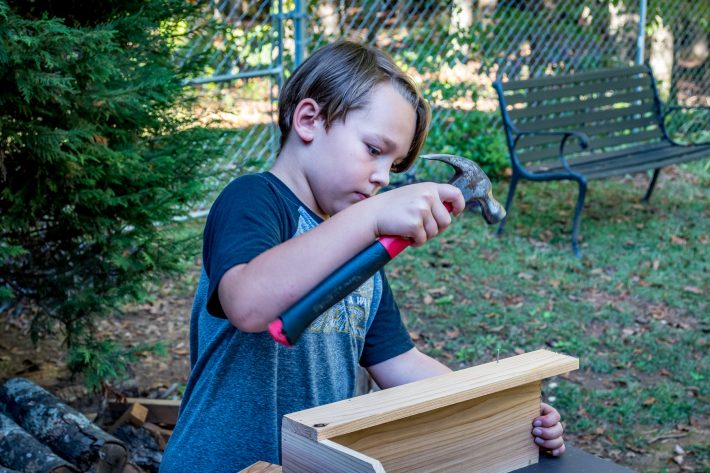
Yesterday was the cut day; today we assembled everything. I struggled to figure out how much to do and how much to let him do, to decide how many mistakes to correct and how many to let slide.

“Oh, Daddy, that nail is actually coming out of the bottom.” That’s one to correct.

“Daddy, I didn’t evenly space these nails.” Just pat him on the head and say, “It’s not a big deal, buddy.”

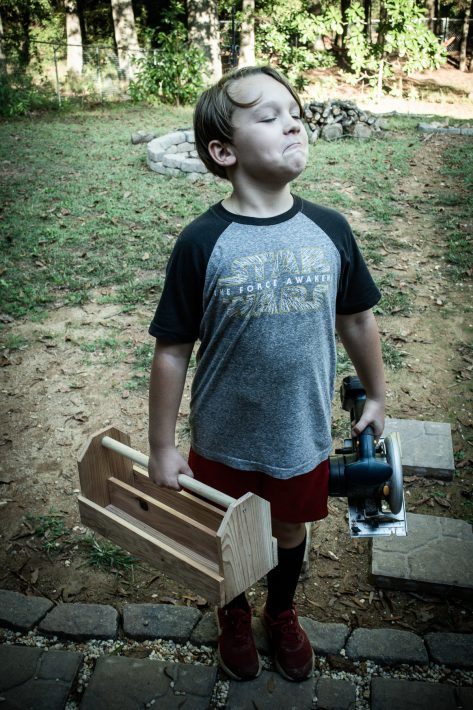
In the end, it wasn’t perfect, but he’d done almost all of it — a good reason to do your best Dr. Seuss character imitation. (“Daddy, why do so many of the characters go around with their eyes closed?” he once asked. I’d never really noticed that.)

Day 16: Uncertainty and Certainty — Random Thoughts

I am no longer certain about anything regarding school. We've been out for almost three weeks now and we have another three to go, but the rates of infection here in South Carolina are not decreasing. I, and many of my students, suspect and fear that we won't be heading back this year. But we could be wrong; I hope we're wrong.

I am no longer certain about Papa's condition. Something neurological seems to be going on, and with COVID-19 pillaging our country right now, it throws the whole medical community into comparative chaos. It's not a simple matter getting an appointment with a doctor anymore.

I'm no longer certain I want to update this daily. It's been my longest streak: over 100 consecutive days at this point, stretching back to December 22. I've been doing it more out of a sense of stubbornness than anything else. "I've made it a month: might as well try to make it two." "I've made it two months: might as well try to make it three." And to what end? And if I do continue, to what loss? A few minutes' time every night to make a record for -- for whom? I don't even think it matters.

I am certain about the value of the increased time we've been spending together. Being it home makes schooling both easier and more challenging, but we're spending more time together as a result of everything being shut down -- nightly walks, movie nights (tonight, Hugo -- E loved it; L claimed it was boring but still demanded we pause it when she went to the restroom), evening games of Monopoly, afternoons spent in the backyard messing around.